
Mon–Fri 9am–5pm  ·  Sat 12pm–5pm Review us on Google Serving the Treasure Coast  ·  561-566-2855
Documented jobs · Port St. Lucie & the Treasure Coast

Work samples from Treasure Coast homes

Two jobs that show where the technical line sits: a curved transom that had to match an existing arch on the first cut, and a struck impact window re-glazed inside its original frame. Both were repairs. Neither needed a new window.

5.0★ Google RatingFrom 170+ customer reviews
Written Warranty1–3 years on parts and labor
1,600+ Doors RepairedAcross 5 years on the Treasure Coast
Same-Day Service96% of jobs finished in one visit

Most of what SliderPro does is invisible when it is done well. A door glides, a window is clear, and nothing about the opening looks new. The two jobs on this page are worth documenting because they are the ones homeowners are most often told cannot be repaired — curved glass and impact glass. Both were repaired in the existing opening.

Every job here was photographed by the technician on site. The measurements quoted are the ones written on the job's own shop drawing. We have not staged anything, and we have not put a customer's name, address or invoice on the internet. If you want to see more of a particular repair type before you book, call and ask — there are far more jobs in the phone than there are on this page.

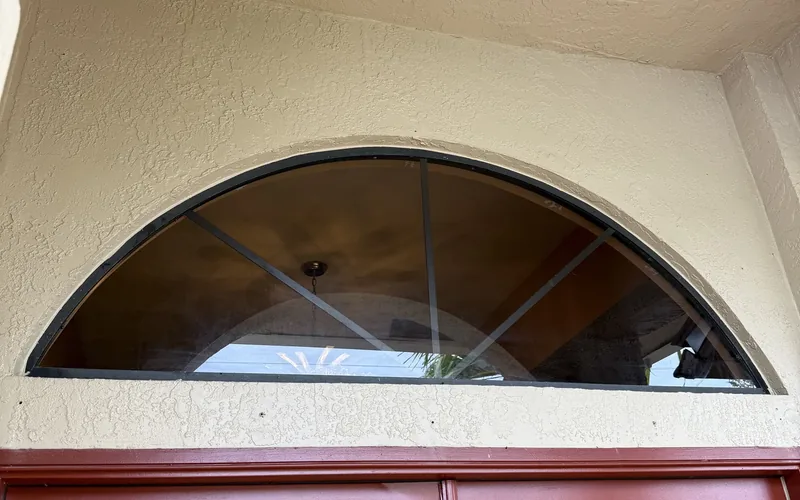
Half-round entry transom with new bronze glass and radial muntin bars, fitted into the original stucco opening
Entry transom · Treasure Coast

Curved & arched glass replacement

A curved transom re-glazed in bronze against the original stucco arch. No rebuilt opening, no replaced frame — one piece of glass cut to a radius that has to be right the first time.

See the job
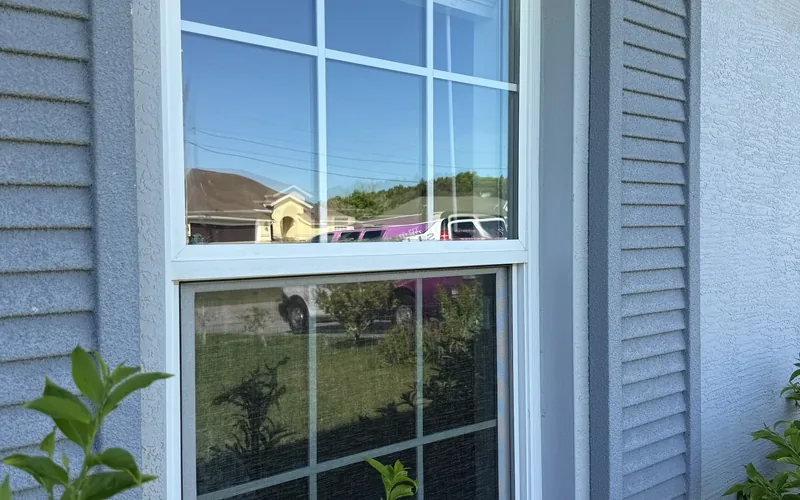
White colonial-grid window with a new low-E insulated impact glass unit installed in the original frame
Low-E insulated unit · Treasure Coast

Impact window glass replacement

A struck impact pane replaced as a sealed low-E unit inside the existing frame — grids, frame and stucco all left alone.

See the job

What these two jobs have in common

Both openings were told-you-need-a-new-window jobs that turned out to be glass jobs. In each case the frame, the stucco surround and the surrounding wall were sound. Only the glazing had failed, and glazing can be replaced on its own.

That distinction is worth money. Replacing a window means pulling the frame, cutting the stucco, re-flashing, re-sealing and re-finishing — then repainting the patch so it does not read as a scar on the elevation. Replacing the glass means removing the stops or the glazing bead, lifting the failed unit out, bedding the new one and putting the trim back. The wall never opens.

The catch is that both of these jobs are harder than a rectangle. One demanded a curve matched to an existing arch; the other demanded a sealed multi-layer unit built to the right stack. Plenty of companies quote a full replacement because it is simpler to sell than either of those. That is a business decision, not an engineering one.

The questions we ask before quoting either one

  • Is the frame straight and sound? If the frame is racked, corroded through or has lost its corner joints, glass alone will not fix it and we will say so.
  • Is the surround intact? Curved openings live in stucco. If the stucco arch is spalling, that gets addressed before glass is ordered, because the new piece is cut to the opening as it exists.
  • What is the existing glass stack? Thickness, tint, tempered or laminated, single or insulated. The replacement has to match, or the sightline and the colour will not match the windows either side of it.
  • Is this a safety-glazing location? Glass beside and above doors is generally treated as a hazardous location and has to be safety glazing. That decides the product before anything else does.

How a job gets documented

Every repair that involves ordered glass starts as a hand-measured drawing and ends as a photograph. The drawing is what the glass shop cuts from. The photograph is what proves the opening was left the way it should be.

It is a deliberately low-tech process and it is the reason curved work is possible at all. A laser measure will give you a width. It will not give you the shape of an arch that a mason floated by hand in 1994. For that you need the chord, the rise, and often a physical template taken off the opening itself.

On the curved job below, the drawing specified bronze one-eighth-inch glass, a half-round measuring 71 inches by 26 inches, and a quarter-round measuring 24½ inches by 61 inches. Those fractions are not decoration. A quarter of an inch of error on a curve does not sit proud in one place — it walks around the arc and opens a gap somewhere you did not expect.

The job types we photograph most

Curved and impact glass are the headline jobs, but they sit inside a much larger volume of ordinary repair work. Roughly speaking, the jobs that get documented are the ones where the homeowner had been quoted a replacement first.

Where the repair-versus-replace line usually falls
What failedUsually repairableWhy people are told otherwise
Curved or arched glass, crackedYes — cut to templateShape has to be ordered; easier to sell a new window
Impact pane struck, frame soundYes — unit swapAssumed the whole window is compromised
Fogging between the panesYes — failed seal, new unitMistaken for a permanently ruined window
Door drags, grinds or jumpsYes — rollers and trackSold as a door replacement
Frame racked, corners failed, corroded throughNoThis one is genuinely a replacement

That last row matters. There is a real line, and we would rather tell you where it is than sell past it. If your frame is gone, new glass in a bad frame is money spent twice.

Questions about our work

Can I see more examples before I book?

Yes. The two jobs on this page are the ones with full written notes and before-and-after photography, but they are a small sample. Call 772-722-4036 and describe your opening, and we can tell you whether we have done that exact shape or glass type recently.

Do you photograph every job?

Any job involving ordered glass is measured on a drawing and photographed before and after, because the drawing is what the glass is cut from and the photograph is the record of how the opening was left. Routine roller and track work is not usually photographed unless something unusual turns up.

Why aren't customer names or addresses shown?

Because they are somebody's home. The work is the evidence; the address is not ours to publish. If you want a reference for a specific job type, ask when you call.

Do you only work on sliding doors?

No. SliderPro Doors and Window Service covers sliding glass doors and windows, which includes glass replacement in fixed, arched, circular and impact openings. The sliding door work is simply the largest share of the volume.

Are these jobs typical, or your hardest work?

They are toward the harder end. A curved transom and a sealed low-E impact unit are both more technical than the day-to-day roller, track and screen work that makes up most of the schedule. They were documented precisely because they show the limit of what can be repaired rather than replaced.

Do you charge more for curved or impact glass?

The labour is comparable to any careful glazing job; the glass itself costs more because it is cut to shape or built as a sealed multi-layer unit. Repairs start at $275 and every repair carries a 1–3 year warranty on parts and labor. An exact figure needs the measurements.

How long does ordered glass take to arrive?

It depends on the shape and the stack. A rectangular insulated unit is routine; a curved piece cut to a template takes longer because it is made for your opening and nobody else's. We give you the lead time when we quote, not after.

What areas do you cover for this work?

The same ten communities as the rest of our service: Port St. Lucie, Fort Pierce, Stuart, Jensen Beach, Palm City, Hobe Sound, Port Salerno, Vero Beach, Jupiter and Palm Beach Gardens.

Got an opening someone told you to replace?

Send a photo and the measurements you have. If it can be repaired we will tell you, and if it genuinely cannot we will tell you that too.

Call Now — 772-722-4036