Roller Replacement
Doors that stick, grind, or jump the track almost always come down to worn rollers. We replace them with heavy-duty stainless rollers so your door glides with one finger again.
About this service
From the historic homes off Orange Avenue to the oceanfront condos of North Hutchinson Island — Fort Pierce doors fight salt air every day, and we fight back.
Fort Pierce is one of the oldest communities on the Treasure Coast, and its sliding doors span a century of construction styles. In the historic districts around downtown and Orange Avenue, we work on doors retrofitted into older masonry homes. Along Indian River Drive, waterfront homes take the full brunt of lagoon-side salt exposure. And on Hutchinson Island, high-rise and low-rise condos have hundreds of balcony sliders that face the Atlantic directly — the single hardest environment for door hardware anywhere on our route.
Salt is the story in Fort Pierce. Within a mile of open water, airborne salt settles on every exposed metal surface, wicks into roller bearings, and starts electrolytic corrosion that no amount of WD-40 will reverse. We see oceanfront rollers seize completely in five to seven years — while the same hardware twenty miles inland might last twenty. That's why our Fort Pierce work leans heavily on stainless steel replacement rollers and sealed bearings that resist the salt instead of feeding on it.
Balcony doors on the island bring a second issue: wind-driven rain packs fine sand into tracks during every blow, and condo sliders are heavy — many are impact-glass panels that put serious weight on their rollers. When those doors start dragging, owners often assume the door is "just old." It isn't. It's a hardware problem, and it's fixable in an afternoon.
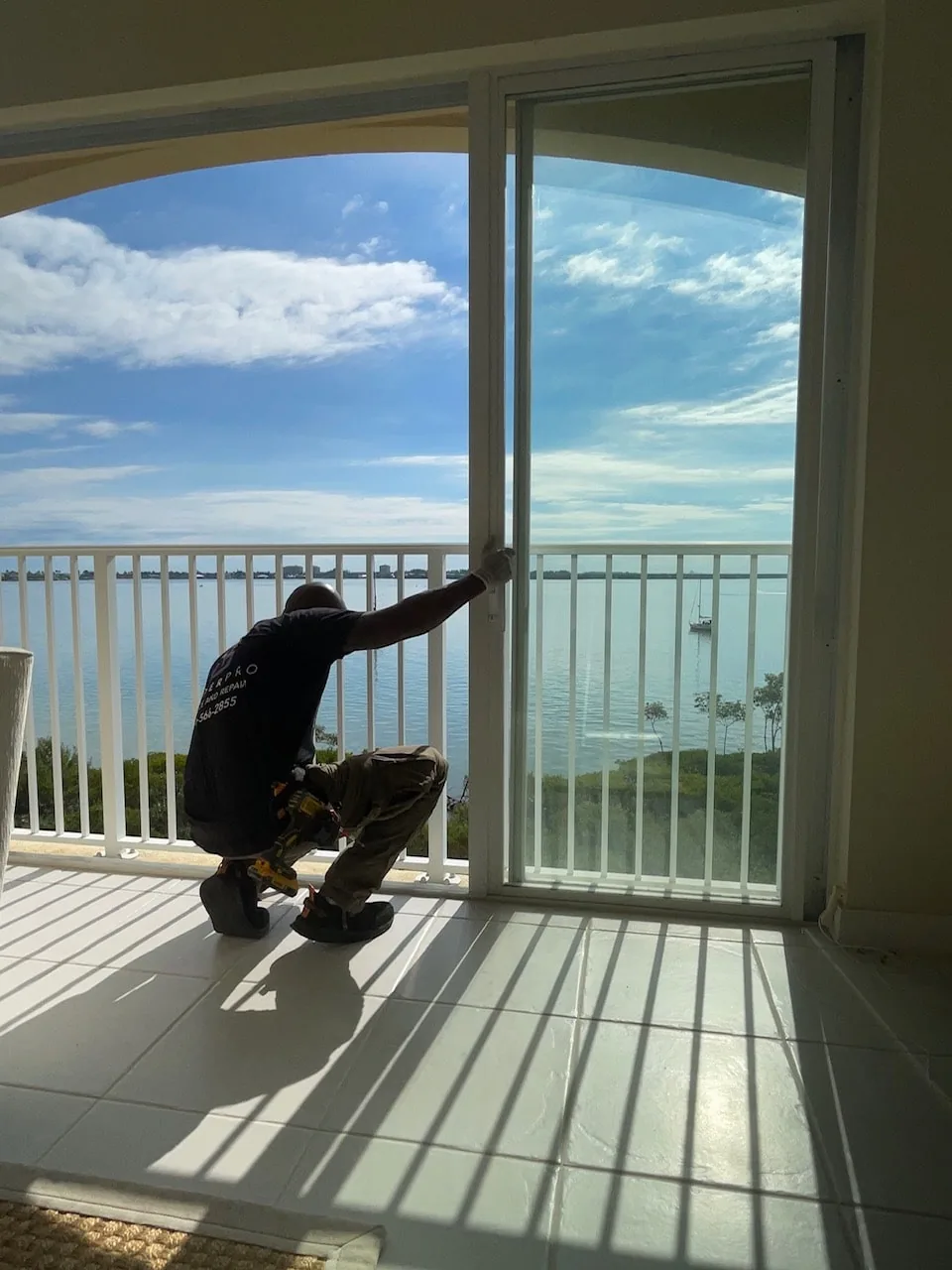
Doors that stick, grind, or jump the track almost always come down to worn rollers. We replace them with heavy-duty stainless rollers so your door glides with one finger again.
About this serviceWe repair torn, sagging, or sun-damaged screens using your existing frames — for a fraction of the cost of a new screen, so bugs stay outside where they belong.
About this serviceBroken pane, cloudy seal, or stained glass? We replace the pane in your existing frame — safely removing the old glass and fitting new, so the fix is permanent, not a temporary shine.
About this serviceFactory latches are solid for everyday use. We add true deadbolts and secondary locks engineered for sliding doors, for an extra layer of security where it counts.
About this serviceDeep track cleaning, lubrication, alignment, and inspection — the tune-up that keeps small wear from turning into a seized door or a broken roller.
About this serviceA cracked arch is a glass problem, not a window problem. The new piece is cut to the shape of your existing opening — half-round, quarter-round or circular — so the frame and surround stay put.
About this serviceStruck impact glass cracks and stays put — that is the system working. In most cases the sealed unit is replaced inside the original frame, grids and all, instead of the whole window.
About this serviceFort Pierce has the steepest corrosion gradient on our route. On Hutchinson Island — Ocean Village, Harbour Isle and the buildings lining A1A — doors face open Atlantic salt spray directly, and roller bearings there can seize in five to seven years without maintenance. Cross to the mainland and the rate drops, but Indian River Drive and the South Beach causeway neighborhoods still sit in brackish lagoon air, which corrodes hardware faster than anywhere inland.
West of US-1, in Sunrise City, Lakewood Park, White City and Indian River Estates, the story changes entirely: salt is a minor factor and wear comes from use and track grit instead. Same door, same brand, very different lifespan — which is why we recommend sealed stainless hardware near the water and why an annual service pays for itself on the island but is optional out west.
Fort Pierce also holds some of the oldest housing stock we work on. Doors retrofitted into historic-district homes near downtown sit in openings that have settled over decades, so alignment matters as much as parts — a door can have perfect rollers and still refuse to latch because the opening is no longer square.
Not listed? Call 772-722-4036 — this is a sample, not a limit.
A lot of our Fort Pierce calls come from condo owners and property managers on Hutchinson Island — snowbirds who arrive in November to find the balcony door seized after a summer of salt and disuse, and rental owners who need a door fixed between guests. We're used to working within condo building rules: elevator scheduling, protecting common hallways, and coordinating with association managers when the work touches anything the building is responsible for. For directly oceanfront units we recommend an annual service visit — it is dramatically cheaper than replacing hardware that's been left to seize.
Airborne salt. Within roughly a mile of open Atlantic water, salt spray settles into the door track and works into the roller bearings, where it causes corrosion that lubricant can't undo. Oceanfront hardware can seize in five to seven years — which is why we fit stainless, sealed-bearing replacement rollers on island jobs.
Yes, regularly. We're familiar with condo logistics — association notice, elevator pads, protecting hallways — and we're happy to coordinate with your property manager. If your association has rules about who repairs what on a balcony slider, we can help you figure out which side of the line your repair falls on.
Very likely. Wind-driven rain during a tropical system packs fine sand and salt deep into the track, and it grinds the rollers every time the door moves afterward. A post-storm track service and roller inspection catches this before the grit destroys the hardware.
Yes. Historic-district homes often have sliders retrofitted decades ago into openings that have settled, which throws off alignment and makes latches miss. We rehang and realign the door in its existing frame — keeping the character of the home while making the door work like a modern one.
Yes — the island condos are a regular part of our week. We are used to building requirements: association notice, elevator scheduling, and protecting common corridors while a panel is out. If your association needs a certificate of insurance before we attend, ask your manager to send the requirements over.
The whole city and its surrounds — Hutchinson Island and South Beach, Indian River Drive, the historic downtown district, Sunrise City, Lakewood Park, White City and Indian River Estates.
It depends entirely on which side of the water you are on. Directly ocean-facing doors genuinely benefit from an annual clean, lubricate and inspect — it catches salt corrosion while it is still surface-level. West of US-1 you can comfortably stretch that out. We will tell you honestly which category your home falls into rather than selling everyone the same plan.
Almost certainly not. Tropical systems drive fine sand and salt deep into door tracks, and that grit then grinds against the rollers every time the door moves. Post-storm is our busiest period for exactly this. A track service and roller inspection soon after a blow stops it becoming permanent damage.
They last longer, and the reason is specific. Chloride attacks the thin passive oxide film that protects steel, and stainless alloys carry enough chromium to keep rebuilding that film, so pitting starts much later. The sealed part matters just as much: a shield keeps the salt brine out of the bearing race, which is where the damage that seizes a wheel actually happens. Neither makes a roller immortal on an ocean-facing balcony. What they buy you is years instead of a handful of seasons, and a door that can be maintained rather than one that has to be rescued.
Repairs start at $275, including parts, labor and a written 1–3 year warranty on both. Where a job goes above that is fairly predictable: how badly corroded the roller housings are, whether the glass is impact-rated and therefore heavy, whether the rail needs capping over a groove, how many panels you have done at once, and whether the lock needs realigning once the panel is back at its correct height. Access counts as well — a sixth-floor balcony with elevator scheduling takes longer than a ground-floor lanai. Having every slider looked at in one visit is the cheapest way to buy the work.
Usually not, and the test is whether the metal is dirty or gone. White powder and a chalky finish are aluminum oxide; they clean off and mean very little. What matters is section: a rail that flexes under thumb pressure, a sill corner you can dent, or a bottom rail gone soft around the roller pocket. Those are the cases where a new roller has nothing solid to sit in and replacement is the honest answer. Short of that, a matched roller set, a full rail service and a height reset bring most island doors back. We will show you which category yours is in.
As early in your stay as you can manage, and ideally before you find out the hard way that it has seized. A door that sat locked through a Fort Pierce summer has had five months of standing brine on a motionless bearing, so the damage is already done by the time you try it in November. Booking in the first couple of weeks of season means the repair happens before you rely on the door daily, and it keeps you clear of the pre-storm rush at the other end of the year. If it will not move at all, do not force it — that is how a roller job becomes a rail job.
Also serving nearby:
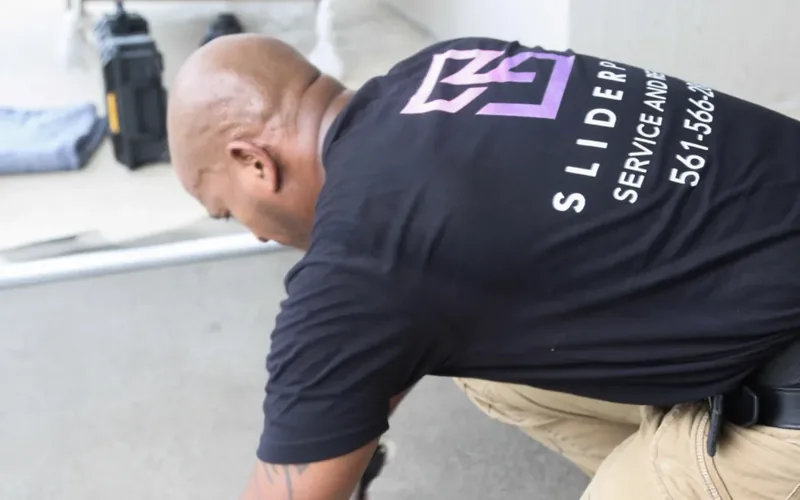
Grooved, bent, pitted or cracked: a sliding door track fails in four ways, and a repair kit only fixes some of them. Here's what dressing, capping and replacement each solve, and what they don't.
Read the guide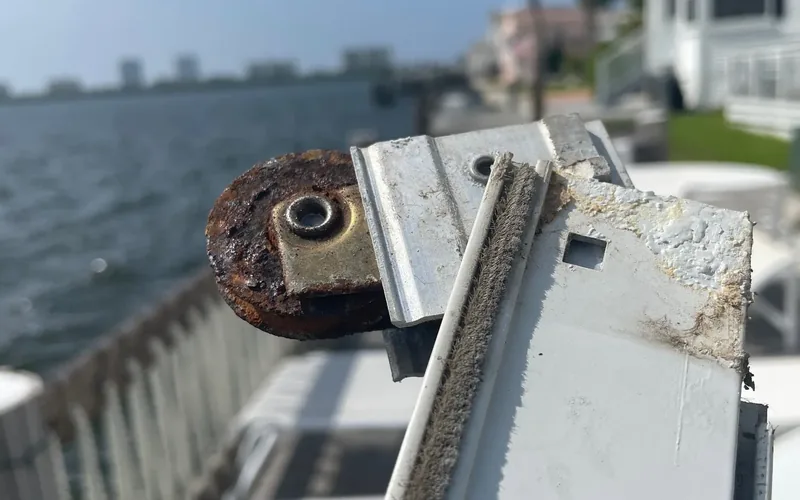
Wheel material, bearing type, single or tandem, and the profile of the wheel's edge. Here's how every roller option compares, and which one belongs under your door.
Read the guide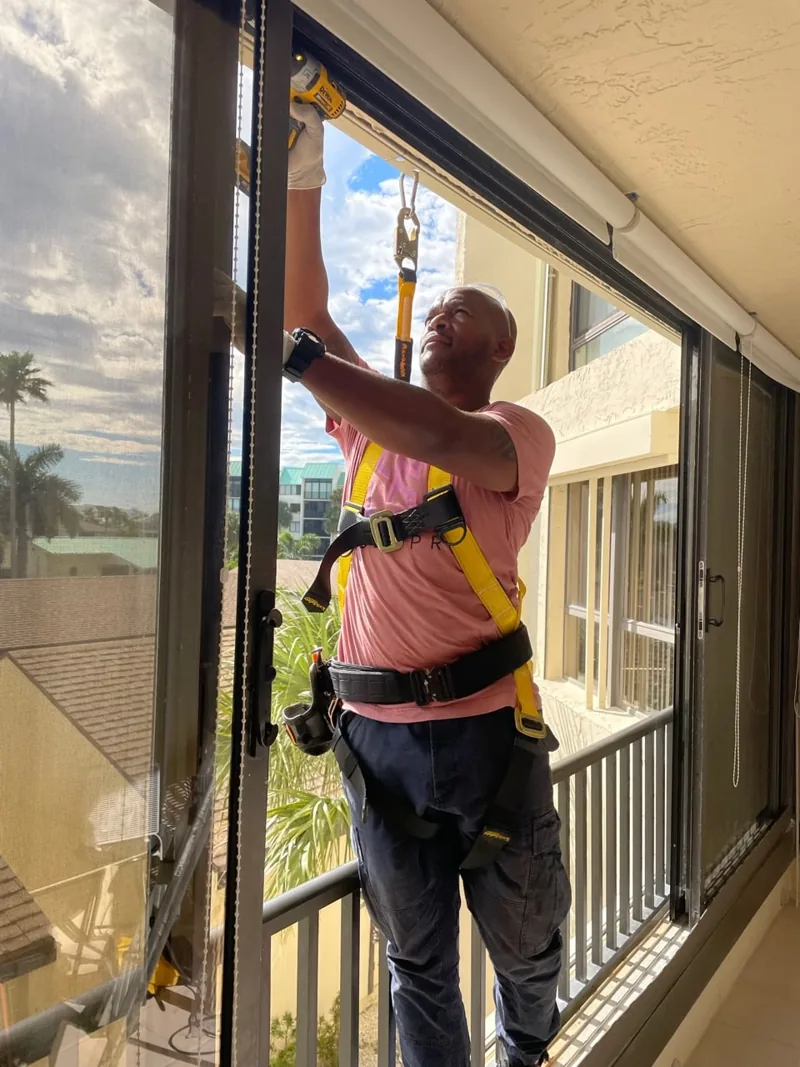
The ocean-facing balcony door takes salt spray the rain never rinses off, wind that grows with every floor, and the weight of impact glass. Here's what that does to the hardware, and how to plan a repair inside a condo building.
Read the guideEvery company on this coast will tell you that salt air is hard on doors. Almost none of them will tell you what the salt actually does, and the mechanism is worth understanding because it explains which repairs last and which ones are money thrown at a symptom.
It starts offshore. Breaking waves throw droplets into the air, the water evaporates, and what is left is a microscopic salt particle riding the sea breeze inland. Deposition is heaviest at the beach and falls off quickly with distance and with anything that blocks the wind, which is why the same door has a completely different lifespan on Hutchinson Island and in White City.
What makes those particles destructive is that chloride is deliquescent: above roughly 75% relative humidity it pulls water out of the air and turns into a liquid brine. Treasure Coast nights sit above that threshold for much of the year. So the salt on your track is not occasionally wet. It is a standing film of strong electrolyte sitting on metal, most of the time.
From there it is straightforward electrochemistry. Steel components inside an aluminum housing form a galvanic couple in that brine, and current flows. Chloride also breaks down the thin passive oxide layer that normally protects both metals, and it does that worst in tight crevices — the gap between a bearing race and its balls is exactly the geometry that keeps oxygen out and chloride in. The corrosion product occupies more volume than the metal it consumed, so it packs the race and binds the cage.
The wheel stops turning freely long before anything looks broken. It skids instead of rolling, the skid flattens one spot on the wheel, and that flat hammers the rail on every pass. That is the grinding you hear. It is also why lubricant achieves nothing here: spray cannot reach inside a sealed race, and it cannot put back metal that has already dissolved. Sealed stainless assemblies do better because they combine a physical barrier against the brine with an alloy that rebuilds its own passive layer. There is more on the chemistry in why Florida sliders stick.
Where you live in Fort Pierce predicts the failure, not just how fast it arrives.
The useful takeaway is that two doors twenty minutes apart do not need the same maintenance interval, and anyone selling one plan to the whole city is not paying attention to the address.
On this side of the county the question is nearly always about corrosion, and the distinction that matters is between metal that is corroded on the surface and metal that has lost section.
Replacement genuinely wins when the panel's roller pocket has corroded soft, when the sill has lost material at the corners where water stands, or when one door needs glass, frame and hardware all at the same time. On an ocean-facing unit that has gone twenty years without service, that does happen. When it does we say so on the first visit rather than after taking your money. Everything short of it is a repair, and the great majority of Fort Pierce doors are short of it.
The barrier island is dense with association-owned buildings, and the balcony slider is the item those documents split more often than any other.
The declaration is what governs, and it usually divides one door between two parties along lines that surprise owners. The glass may be handled one way, the frame and track another, the screen a third, and the hardware may not be named at all. The terms to look for in the maintenance article are unit boundary, common element and limited common element. A balcony is very often a limited common element, which is its own category rather than simply "yours."
Two things save owners money here. First, maintenance and insurance are separate questions: an association can be responsible for maintaining something it does not insure, and the answer to one tells you nothing about the other. Second, ask management in writing and keep the answer, because a verbal reply is not something you can hand to a board later.
What we can do is quote itemized by part rather than as a single number, so whoever reviews it can see which line falls on which side of the boundary. The detail is in who pays for a condo slider. None of this is legal advice. Where your declaration is ambiguous, the association's attorney is the person to ask, not a repair company.
A large share of Fort Pierce's island units are closed from spring until late fall. That happens to be the wettest, saltiest, hottest half of the year, and the door spends all of it in one position.
Movement is what keeps a roller alive. Each pass wipes the brine film off the bearing, redistributes whatever lubricant is left, and rotates the wheel onto fresh circumference. A locked, motionless door does none of that, so the wheel takes a set at its two contact points while corrosion works undisturbed inside the race. A closed unit also runs a higher indoor humidity than a lived-in one, and on the ocean side that door is the only thing standing between conditioned air and salt aerosol.
Before you leave: clean and dry the track, get any oil-based lubricant off it, close and lock the door so the panel is properly supported, and if anyone checks the unit, ask them to slide each panel end to end once a month. On arrival: do not force it. A seized wheel dragged under a heavy impact panel cuts a groove into the rail and turns a roller job into a rail job. Clean first, try it again gently, then call.
Rental owners get the same problem compressed into a week. Guests force doors that stick, lock them wrong and put screens back crooked. The turnover checklist covers the 90-second check that catches most of it between stays.
Fort Pierce holds some of the oldest housing we work on, and a lot of it has sliding doors that were retrofitted into masonry openings decades after the house itself went up.
Two things follow from that. First, the hardware belongs to an era of single-wheel and early tandem steel rollers whose profiles are long out of production, so the job is matching housing length, wheel diameter and stem height by measurement rather than by part number. Most can be matched. Second, the opening has had fifty or sixty years to settle, and a retrofit frame follows whatever the masonry around it does.
That second point is why parts alone sometimes fail to fix these doors. A perfectly good roller set in an out-of-square opening gives you a door that slides beautifully and still will not latch, because the hook is arriving above or below the keeper. Here is how to tell which you have: close the door and read the gap along the jamb from top to bottom. Even gap means a square opening and a hardware problem. A tapering gap means the opening has moved, and the fix is height and alignment work, with the keeper repositioned last rather than first.
These older frames are usually worth keeping. The extrusions are heavier than most modern budget doors and the glass is generally sound. Why a slider stops locking works through the alignment sequence in full.
Island doors carry two loads at once: the corrosion the salt brings, and the weight the code brought.
An impact panel is two lites of glass bonded to a plastic interlayer, and that construction can put it close to twice the weight of a single-glazed panel of the same size. The rollers underneath carry all of it. Double the load on the same contact patch and the rail work-hardens and then crowns, spreading at its edge under repeated loading into a lip the wheel starts to climb. Add a bearing that is corroding on an island schedule and the two problems feed each other: a stiff wheel skids, a skidding wheel damages the rail, and a damaged rail loads the wheel harder still.
The lock matters more here than owners usually realize. On a slider, the latch and keeper are part of how the panel stays in its frame under pressure, so a latch that only half-engages is a structural issue rather than an inconvenience. If yours needs a nudge to catch, get it looked at before the season rather than during it.
After a storm the track needs a fresh-water flush and the weep holes need proving with water, because wind-driven rain packs salt and sand deeper than ordinary weather ever does. On what opening protection your building or home is actually required to have, your county building department is the authority, not a repair company. Our hurricane checklist covers the before and the after.
Repairs start at $275, and that figure includes parts, labor and a written 1–3 year warranty on both. What moves a Fort Pierce job above the starting point is largely predictable from your address and your door.
The repair cost guide goes through what a complete written estimate should contain, and the questions worth asking whoever quotes you.
A few minutes with your phone gets the right parts onto the truck, which is a large part of why most jobs finish in a single visit.
Then photograph four things: the bottom corner of the moving panel, the rail under the fixed panel, the lock with its keeper, and the exterior sill. Send them with your message and we can usually tell you what we expect to find before we set off.
Honest quotes and repairs usually finished in a single visit — call or send the form.