Roller Replacement
Doors that stick, grind, or jump the track almost always come down to worn rollers. We replace them with heavy-duty stainless rollers so your door glides with one finger again.
About this service
SliderPro is headquartered right here in Port St. Lucie — when your slider sticks, the truck is already in the neighborhood.
Port St. Lucie is our home base. Our shop sits off SW Eckard Avenue, which means PSL homeowners get the fastest response times on our entire route — from Tradition and St. Lucie West out to Torino, Gatlin, and the older Floresta-area neighborhoods east of the turnpike.
The city's housing stock tells us a lot about the repairs we'll find before we even arrive. Port St. Lucie boomed in two big waves — the 1980s–90s General Development era and the 2000s–2020s expansion around Tradition — and each wave came with wall-to-wall sliding glass doors opening onto lanais and pool cages. The older GDC-era homes are now running 30- and 40-year-old door hardware: original steel rollers that have long since corroded, tracks worn thin from decades of dragging, and latches that were basic even when new. The newer builds have better glass, but builders routinely fitted budget-grade rollers that start failing in as little as five to ten years of daily use.
Add PSL's inland-but-humid climate — afternoon storms, irrigation overspray on the back slider, sand tracked in from yards that were pine flatwoods not long ago — and you get the exact failure pattern we fix every day: a heavy door, a gritty grinding sound, and a track full of debris. We replace the rollers with stainless hardware, deep-clean and dress the track, and reset the alignment so the latch actually catches again.
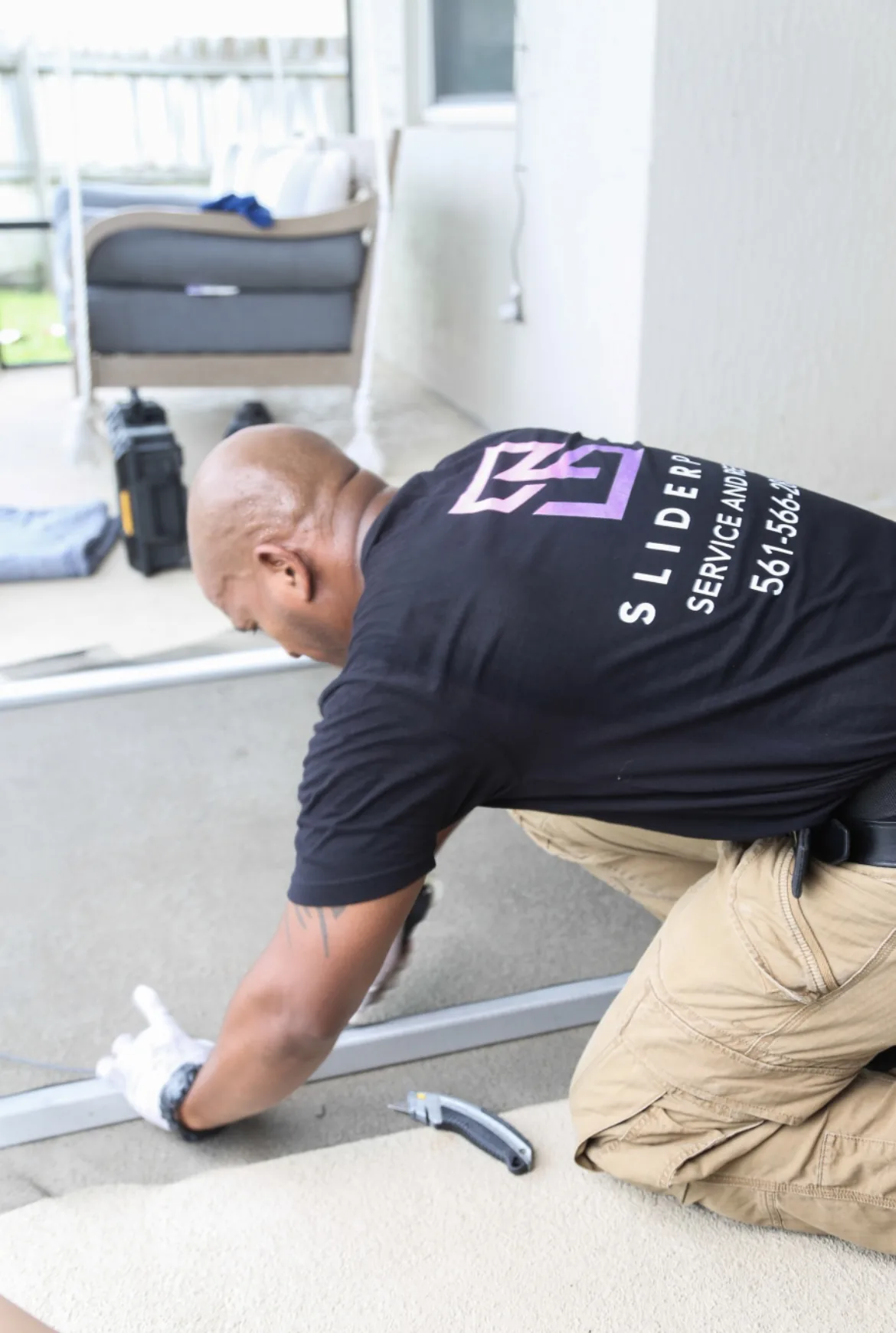
Doors that stick, grind, or jump the track almost always come down to worn rollers. We replace them with heavy-duty stainless rollers so your door glides with one finger again.
About this serviceWe repair torn, sagging, or sun-damaged screens using your existing frames — for a fraction of the cost of a new screen, so bugs stay outside where they belong.
About this serviceBroken pane, cloudy seal, or stained glass? We replace the pane in your existing frame — safely removing the old glass and fitting new, so the fix is permanent, not a temporary shine.
About this serviceFactory latches are solid for everyday use. We add true deadbolts and secondary locks engineered for sliding doors, for an extra layer of security where it counts.
About this serviceDeep track cleaning, lubrication, alignment, and inspection — the tune-up that keeps small wear from turning into a seized door or a broken roller.
About this serviceA cracked arch is a glass problem, not a window problem. The new piece is cut to the shape of your existing opening — half-round, quarter-round or circular — so the frame and surround stay put.
About this serviceStruck impact glass cracks and stays put — that is the system working. In most cases the sealed unit is replaced inside the original frame, grids and all, instead of the whole window.
About this servicePort St. Lucie went up in two distinct waves, and each one left a different problem behind the glass. The General Development Corporation era of the 1970s–90s filled the older grid east of the turnpike — Sandpiper Bay, Lake Forest, the streets off Prima Vista and Floresta — with heavy aluminum sliders whose original steel rollers are now decades past their service life. Those doors are worth repairing: the frames were overbuilt and the glass is usually fine, so new stainless rollers and a track service typically buy another decade.
The second wave — St. Lucie West in the 90s, then Tradition, Torino, Veranda Gardens and Portofino Shores through the 2000s and 2010s — brought better glass on cheaper hardware. National production builders specify rollers to a price, and across whole streets they reach end of life at roughly the same time. If your neighbors are complaining about sticking doors, that is not coincidence; it is the hardware cohort ageing out together.
One more local factor worth knowing: under the Florida Building Code, properties in the Wind-Borne Debris Region need rated opening protection, and much of eastern St. Lucie County falls inside it. That drives the heavy impact glass now common in newer PSL homes — panels that weigh far more than the hardware underneath them was originally sized for, which is exactly why they start dragging sooner than owners expect.
Not listed? Call 772-722-4036 — this is a sample, not a limit.
In 55+ and golf communities like Kings Isle, Cascades, and the Tradition villages, we're often asked to make doors lighter for residents who struggle with a stiff slider — a roller replacement and track service typically takes a two-hand shove back down to a one-finger glide. In family neighborhoods off Gatlin and Port St. Lucie Boulevards, it's pet doors' worth of screen damage and pool-cage sliders that get heavy seasonal use. And across the city's rental homes, we work with landlords who need doors locking properly between tenants — a security and liability issue, not just a convenience.
No — PSL is our home turf. Our shop is based off SW Eckard Avenue, so Port St. Lucie addresses get our fastest scheduling and no distance surcharges. Call 772-722-4036 and we'll usually have a straightforward answer about timing on the spot.
Almost always. Those older aluminum-frame doors were built heavy and simple, which makes them great candidates for repair — we stock roller patterns that fit the common legacy brands, and a new set of stainless rollers plus a track service usually brings a 40-year-old door back to smooth daily use.
Yes, and it's the most cost-effective way to book us. Many PSL homes have three to five sliding panels between the living room, primary bedroom, and lanai — we inspect and service all of them in a single appointment, and only replace parts that actually need it.
All the time — that's half of Port St. Lucie. Pool-cage doors live in a harsher micro-climate (chlorinated splash, sprinkler overspray, constant humidity), so their rollers and screen fabric wear faster than street-facing doors. We service the glass slider and the screen door in the same stop.
All of them — from the older GDC grid around Sandpiper Bay and Floresta out to St. Lucie West, Tradition, Torino, PGA Village, Kings Isle, The Cascades, Magnolia Lakes, Portofino Shores and Veranda Gardens. Our shop is on SW Eckard Avenue, so nowhere in the city is a long trip for us.
Because your street was built at once. Production builders fit the same roller across an entire phase, so those rollers wear out on the same schedule — we regularly service several homes on one street in a week. It is worth mentioning to neighbors, since consecutive visits in the same area are the most efficient way for everyone to get sorted.
Yes. Impact panels are heavier than standard glass — often dramatically so — which puts real load on their rollers and makes correct handling important when the panel comes out. The repair logic is unchanged: the glass and frame are fine, the hardware wears. We fit roller assemblies rated for the actual weight of the panel rather than whatever was cheapest at build time.
Yes — rentals, seasonal homes and commercial premises alike. For landlords and property managers we can work through turnovers and coordinate access without the owner needing to be there, which is the usual arrangement across Port St. Lucie's large rental stock.
Usually worth repairing. Doors from that build wave came with decent glass on cost-specified rollers, so what has failed is the cheapest part of the assembly rather than the expensive part. The frame is normally sound and the glass unit is normally intact, which means a matched roller set, a full track service and a height reset bring the door back to one-finger operation. We only steer people toward replacement when the frame has lost material at the sill, the roller pocket in the bottom rail has corroded soft, or the opening itself has moved out of square — and we show you which of those we found.
Your declaration decides, and Florida declarations commonly split one door between two parties: the glass one way, the frame and track another, the screen a third. Look for the maintenance article and the terms unit boundary, common element and limited common element. Ask your manager in writing rather than in the parking lot, and keep the reply. Bear in mind that maintenance responsibility and insurance responsibility are separate questions with separate answers. We can supply a quote itemized by part so a board can see which lines fall on which side. This is general information, not legal advice.
Stillness, mostly. A roller stays healthy because it moves: each pass wipes the moisture and salt film off the bearing and rotates the wheel onto a fresh part of its circumference. A door locked shut for five months rests on the same two contact points through the hottest, wettest half of the year, so the wheel takes a set at those points while corrosion works undisturbed inside the race. Do not force it when you get back. A seized wheel dragged under the weight of the glass cuts a groove into the rail. Clean the track, try it gently, and if it is still heavy, it is hardware.
Repairs start at $275, and that includes parts, labor and a written 1–3 year warranty on both. Where a job lands above that depends on countable things: how many panels you have done at once, whether the glass is impact-rated and therefore much heavier, whether the rail needs a cap fitted over a worn groove, whether an older roller housing has to be matched by measurement, and whether the lock needs realigning after the panel comes back to its correct height. Having every slider in the house looked at in one visit is the cheapest way to buy the work.
Close the door and look at the gap between the panel edge and the jamb from top to bottom. If that gap is even, the opening is square and the problem is almost certainly hardware. If it tapers — wider at the top and tight at the bottom, or the reverse — the panel has dropped or the opening has moved, and new rollers alone will not settle it. Then lift the door by its handle: more than about a quarter of an inch of travel means the rollers have collapsed or their adjusters are already wound out. Both checks take under a minute and neither needs tools.
Also serving nearby:
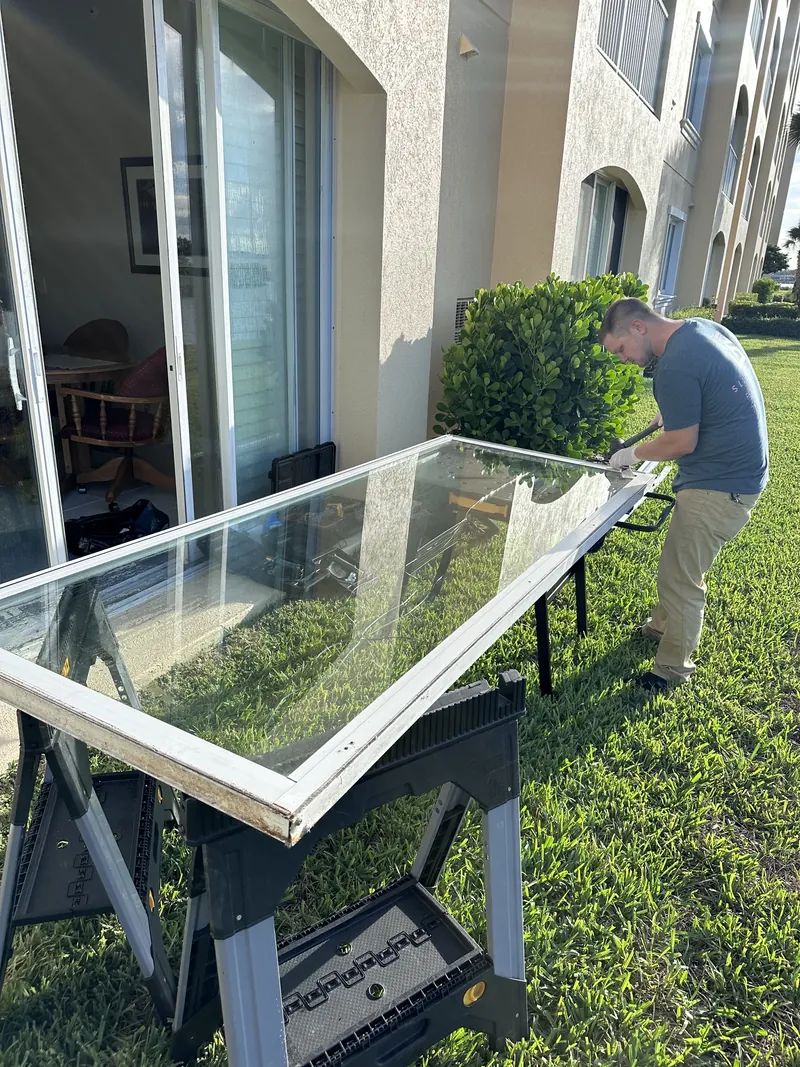
A door off its track is either out of the head channel at the top or off the rail at the bottom, and the two have different causes. Here's how to tell which you have, what's safe to try, and when to leave a heavy panel alone.
Read the guide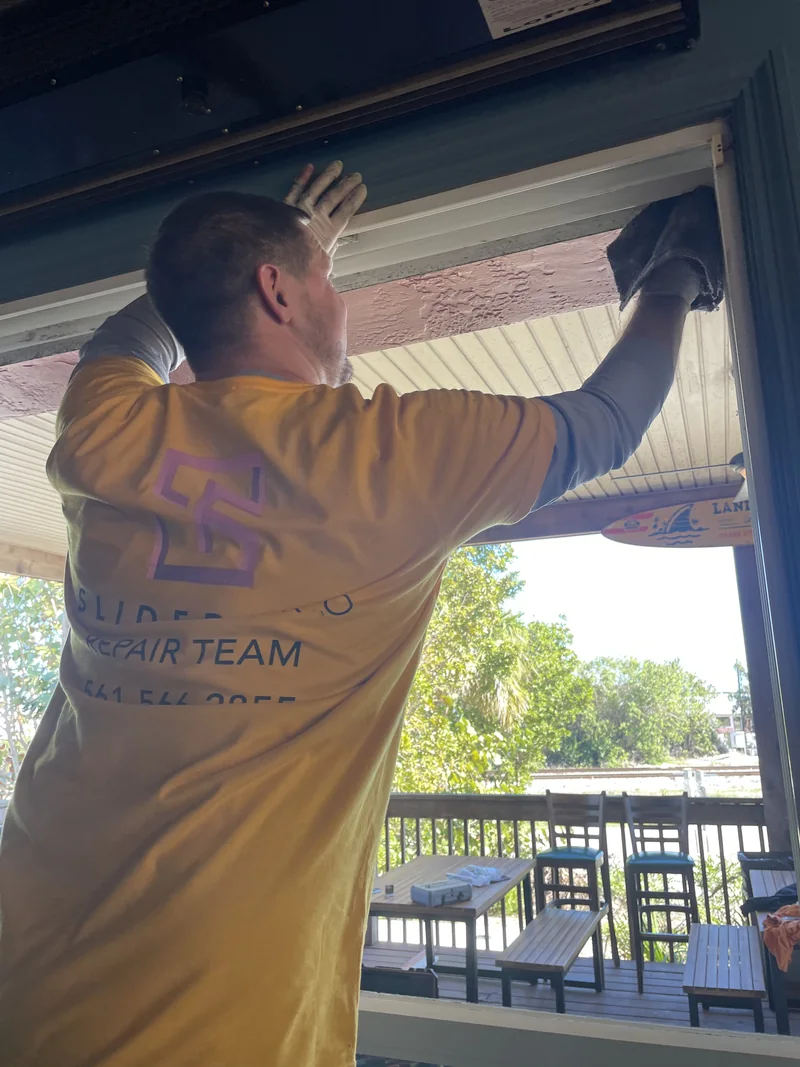
Salt explains most failures on a beachside slider. Inland, the story is sun on the seals, afternoon storm water at the sill, pool splash and older housing stock. Here's how to tell which kind of wear your door has.
Read the guide
A door that doesn't move corrodes faster than one that does. Here's the week-before-you-leave routine for your sliders, how to handle shutters and storms while you're gone, and the order to check things when you come back.
Read the guideThe doors in the older grid east of the turnpike were built in an era when a sliding door was a heavy aluminum extrusion, plate glass and two small steel wheels. The frames have aged well. The hardware has not, and the reason is chemistry rather than age.
A steel roller sitting in an aluminum housing is a galvanic pair. Put a film of moisture with dissolved salt in it between two dissimilar metals and you have a small battery: current flows, and the less noble metal gives up material. The corrosion product that replaces it takes up more room than the metal it came from, so it swells inside the housing pocket and pinches the wheel. That is why a forty-year-old door can feel welded shut while the wheel itself, once you pull it out, still looks round.
The second issue is supply. Many roller profiles from that period are long out of production, so the job is not looking up a part number. It is measuring the housing length, the wheel diameter, the stem height and the adjuster position, then fitting a current assembly that matches all four. Get one of them wrong and the panel sits at the wrong height, which drops the lock hook below the keeper even though the door slides beautifully.
These doors are usually worth keeping. The extrusion is heavier than most of what gets sold today, the glass is generally sound, and a matched roller set plus a full track service typically buys another decade. Roller replacement covers how we identify and fit them.
The wheels fitted to most tract-built sliders of that period are molded nylon or acetal running on a small bearing. Nylon is a good material in a dry, temperate house. In a Port St. Lucie lanai it does two things it was never chosen for: it absorbs moisture out of the air, which softens it, and it takes a permanent set under a static load, which engineers call creep.
Your door spends most of its life parked in one position under a couple of hundred pounds of glass. The wheel flattens at the two points where it sits. That is why the first slide of the morning feels notchy and the door improves after a few passes: you are riding over the flats until they warm and partly recover. Over the years they stop recovering. A flattened wheel no longer rolls cleanly, it rolls a little and skids a little, and the skid polishes a bright line into the rail.
Sun finishes the job. UV embrittles the surface of the polymer, so the wheel that softened through the wet season cracks at its rim in the dry one. Pull one out and the rim often crumbles in your hand.
Because a production builder specifies one roller across an entire phase, every door in that phase is running the same clock. When we replace them we fit a wheel and bearing rated for the panel's real weight rather than the build budget, which is why the second set outlasts the first. The seven stages of roller failure describes what each stage sounds and feels like.
An impact panel is two lites of glass bonded to a plastic interlayer. That construction is what keeps the opening closed when something hits it, and it is also why the panel can weigh close to twice what a single-glazed panel of the same size weighs.
Everything downstream of that weight scales with it. The load on each roller doubles. The contact patch where the wheel meets the rail carries twice the stress, so the rail work-hardens and then crowns: the top edge spreads sideways under repeated loading and forms a lip. Once there is a lip, the wheel is no longer running on a flat surface and starts to climb it, which is what owners describe as the door wanting to come off its track.
The hardware underneath is often the same assembly the builder used on the lighter doors in the same house. That was a cost decision made when everything was new and nothing was worn. It shows up years later as a door that drags when its neighbors do not, a latch that misses (see why a slider stops locking), and a groove in the rail rather than a polish.
The fix is to take the weight seriously: roller assemblies rated for the actual panel, a rail assessed before anyone quotes parts, and a height reset afterward so the lock hook centers in the keeper again. Two people handle these panels. A heavy impact door is not a one-person lift, and dropping one is how a hardware job becomes a glass job.
A screened lanai looks like protection for the door. Mechanically it is close to the opposite.
Rain is what rinses a track. A screen enclosure blocks most of the direct rain while letting through everything airborne, so the rail collects sand, pollen and pool-side spray and then never gets washed. Pool water carries chlorides of its own, and irrigation overspray keeps the film damp between storms. The result is a rail that is permanently slightly wet and permanently slightly dirty, which are the two conditions corrosion needs.
Then there is the sand. Florida yards are sand with grass on top, and quartz sand is harder than the steel in the wheel and much harder than the aluminum in the rail. Every pass of the door drags that grit between the two, which is a lapping operation: it wears the wheel and the rail at the same time. Oil-based sprays make it dramatically worse, because oil binds loose grit into a paste and holds it exactly where it does the most damage. Dry silicone on a clean rail, or nothing at all.
The last piece is drainage. The outer rail has weep holes that carry rainwater out through the sill. Packed with sand and pollen they stop draining, and the rail then holds standing water against the roller housings for days after a storm. You can test yours in a minute: pour a cup of water into the outer track and watch whether it leaves. If it sits, the holes are blocked. Our track cleaning routine covers clearing them, and a maintenance visit reaches the parts you cannot get to with the panel in place.
We repair for a living, so the useful thing we can hand you is the test rather than the verdict. Four checks decide it, in this order.
Replacement genuinely wins in four situations: the frame has lost material at the sill corners, the roller pocket in the bottom rail has corroded soft so a new roller has nothing solid to sit in, the opening has moved far enough that the panel no longer seals anywhere along its length, or a single door needs glass, frame and hardware all at once. When we find one of those we tell you to go and get replacement quotes, and we would much rather say it on the first visit than after you have paid us. The repair cost guide works through how that math usually falls out.
A great deal of Port St. Lucie housing sits inside a condominium or villa association, and the patio slider is the classic split-responsibility item because it sits on the boundary between your unit and the building.
Florida declarations tend to divide one door between two parties, and the line is rarely where owners expect it. The glass may be treated one way, the frame and track another, and the screen a third. The words that decide it are unit boundary, common element and limited common element, and they live in the maintenance article of your declaration, usually a page or two of dense text that is worth reading once properly.
Two practical points save owners money. First, maintenance responsibility and insurance responsibility are separate questions with separate answers; an association can be responsible for maintaining something it does not insure, and the reverse happens too. Second, ask in writing and keep the reply, because a manager's verbal "that one's yours" is not something you can put in front of a board six months later.
What we can do is make the paperwork easy: a quote itemized by part, so whoever reads it can see which line falls on which side of the boundary instead of being handed one number for "door repair." The full walkthrough is in who pays for a condo slider. None of this is legal advice — your declaration governs, and where it is ambiguous the association's attorney is the person to ask.
This is one of the most common calls we get in the first weeks of season, and the cause is not neglect. It is stillness.
Movement is what keeps a roller alive. Every pass of the door wipes the moisture and salt film off the bearing, redistributes whatever lubricant is left, and rotates the wheel onto a fresh part of its circumference. A door that is closed, locked and left for five months does none of that. The wheel rests on the same two contact points through the hottest, wettest half of the Florida year, so it takes a set at exactly those points while corrosion works undisturbed inside the race. A closed-up house also runs a higher indoor humidity than a lived-in one, which does the rail no favors either.
What helps before you fly north: clean and dry the track properly, leave no oil-based lubricant sitting on it, close and lock the door so the panel is supported in its frame, and if anyone checks the house while you are away, ask them to slide each panel end to end once a month. Thirty seconds a door is genuinely enough.
What helps when you get back: do not force it. A seized wheel dragged under two hundred pounds of glass machines a groove into the rail, which turns a roller job into a roller-and-rail job. Clean the track first, try it again gently, and if the door is still heavy on a clean rail, that is hardware. The seasonal and rental checklist has the full close-up and open-up sequence.
Repairs start at $275, and that figure includes parts, labor and a written 1–3 year warranty on both. What moves a job up from there is mostly countable, so you can work out the shape of yours before we arrive.
For the full breakdown of what drives repair pricing in Florida, and what a complete written estimate should contain, see the cost guide.
Honest quotes and repairs usually finished in a single visit — call or send the form.