Roller Replacement
Doors that stick, grind, or jump the track almost always come down to worn rollers. We replace them with heavy-duty stainless rollers so your door glides with one finger again.
About this service
Old-Florida cottages, preserve-side neighborhoods, and intracoastal estates — Hobe Sound's doors are as varied as the town, and we service all of them.
Hobe Sound might be the most varied stop on our route. In a single day here we can work on a 1960s cottage in Zeus Park, a family home in Heritage Ridge or Poinciana Gardens, and a waterfront estate off Gomez Avenue looking across the Intracoastal at Jupiter Island. Each brings its own door problems — and its own hardware eras.
The older cottages and mid-century homes carry some of the oldest operating sliders we see anywhere: original steel-wheel hardware from the 60s and 70s, often still limping along on tracks worn into grooves. These doors were overbuilt by modern standards and almost always repairable — the frames outlive the wheels by decades. The estates near the water face the opposite problem: modern, heavy impact-glass panels whose sheer weight wears even good rollers, compounded by intracoastal salt air that shortens bearing life on the east side of US-1.
In between, Hobe Sound's family neighborhoods deal with the universal Florida issues — track grit from sandy yards, screen fabric baked brittle by sun, and factory latches that stopped catching when the door dropped on its worn rollers. Whatever vintage your door is, our approach is the same: repair first, honest advice, quality stainless hardware, and an alignment that makes it glide and lock properly again.
Doors that stick, grind, or jump the track almost always come down to worn rollers. We replace them with heavy-duty stainless rollers so your door glides with one finger again.
About this serviceWe repair torn, sagging, or sun-damaged screens using your existing frames — for a fraction of the cost of a new screen, so bugs stay outside where they belong.
About this serviceBroken pane, cloudy seal, or stained glass? We replace the pane in your existing frame — safely removing the old glass and fitting new, so the fix is permanent, not a temporary shine.
About this serviceFactory latches are solid for everyday use. We add true deadbolts and secondary locks engineered for sliding doors, for an extra layer of security where it counts.
About this serviceDeep track cleaning, lubrication, alignment, and inspection — the tune-up that keeps small wear from turning into a seized door or a broken roller.
About this serviceA cracked arch is a glass problem, not a window problem. The new piece is cut to the shape of your existing opening — half-round, quarter-round or circular — so the frame and surround stay put.
About this serviceStruck impact glass cracks and stays put — that is the system working. In most cases the sealed unit is replaced inside the original frame, grids and all, instead of the whole window.
About this serviceHobe Sound is the most varied stop on our route, and the door work reflects that. The mid-century cottages of Zeus Park and the older streets off Bridge Road carry some of the oldest operating sliders we see — original steel-wheel hardware from the 1960s and 70s, running on tracks worn into grooves. These are excellent repair candidates: the frames were built heavy and outlive their wheels by decades.
Then there are the family neighborhoods — Heritage Ridge, Poinciana Gardens, Osprey Ridge, The Soundings — where the issues are the standard Florida set: sandy-yard grit in the tracks, sun-brittled screen fabric, and latches that stopped catching when the panel dropped on worn rollers.
And east of US-1, along Gomez Avenue and the streets facing the Intracoastal toward Jupiter Island, the doors are modern, large and heavy — impact glass whose weight wears even good hardware, in air salty enough to shorten bearing life noticeably. Backing onto Jonathan Dickinson State Park or the local preserves adds a fourth factor most towns do not have: wildlife testing porch screens nightly, which standard mesh loses to.
Not listed? Call 772-722-4036 — this is a sample, not a limit.
Backing onto Jonathan Dickinson State Park or the Hobe Sound preserves is a privilege that comes with wildlife pressure on your screens — raccoons, cats, and birds test porch mesh constantly, and standard fabric loses. We re-screen a lot of preserve-side porches with heavier pet-and-wildlife-resistant mesh that shrugs off claws. On the security side, quieter streets and seasonal absences make sliding-door deadbolts a smart upgrade here; a factory latch on a dark back patio is exactly the entry a prowler tests first, and hardening it is an inexpensive afternoon job.
Repair, in most cases. Mid-century sliders were built with heavy frames that modern doors don't match — the wheels and latches wear out, but the door itself is usually excellent. New stainless rollers and a track service typically give these doors another decade or more of smooth use, at a fraction of replacement cost.
Yes. East of US-1 and anywhere near the water, salt air measurably shortens roller-bearing life — not as brutally as open-ocean exposure, but enough that we recommend stainless hardware and a periodic maintenance visit for waterfront homes off Gomez and Beach Road.
Heavier mesh. We re-screen with pet-resistant fabric that's dramatically tougher than standard fiberglass — it's the practical answer for preserve-side homes where wildlife tests the porch nightly. We can do the whole porch or just the panels that take the abuse.
Yes — we install deadbolt-style locks purpose-built for sliding doors, which anchor the panel to the frame far more solidly than the factory latch. It's one of the most cost-effective security upgrades for a home that sits empty part of the year.
The whole area — Zeus Park and the older streets near Bridge Road, Heritage Ridge, Poinciana Gardens, The Soundings, Osprey Ridge, Banyan Creek, and the waterfront streets off Gomez Avenue.
Usually more worth it than a modern one. Mid-century sliders were built with heavy frames that today's budget doors do not match — the wheels and latches wear out but the door itself is often excellent. New stainless rollers and a track service commonly give these doors another decade at a fraction of replacement cost.
Heavier mesh. Pet-and-wildlife-resistant fabric is far tougher than standard fiberglass and shrugs off claws, which matters a great deal backing onto the state park or the preserves. Most people fit it on the lower panels and door panels where the damage happens, and keep standard or fine mesh higher up.
Yes, and it is worth doing. A deadbolt built for sliding doors anchors the panel to the frame far more solidly than the factory latch — which matters most on a quiet street where a house sits visibly empty for part of the year. We can service and secure everything in one visit before you travel.
It depends on the declaration for your specific building, and there is no single Florida answer. A common pattern treats a patio or balcony slider as a limited common element serving one unit, then splits maintenance: the association takes the frame or the exterior finish and the owner takes the operating hardware, or the reverse. Some declarations make the whole door the owner's. Read the maintenance obligations clause and the limited common element definition before you approve any work. If the association is responsible, put the fault in writing so it reaches an agenda. Our guide to who pays for a condo sliding door walks through the usual wording.
It can almost always be repaired, and on the Intracoastal side of Hobe Sound that is a large saving. What fails on these doors is the running gear, not the glass. A laminated impact panel weighs half again to twice what a standard panel does, and the rollers fitted underneath were frequently rated for less, so they flatten early. The fix is a roller assembly rated for the weight the panel actually is, plus a rail that has been cleaned and dressed. Repairing the hardware does not alter what the glass itself is rated for, but a door that closes into its interlock and latches properly is a door performing as designed.
Almost certainly not, but stop pushing it. A panel that will not move after a summer away is usually a seized roller: the wheel sat in one position for months while a salt film corroded the bearing race, and now the balls will not turn. Forcing it puts all that load into the rail and the frame corners, which is how a straightforward roller job becomes a track repair and a cracked frame. Leave it, and if the door is your only exit from that room, use another until it is sorted. Nearly every autumn seize-up we attend is fixed in a single visit.
Lift the panel by the handle stile. If it rises a quarter inch or more, the wheels have collapsed and the panel is sitting on the frame, which is a roller problem and the most common one we see. Then press the bottom rail of the frame with a thumb. Solid metal means the frame is fine. If it flexes, or if a corner joint has visibly opened, the frame has lost its geometry and new hardware will not stay adjusted in it. Surface pitting and white chalking look dramatic but are cosmetic. If the door slides but no longer latches, that is the panel sitting low, which is still the rollers.
Also serving nearby:
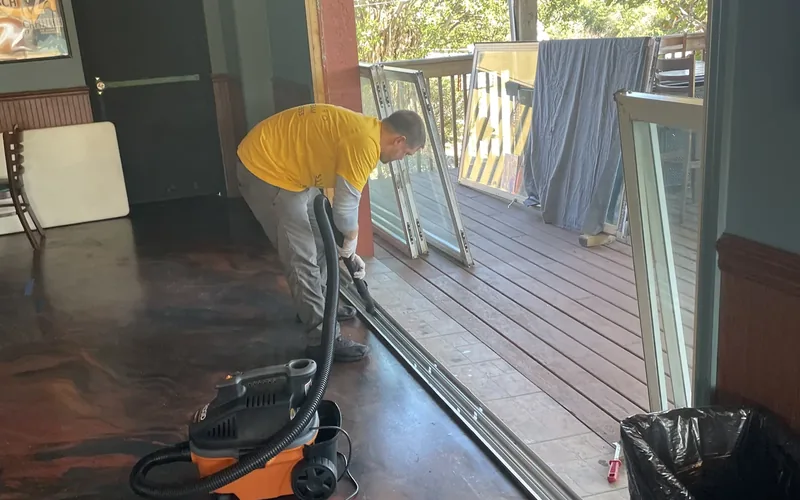
A four-panel stacking slider or a door that pockets into the wall isn't a big version of a patio door. It's a chain of panels that pull each other, a hidden track that collects sand, and a lot more rollers. Here's how they fail and what fixing them involves.
Read the guideThe oldest sliding doors we work on anywhere are in Hobe Sound. Zeus Park and the older streets off Bridge Road hold cottages whose original doors went in during the 1960s and early 70s, and a surprising number of them are still the doors in the opening.
They are worth keeping. Those frames were extruded with wall thicknesses no budget door has today, the openings were built around them, and the glass is usually intact. What has failed is the running gear: small steel wheels in pressed housings, often with a nylon tire that perished decades ago, riding on a rail that has been worn into a shallow groove. The door feels dead because it is skidding rather than rolling.
The reasonable worry is parts. Original hardware for a sixty-year-old door is not sitting on a shelf, and in most cases the manufacturer no longer exists. In practice that matters less than it sounds, because rollers are identified by measurement rather than by badge: wheel diameter, housing width, axle offset, and whether the assembly is a single or a tandem. Most profiles from that era map onto a current equivalent, and where they do not, a housing can often be adapted to take a modern sealed wheel that will outlast the one that came out of it.
What we will not do is tell you a cottage door is unrepairable because it is old. On these houses, age is the argument for repairing it, not against.
Heritage Ridge, Poinciana Gardens, The Soundings, Double Tree, Hobe Heights and the streets around them went up across the 1970s, 80s and 90s, and their sliders are now at a very specific point in life. The frames are sound, the glass is sound, and the hardware has simply run out.
Builder hardware from that period was chosen to a price for a house nobody expected to still be on its original door. Nylon-tired wheels in stamped steel housings will manage twenty to thirty years of ordinary use in a dry climate. In Florida they manage fewer, because the bearing is not sealed and the track is never dry for long.
The tell is that it happens by street rather than by house. A phase built in one year got one part number across every home in it, so the doors reach end of life together. If a neighbor had their slider sorted last spring and yours has just started dragging, those are not two separate events.
These are among the most straightforward repairs we do. New sealed rollers rated for the actual weight of the panel, a track clean and dress, and the latch brought back into line with its keeper, usually inside one visit. What they are not is a reason to replace a door that is otherwise in good condition, which is what these homeowners are most often quoted. Roller replacement covers what that job involves.
East of US-1, on the streets running toward the Intracoastal, the doors are a different animal: wide multi-panel and pocket systems carrying laminated impact glass, often ten feet tall.
Weight is the whole story. Laminated impact glass is two panes bonded either side of an interlayer, so a panel can weigh half again to twice what an equivalent annealed panel weighs, and a tall four-panel run puts several hundred pounds onto each set of wheels. Hardware that would last decades under a standard patio door reaches the same wear in a fraction of the time under that load. A wheel carrying more than it was rated for does not fail gracefully either. It flattens, then it seizes, and then it starts cutting the rail underneath it.
Pocket systems add urgency to all of that. A pocket panel travels into a cavity inside the wall, so if the rollers collapse while the door is retracted, the panel is stuck somewhere you cannot reach, and recovering it is a far larger job than servicing it would have been a month earlier. A pocket door that is wobbling or dragging as it travels is telling you to call now rather than when it stops.
None of this makes an expensive door unrepairable. It makes hardware selection matter: assemblies rated for the weight the panel actually is, rather than a like-for-like replacement of a part that was already undersized when the house was built.
Two minutes and no tools will tell you most of what a technician would say on arrival, and it makes the call much more useful.
One thing worth ruling out separately: if the door drags in one short stretch of its travel and runs freely everywhere else, look for something packed into the track or a damaged section of rail before assuming the hardware. And whatever the test tells you, do not force a door that has stopped moving. The force goes into the track and the frame corners, and that is how the cheapest repair we do becomes one of the more expensive ones.
Every company in this business will tell you salt air is hard on doors. Almost nobody explains what it is doing, and the mechanism is worth knowing because it changes what you should ask for.
Surf and wind put fine salt aerosol into the air and carry it inland. It lands on everything, including the inside of your bottom track. Sodium chloride is hygroscopic: above roughly 75% relative humidity it pulls water out of the air and goes into solution, which on this coast means the salt in your track spends most of the year as a film of brine rather than as dry crystals.
That brine is what does the damage. Chloride ions break down the thin passive oxide layer that protects aluminum and stainless steel, and once the film is breached the attack concentrates into tiny spots instead of spreading evenly. That is pitting corrosion, and a single pit inside a bearing race is enough: the balls no longer run true, corrosion product takes up the clearance they need, and the wheel stiffens and then locks. Where a steel axle sits in an aluminum housing there is a galvanic couple on top of that, with the aluminum corroding preferentially around the pin.
Two conclusions follow for Hobe Sound. East of US-1 and near the water, sealed stainless hardware and an occasional fresh-water rinse of the track are worth the difference, because you are managing a chemical process rather than dirt. Inland and preserve-side, the pressure is different: less salt, more sand, pollen and organic debris, which wears hardware mechanically instead and responds much better to plain cleaning. Why sliding doors stick in Florida goes further into both.
A good share of Hobe Sound closes up for the summer, and the door you left working in April is often the door that will not move in October. The reason is not neglect. It is stillness.
A door that gets used wipes its own bearings. Every pass rolls the balls through the race and pushes moisture and dust out of the contact area. A panel parked in one position for five humid months does none of that, so the brine film sits undisturbed on the same few millimeters of race and corrodes exactly there. It is the same reason a bicycle left in a shed seizes while one that gets ridden does not.
Before you leave: vacuum the tracks dry, clear the weep holes at the outer edge of the sill so summer rain drains instead of standing, run every panel fully open and closed a few times so no wheel is parked, and confirm each door genuinely latches. A door that does not latch is not secure for a season, and on a quiet street a visibly empty house makes the patio slider the obvious place to try. Sliding door lock repair and secondary locks covers what actually holds.
When you get back, do not force a stiff panel. Shoving a seized wheel is how a roller job turns into a bent rail, a cracked frame corner or a snapped handle. Book it instead, and if you can, book it before the autumn rush rather than after everyone else has arrived and found the same thing.
Hobe Sound has fewer high-rise buildings than the barrier island towns, but it has plenty of villas, townhomes and association-governed neighborhoods, and the same question comes up before anyone books a repair: is this door yours or the association's?
In a single-family HOA neighborhood the door is almost always the homeowner's, and a repair rarely needs approval, though anything that changes the appearance of the opening can. In a condominium or villa association the answer lives in the declaration. Florida declarations frequently treat a patio or balcony slider as a limited common element serving one unit, then assign maintenance of it to either the owner or the association, and they often split the door itself, giving one party the glass and frame and the other everything that moves. Two buildings on the same road can be written completely differently.
Read two clauses before you approve anything: the maintenance obligations section, and the definition of limited common elements. If the association turns out to be responsible, put the fault in writing rather than raising it verbally, because that is what gets it onto an agenda. If it is yours, you can book the repair and be done with it.
The full breakdown is in who pays for a condo sliding door, owner or HOA.
Repair first is a position, not a religion. Several times a year we look at a door and tell the owner to put the money into a new unit instead, and it is worth setting out what actually puts a door in that category, because it is never the things people expect.
Age does not. A 1965 cottage slider with a heavy frame and sound glass is a better repair candidate than a fifteen-year-old builder door. Neither does a door being hard to move, which is the symptom of the cheapest repair we do. Nor does an obsolete brand, because hardware is matched by measurement rather than by badge.
What does end it is the frame. If the bottom rail flexes when you press it, if a corner joint has opened, or if corrosion has gone through the metal rather than pitting its surface, the frame no longer holds its geometry and new rollers will not stay adjusted in it. A track rail that a collapsed wheel has cut away completely, rather than merely grooved, is the same story: there is nothing left to dress or cap.
The other genuine case is the glass rather than the door. A laminated impact pane delaminating at its edges, or an insulated unit permanently fogged after its seal failed, is a panel problem. We clear and secure broken glass, and when the panel itself is what needs attention we will say so rather than sell you hardware that will not solve it.
If a company has told you your door is beyond repair without checking the frame rail, the corner joints and the track, they have not run the test that decides it. If replacement really is the answer, frame material and hardware matter more on this coast than the glass specification does.
Repairs start at $275, and that number includes parts, labor and a 1 to 3 year warranty on both. It is worth comparing on that basis rather than against a bare call-out figure, because the low numbers advertised in this trade usually stop at the door and do not include the hardware that fixes it.
What moves it, in Hobe Sound specifically:
You get the figure for your door before work starts, not after. The cost guide sets out what a complete quote should itemize so you can compare two quotes properly.
Honest quotes and repairs usually finished in a single visit — call or send the form.