Impact window glass replacement: the unit, not the whole window
When impact glass is struck it cracks and stays put. That is the system doing its job. In most cases the sealed unit is replaced inside the original frame, grids and all.
If something struck your impact window and the glass cracked without falling out, the window worked exactly as designed. The laminated interlayer holds the fragments in place. What you now have is a damaged pane in an undamaged frame, and a pane can be replaced on its own.
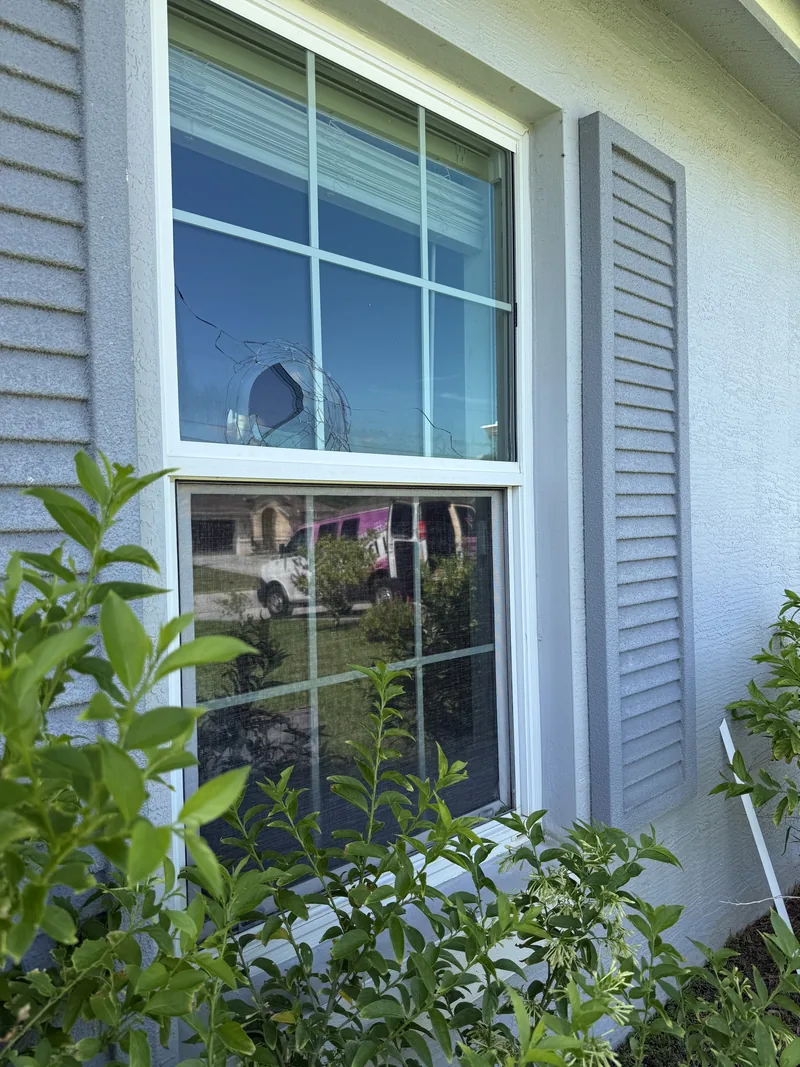
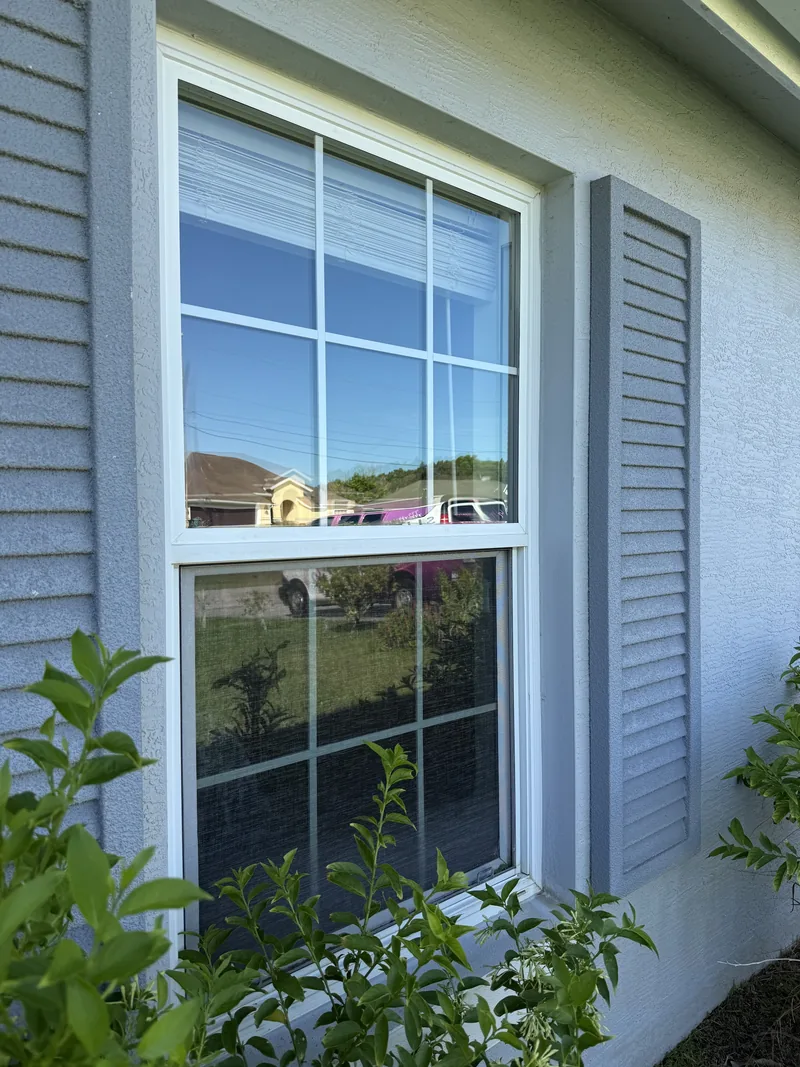
The photographs on this page show precisely that: a clean strike with cracks radiating out from it, the glass fully intact in the sash, and the same window afterwards with a new sealed unit fitted. The frame, the grids, the stucco and the decorative shutters were never touched.
What actually happened when your impact window cracked
Impact glass is a laminated assembly — two or more panes bonded to a resilient interlayer. When it is struck hard enough to fracture, the glass breaks but the interlayer keeps the pieces bonded, so the opening stays sealed and the wall stays closed.
That is the entire point of the product. An ordinary annealed pane in the same event exits the frame and leaves you with a hole in the building envelope during the worst possible weather. A laminated pane cracks in place and keeps doing most of its job until someone comes to replace it.
The visual signature is distinctive and you can see it in the before photograph: a small, clean point of contact with fractures radiating outward from it, the whole pattern locked in place rather than collapsed. Impact glass fails in a way that stays put.
What it means for urgency
A cracked impact pane is not usually an emergency in the way a shattered slider is. There is no open hole, no glass on the floor, no exposure. It is, however, a compromised pane: the laminate is doing structural work it was only meant to do once, and the seal on an insulated unit is very likely broken. It should be replaced, but you are not sleeping next to an open wall while you arrange it.
Inside a modern low-E impact unit
A contemporary impact window is not a sheet of glass. It is a layered system: a laminated impact assembly, an insulated cavity, a sealed spacer, a microscopically thin metallic low-E coating, and frequently a muntin grid — all of which have to work together.
Angelo's notes on this job put it well: the core structure is still the laminated impact assembly, multiple panes bonded with a resilient interlayer that keeps the glass intact under force. But the insulated cavity and the muntin grid now have to work in harmony with a coating engineered to control solar heat gain. Every component — the spacing of the insulated unit, the alignment of the muntins, the seal integrity and the lamination — has to be manufactured and installed precisely, so that the coating performs uniformly across the whole surface.
Layer by layer, that means:
- The laminated assembly. Two panes bonded to an interlayer. This is the part that resists impact and holds together when it fails.
- The insulated cavity. A gas-filled or air-filled gap that does the thermal work. Its width is engineered, not arbitrary.
- The spacer and seal. What keeps the cavity sealed. When this fails you get fogging between the panes, which no amount of cleaning will touch.
- The low-E coating. A metallic layer thinner than a wavelength of light, applied to one specific surface within the stack.
- The grid or muntins. Often sitting inside the sealed cavity, which is why they cannot simply be added or moved later.
Replacing this is not glazing a pane. It is ordering a sealed unit built to the correct stack and fitting it without compromising the seal.
What low-E actually does
Low-E stands for low emissivity. It is a microscopically thin metallic coating that reflects infrared energy while letting visible light through, so the room stays cooler without the window looking tinted or dark.
In practical Florida terms, it does three things at once. It reflects infrared, which is the part of sunlight you feel as heat, so solar heat gain drops. It stabilises interior temperatures, so the air conditioning cycles less and the room next to a west-facing window stops being the room nobody sits in. And it cuts ultraviolet transmission, which is what fades flooring, furniture and artwork over years.
The reason it matters for a repair rather than only for a new build is uniformity. The coating is applied to a specific surface inside the glass stack, and it performs evenly only if the whole assembly is built and installed correctly. A replacement unit with the coating on the wrong surface, or a stack that does not match, will behave differently from the windows either side of it — and on a sunny elevation you will feel the difference from across the room.
Matching the existing glass matters more than upgrading it
Homeowners sometimes ask for a better unit than the original when replacing one pane. It is usually the wrong instinct. A single window with a different coating, tint or thickness reads as a mismatch from outside and performs differently from inside. Matching the existing stack keeps the elevation consistent and the room behaving the way the rest of the house does.
Why the grid complicates the job
On most modern units the muntin grid sits inside the sealed cavity, between the panes. That protects it and makes cleaning easy, but it also means the grid is part of the sealed unit and is manufactured with it — not fitted afterwards.
The consequence at quoting time is that the grid pattern has to be specified exactly: bar width, colour, and the layout of lights across the sash. The window in these photographs carries a colonial grid, and it sits in a run with other windows carrying the same pattern. If the replacement came back with bars a different width, or with the horizontals at a slightly different height, the mismatch would be obvious from the street even though every individual piece was correctly made.
It also rules out a common shortcut. You cannot open a sealed unit to adjust a grid without destroying the seal, and a destroyed seal means fogging within months. The grid has to be right in the order.
Fogging, seal failure and when glass alone is the answer
Moisture or haze between the panes that you cannot clean off is a failed seal on the insulated unit. It is a glass problem, not a window problem, and the fix is a new sealed unit in the existing frame.
The mechanism is straightforward. The cavity is sealed at manufacture. Over years, thermal cycling works on that seal, and when it eventually loses integrity, humid outside air enters the cavity. When the temperature drops, the moisture condenses on the inner surfaces — where no cloth can reach it. What you see is a permanent haze, sometimes with visible droplets or a tide-mark of mineral deposit at the bottom.
Once that has happened, the thermal performance the unit was sold on is largely gone, because the cavity is no longer sealed and the low-E coating may be degrading. But the frame is generally fine. Frames outlast seals comfortably.
| What you can see | What it means | What it needs |
|---|---|---|
| Strike point with radiating cracks, glass in place | Laminate did its job; pane compromised | New sealed unit, existing frame |
| Haze or moisture between the panes | Insulated seal has failed | New sealed unit, existing frame |
| One room hotter than the rest, glass clear | Possible coating or stack mismatch | Identify the stack before ordering anything |
| Glass loose, rattling in the sash | Glazing bead or bedding has failed | Re-bed or re-glaze; often not a new unit |
| Frame racked, corners open, water entering around it | Frame failure | This one genuinely is a window replacement |
What we need in order to quote it
An accurate impact glass quote needs the sash measurements, the glass stack and the grid pattern. Photographs of the damage and of the whole window get us most of the way there before anyone drives out.
- Daylight and overall sash sizes. The unit is sized to the sash, not to the opening in the wall.
- The existing stack. Overall thickness, whether it is laminated, insulated, or both, and whether there is a low-E coating.
- The grid. Internal or applied, bar width and colour, and the number of lights across and down.
- Frame material and glazing method. How the existing unit is held in determines how the new one goes back.
- Any labels still on the glass. Etched or printed markings in a corner often identify the product outright, which removes all guesswork.
Repairs start at $275 with a 1–3 year warranty on parts and labor. Sealed impact units are priced on the unit, since they are built to your sash and your grid pattern.
The job, photographed
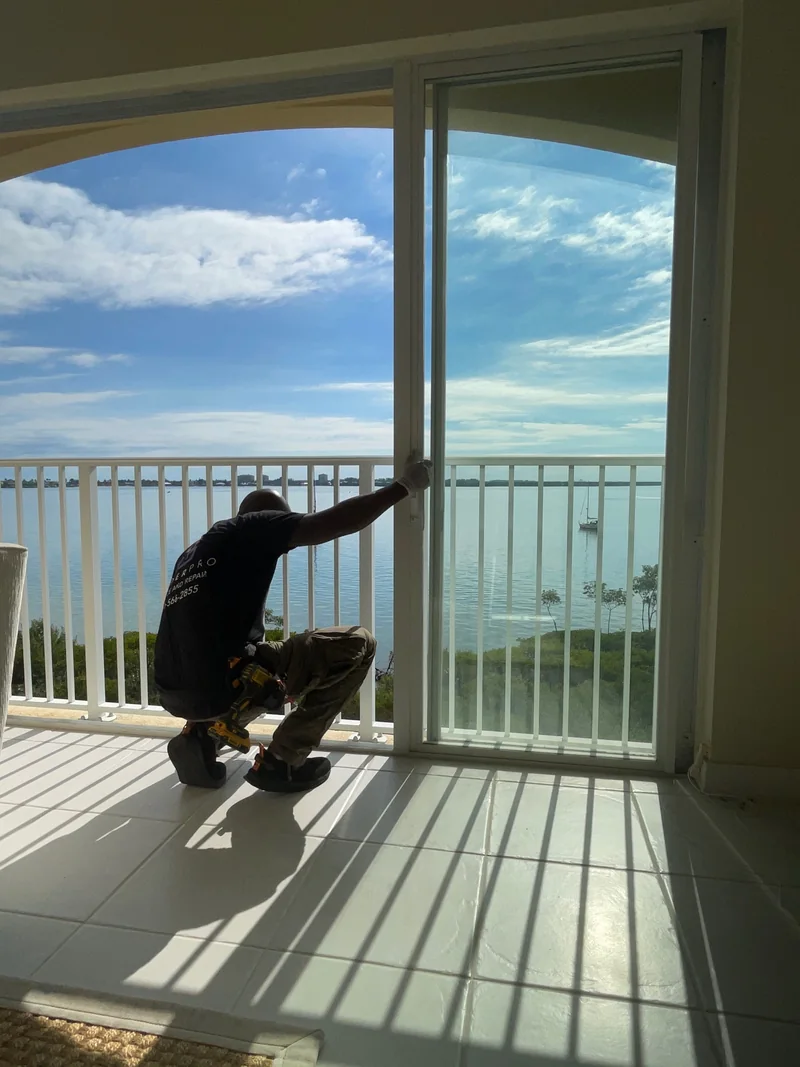
Photographed on site by the technician who did the work.


Impact Window Glass Replacement — your questions
Can a cracked impact window be repaired, or does the whole window need replacing?
In most cases the glass unit alone is replaced inside the existing frame. If the frame is straight, sound and watertight, there is no reason to remove it. A cracked pane in a good frame is a glazing job.
My impact window cracked but didn't shatter. Is that normal?
That is the product working correctly. Impact glass is laminated — panes bonded to a resilient interlayer — so when it fractures the pieces stay bonded in place and the building envelope stays closed. Glass that exits the frame is what non-impact glazing does.
Is a cracked impact window an emergency?
Usually not in the way a shattered slider is, because there is no open hole and no glass on the floor. It is still a compromised pane with a probably-broken seal and should be replaced, but you are not exposed while you arrange it.
What does low-E glass actually do?
Low-E, or low emissivity, is a microscopically thin metallic coating that reflects infrared energy while passing visible light. It reduces solar heat gain, stabilises interior temperatures and cuts ultraviolet transmission that fades flooring and furniture — without the glass looking dark.
Why is there fog or moisture between my window panes?
The seal on the insulated unit has failed, letting humid air into the sealed cavity where it condenses. It cannot be cleaned because the moisture is on interior surfaces. The fix is a new sealed unit in the existing frame.
Can you match my existing grid or muntin pattern?
Yes, and it matters. On most modern units the grid sits inside the sealed cavity and is built into the unit, so bar width, colour and layout have to be specified in the order. A grid that is slightly off reads as a mismatch from the street.
Should I upgrade to a better glass unit when replacing just one pane?
Usually not. A single window with a different coating, tint or thickness looks mismatched from outside and behaves differently from inside. Matching the existing stack keeps the elevation consistent and the room performing like the rest of the house.
Will a replacement unit still be hurricane rated?
It should be specified to match what was there. That is exactly why we identify the existing stack — laminated, insulated, coated, and how thick — before ordering anything, rather than fitting whatever unit is closest in size.
How long does a replacement impact glass unit take?
It is made to your sash and your grid pattern, so it is an order rather than a stock item. We give you the lead time when we quote.
How much does impact window glass replacement cost?
Repairs start at $275 and every repair carries a 1–3 year warranty on parts and labor. Sealed impact units are priced on the unit because they are built to your specific sash and grid, so the figure comes after measuring.
Do you replace impact glass in sliding glass doors as well as windows?
Yes. Sliding glass door panels are the larger part of our work, and the same principles apply — laminated and insulated panels are replaced within the existing door frame wherever the frame and rollers are sound.
Which areas do you cover for impact glass work?
Port St. Lucie, Fort Pierce, Stuart, Jensen Beach, Palm City, Hobe Sound, Port Salerno, Vero Beach, Jupiter and Palm Beach Gardens.

The other job people are told to replace
A curved transom matched to a 37-inch radius and re-glazed into the original stucco arch, with radial muntins struck from the same centre.
Send us the opening.
A photo and a rough measurement is enough to tell you whether this is a glass job or a window job. Free consultation, honest answer.