Short answer: Before June 1, make sure every slider closes square and locks positively, clear the track and prove the weep holes drain, check the panel doesn't rack in its frame, run your shutters, and add a secondary lock. Before landfall, lock every door, photograph each one, then leave them shut. After any storm, even one that missed, rinse the salt and sand out of the tracks with fresh water.
June 1 arrives every year, and every year the Treasure Coast spends it thinking about plywood, generators, and water jugs. Here's what rarely makes the list: the sliding glass doors that are, square foot for square foot, the largest openings in your home's protective envelope. When the National Hurricane Center starts drawing cones toward Florida, a slider that doesn't close fully, doesn't lock positively, or wobbles in its track becomes a genuine vulnerability — and one you can't fix with a storm 48 hours out.
Here's the preparation checklist we walk through on our own homes, in the order that matters. (For the official all-hazards preparation picture, NOAA's hurricane preparedness guidance is the authoritative starting point — this checklist covers the doors specifically.)
1. Confirm the door closes and locks — completely
Wind load and wind-driven rain exploit gaps. A door riding on worn rollers sits low and out of square, which opens daylight around the frame and — critically — lets the latch miss its keeper. A door that doesn't positively lock isn't just a security issue in a storm; an unlatched slider can be worked open by gusting pressure differentials, and once wind enters a home, roof damage risk rises dramatically.
The test takes ten seconds: close the door normally, lock it, then try to lift the panel and pull it open. Movement, rattle, or a latch that needs the door "jiggled" to catch means the door needs alignment or roller work — in June, when it's a routine appointment, not in the week a storm is named.
2. Clear the tracks and weep holes
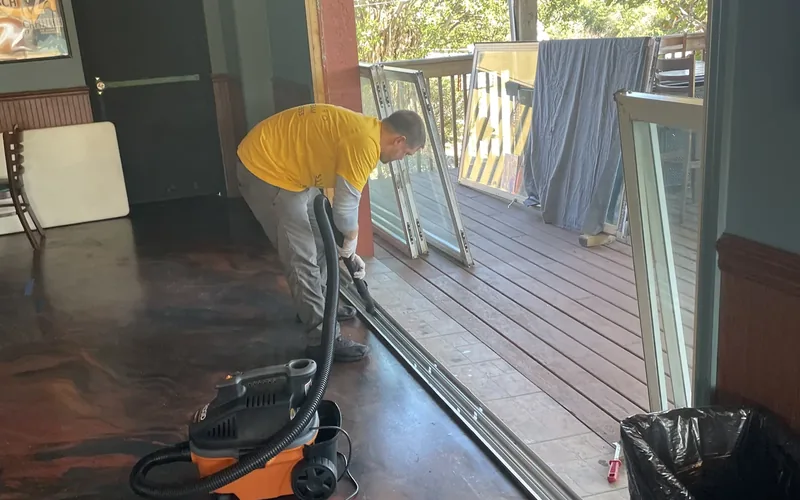
The small slots on the exterior track face are weep holes — the drainage path that lets wind-driven rain escape outward instead of pooling and overtopping into your home. Years of sand and debris block them silently. Vacuum the track, then verify each weep hole is clear (a pipe cleaner works). During a tropical downpour, functioning weeps are the difference between a wet track doing its job and water sheeting over the sill into the living room.
3. Check the panel for movement in the frame
Grip the closed panel's handle side and rack it gently — it should feel solid. Wobble usually means worn rollers or loose head-track guides, and a loose panel in a frame is exactly what you don't want absorbing gust loads for six hours. This is a hardware fix, not a storm-week improvisation.
4. Know your protection plan — shutters, impact glass, or neither
If you have accordion or panel shutters over the sliders, run them now: coastal shutter hardware corrodes on the same salt clock as door rollers, and a shutter that won't deploy is discovered at the worst possible moment. If you have impact glass, understand what it is — a system designed to fail safely without breaching, not to emerge unscathed; it still wants the door locked and seated correctly to perform as tested. And if you have neither, your slider is ordinary glass facing whatever the season brings — worth an honest conversation about protection options before you need them. The Federal Alliance for Safe Homes (FLASH) publishes excellent homeowner guidance on opening protection.
5. Reinforce the "lift and slide" weakness
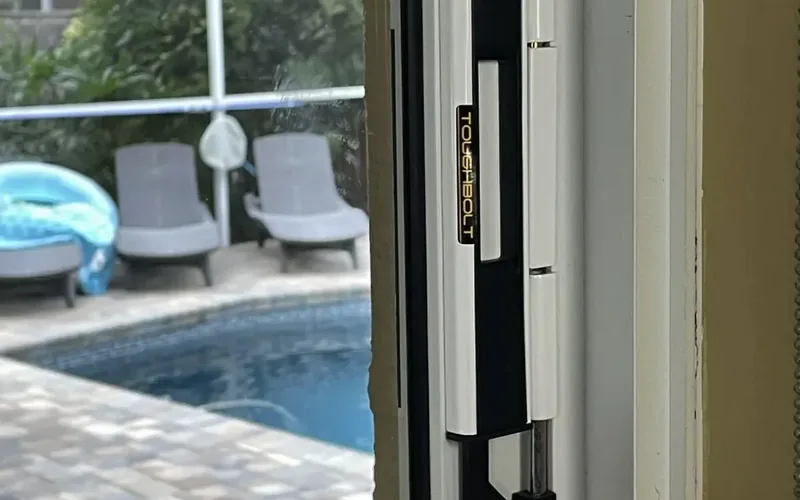
Storm season is also looting season, uncomfortable as that is. Evacuated neighborhoods get tested, and the sliding door's factory latch remains the easiest entry in most homes. A deadbolt-style slider lock anchors the panel to the frame against both prying hands and pressure — one hardware upgrade serving security and storm-worthiness at once.
After the storm: the salt flush
Whether the storm hit or brushed past, its winds carried enormous quantities of salt spray and fine sand far inland — and packed them into every door track on the coast. What we see every post-storm season: doors that survived the wind fine, then degrade rapidly over the following months as storm-deposited salt eats the bearings.
The fix costs nothing: once conditions clear, rinse tracks with fresh water, wipe them dry, and run the door a few times. If the door came through with new grinding, shuddering, or drag it didn't have before, that's storm grit in the hardware — worth a service visit before it grinds anything permanent.
The June appointment beats the October emergency
Every item above is either free or a routine repair in the calm months. The same items in an active-storm week range from stressful to impossible — parts get scarce, schedules jam, and a door problem you knew about in June becomes the thing you're bracing with a broomstick in October. If your sliders failed any test on this list, get them looked at now, while "now" is easy.
How does storm water actually get in through a door track?
Most storm damage to a slider is not the glass. It is water on the floor, and it arrives by a route that surprises people.
A sliding door sill is not a dam. It is a drainage system. Rain that hits the glass runs down into the outer track, and the track is designed to carry it sideways to small slots on the exterior face called weep holes, which let it drain back outside. In ordinary rain, that works quietly and you never think about it.
A hurricane changes two variables at once. The volume of water arriving is far higher than the track was sized for, and the wind is pushing on it. Wind-driven rain does not fall into the track, it is fired at it horizontally, and sustained pressure on the outside face means water is being pushed inward at the same time gravity is trying to send it out through the weeps.
Now block the weeps with years of sand, lawn clippings and salt crust — which is the normal condition of a Florida track nobody has vacuumed — and the outer channel fills. Once the water level in that channel reaches the inner track, it stops being drainage and becomes a reservoir sitting against your floor. It overtops the sill and runs inside, and the homeowner concludes the door leaked. The door did not leak. Its drainage was full.
That is why weep-hole clearance is a genuine storm-prep item and not a housekeeping detail. Our track cleaning routine covers the whole sequence, weeps included.
Which seals and sweeps can you test by hand?
You do not need instruments for this. Do it on a bright day with the door closed and locked, and work around the perimeter.
- The light test. Stand inside, lights off, and look along the interlock where the two panels meet and along the head and jamb. Continuous daylight is a gap, and a gap that lets light through lets wind-driven rain through.
- The paper test. Close the door on a sheet of paper at three heights on the latch side. If it slides out with no drag at one height and grips at another, the panel is not meeting the frame evenly, which usually means the panel has dropped rather than that the seal has failed.
- The bottom sweep. Look at the brush or fin along the bottom edge of the panel. Florida sun turns the backing brittle and the bristles get crushed flat and stay flat. A sweep that no longer touches the sill is doing nothing.
- The finger test on the weatherstrip. Press the pile or bulb seal in the jamb. It should spring back. If it stays compressed, or crumbles into a chalky powder on your fingertip, it is finished.
Seals and sweeps are the cheapest components on a slider and among the most commonly ignored. They are also worth replacing in a calm week rather than a named one, since a brittle seal is not a part anyone keeps on the shelf during a rush.
What should you do in the last 30 minutes before landfall?
By this point the repairs are behind you. What is left is a short sequence, and it is worth writing down before the day arrives.
- Deploy the protection you have. Close and pin accordion shutters, or fit panels, and confirm every latch is engaged rather than looking engaged.
- Close and lock every slider, including the ones behind shutters. A locked panel is seated into its frame and carries wind load as a system. An unlocked one is a loose sheet of glass that can be worked open by pressure alone.
- Engage the secondary lock and the track block. They are pressure resistance as much as security hardware.
- Clear the track one last time. Ten seconds with a vacuum or a brush, because whatever is in there is about to be underwater.
- Lay old towels along the inside sill. Not as a barrier — they will not stop a real overtop — but because they buy you time to notice water before it reaches carpet or wood.
- Move furniture off the sill line and lift anything of value off the floor within a couple of feet of the door.
- Take your photographs. See the next section.
Then leave the doors alone. Opening an interior slider mid-storm to check on the lanai is how pressure gets into a house, and pressure inside a house is what lifts roofs.
What should you photograph before you touch anything?
This is documentation, not claims advice, and we are not the people to tell you what any policy covers. What we can tell you is what people wish they had photographed, because we hear about it every season.
Before the storm, take a short set of pictures of each slider in daylight: the full door from inside, the full door from outside, the track, and any shutter or panel in its deployed position. Timestamped images of an intact, functioning door are the baseline that everything afterwards gets compared against, and they take four minutes.
After the storm, photograph before you clean, before you dry and before you move anything. Water lines on the floor and the sill. Debris where it landed. The track with whatever is in it still in it. Any cracked, chipped or displaced glass, from far enough back to show which opening it is and close enough to show the damage. Standing water outside the door as well as inside, because where the water was outside often explains how it got in.
Then wait for your own photographs to be safely off the phone before you start the cleanup. Once a track is vacuumed and a floor is dried, the evidence of what happened is gone, and a repair visit two weeks later can only tell you what the door is like now.
Take the pictures, then get the salt out. The next section covers that.
What may you do to a condo or HOA balcony slider?
Storm prep on a balcony door runs into association rules faster than anything else on this list, and the time to find out is June rather than the day a cone appears.
Three questions decide most of it. Who is responsible for the door, which in Florida buildings usually splits the glass and outer frame from the operating hardware. What may be attached to it, which is normally governed by uniform-appearance and frame-penetration rules. And who deploys the building's protection, which in many towers is a staff task on a schedule rather than something an owner does from inside the unit.
Practical consequences worth knowing now:
- Owner-side hardware — rollers, latch, keeper, track cleaning, weep clearance — is generally yours to maintain and you do not need to wait for anybody to have it serviced.
- Shutters and any exterior-mounted protection usually are not yours to add, change or improvise on.
- Interior track locks and inside-face secondary locks are commonly acceptable; anything drilled through the exterior frame commonly is not.
- Balcony furniture and planters are almost always covered by a written pre-storm rule, and they are also the debris that breaks your neighbor's glass.
Ask the manager by email in the calm season and keep the reply. Our guide to who pays for a condo slider sets out the vocabulary and the order in which to ask.
How do you prep a slider on a house nobody will be in?
Seasonal owners leave in May and the storms arrive in August, which means the doors have to be storm-ready with nobody there to react.
Before you fly out: clear every track and prove every weep hole drains, because that is the failure that floods an empty house for hours before anyone notices. Close and lock every panel, engage secondary locks, and confirm each door latches without being lifted. Run the shutters through a full cycle so you learn now, not in October, that coastal shutter hardware has corroded on the same salt clock as everything else. Move lanai and balcony furniture inside. Photograph each door.
Then deal with the seize-up, which is the specifically Florida problem. A door left locked and unmoved through five humid months corrodes faster than one used daily, because motion is what wipes the brine film off the bearing surfaces. Nothing moves, so the film sits and works all summer. That is why so many returning owners find a door that will not slide in November, having left a door that slid fine in May.
The circuit that prevents it: ask whoever checks the property to cycle each slider fully both ways, once a month, then lock it again. It takes a minute per door and it is the single highest-value thing a house-checker can do.
Booking the service check before you return beats booking it after you land. Same-day service is available, but October is a calmer week than the one you arrive in. See maintenance service.