Orlando sliding doors and coastal sliding doors break down for different reasons. On the coast, salt is the main enemy: it corrodes roller bearings, screws and lock parts from the inside. Inland, salt mostly drops out of the picture, and the wear comes from sun on seals and vinyl, heavy afternoon storms at the sill, constant use on pool and lanai doors, and the age of the house. If you own a door in both places, or you've just moved from one to the other, the advice you got there may not fit here.
Our Orlando sliding door repair page already covers what collects in an inland track and why the lanai door wears first. This guide is the side-by-side: what's different about inland wear, what's different on the coast, and how to read your own door.
How sliding doors wear in inland Orlando compared with coastal Florida
| Factor | Inland Orlando area | Coastal (Treasure Coast, Space Coast) |
|---|
| Main wear driver | Abrasion, sun and heavy use | Salt corrosion |
| How failure shows up | Door gets heavier slowly over years | Door can go from fine to stuck once a bearing seizes |
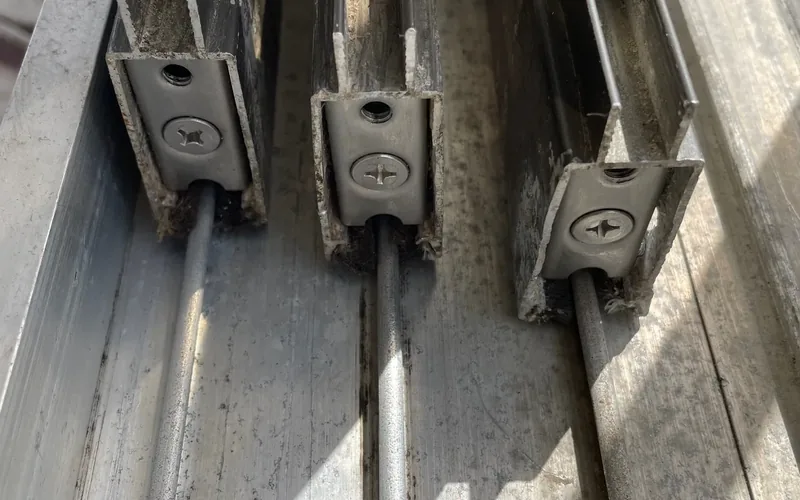
| Rollers | Wheels wear flat; bearings usually still turn | Bearings rust and lock up |
| Screws, locks, latches | Mostly mechanical wear and misalignment | Steel parts corrode, often seize in place |
| Weatherstrip and seals | Sun-baked, flattened, cracked | Same sun damage, plus salt crust |
| Water at the sill | Short, intense afternoon storms; clogged weep holes | Same, plus longer tropical rain events from the ocean side |
| Screens | UV-faded mesh, pet and traffic damage | UV plus corroded frames and splines |
| Habit that helps most | Keep tracks dry-clean and seals checked | Rinse salt off and service hardware yearly |
Why don't Orlando sliding doors corrode like coastal ones?
Because corrosion needs an electrolyte, and on the coast that's a salt film deposited from the air. Salt aerosol from breaking surf settles heaviest near the shore and thins out with distance inland, so an Orlando roller bearing sees mostly fresh water and dust instead of a standing salty film.
Salt is hygroscopic. It pulls moisture out of humid air and holds a thin, conductive layer of brine against metal. On a door near the ocean or the Indian River Lagoon, that brine sits inside steel roller bearings, around steel screws in aluminum frames and in lock mechanisms, and it keeps working on them between rains. A door in Orlando still gets wet constantly, but plain rainwater evaporates and leaves little behind.
That's why an Orlando roller we pull out is usually worn rather than rusted: the wheel is flat or grooved, but the bearing still spins. On a beachside door the wheel may look fine while the bearing is frozen solid. Different cause, and it changes what we check first.
What does Central Florida sun do to weatherstripping and vinyl?
It breaks them down slowly, and inland it's often the first thing to go. Ultraviolet light breaks the long polymer chains in rubber, vinyl and the plastic backing of pile weatherstrip. The material loses its spring. Pile weatherstrip (the fuzzy strip along the interlock and jambs) flattens and stops brushing the glass. Rubber gaskets harden, shrink and crack at the corners. Vinyl parts, from bumpers to roller housings, turn brittle and chalky.
Heat adds to it. A door frame on an unshaded west wall can get far hotter than the air in the afternoon, and every heating and cooling cycle works the seals a little more. Coastal doors get the same sun, but salt usually takes out their hardware first, so sun damage gets less attention there. In Orlando, with the hardware lasting longer, it's often the seals that decide when a door starts letting in hot air, water and bugs.
The sign to look for: daylight or a draft at the interlock where the panels meet, or weatherstrip that crumbles when you press it with a fingernail. Our guide to sliding door seals and weatherstripping covers which seal does which job and what replacing them involves.
Why does water come in at the sill during an afternoon storm?
Because a short, violent storm delivers more water and wind than a door track can drain at once. Wind piles water against the glass and pushes it across the sill, and if the weep holes are partly clogged, the track fills and spills inside.
Central Florida gets a lot of these storms. The Florida Climate Center notes that Central Florida's frequency of summer thunderstorms equals that of the world's maximum thunderstorm areas. Many of them arrive with a gust front: a sudden push of wind ahead of the rain that drives water sideways, straight at the door.
A slider manages water with a sill dam and a track that drains through weep holes to the outside. That works for steady rain. A downpour with gusts can overwhelm it, and the weak point inland is usually the weep holes, which get choked with the sand and pollen mix that builds up in Orlando tracks. On a lanai, a deck that slopes even slightly toward the house makes it worse by sending runoff to the door.
On the coast, the same storms happen, plus longer tropical rain from systems coming off the ocean, so sills take a sustained beating as well as short bursts. Either way, the fixes overlap: clear weep holes, sound sill and interlock seals, and correct panel height so the bottom seals actually touch. Our guide to why sliding glass doors leak walks through the checks.
One inland detail worth checking: pavers. Plenty of Orlando lanais get re-surfaced with pavers or a raised deck coating years after the house was built, and each layer lifts the deck closer to the door sill. When the deck ends up level with the bottom of the track, there's no step left to stop water, and storm runoff rolls straight into the track. If your door started leaking after a lanai remodel, that's the first place to look. A door repair can't fully undo it, but clear weep holes, a sound sill seal and correct panel height buy back a good margin.
Does a saltwater pool corrode a sliding door the way the ocean does?
Not as fast, but it isn't harmless, and it's the one way salt reaches an Orlando door. Saltwater pools are much less salty than seawater. The catch is evaporation: splash and drips that dry on a track or roller leave their salt behind, and repeated splashing builds it up. A pool door that gets splashed every day and never rinsed can develop the same white crust and stiff hardware we see near the beach, just more slowly.
Chlorinated water and pool chemicals add their own wear on rubber seals. If your lanai door opens straight onto the pool deck, give the track a fresh-water wipe after heavy pool days, and treat its hardware more like a coastal door's.
What's different about a slider inside a pool enclosure or screen room?
The enclosure helps and hurts. The screen cage blocks some wind-driven debris and takes the edge off direct rain, so the door itself sees a bit less weather. But the cage also holds in heat and humidity, and the door sits on a deck that collects pool water, sand and pollen right at its sill.
Pool doors carry one more requirement. Florida's pool safety law requires new residential pools to have at least one safety feature to pass final inspection, and one of the options in section 515.27 is that every door giving direct access from the home to the pool has an exit alarm, or a self-closing, self-latching device with its release at least 54 inches above the floor. If your pool door has a door alarm or a high-mounted latch, keep it working: a misaligned panel that won't fully close defeats both. A latch that doesn't catch is usually an alignment problem rather than a broken lock, which our lock and latch service handles.
Many enclosures also have a separate screen door to the yard. That's a hinged screen door, not a slider, and its mesh takes UV, pets and traffic. Torn screen panels on the slider itself are a quick fix with screen fabric replacement.
What does an older Orlando house tell you about its sliders?
A lot, before we even arrive. Greater Orlando has large neighborhoods built from the 1970s through the 1990s, along with newer subdivisions that keep spreading outward. The doors that came with each era wear differently.
- Older homes often have single-pane aluminum sliders with no thermal break, steel rollers and simple hook latches. The frames are usually sound. The hardware has decades of wear, the original roller design may be discontinued, and the house may have settled enough that the opening is slightly out of square. These doors are usually repairable with the right parts and adjustment.
- Newer homes are more likely to have dual-pane, low solar gain glass in a heavier panel. Heavier glass means more load on the rollers, so builder-grade rollers can wear out sooner than you'd expect on a newer door.
- Homes with replaced doors can have almost anything, so identifying the brand and series matters for parts. The brand name is often stamped on the frame or printed on a label inside the jamb, and finding it saves a lot of guesswork.
Coastal towns have their own build-era patterns, covered city by city on our Port St. Lucie and Stuart pages.
What wears out first on a coastal door in Stuart, Port St. Lucie or Cocoa Beach?
The hardware that salt can reach. In order, it's usually roller bearings, then steel screws where they meet the aluminum frame, then lock and latch mechanisms. Weatherstrip still suffers from the sun, but it's rarely the first failure. Closer to the water the clock runs faster. Our Cocoa Beach page covers why oceanfront condo doors there wear quickest, and our guide to Space Coast sliding doors goes through Brevard's barrier island and lagoon-side differences.
Beach sand plays a part too, but in a different way from inland grit. It arrives already carrying salt, so a coastal track grinds and corrodes at once: the wheel wears while the bearing rusts, and the track surface pits as well as scuffs. That combination is why coastal doors so often need roller replacement with stainless, sealed-bearing parts rather than whatever came with the door.
How should you care for doors if you own homes in both places?
Plenty of Central Floridians keep a beach condo, and plenty of coastal owners have an Orlando rental. Treat the two doors differently:
- Coastal door: rinse the track and hardware with fresh water every few weeks and after storms, keep the door moving instead of letting it sit locked for months, and have the hardware serviced yearly.
- Inland door: vacuum the track dry before any water touches it, check the weep holes before storm season starts, and look at the weatherstrip every spring for flattening and cracks.
- Timing: hurricane season runs June 1 to November 30, and the afternoon storm pattern builds through late spring. A May check on weep holes and seals covers both homes before the wet months.
- Both: no oil sprays in the track, and if a door gets harder to slide, deal with it before the rollers grind into the track. Our track cleaning guide covers both versions.
If you'd rather hand it off, our maintenance visits cover every slider in the house in one trip, coastal or inland. Repairs start at $275 including parts, labor and a written 1 to 3 year warranty. We work from the Palm Beaches north through the Treasure Coast and the Space Coast to Orlando, so you can contact us about both properties at once.