A sliding glass door leaks when the water that's supposed to drain out of its sill can't, or when water gets around the door through the wall. Clogged weep holes, wind pressure pushing water over the inside sill dam, and a panel sagging on worn rollers are door problems. Failed caulk between the frame and the wall, or a missing or broken sill pan underneath, are building problems. Finding out which one you have saves you from paying the wrong trade.
Why is my sliding glass door leaking from the bottom?
Because the sill filled faster than it drained, or wind pushed the water in the sill higher than the dam on the inside edge. Most sliders are built to take water in and send it back out, so a bottom leak means that drainage system is clogged, damaged or overpowered.
FEMA puts it plainly in its review of Hurricane Ian damage: most sliding doors are "contain and drain" products. They let water into an integral sill pan and drain it to the outside, and the sill has a raised riser, or dam, on the interior side. FEMA notes that the taller the riser, the better the water resistance, and that some homeowners remove the riser as a trip hazard, leaving the door with little resistance to water (FEMA Hurricane Ian Recovery Advisory 3).
So a bottom leak has a short list of suspects:
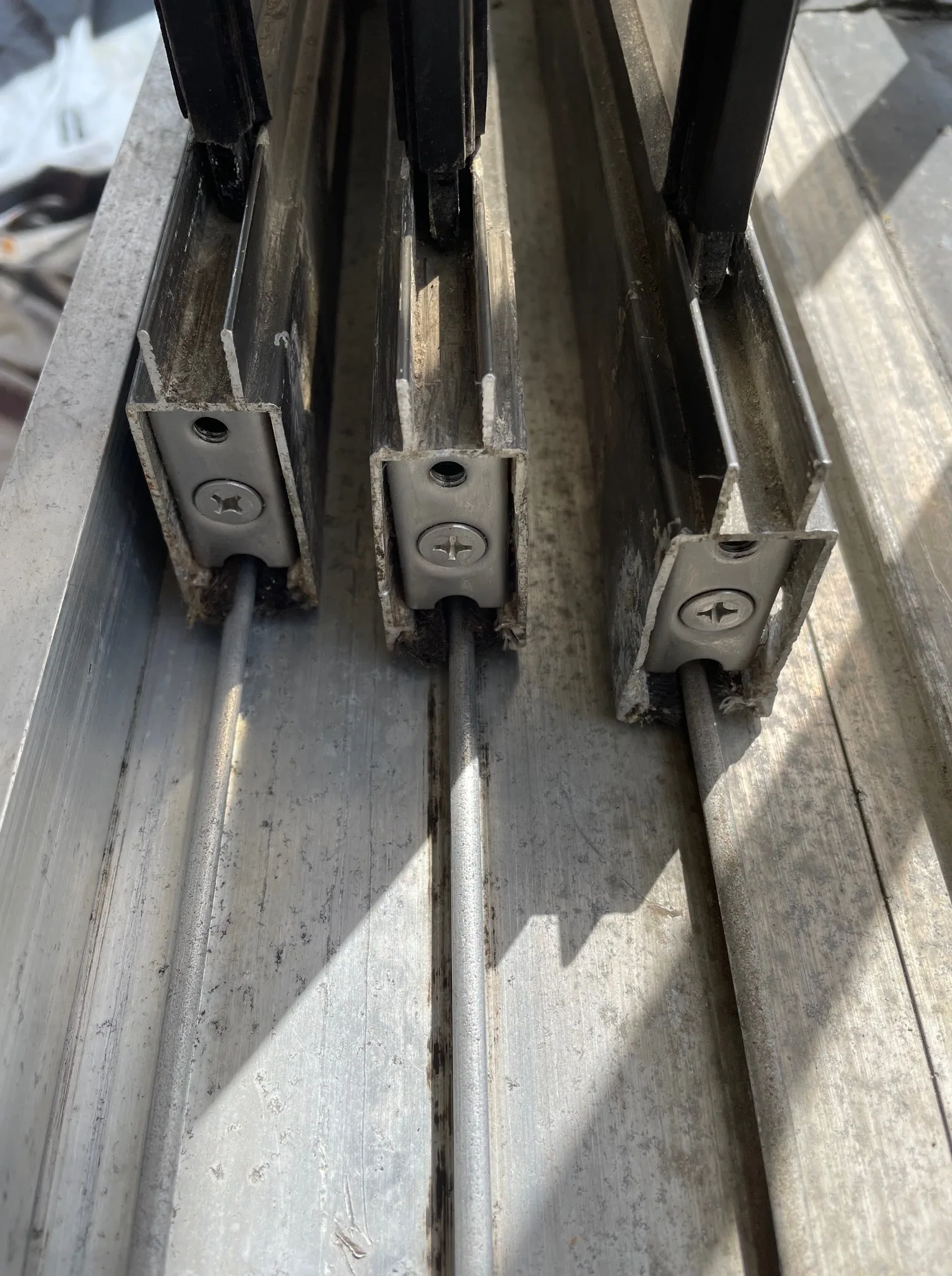
- Weep holes blocked with sand, salt crust, leaves, a pet-door insert or caulk.
- The interior riser removed or cut down at some point.
- The sill pan's end seals failed. FEMA notes the ends of the integral sill pan have to be sealed to the jambs up to the height of the riser. When that sealant cracks, water in the sill runs out the corners and under the frame.
- The panel's bottom seals aren't touching because the panel has dropped.
- Water getting under the sill from a crack in the base or a failed sill pan, which shows up as water on the floor a few inches inside while the sill itself looks dry.
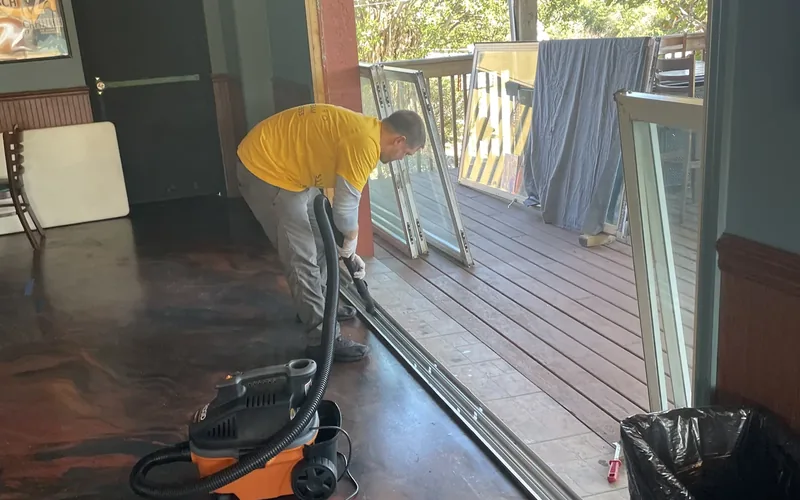
Clearing weep holes is a homeowner job, and it's step four of our track cleaning routine, so we won't repeat it. Pour a cup of water into the outer channel and watch it leave. If it doesn't, start there.
Why does my sliding door only leak when it rains hard?
Because wind pressure, not rain volume, is what pushes water over the sill dam. A gentle shower drains normally. A storm blowing straight at the glass raises the water level inside the sill until it tops the riser.
This is the part nobody explains, and it's simple physics. When wind hits the outside of the door, the air pressure outside is higher than inside your house. That pressure difference pushes on the water sitting in the sill. Water in the sill rises on the inside edge until the weight of the water column balances the push. One inch of water exerts about 5.2 pounds per square foot of pressure, so every 5.2 pounds per square foot of wind pressure difference can lift water about an inch up the inside of the sill.
Put numbers on it with FEMA's own example. FEMA explains that a door rated PG 60 is water-tested at 15 percent of its design pressure, which works out to 9 pounds per square foot. That's roughly 1.7 inches of water lift. A door rated lower is tested at a lower pressure, and a door with its riser removed has almost nothing to hold back even an ordinary afternoon squall.
That's why the same door can stay dry through a week of summer thunderstorms and leak in one tropical system, and why it leaks when the rain comes from one direction and not the other. East-facing doors on the barrier islands take the hardest wind. Hurricane season runs June 1 to November 30, according to the National Hurricane Center, but a strong afternoon cell blowing straight onto a lanai can be enough on a door with a short riser or clogged weeps.
The fixes follow from the mechanism. Keep the weeps clear so the sill empties between gusts. Don't remove the riser. Keep the panel sitting at the right height so its seals close the path at the interlock and bottom. Our hurricane season checklist covers storm-week prep.
Why is water sitting in my sliding door track?
A little water in the sill right after rain is normal. That's the sill doing its job. Water that's still there hours later means the weeps aren't draining, or the sill has a low spot.
Weep holes clog in predictable ways on Florida doors. Wind-blown sand settles in the outer channel and packs into the slots. Salt film dries into a crust that narrows them. Many weeps have small flap covers on the outside to keep wind and bugs out, and those flaps can stick shut with dirt or old paint. And sometimes someone has caulked over them, thinking they were gaps. FEMA specifically warns against covering or plugging weep holes with caulk.
A sill can also hold water if it's no longer level. If the base under it settled toward the house, water in the sill runs toward the inside instead of toward the weeps. That's a door on a base problem, and it overlaps with what we cover in sliding glass door track repair.
Why is my sliding glass door leaking from the top?
Water rarely gets through the head of a slider itself. Leaks that appear at the top, or that run down the inside of the jambs, almost always come from the wall above or around the frame:
- The frame-to-wall caulk along the head and jambs has cracked, pulled away or was never continuous.
- Head flashing above the door is missing, damaged, or tucked the wrong way, so water running down the wall is directed behind the frame instead of over it.
- Stucco cracks above the door, or a leaking window or balcony above, feed water into the wall, and the door opening is simply the first place it can come out.
- The upper interlock where the two panels meet, if the panels have dropped or the interlock seal is worn, can let wind-driven rain through at the top of the meeting edge.
Water travels. A leak at the head can run down inside the jamb and come out at the bottom corner, where it looks like a sill leak. That's why the hose test below goes from the bottom up.
Is the water coming from the door or the wall around it?
Run a hose test. It takes about half an hour, two people and a garden hose, and it beats guessing. Do it on a dry day so you start with dry surfaces.
- Close and lock the door. Put one person inside with a flashlight and dry paper towels.
- Start low. Run the hose on gentle spray at the sill only, for about five minutes. No water on the glass or the wall.
- Move up in zones. Next the bottom of the panels and the interlock, then each jamb, then the head, then the wall above the door. About five minutes per zone.
- Stop at the first sign of water inside and note which zone you were spraying.
Reading the result: water during the sill or panel zones points to the door. Water at the sill corners points to the sill pan end seals. Water during the jamb, head or wall zones, especially when it shows up inside the wall or under the baseboard, points to the frame-to-wall seal or the wall itself. A garden hose won't reproduce hurricane pressure, so a door that passes can still leak in a big storm. A door that fails is telling you something real.
Does a door sitting low on worn rollers leak more?
Yes, and it's one of the most overlooked causes. A sliding panel seals against the frame with weatherstrip along its edges and a sweep or seal along the bottom, and the two panels seal against each other at the interlock. All of that is set for a panel sitting at the right height.
When rollers wear, the panel sinks. The bottom seal flattens or stops touching where it should, the interlocks no longer line up, and a gap opens at the top of the meeting edge. You often get a door that also won't lock properly, which our alignment guide explains. The fix is new rollers set to the right height, which is a straightforward roller replacement, and then checking the seals once the panel is back where it belongs.
Is it condensation or a leak?
Check where the water is and when it shows up. A leak appears during or right after rain and comes from an edge, a corner or the sill. Condensation forms on the glass surface itself, with or without rain, and runs down to the sill.
In Florida, the glass usually sweats on the outside face, because your air conditioning cools the glass and the outdoor air is humid. That's harmless. Water on the inside face with no rain points to high indoor humidity or an AC vent blowing cold air across the glass. Moisture between the two panes of an insulated unit is neither a leak nor condensation you can wipe: the glass seal has failed, and our glass replacement page covers what happens next.
What about air leaks and drafts?
Air and water often use the same gaps, so a door that whistles in the wind is worth checking for water too. Worn pile weatherstrip, a crushed bottom sweep and a misaligned interlock are the usual sources. Drafts and seal replacement get their own detailed treatment in our guide to sliding glass door seals and weatherstripping.
Which leaks can a door repair fix, and which can't?
Sliding door leak causes and who usually fixes them
| Cause | What you'll see | Who fixes it |
|---|
| Clogged weep holes | Water standing in the sill, overflowing in storms | You, with a brush and a rinse |
| Panel dropped on worn rollers | Leaks at the interlock or bottom, door hard to lock | A sliding door repair company |
| Worn weatherstrip or bottom seals | Daylight or drafts at edges, water in strong wind | A sliding door repair company |
| Sill pan end seals cracked | Water at the bottom corners of the frame | Depends on access; often a door installer |
| Frame-to-wall caulk failed | Water at jambs or head, stains on interior wall | A window and door installer or general contractor |
| Missing or failed sill pan or flashing | Water under the floor or baseboard inside, sill looks dry | A contractor who works on the wall and opening |
| Stucco cracks or leaks above | Water appears high or inside the wall | A stucco or general contractor |
We'll be straight with you: flashing, sill pans and the wall around the opening aren't a door repair, and we don't pretend otherwise. FEMA notes the Florida Building Code requires pan flashing at the sill of exterior door openings where the manufacturer doesn't provide a detail. If that's missing or failed, the fix means opening up the area around the frame, and that's a job for someone who works on the building, not on the moving parts.
In a condo, the wall and the opening are often the association's responsibility while the door itself may be yours. Our condo and HOA guide explains how that split usually works.
What we do fix: rollers and panel height, weatherstrip and bottom seals, interlock alignment, and drainage problems inside the door itself. Repairs start at $275 including parts, labor and our written 1–3 year warranty.
If water is getting in, take photos of where it shows up inside, the sill from above, and the outside face of the sill where the weep holes are. Send them for a quote, tell us whether it happens in every rain or only in wind, and we'll tell you honestly whether it's the door or the wall.