Low-E glass carries a microscopically thin metallic coating that turns away a large share of the sun's heat while letting most of the daylight through. Clear glass lets nearly all of the heat in. Tinted glass cuts heat by darkening the view, and reflective glass cuts it by turning the outside face into a mirror. For a Florida sliding door, the number to compare is the solar heat gain coefficient, and a solar-control low-E coating is the usual way to get it low without living behind dark glass.
One thing before the comparison. If your complaint is a draft, a damp sill or a room that never cools near the door, glass may not be your problem at all. Our guide to sliding door energy efficiency shows how to find air leaks first. This page is about the glass itself.
Clear, tinted, reflective and low-E glass in a Florida sliding door
| Clear | Tinted (gray, bronze) | Reflective | Solar-control low-E |
|---|
| Sun's heat (SHGC) | Lets most of it in | Lower; the glass absorbs heat and gets hot | Low; bounces heat off the outside | Low; reflects much of the infrared |
| Daylight and view | Brightest | Darker, color-shifted | Noticeably darker | Close to clear |
| Look from outside | Plain glass | Gray or bronze | Mirror by day | Slight sheen or hue at an angle |
| At night, from inside | See out to lit areas | Slightly dim | Mirror; you see the room | Close to clear |
| Glare control | None | Good | Strong | Modest; depends on the product's VT |
| Works as a single pane? | Yes | Yes | Depends on coating | Only durable hard-coat types; most low-E sits inside a sealed unit |
| Main cost drivers | Size, tempering | Size, tint match | Coating, match | Coating type, insulated unit, size, match |
Which should you choose?
For most Florida sliders, a solar-control low-E coating in an insulated unit, with the whole door rated at an SHGC of 0.23 or lower. Shift from that only for a clear reason: a shaded opening, a condo spec, or a single pane that has to match its neighbors.
- If the slider faces west or south with no overhang: solar-control low-E, and pay attention to SHGC above everything else on the label. This is where the afternoon heat comes through.
- If it sits under a deep covered lanai or faces north: clear or a light low-E is fine. Here you care more about daylight (VT) than heat.
- If glare off a pool, canal or the ocean is the problem: low-E with a lower visible transmittance, or a light tint, or an exterior solar screen. Pure clear glass does nothing for glare.
- If you want daytime privacy from a street or walkway: reflective glass does that, as long as you accept the mirror you'll see at night.
- If you live in a condo: the association likely dictates the tint and reflectivity on the elevation. Get the spec in writing before you choose anything.
- If one pane of a matched set broke: match the others. An upgrade on one panel looks like a mistake and doesn't change the room much.
- If the door is drafty and the glass is sound: fix seals and alignment first. New glass in a door that leaks air is an expensive way to keep the draft.
What do SHGC, U-factor and VT on the NFRC label mean?
SHGC is how much of the sun's heat gets through, U-factor is how fast heat conducts through, and VT is how much daylight gets in. Lower SHGC and U-factor are better for cooling; higher VT means a brighter room.
The National Fenestration Rating Council's consumer guide to its label defines each one. Solar heat gain coefficient runs from 0 to 1: low numbers resist solar heat, high numbers let it in. U-factor measures how well the product keeps heat from passing through, and the lower the number, the better. Visible transmittance also runs from 0 to 1, and the higher it is, the more natural light comes in. The label also lists air leakage and, on some products, condensation resistance.
Two things trip people up when they read a label. First, the ratings describe the whole product, frame included, not just the glass, so a glass-only quote and a whole-door label aren't measuring the same thing. Second, SHGC and VT pull against each other. Push SHGC down with dark tint and VT drops with it. The trick of a good low-E coating is lowering SHGC while keeping VT reasonably high, so the room stays cool without looking dim.
Why does Florida care more about SHGC than U-factor?
Because in a cooling climate the sun pouring through the glass is a bigger load than heat conducting through it. A low SHGC attacks the bigger problem.
Think about a July afternoon. Inside, you keep the house somewhere in the mid-70s. Outside it's in the low 90s. That gap is real, and it pushes heat through the glass by conduction, which is what U-factor measures. But the sun striking a west-facing slider is a far larger flow of energy, landing on the floor and furniture as radiant heat. A lower U-factor slows the first. Only a lower SHGC, or shade, stops the second.
The ENERGY STAR program reflects this. Its key product criteria include a separate table for doors, and for doors that are more than half glass, which covers sliders, the southern zones call for a U-factor of 0.28 or lower and an SHGC of 0.23 or lower. On ENERGY STAR's climate map, all of Florida falls in the Southern zone. A northern-zone door of the same type is allowed an SHGC up to 0.40, because up north some winter sun is welcome.
That 0.23 is a useful benchmark when you compare products, even if you never buy an ENERGY STAR model. A door rated well above it will let noticeably more afternoon heat in.
Is low-E the same as double pane?
No. Double pane means two sheets of glass with a sealed air or gas space between them, which mainly cuts conducted heat. Low-E is a coating on one of the glass surfaces, which mainly cuts radiant heat. They solve different halves of the problem, and most modern doors use both.
Here's how they work together. In an insulated unit, the most common solar-control layout puts the low-E coating on the inner face of the outer pane, inside the sealed space. Sunlight hits the outer pane, the coating reflects much of the infrared back out, and the air space keeps whatever heat the outer pane absorbs from conducting straight into the room.
So "low-E vs double pane" isn't really an either-or. A double-pane clear unit has a better U-factor than single pane but still lets plenty of solar heat in. A single pane with low-E can cut solar heat but conducts more. In Florida, if you can only change one thing on an unshaded opening, the coating usually does more than the second pane. We compare the pane count question on its own in single vs double pane sliding glass doors.
One more practical difference: a double-pane unit has a seal that can eventually fail. When it does, the unit fogs between the panes and loses some of its performance. Our guide to a foggy sliding glass door with a broken seal covers what that means and what fixes it.
Low-E vs tinted glass: which keeps a room cooler?
At the same darkness, low-E. Tint cuts heat mostly by absorbing it and dimming the view. Solar-control low-E reflects heat while passing most visible light, so you get a cooler room without the gloom.
The U.S. Department of Energy's Federal Energy Management Program puts it plainly in its guidance on buying efficient windows and doors: low-e coatings, especially spectrally selective ones, are effective at reducing summer heat gain without significantly affecting visible light or color, while tinted windows reduce solar heat gain but transmit less visible light. The same page says tinting is not recommended for homes because it reduces your ability to see clearly through the glass.
There's also a mechanism people miss. Tinted glass absorbs the sun's energy, so the glass itself gets hot. Some of that heat then radiates and convects into the room from a warm pane. A low-E coating turns much of the infrared away before the glass soaks it up. Stand near a tinted slider at 4 p.m. and near a good low-E slider at the same hour, and the low-E pane usually feels cooler to the hand.
Tint still has a place. Bronze and gray glass are common on older Florida homes and condos, and if the rest of your house is bronze, a clear replacement pane will stick out. Many low-E products also come on tinted glass when an association wants both the look and the performance.
What about reflective glass and glare?
Reflective glass has a metallic coating dense enough to act like a one-way mirror in daylight. It's very good at stopping heat and glare, and good for privacy, because people outside see their own reflection. It's also the darkest option for daylight, and the mirror flips at night: with lights on inside, you see the room reflected and the outside disappears.
Glare is a separate problem from heat. It's about brightness and contrast, and on the water it can be fierce off a canal or a white pool deck. Lowering VT is what cuts glare, so a product with a moderately lower VT, a light tint, or an exterior screen helps more than a high-VT low-E coating does. If glare is your main complaint, say so when you get quotes. Many people buy the coolest glass on the market and are surprised the room is just as bright.
Before choosing reflective, check two things: your association's rules on reflectivity, which are common on oceanfront buildings, and whether your neighbors will be looking at a mirror that bounces the afternoon sun into their windows.
Can you switch to low-E when replacing one broken pane?
Often, but think twice. A low-E pane next to clear panes looks different in color and reflection, and the frame's glazing pocket has to accept the new glass. In a condo, the association may decide for you.
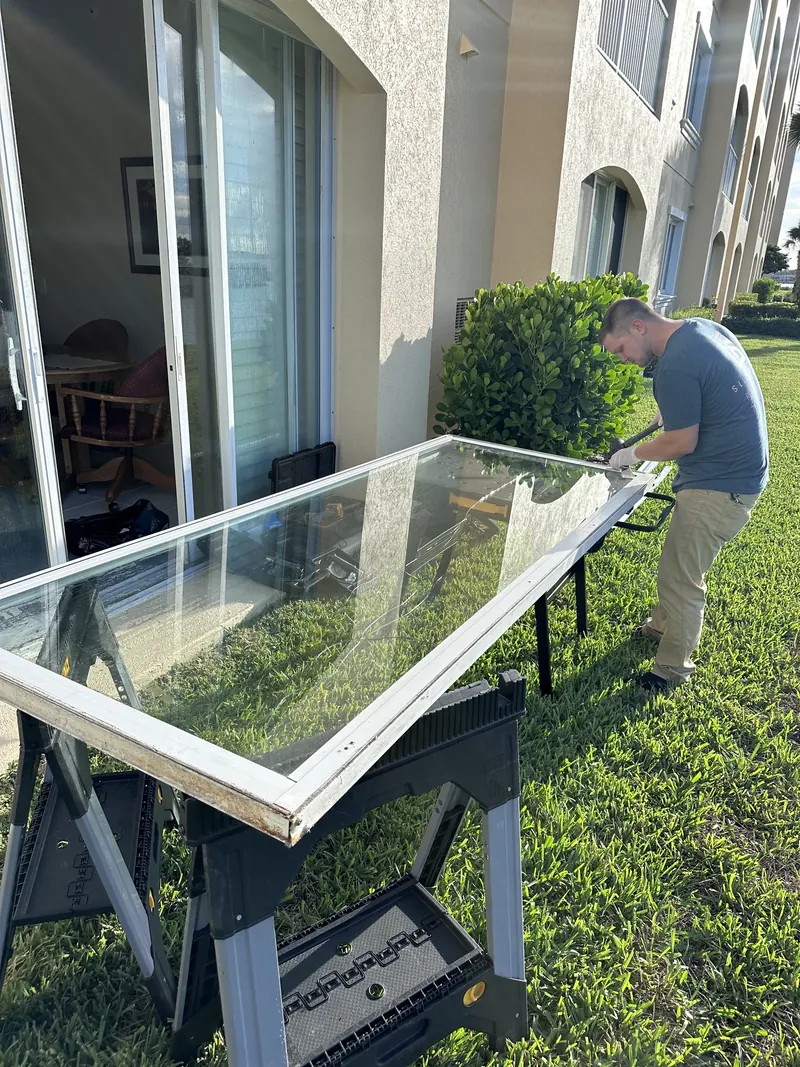
When one pane of a slider breaks, the door is otherwise sound, and replacing that pane in the existing frame is usually the right repair. Our sliding door glass replacement service does exactly that. The question is whether the new pane should be an upgrade.
- Appearance. Low-E glass has a faint hue and a different reflection at an angle. Next to clear or bronze panels on the same door, it can read as a mismatch from the yard.
- Fit. Most low-E coatings sit inside a sealed insulated unit, which is thicker than a single pane. A frame built for single glass may not have the pocket depth for it. Durable hard-coat low-E can go on a single pane, but it generally gives less solar control than the coatings sealed inside a unit.
- Safety glazing still applies. Whatever coating you choose, sliding door glass still has to be safety glass. We cover that rule in tempered vs laminated vs impact glass.
- Impact units. On an impact door the replacement has to match the tested makeup. Our impact glass replacement work replaces the sealed low-E unit inside the original frame.
- Payoff. One upgraded pane out of two or four changes a room less than you'd hope. If performance is the goal, plan the whole door, not one panel.
What drives the cost of low-E compared with clear glass?
We won't put a number on it, because size, makeup and supplier move the price more than the coating alone. The drivers are these:
- Coating type. Basic low-E, spectrally selective, and multi-layer coatings step up in price and in solar control.
- Insulated unit. A sealed two-pane unit with a spacer, and sometimes a gas fill, costs more than a single pane.
- Safety and impact makeup. Tempering or laminating the coated glass, and matching an impact approval, adds cost.
- Tint and color matching. Matching an existing bronze or gray door, or an association spec, limits the choices.
- Size and access. Large panels, unusual sizes and high balconies take more time and hands.
- Pane only or whole door. A glass swap is one price. A new door with a rated label is a different purchase with frame, installation and permit costs.
Does low-E glass stop furniture and floors from fading?
It slows fading. It doesn't stop it. Most low-E coatings cut a good share of the ultraviolet that drives fading, but visible light and heat fade fabrics, rugs and wood too, and a coating that lets daylight in lets some of that through. Laminated glass blocks more UV through its interlayer. Closing blinds during the hours the sun hits the floor, or shading the opening outside, does the rest.
If you're not sure what's in your slider now, look at the etched mark in a glass corner and any surviving label on the frame, then send us photos of the door, the mark and the break. We'll tell you what the glass is and what a replacement pane can and can't change.