Impact glass and double-pane glass aren't competitors. They answer different questions. Impact glass is about keeping a hurricane's flying debris from breaking open your house. Double pane is about keeping heat out and stopping condensation. A standard double-pane slider or window gives you no protection against wind-borne debris, and a basic impact unit made from a single laminated lite doesn't insulate much better than single pane. The product most Florida coastal homes end up with is an impact insulated unit: laminated glass on one side of a sealed double-pane unit, doing both jobs.
So the real comparison has four options, not two. Here's how they line up.
Standard double pane vs impact glass vs impact insulated glass in Florida
| Factor | Standard double pane | Impact, single laminated lite | Impact insulated (laminated + double pane) |
|---|
| What it is | Two tempered or annealed panes, sealed spacer, air or gas gap | Two layers of glass bonded to a tough plastic interlayer | A sealed insulated unit with at least one laminated lite |
| Wind-borne debris | No protection; glass breaks out of the frame | Cracks but stays in the frame when the assembly is approved | Cracks but stays in the frame when the assembly is approved |
| Wind mitigation form | No protection unless covered by approved shutters | Can count as protection if the product approval is verified | Can count as protection if the product approval is verified |
| Heat and solar gain | Good; much better with low-E | Close to single pane unless coated or tinted | Best of the three when low-E is included |
| Condensation on the glass | Rare | Similar to single pane | Rare |
| Noise | Somewhat better than single pane | Noticeably better; the interlayer damps vibration | Best of the three |
| Break-in resistance | Low; tempered glass shatters fully | High; the interlayer holds | High |
| Weight on the door hardware | Moderate | Moderate to heavy | Heaviest |
Isn't impact glass already double pane?
Not always. Impact glass is laminated glass, which is two sheets bonded to a plastic interlayer with no air gap. Some impact products use one laminated lite on its own. Others build that laminated lite into a sealed double-pane unit. Only the second kind is both impact-rated and insulated.
The confusion comes from the look. A laminated lite is two sheets of glass, so from the front it can resemble double pane. Check the edge. Laminated glass is one solid sandwich with no gap and no spacer bar. An insulated unit shows a spacer strip around the perimeter with clear air between the sheets. An impact insulated unit shows both: a spacer, and on one side of it, a thicker sheet that is itself a laminate.
Laminated isn't automatically impact-rated either. A door or window only counts as impact-resistant when the whole assembly, glass, frame and anchoring together, passed the missile and pressure tests and holds a product approval. Our upcoming guide to tempered vs laminated vs impact glass goes through each type in detail.
What does impact glass do in a hurricane that double pane can't?
It keeps the opening closed after it's hit. When a piece of roof tile or a branch strikes ordinary tempered glass, the glass shatters into small pieces and falls out, and the opening is now a hole. Standard double pane is just two tempered sheets, so it fails the same way, one sheet after the other.
That hole matters more than the broken glass. Wind blowing into an opening on the windward side pressurizes the inside of the house, while the wind passing over the roof is already pulling up on it. The two loads add together. That's how one failed slider can lead to roof and wall damage far from the door, and it's why Florida treats openings as part of the structure, not just as glass.
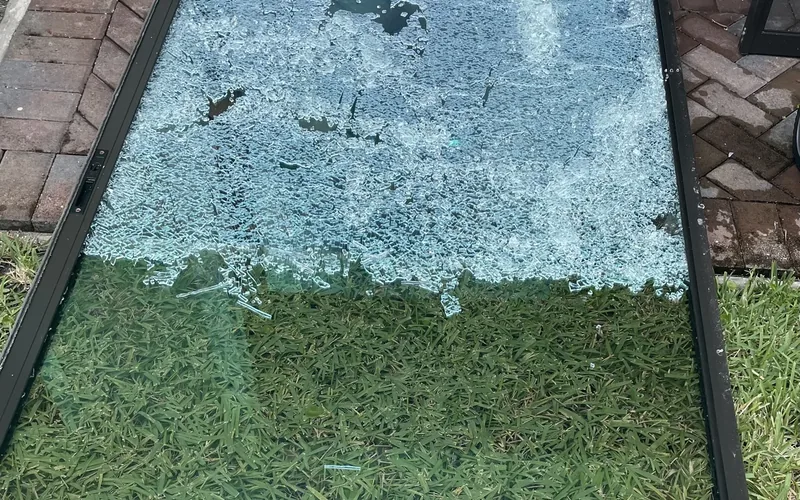
Laminated impact glass cracks on a strike, sometimes into a spider web, but the interlayer holds the pieces together and the frame holds the interlayer. The house stays closed. It still needs replacing afterward; our impact window glass replacement service covers swapping a cracked impact unit inside the existing frame.
Does a double-pane door count for wind mitigation?
No. Florida's wind mitigation form only credits openings protected by products tested and approved against wind-borne debris. Ordinary double pane isn't one of them, so a double-pane slider with no shutter counts as unprotected.
The state's Uniform Mitigation Verification Inspection Form (OIR-B1-1802) asks the inspector for the weakest form of wind-borne debris protection on the house, and it names sliding glass doors among the openings counted. The top levels require products listed in the State of Florida or Miami-Dade County product approval system and tested to specific large-missile and cyclic-pressure standards. Insulating glass isn't on that list. Double pane is an energy feature.
The practical upshot: if every other opening is impact glass and one double-pane slider has no shutter, that slider sets the rating. Our comparison of impact sliding doors vs hurricane shutters covers the form's levels and how to close that gap, so we won't repeat it here. Ask your insurance agent what your policy credits; we don't quote discounts.
How do you tell what's in your doors and windows right now?
Start with the glass edge, then the etched mark in a corner of each pane, then your paperwork. Between them you can usually tell whether an opening is plain double pane, laminated impact or an impact insulated unit, and whether anyone can prove it.
The edge tells you the make-up, as described above: a spacer means insulated, a solid sandwich means laminated, and both together means impact insulated. The corner mark tells you more. Safety glass carries a small permanent mark from the fabricator, and on laminated glass it often names the laminate. It won't always say "impact," but it gives a glass shop or inspector something to trace.
The frame is next. New doors and windows sold in Florida carry a label with the manufacturer and the design pressure ratings, and the label often shows the product approval number too. Those stickers usually get peeled off after the final inspection, so if yours are gone, look in the closing documents, the installer's invoice or the building permit for the job. Many county and city building departments let you search past permits by address, and the permit file often lists the product approval numbers used.
That proof matters for two reasons. A wind mitigation inspector needs it to credit the opening, and anyone replacing a cracked or fogged unit needs it to order glass that matches the approved make-up. Our guide to identifying a sliding door's brand and parts shows where the marks and labels hide on a slider. If you find an approval number, keep a photo of it with your insurance papers.
Does it matter where in Florida you live?
Yes. Miami-Dade and Broward counties are the High-Velocity Hurricane Zone, and a Florida Building Commission summary of the code's wind provisions describes the HVHZ as specifically those two counties. Their requirements for openings are the strictest in the state, and many products are tested to them, which is where the Miami-Dade Notice of Acceptance you see on spec sheets comes from.
The Treasure Coast, the Palm Beaches and the Space Coast are outside the HVHZ but face the same storms. Whether a new or replaced opening at your address must have impact protection depends on the code's wind-borne debris rules for your location, so ask your county or city building department before buying anything. For existing glass, the question is simpler: if you live within reach of a hurricane's wind field, and in Florida that's everyone, double pane alone leaves the opening unprotected.
Which is more energy efficient, impact glass or double pane?
Standard double pane with low-E beats a single laminated impact lite on energy. Laminated glass blocks most ultraviolet light thanks to its interlayer, but with no air gap it conducts heat much like single pane. Impact insulated glass with a low-E coating beats both, because it combines the gap, the coating and the laminate.
If you're comparing quotes, read the NFRC label numbers instead of the marketing words. ENERGY STAR's criteria for doors and windows set limits on U-factor and solar heat gain coefficient for each climate zone, and for Florida's Southern zone the solar heat gain limit is the one that does the most work. A product that's impact-rated and meets those limits is doing both jobs. Our guide to single vs double pane sliding doors explains the two numbers and the condensation side.
Which one is quieter and harder to break into?
Laminated glass wins both. The plastic interlayer damps the vibration that carries sound through glass, so impact units are generally quieter than standard double pane, and impact insulated units are quieter still. On a slider, remember that a lot of noise sneaks in around the panel through worn weatherstrip, so the glass only helps if the seals do.
For security, tempered glass in standard double pane breaks fully once it's hit hard enough, and the opening is clear. Laminated glass cracks but stays in one piece, so getting through it takes time and noise most burglars won't spend. The weak point on a slider then moves to the hardware: the latch, a panel that can be lifted off its track, a misaligned keeper. Our sliding door security guide covers those.
What does the extra weight do to a sliding door?
Impact insulated units are the heaviest glass you'll find in a residential slider: a laminated lite, a second lite and a spacer, in a frame stiff enough to pass the pressure test. All of it rides on the rollers. Heavy panels wear bearings faster, flatten undersized wheels and, when a wheel seizes, grind the track. They're also harder and riskier to lift out, which is why we don't recommend owners pull impact panels themselves.
If you already have impact sliders and they've gone heavy to push, that's usually rollers, not the glass. The fix is roller replacement with wheels and bearings rated for the panel's real weight.
What drives the cost of impact glass vs double pane?
New-product prices vary too much by size, brand and installer for one fair figure, so here's what moves the quote:
- Glass make-up. Plain double pane costs least; a laminated impact lite costs more; an impact insulated unit with low-E costs the most.
- Design pressure. Higher wind loads, common on upper floors and near open water, need stronger frames and thicker glass.
- Opening size and panel count. Big sliders and multi-panel doors multiply every other cost.
- Whole door vs glass only. Replacing a failed or cracked unit inside an existing approved frame costs far less than a new door, as long as the replacement matches the approved glass make-up.
- Permits, approvals and installation. New impact openings are usually permitted work with inspection, and condos add association approval.
- Hardware. Heavier glass needs rollers and locks sized for it.
Impact or double pane: which should you choose?
- If you want storm protection without shutters, choose impact. Double pane alone doesn't protect the opening.
- If you want storm protection and lower cooling loads, choose an impact insulated unit with a low-E coating and a low solar heat gain coefficient.
- If you already have reliable approved shutters on every opening, standard double pane with low-E is a reasonable energy upgrade behind them.
- If noise or break-ins are the main concern, choose laminated glass, impact or not.
- If one impact unit is cracked or fogged, replace that unit in its frame with a matching approved make-up, not the whole door.
- If your existing impact slider is hard to push, fix the rollers before considering anything else.
Not sure what's in your openings? Send us photos of the glass edge, the etched corner mark and the track, and we'll tell you what you have and what it needs. Repairs start at $275 including parts, labor and a written 1 to 3 year warranty.