To identify your sliding glass door's brand, check four places: the small etched mark in a corner of the glass, labels or stamps on the frame edge, interlock and head track, any NFRC or Florida Product Approval sticker that survived installation, and the paperwork from your purchase, permit or association. The brand matters because sliding door parts aren't universal. Rollers, locks, handles and weatherstrip are specific to the manufacturer, the product series and often the year it was made.
Why does the brand matter for sliding door parts?
Because almost nothing on a slider is standard. Roller housings, lock bodies, handle screw spacing and weatherstrip profiles all vary by manufacturer, and a single maker's doors change between series and production years.
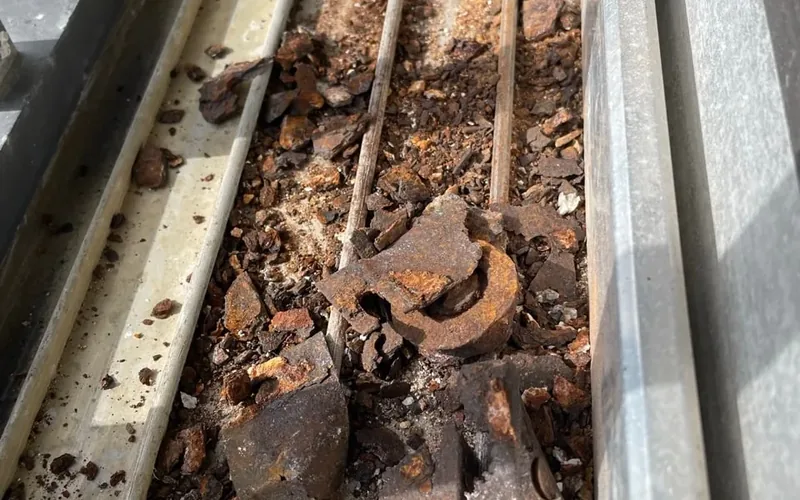
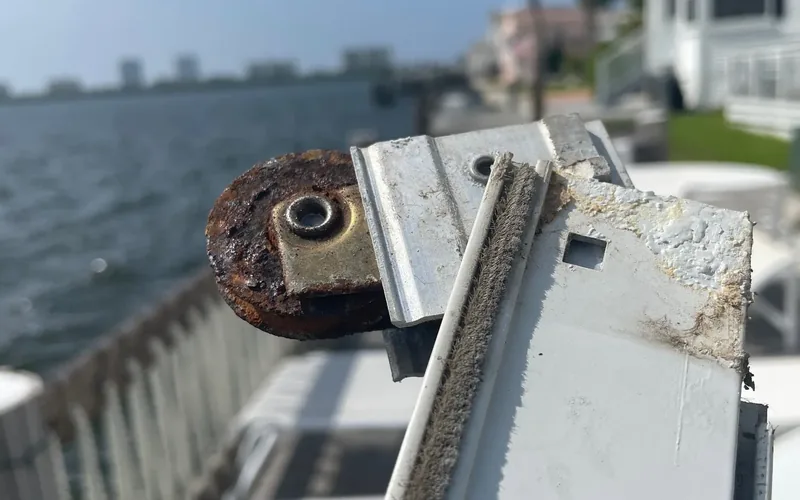
Take the roller. It sits in a pocket in the bottom rail of the panel, and that pocket has a specific length, width and depth. The wheel has a specific diameter and edge shape to match the track. The housing has its own adjustment screw position. Get one of those wrong and the panel sits too high, too low or crooked, and the door drags or the lock stops lining up. Locks are the same story: the body has to fit the cut-out in the stile, and the keeper has to meet it. Handles depend on screw spacing. Weatherstrip depends on the exact groove profile in the extrusion.
And the brand alone isn't the full answer. A manufacturer can make several door series at once and change them over the years, so two doors with the same name on the label can take different parts. That's why the most useful identification is brand plus series plus a rough age. Our roller replacement page has a five-minute guide to identifying which rollers a door takes by measurement, which fills the gaps when the brand can't be found.
Where is the brand name on a sliding glass door?
Look at the corners of the glass, the edges of the panel you can only see with the door open, the interlock where the panels meet, the head track above the door, the sill, and the hardware itself. Stickers and stamps hide in places you don't see from the room.
Work through it in this order:
- The glass corners. Look for a small etched or sandblasted mark, usually in a lower corner. More on what it means below.
- The panel edges. Slide the door open and look at the lock edge and the interlock edge of the moving panel. Labels and part numbers are often on edges that face the frame when the door is shut.
- The head track and jambs. Check the top of the frame and the inside faces of the side jambs. Some makers stamp or emboss the name into the extrusion.
- The sill. Look along the threshold and at the ends of the track for a stamp or a sticker remnant.
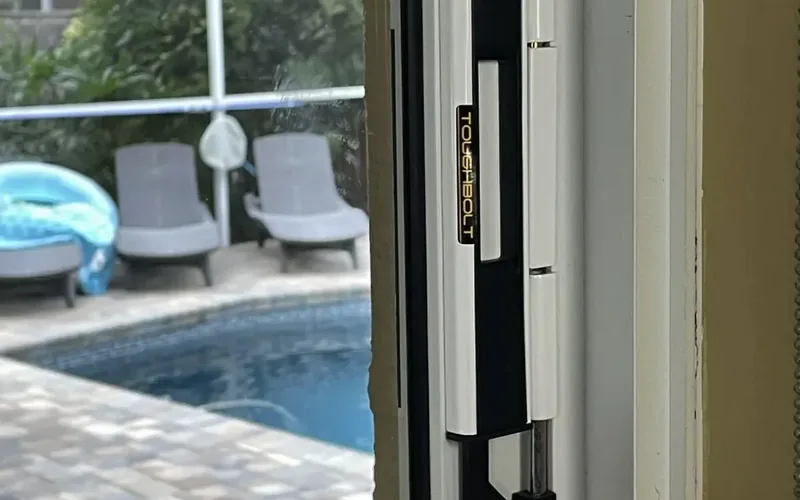
- The hardware. Pull the handle cover or look at the lock body and the roller housing if one is visible at the bottom of the panel. Hardware makers often mark their parts, and those names can point back to the door system.
Take a flashlight and a damp cloth. Labels that look blank are often just dirty.
What does the etched mark in the corner of the glass mean?
The etched mark, sometimes called the bug, is the safety glazing designation. Florida's code requires it on safety glass in doors, and it names whoever applied it and the safety standard the glass meets. It may name the glass fabricator rather than the door's maker.
Glass in sliding doors counts as a hazardous location under the Florida Building Code, so it has to be safety glazing. The code then requires each pane to carry a designation specifying who applied it, the manufacturer or installer, and the safety glazing standard it complies with, and the mark has to be acid etched, sandblasted, ceramic fired, laser etched, embossed or otherwise impossible to remove without destroying it (Florida Building Code, Building, sections 2406.3 and 2406.4.1). Tempered panes get a permanent mark for the same reason.
Here's the catch for parts hunting: the company named on the bug is whoever applied the designation, which is often the company that tempered or fabricated the glass. Some door makers do that in-house, so their own name appears. Many don't. So the bug is a strong clue, not proof. It also tells you something useful even when the name is a stranger: what kind of glass you have. Look for references to the safety standard, such as ANSI Z97.1 or CPSC 16 CFR 1201, and for words like tempered or laminated.
Two more things to watch for. If a pane has been replaced, its bug may differ from the others on the same door, so check every panel. And impact glass is laminated, so its marking can look different from the plain tempered panes on older doors. Our glass replacement page explains the difference between tempered, laminated and impact panels.
What do the stickers on a sliding door frame tell you?
An NFRC label, a Florida Product Approval reference or a design pressure sticker can name the manufacturer and the exact product line, which is more useful than the brand alone. Most are removed after installation, so check edges and the inside of the frame for survivors.
NFRC labels. The National Fenestration Rating Council says products in its program carry both a temporary and a permanent label (NFRC FAQ). The temporary one is the big sticker on the glass that usually gets peeled off on day one. The permanent one is smaller and less obvious, so look along the frame edges. Whatever text you find gives you something to search in NFRC's product directory.
Florida Product Approval. Exterior doors sold in Florida go through state product approval, and each approval has an FL number. If you find an FL number on a label or in your paperwork, you can look it up on the state's Florida Product Approval search, run by the Department of Business and Professional Regulation. The search takes an FL number or a manufacturer, and you can narrow it to the category Exterior Doors and the subcategory Sliding Exterior Door Assemblies, with fields for the product model, number or name, impact resistance and design pressure. An approval record ties a manufacturer to a named product, which is exactly what you need to talk about parts.
Design pressure and impact stickers. These show the door's rated pressures and whether it's impact-rated. They often carry the maker's name and the series too.
What if every label is gone?
Go to the paperwork. Your closing documents, the builder's warranty packet, a replacement-door permit or your condo association's records often name the door and its approval. If those are gone too, the hardware's measurements can stand in for the brand.
Places worth checking:
- Purchase and closing papers. New-build packets often list the window and door supplier.
- Permit records. If the door was replaced under a permit, the county building department's file often lists the product approval that was used. Ask the building department in your county.
- Your condo association or HOA. Associations that approve exterior changes often keep the approved product on file, and buildings where every unit got the same doors may have the spec sheet. Our guide to condo and HOA door responsibility covers who owns which part of a balcony door.
- The previous owner or the original installer, if you can reach them.
When nothing survives, we identify parts the old-fashioned way, by taking them out and measuring them. A brand name speeds things up. It isn't required.
Which sliding door brands will you find on Florida homes?
On Florida homes you'll find names like PGT, CGI, ES Windows, Andersen, Pella, Milgard and Jeld-Wen, plus plenty of older and regional makers whose names are no longer on the market. The steps above work the same for every one of them.
We list those names only because they're ones people find on their own doors. We make no claims about any brand's quality or parts availability; the names are here only because they're what people find printed on their own doors. If you're searching for something like "PGT sliding door parts" or "PGT sliding door rollers," the same rule applies as for any brand: the name narrows it down, but the series and approximate year decide which part fits. The manufacturer's own customer service is the right place to ask whether a specific part is still made.
Older doors bring their own wrinkle. Manufacturers merge, rename series and drop product lines, so a door from a few decades ago may carry a name nobody sells under anymore. That doesn't make it unrepairable. Rollers, locks and weatherstrip can often be matched or adapted by measurement, and the planned roller types comparison explains the main families you're likely to find.
How do you photograph a sliding door for a parts quote?
Take one photo of the whole door from inside, then close-ups of the glass mark, any label, the bottom corner of the moving panel, the lock edge and handle, and the track end-on, with a tape measure in the frame for the hardware shots.
A good set of photos often lets us identify the door, or at least the parts, before anyone visits. Here's the list:
- The whole door, from inside, so we can see the panel count and which panel moves.
- The etched glass mark, close and in focus. Shoot at a slight angle so the etching catches the light.
- Every label or sticker, even if it's half gone.
- The bottom corner of the moving panel, where the roller sits, with the door slid open a little.
- The lock edge and the handle, with a tape measure showing the screw spacing.
- The track, end-on, so we can see its profile and condition.
- The panel's height and width, measured, and whether the glass is single, insulated or impact if you know.
Send them through our online quote form. If the door also drags, doesn't lock or leaks, say so, because those symptoms tell us which parts to look for first.
Can you find the right part without knowing the brand?
Usually, yes. Rollers can be matched by housing size, wheel diameter and whether they're single or tandem. Locks by the cut-out and screw spacing. Handles by hole centers. Weatherstrip by the groove it sits in.
This is how most repairs on older Florida doors actually get done: the part comes out, it gets measured, and a matching or adaptable replacement goes in. Where a door has been modified over the years, measuring is more reliable than the label anyway, because the parts in it may not be the ones it left the factory with. For handles specifically, the planned handle replacement guide covers how to match the hole spacing, and lock hardware is covered on our security locks and latches page.
When a matching part genuinely can't be found or adapted and several other parts are also failing, that's one of the few situations where replacing the door can be the honest answer. Otherwise, the brand is a shortcut, not a requirement. Repairs start at $275 including parts, labor and a written warranty of 1 to 3 years. Gather what you can find, send us the photos, and we'll tell you what your door takes and what it needs.