Short answer: For no-see-ums, choose 20x20 mesh. Standard 18x14 screening stops mosquitoes and flies, but biting midges around a millimeter long walk straight through it. 20x20 keeps them out at the cost of a little airflow and a faint haze. Use it where you sit at dawn and dusk, especially near mangroves and the lagoon, with pet mesh on low panels and solar mesh on a west-facing wall.
It's a specific Florida misery: sitting on your screened lanai at dusk, screens intact, door closed — and getting eaten alive anyway. The culprits are biting midges, universally known here as no-see-ums, and the uncomfortable truth is that standard window screening barely slows them down. At around a millimeter long, they pass through the openings in ordinary mesh the way a person walks through a doorway.
The fix isn't sprays or candles. It's mesh geometry — and if you're already re-screening damaged panels, choosing the right fabric costs little more than choosing the wrong one. Here's the field guide.
Mesh numbers, decoded
Screen mesh is described by openings per inch: standard screening is 18×14 (18 openings per inch one way, 14 the other), designed decades ago around mosquitoes and houseflies. It stops both — but a no-see-um needs a fraction of that opening. 20×20 "no-see-um" mesh tightens the weave enough to physically exclude midges, and it's the standard answer anywhere within their range — which, near the Indian River Lagoon's mangroves and salt marshes where midges breed, means most of the Treasure Coast's waterfront and near-water neighborhoods.
The trade-offs nobody mentions
Finer mesh means finer trade-offs, and honesty about them beats surprise:
- Airflow: 20×20 passes measurably less breeze than 18×14. On most lanais the difference is minor; on a porch that depends on cross-breeze, you'll notice it on the stillest days.
- Visibility: the tighter weave reads slightly more "present" to the eye — a subtle haze compared to standard mesh, most noticeable looking into bright light.
- Debris: finer openings catch more dust and salt film, so no-see-um mesh rewards an occasional rinse to stay clear and breathing.
Our practical rule: screen the panels where you actually sit at dawn and dusk with 20×20, and consider standard mesh elsewhere. Mixed-mesh porches are common and sensible.
The rest of the mesh menu
Pet-resistant mesh is the answer to the most common screen damage we see — dogs, cats, and the occasional raccoon. It's a heavier vinyl-coated polyester, roughly seven times stronger than standard fiberglass, and it turns the nightly paw-test into a non-event. The trade-off is a visibly heavier weave; most owners use it on the lower panels and door panels where animals hit, standard or no-see-um mesh above.
Solar mesh blocks a majority of solar heat gain before it enters the porch — meaningful on west-facing lanais that bake every afternoon. It darkens the view noticeably; it's a comfort choice, not a default.
Heavy-gauge fiberglass (18×14 in thicker strand) is the quiet workhorse upgrade: same insect performance as standard, noticeably better wind-flex fatigue life — relevant on breezy island porches where standard fabric fails on a two-to-three-year cycle.
Repair economics: re-screen, don't replace
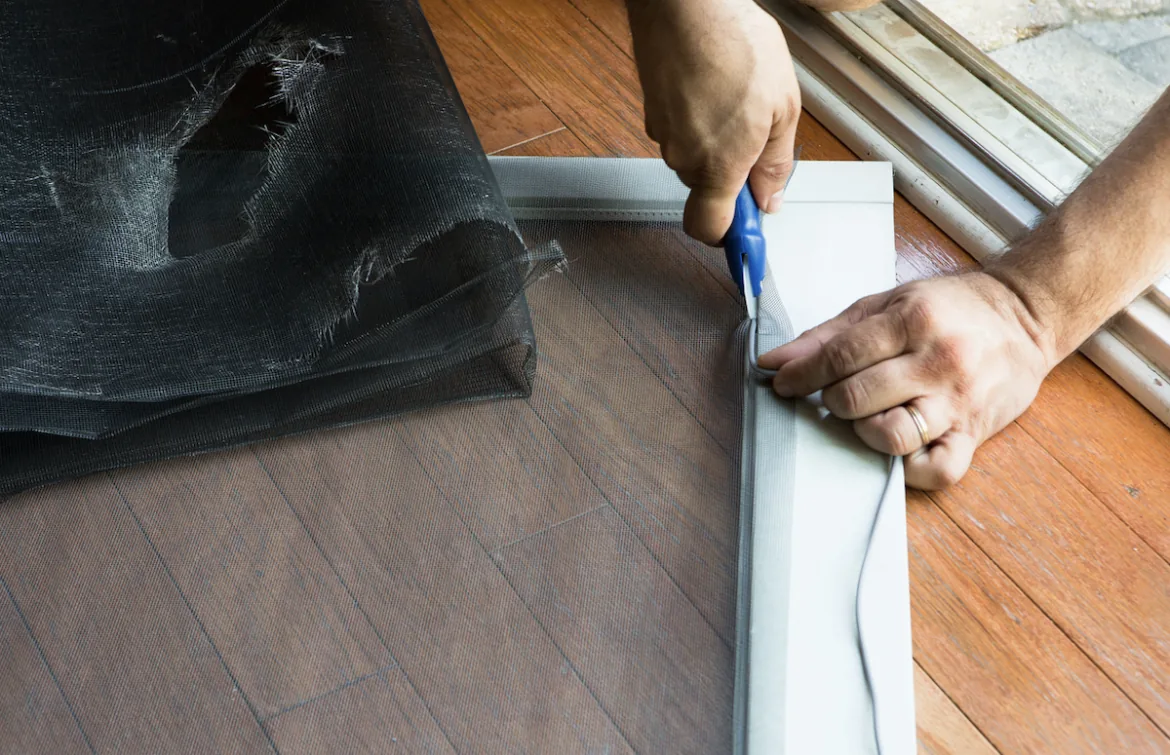
Whatever mesh you choose, the frame math doesn't change: aluminum screen frames outlive their fabric by decades, and screen fabric replacement in existing frames costs a small fraction of new panels while looking identical when done properly — fabric stretched drum-tight, splined evenly, square in the frame. A re-screen visit is also the natural moment to service the screen door's rollers and latch, which age on the same schedule as the fabric.
Matching mesh to your micro-climate
The right answer is local. Mangrove-adjacent and lagoon-front homes get bitten through standard mesh and should default to 20×20. Preserve-backing homes fight wildlife and want pet mesh low. West-facing pool cages bake and may want solar panels on the sun wall. Inland, sheltered porches can run standard fabric happily for years. We carry the full menu on the truck, and part of a free screen quote is simply telling you which mesh your porch actually needs — including when the honest answer is the cheap one.
18x14 vs 20x20: how do they compare side by side?
Everything above in one comparison, so you can decide without rereading it.
- Openings per inch. 18x14 gives eighteen openings across and fourteen down. 20x20 gives twenty in both directions, so the openings are both smaller and squarer.
- Mosquitoes and houseflies. Both stop them comfortably. This was the job 18x14 was designed around decades ago and it still does it.
- No-see-ums, biting midges and sand flies. 18x14 does not stop them. A midge is around a millimeter long and walks through. 20x20 is the mesh that excludes them.
- Airflow. 18x14 passes measurably more breeze. On a lanai that depends on cross-ventilation you will notice the difference on the stillest evenings, and nowhere else.
- Visibility. 18x14 reads slightly clearer. 20x20 has a faint haze looking into bright light, most obvious on a west-facing porch late in the day.
- Cleaning. Finer openings catch more dust and salt film, so 20x20 wants rinsing more often to keep breathing.
The honest summary is that 20x20 is a strict upgrade on protection and a small step down on airflow and clarity. Near mangrove, salt marsh or lagoon, that trade is worth making. Several miles inland with no biting-midge problem, standard mesh is not a compromise, it is the right answer.
Why is a sliding screen door a different problem from a pool cage?
People treat them as one job because both are aluminum frames with mesh in them. They fail completely differently, and the difference decides what you should spend.
A pool-cage panel is static. It gets fitted once, and after that the only forces on it are wind, UV and whatever the yard throws at it. Its failure mode is fabric fatigue: the mesh chalks in the sun, loses its flex, and eventually splits along a stress line, usually starting at a corner or a screw. The frame itself rarely does anything at all.
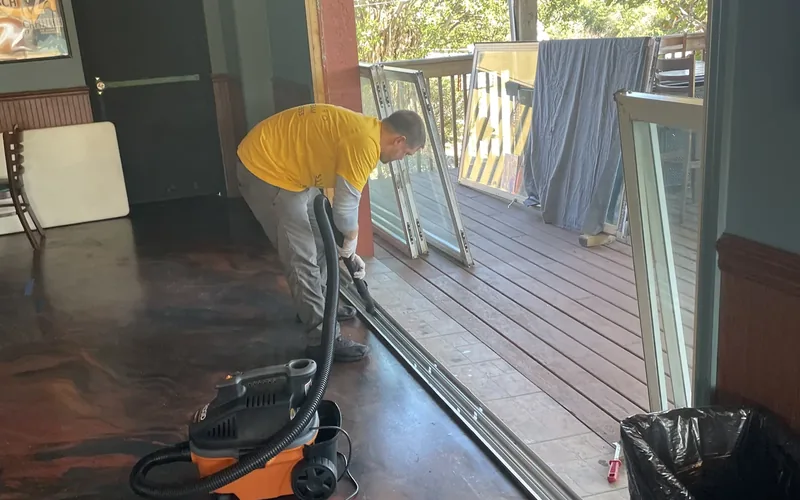
A sliding screen door is a machine. It rides on rollers, travels in a track hundreds of times a season, and is pushed, slammed and dragged by people whose hands are full. Its failure modes are mechanical before they are fabric-related: rollers wear or seize, the door goes out of square, it starts catching in the track, and the mesh tears because the frame is racking around it.
The practical consequence is that re-screening a sliding screen door without touching the rollers often buys you a year. The new fabric goes into a frame that is still twisting on every pass, and it tears again in exactly the same place. On a cage panel, new fabric in a sound frame is the whole job.
So when a screen door is the problem, treat it as a door. That is what our screen repair service does: mesh and mechanism in the same visit.
Why does the mesh tear in the same corner every time?
Because the frame is telling you something, and the mesh is where you hear it.
A screen door frame is four light aluminum extrusions joined at the corners. It holds its shape because it is square and because it is supported evenly by two rollers. Take either away and the frame becomes a parallelogram that flexes slightly on every pass.
When a roller wears down or seizes, that corner of the door drops. The frame is now carrying its load diagonally, and all of the racking concentrates at the corner furthest from the failed roller. The mesh, splined into a groove around the perimeter, gets stretched and released a few thousand times a season at exactly that point. It fatigues, the spline creeps out of its groove, and the fabric lets go — in the same corner, on the same door, after every re-screen.
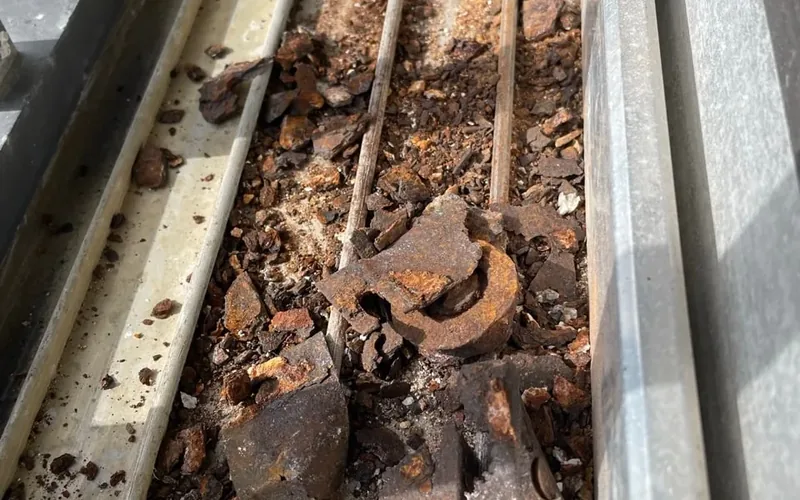
The second cause is the track. A screen track filled with sand makes the door climb and drop as it travels, which is the same racking delivered as a series of small shocks. That is also why beach-adjacent screen doors fail faster than identical doors two miles inland.
If your screen has torn twice in the same place, the mesh is not the fault. Check whether the door drops when you lift the handle side, and whether it runs unevenly along its travel. Fix that, then re-screen once.
What makes a re-screen last: spline, tension and frame prep
A re-screen is a five-minute job done badly and a proper repair done well. The difference is entirely in three things you cannot see once it is finished.
Spline sizing. The mesh is held by a flexible cord pressed into a groove around the frame. Too thin and the fabric can creep out under load. Too thick and it distorts the frame or splits the groove. It has to match both the groove and the fabric thickness, and heavier meshes need a different spline from standard fiberglass — which is why a re-screen that reuses the old spline is a false economy. Old spline has spent years in Florida sun, and vinyl spline shrinks and hardens as its plasticizers migrate out. Shrunken spline is why fabric that was drum-tight in spring is loose by the following summer.
Tension. The fabric has to go in evenly tensioned on all four sides. Pull one side harder and the frame bows, which on a sliding door means it no longer runs square in its track. A sagging screen and a bowed frame are two symptoms of the same rushed job.
Frame prep. The groove gets cleaned out first. Sand and old spline residue left in the channel stop the new spline seating to full depth, and fabric held at half depth is fabric that will pull out.
Done properly, on a sound frame, a re-screen looks identical to a new panel and outlasts several careless ones.
What is it like living with 20x20 mesh?
Worth knowing before you commit the whole lanai, because the differences are real and small.
You will notice the airflow on still evenings only. With any breeze at all, the difference between 18x14 and 20x20 disappears into the general movement of air. On a dead-calm August night on a porch that relies on cross-ventilation, it is perceptible.
It holds more film. Finer openings intercept more of what the air carries, and near the coast what the air carries is salt aerosol and fine sand. Salt is hygroscopic — it pulls moisture out of humid air — so a salt film on mesh stays slightly damp and holds dust rather than letting it blow through. The visible result is a screen that hazes over faster than the standard mesh next to it.
The maintenance is trivial but not optional. Rinse from the outside with a hose two or three times a year, more if you are on the water, and let it dry. Do not pressure wash: the jet stretches the fabric out of the spline, which is the fastest way to turn a good re-screen into a sagging one. A soft brush and plain water is the whole method.
The view settles. Most people stop seeing the finer weave within a week or two. The ones who do not are usually looking at a west wall in the late afternoon, which is the hardest condition for any mesh.
When is a screen frame genuinely finished?
We re-screen frames far more often than we condemn them, so it is worth being specific about the cases where the frame really is done.
- The corners have opened. Screen frames are held together by corner keys pressed into the extrusions. Once a joint has worked loose and the corner moves independently, the frame will never hold tension again, and re-splining it just loads the failed joint.
- The spline groove has split. A groove torn open along its length, usually from an oversized spline forced in at some point, has nothing left to grip.
- The extrusion is bowed permanently. A frame bent by being forced back onto a track after a derailment does not straighten. It will run crooked and tear fabric wherever it rubs.
- Corrosion has gone through. Rare, but real on oceanfront properties: aluminum pitted deeply enough that fasteners no longer hold.
Everything else — torn mesh, a chalky brittle fabric, a missing pull handle, worn or seized rollers, a door that jumps its track — is a repair on a frame that has decades left in it. Aluminum outlives screen fabric by a wide margin, which is the whole reason re-screening exists as a trade. Repairs start at $275 including parts, labor and a one-to-three-year warranty on both, and 96% of our jobs finish in a single visit.