Short answer: Clean the track monthly in about ten minutes: vacuum it dry first, brush the packed grit off the rail and vacuum again, wipe with soapy water and dry it completely, clear the weep holes, then use dry silicone only if the door still wants help. Never use oil sprays, steel wool or a pressure washer. A door that still drags on a clean track has worn hardware.
We say this to customers every week, and we mean it: the single most effective thing you can do to extend your sliding door's life is free, takes about ten minutes, and requires nothing more exotic than a vacuum cleaner. Track grit is the sandpaper that grinds Florida door hardware to death — and unlike salt corrosion, it's a factor you can almost entirely remove yourself.
This is our honest DIY guide — the routine we'd teach a family member. (Yes, a repair company publishing DIY advice; a slider that's maintained still needs professional hardware service eventually, and homeowners who take care of their doors make our favorite customers.)
What you need
- A vacuum with a crevice tool (the whole game is the crevice tool)
- A stiff brush — an old toothbrush or a cheap detail brush
- Rags or paper towels, and a bucket of warm water with a drop of dish soap
- A pipe cleaner or cotton swab for weep holes
- Optionally: dry silicone spray — and nothing else. No oil, no all-purpose penetrating sprays.
Step 1: Vacuum dry, before anything gets wet
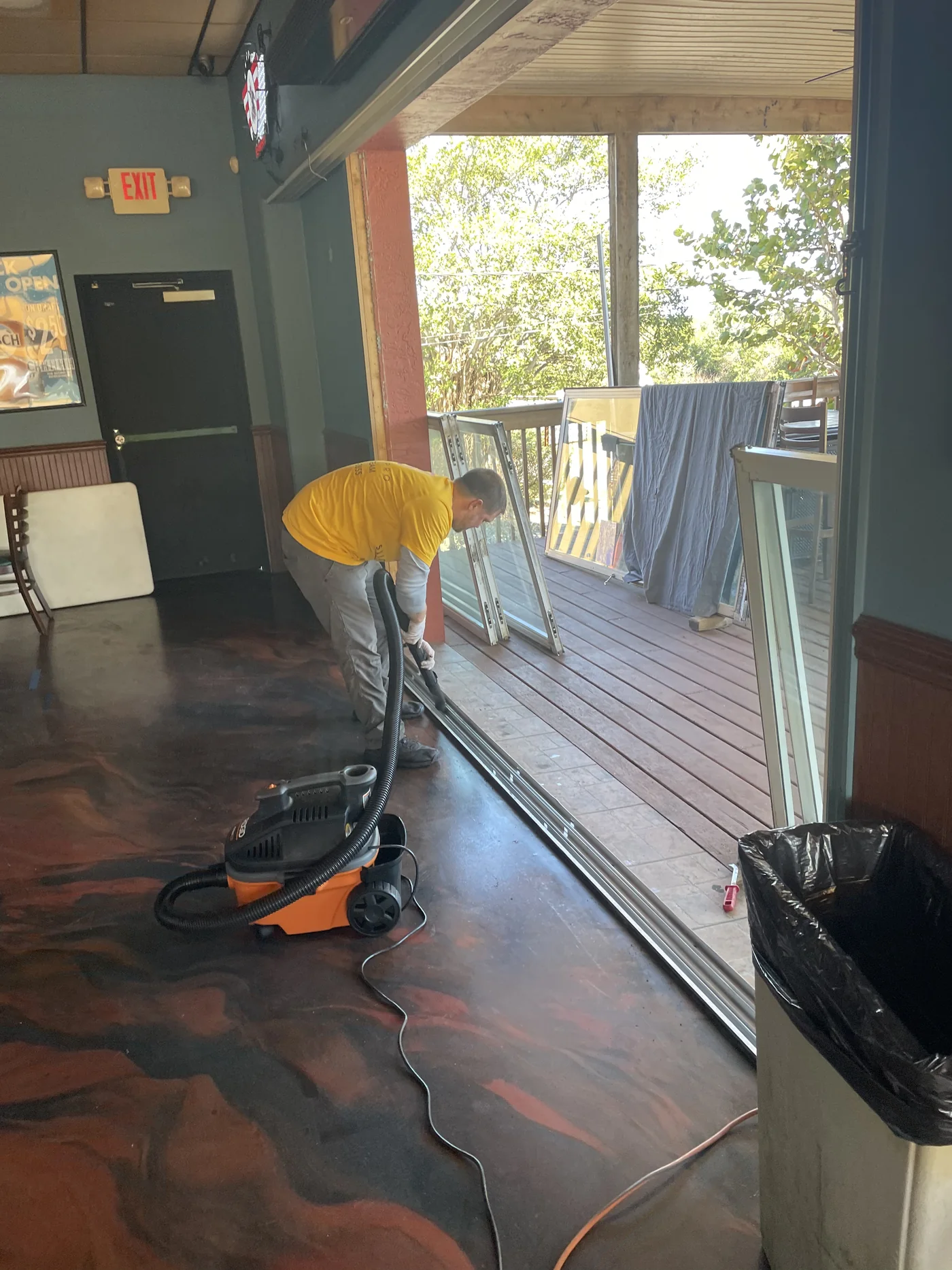
Open the door fully and vacuum the entire exposed track with the crevice tool — both the channel the door rolls in and the outer channel. Work the corners where debris drifts and piles. Dry-first matters: wet sand smears and packs into the roller path; dry sand lifts straight out.
Step 2: Brush the rail and corners loose, vacuum again
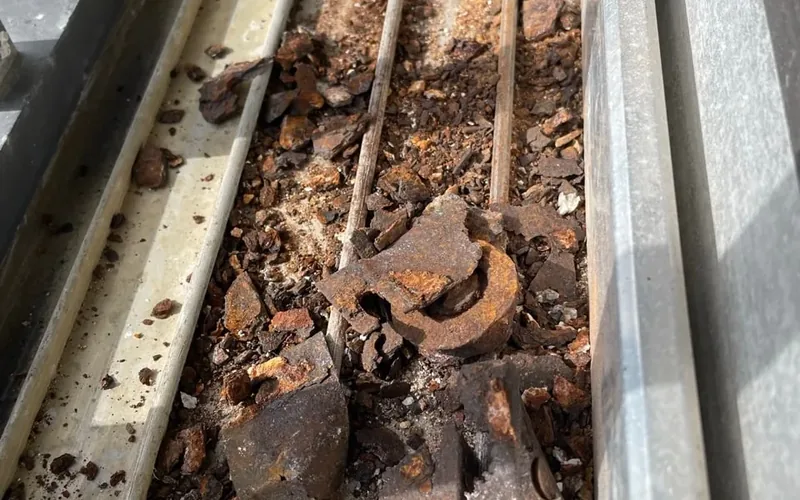
The raised rail your door actually rolls on collects a stubborn line of compacted grit along each side. Scrub it loose with the brush — along the rail's shoulders especially — then vacuum the loosened debris. This packed layer is the stuff monthly vacuuming alone misses, and it sits exactly where the roller wheels run.
Step 3: Wash and dry
Wipe the track and rail with the damp soapy rag until it comes away clean, then — important in our humidity — wipe everything dry. A film of moisture left in a coastal track is a salt-corrosion accelerant, which would be a self-defeating way to end a maintenance routine.
Step 4: Check the weep holes
Find the small drainage slots on the exterior face of the track and confirm each is clear with a pipe cleaner. Blocked weeps turn your track into a bathtub during summer storms, and overflow goes exactly where you'd least like it — indoors. (This check earns its keep double in hurricane season.)
Step 5: Lubricate — correctly or not at all
Here's where well-meaning homeowners do real damage. Oil-based sprays on a Florida track collect airborne dust and track sand into an abrasive paste — you get a week of smooth and a year of accelerated grinding. If the door glides well after cleaning, skip lubrication entirely; a clean dry track is a happy track. If it wants help, a light pass of dry silicone spray on the rail (wipe off the excess) is the only thing we recommend, applied to a clean track only.
Step 6: The 30-second health check
While you're down there, run the monthly diagnostic: roll the door slowly and listen for grinding; watch for shudder or bumping; look for gray metal dust or bright scrape marks on the rail; lock the door and try to lift-and-pull it open. Any of those signs means hardware wear that cleaning can't fix — caught at this stage, it's the cheap end of the roller-wear sequence.
What this routine can and can't do
Done monthly, this routine removes the abrasive that wears wheels and rails, keeps drainage working, and gives you early warning of hardware problems — it genuinely extends door life by years. What it can't do is reverse existing bearing corrosion or roller wear: a door that's already grinding, shuddering, or heavy on a spotless track has a hardware problem, and the fix is mechanical, not chemical.
Clean track, honest signals, early action — that's the whole system. And when the signals do point to worn hardware, we're a phone call away with the free quote and the stainless parts.
What about the upper track and head channel?
The six steps above cover the track everyone cleans. There is a second one, at the top of the opening, that almost nobody does — and a dragging top edge feels exactly like a failing roller from standing height.
The head channel guides the top of the panel and usually carries the anti-lift blocks that stop the door being lifted out of its track. It is out of sight, never rinsed by rain, and it accumulates lint, cobwebs, wasp nests, insulation debris and paint overspray from every repaint the house has had. On pocket systems and multi-panel stacks it does more of the guiding work, so it matters more.
Cleaning it takes about a minute. Run the vacuum crevice tool along the full length of the channel with the door open, then again with the door at the other end of its travel so you reach the section the panel was covering. Wipe it out with a dry cloth on a paint stirrer or a ruler if the channel is deep. Do not spray anything up there; whatever you spray will run down the glass and collect grit on the way.
While you are looking, check the top edge of the panel for a bright rub line. If there is one, the panel has been touching something it should be clearing, and the channel was the reason.
How do you remove white chalky corrosion and salt crust?
The white powder in a coastal track is aluminum oxide, sometimes with mineral scale from sprinkler overspray mixed into it. It is the track corroding, not dirt sitting on it, which is why brushing alone does so little.
What works, in order: a thorough dry vacuum first, then a nylon brush and warm soapy water for the loose material, then a mildly acidic cleaner such as white vinegar left on the deposit for a few minutes to soften the scale, then a firm scrub with a nylon pad, a full fresh-water rinse and a complete dry. The rinse and the dry are not optional. Leaving an acid residue or a film of water in a coastal track is a fast way to restart the problem.
What does not work, and actively causes harm: steel wool and wire brushes. They leave tiny steel particles embedded in soft aluminum, and steel in contact with aluminum in a salt film is a galvanic cell. You get rust freckles within weeks and accelerated pitting underneath them. Use nylon or brass, never steel.
Light chalking cleans up well. Heavy crusting along the rail itself usually travels with bearing damage, because the same conditions produced both, and it is worth having the hardware looked at rather than just the cosmetics.
What should never go in a sliding door track?
Most of the damage we undo was done with good intentions and a spray can. The short list of things to keep away from a Florida track:
- Oil-based penetrating sprays. The single most common mistake. Oil captures airborne dust and track sand into an abrasive paste, glues it to the rail and packs it into the roller housings. You get a week of smooth travel and a year of accelerated grinding.
- Grease of any kind. Same mechanism as oil, only worse, because it holds more grit and never washes out.
- Household oils and furniture polish. Also oil. Also grit magnets.
- Steel wool and wire brushes. They embed steel in aluminum and set up galvanic corrosion in the exact spot you were trying to clean.
- Pressure washers. They drive water and sand straight into the roller housings and past the weatherstrip, and can force water into the wall behind the sill. There is no track this improves.
- Harsh solvents and bleach. They attack anodizing and painted finishes, and bleach residue is corrosive to the aluminum underneath.
If your track has already had oil in it, the fix is mechanical rather than chemical: dry vacuum, scrub the paste out with a stiff nylon brush and soapy water, rinse, dry completely, then leave it dry. A clean dry track needs nothing added to it.
Why is "take the door off first" bad advice for a homeowner?
Plenty of cleaning guides tell you to lift the panel out for a proper job. We service doors for a living and we would rather you did not.
Sliding panels are much heavier than they look, and modern ones are worse. A laminated impact panel in a common Florida size is a genuine two-person lift with awkward geometry: you take the weight at the bottom, swing it clear, and the top edge stays captive in the head channel until the last moment. That is a lift you cannot recover halfway through, and the failure mode is a large sheet of glass coming down onto a tile floor with someone underneath it.
There is a second problem even when the lift goes fine. Panels are retained by stops and anti-lift blocks that are meant to be released in a particular order, and forcing a panel past them bends the retainers, rolls the lip of the rail, or shears the fastener heads. We are then repairing the removal as well as the door.
Everything in the routine above is achievable with the door in place. The parts you genuinely cannot reach — the roller channel under the panel, the underside of the rail, the housings themselves — get cleaned as part of a service visit, where the panel comes out with the right handling and goes back adjusted.
How often should you do this on the Treasure Coast?
Monthly is the honest default, but the right interval depends on where you live and how the door is used. Four factors move it.
- Distance from salt water. Directly ocean-facing doors on Hutchinson Island or along A1A collect salt aerosol every day and benefit from a quick vacuum and wipe every couple of weeks, plus an occasional fresh-water rinse. Brackish lagoon and riverfront exposure sits between. Inland, west of US-1, monthly is comfortably enough.
- Wet season versus dry. June through October drives more sand, more organic debris and more standing water into tracks. Tighten the interval through the wet season and relax it through the winter.
- Traffic. The lanai door a family uses forty times a day earns more attention than a guest room slider. That said, do not skip the unused one entirely — doors that never move corrode fastest, because motion is what wipes the salt film off the bearings.
- Pets, sand and construction. Dogs, beach days and any nearby building work all put grit in a track faster than weather does.
If you only manage one thing a month, make it the dry vacuum. Removing the abrasive is the step that does most of the work, and it takes two minutes per door.
What is the storm-season track check, before and after?
Tracks matter more in a storm than most owners expect, because wind-driven rain does not fall into a track, it is pushed into it horizontally, and the only thing moving that water back out is the weep system.
Before. Run the full routine, then verify drainage rather than assuming it: pour a cup of water into the outer channel and watch it leave. If it sits, clear the weeps with a pipe cleaner and test again. Check that the door closes fully and the latch engages positively without lifting or wiggling, because a panel that is not seated is not sealed and an unlatched slider can be worked open by wind pressure. Run a hand along the weatherstrip for gaps and missing sections.
After. This is the step people skip, and it is the one that decides how the door ages. A tropical system drives fine sand and salt deep into tracks and roller housings, and that grit then grinds every time the door moves. Vacuum dry, rinse the track with fresh water, dry it thoroughly, then run the 30-second health check for new noise, shudder or drag. Post-storm is our busiest period for exactly this, and a track service soon after a blow is what stops a temporary mess becoming permanent damage.
The full seasonal sequence is in our hurricane preparation guide.
What about screen door tracks and pet-door inserts?
The screen rides in its own shallow channel, usually on the outside of the main track, and it gets neglected because a screen weighs almost nothing and complains quietly.
That shallow channel is exactly the wrong shape for the Florida climate. It is the outermost part of the assembly, it catches everything the wind carries, and its small wheels have no mass behind them to push through debris. A screen that jumps its track or refuses to roll is usually running in a channel packed with grit rather than suffering from a broken part. Vacuum it with the crevice tool, brush the corners, and check the small wheels turn freely under a fingertip.
Pet-door inserts add two problems. The insert panel sits in the main track for years without moving, so grit compacts underneath it and the section of rail beneath the insert never gets cleaned. And the insert frequently sits directly over the weep holes, blocking drainage exactly where water needs to leave. If you have an insert, lift it out at least once a year, clean the rail underneath, and confirm the weeps below it are clear.
If the mesh itself is sagging, torn or brittle rather than dirty, cleaning will not help. That is a re-screen, and it is one of the cheapest repairs on a sliding door.
Renters, condo owners and HOA rules: what's yours to clean?
Track cleaning is maintenance, not modification, so it is almost always within your rights wherever you live. The line matters more when cleaning turns into repair.
Renters. Cleaning the track is yours and it is worth doing, because a door that drags gets forced and a forced door gets blamed on the last tenant. Anything beyond cleaning — a roller, a latch, a bent rail — belongs to the landlord, and it is worth reporting a change in how the door sounds or feels in writing when you first notice it.
Condo owners. Florida declarations usually describe a balcony as a limited common element and split the door across the boundary. Cleaning is uncontroversial; hardware repair usually falls to the unit owner because it wears with your use; and anything touching the frame or the exterior appearance normally needs written approval first. This is general information rather than legal advice — read your declaration and ask management in writing. Our condo guide walks through the clauses that decide it.
HOA homes. Cleaning and hardware repair are yours. Restrictions generally bite on visible changes — a different frame color, added exterior hardware, replacement glass — not on maintenance of what is already there.
Still dragging after a clean? Here's what's actually wrong
A spotless track that still fights you has told you something useful: the problem is mechanical, and no amount of further cleaning or spraying will reach it. Four candidates, in order of likelihood.
- Worn rollers. The default answer. Confirm it with the lift test: open the door halfway, lift the panel gently to take weight off the wheels, and slide. If it suddenly moves easily, the rollers are done. The seven-sign guide tells you which stage yours is at.
- A rolled or bent rail. The signature is binding at one specific point rather than heaviness everywhere. Usually left behind by a derailment or by a seized roller skidding in one spot.
- A dragging top edge. A head channel full of debris, or a panel that has dropped enough to contact it. Look for a bright rub line along the top of the panel.
- A settled opening. Less common, more often in older homes and added Florida rooms. Measure the diagonals of the opening; on a square opening they match.
All four are repairs rather than replacements. Repairs start at $275 including parts, labor and a one to three year warranty, and 96% of jobs are finished in a single visit. Tell us what the door is doing or call 772-722-4036.
What if the door hasn't moved in months?
Seasonal homes need the routine adapted, because the failure mode is different. Doors that sit still do not rest; they corrode faster than doors in daily use.
The reason is that motion is what keeps a bearing alive in salt air. Every cycle of the door wipes the salt film off the contact surfaces. A locked, motionless panel lets that film sit on the same few square millimeters of steel, pulling moisture out of humid air, right through June to October when the corrosion chemistry runs hardest. The house is closed, the air conditioning is set high or off, and the track is the dampest part of it.
Two changes to the routine handle it. At close-up: clean every track properly, clear the weeps, wipe everything bone dry, apply dry silicone sparingly to a clean rail, and leave the doors locked but cycled a few times first. On arrival: clean before you operate anything, and if a door will not move, do not force it. A shoulder against a seized panel is how a roller job becomes a bent-rail job.
Whoever opens the house can let a technician in — the owner does not need to be in Florida. The full seasonal calendar is in the seasonal and rental checklist.