Mon–Fri 9am–5pm  ·  Sat 12pm–5pm Review us on Google Serving the Treasure Coast  ·  561-566-2855
Case study · Curved glazing

Curved and arched glass replacement: the cut you only get one shot at

A cracked arch is a glass problem, not a window problem. The new piece is cut to the shape of your existing opening, which means the measurement has to be right before anything is ordered.

5.0★ Google RatingFrom 170+ customer reviews
Written Warranty1–3 years on parts and labor
1,600+ Doors RepairedAcross 5 years on the Treasure Coast
Same-Day Service96% of jobs finished in one visit

Curved glass can almost always be replaced without touching the frame or the wall. The new piece is cut to a template taken from your existing opening, then bedded into the original stucco arch. What makes it advanced is not the installation — it is that the shape has to be measured correctly the first time, because a curve cut a quarter-inch wrong cannot be trimmed to fit.

In Angelo's words, from the notes on this job: matching the circumference of an existing arch is not forgiving. You get one shot at shaping the new piece so it seats perfectly into the original stucco opening without gaps, stress points or visible distortion. The before-and-after looks simple. The craftsmanship is entirely in hitting that exact curve on the first attempt.

Why a curve is a different job from a rectangle

A rectangular pane is defined by two numbers and can be eased into place. A curved pane is defined by a continuous shape, and every point along that shape has to agree with the opening at the same time. There is no adjustment left once it is cut.

Think about what happens when a rectangle is slightly oversized. You trim an edge, or you shift the pane a sixteenth in the rebate and the stops cover it. Both fixes are ordinary. Now imagine the same error on an arc. Shifting the piece to close a gap at the top opens one at the spring line, because the curve is only tangent to the frame in one position. There is exactly one correct placement, and the glass either matches it or it does not.

That is also why a curved pane cannot be forced. If the arc is even slightly tight against the stucco, setting it introduces a stress point, and stress points in glass do not stay local — they wait for a temperature swing and then run. A curved piece that has been persuaded into place is a piece that will crack later, and it will look like bad luck rather than bad fitting.

What "visible distortion" means on a curve

Distortion is the third failure mode and the one homeowners notice without being able to name it. Glass that has been bent, or cut from a template that is fractionally the wrong radius, reflects light unevenly along the arc. From the kerb the arch reads as slightly wobbly, the way a shop window does when the frame has twisted. Nothing is broken. It just looks wrong, and once it is seen it cannot be unseen.

The three numbers that define an arch

A curved opening is described by its chord, its rise and its radius. Chord is the width across the bottom of the arc. Rise is the height from that line to the top of the curve. Radius is derived from the two, using R = c² ÷ 8h + h ÷ 2.

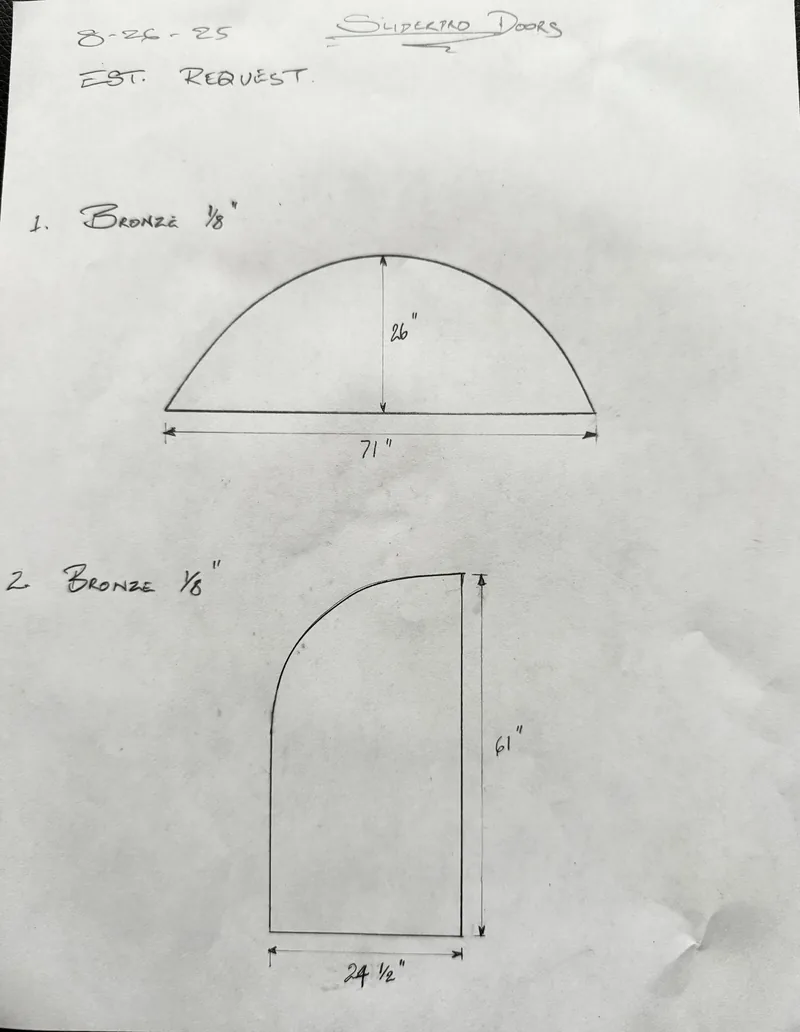
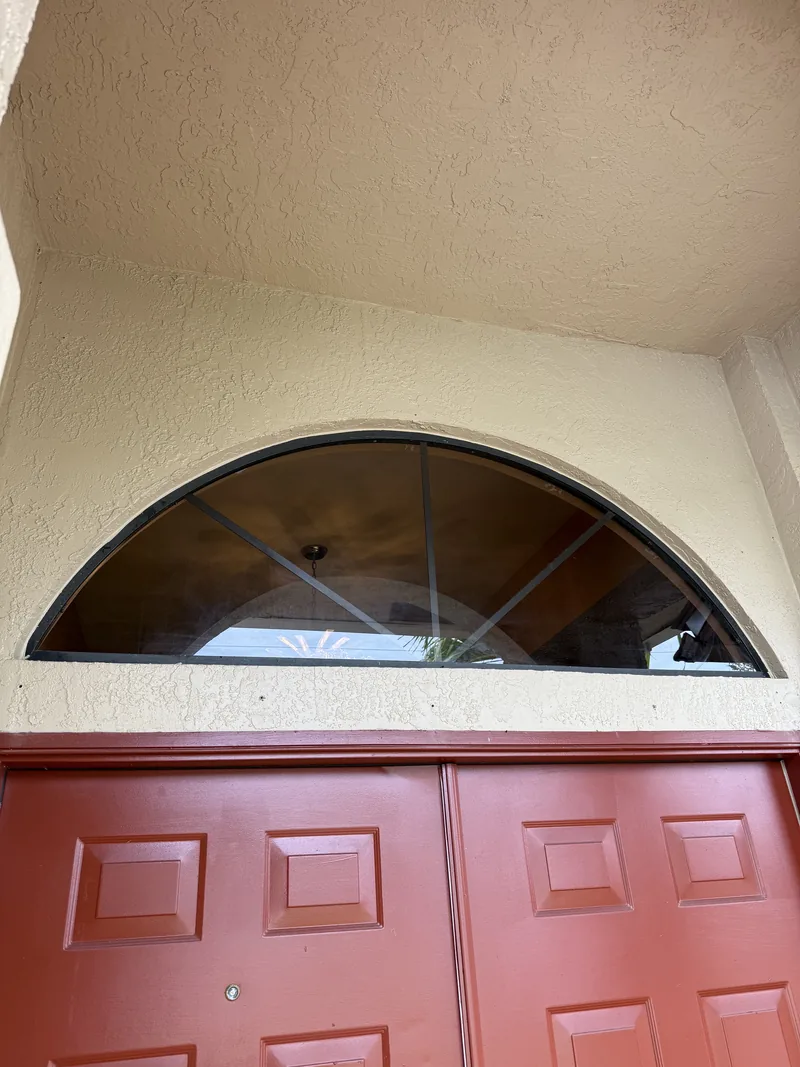
Those three numbers are what a glass shop cuts from, and they are why curved measuring is done by hand. On this job's drawing, the half-round measured 71 inches across with a 26-inch rise. Run those through the formula and the radius comes out at about 37.24 inches.

Here is the part that catches people out. A true half-round on a 71-inch chord would rise 35.5 inches — half its width, because a semicircle's rise is its radius. This opening rises 26. So despite being called a half-round in ordinary conversation, it is geometrically a segmental arch: a slice of a much larger circle, flattened. Order it as a semicircle and the glass arrives with the wrong curve entirely, tall and pinched where the opening is wide and shallow.

This is the single most common ordering error in curved glazing, and it is invisible until the piece is on site. It is also the reason the drawing for this job records a rise at all, rather than just a width and a height.

Worked example, using this job's numbers

  • Chord (c): 71 in — the straight span across the springing line.
  • Rise (h): 26 in — measured at the centre of the chord, straight up to the underside of the arc.
  • Radius (R): c²÷8h + h÷2 = 71² ÷ (208) + 13 ≈ 37.24 in.
  • Sanity check: rise (26) is less than half the chord (35.5), so this is a segmental arch, not a semicircle.

The second shape on the same drawing was a quarter-round: 24½ inches wide by 61 inches high, in the same bronze one-eighth-inch glass. A quarter-round has one straight vertical edge, one straight horizontal edge and a single curve joining them, so it carries an additional constraint — the two straight edges have to be square to each other as well as the curve being right.

How we measure a curved opening

Curved openings are measured physically, on site, from the frame that exists rather than from a plan of what was originally built. Houses settle, stucco is refloated, and the arch you have is rarely the arch on the drawings.

The sequence is the same every time, and it is deliberately slow:

  1. Establish the springing line. This is where the curve starts. It is not always where the trim starts, and getting it wrong shifts every measurement that follows.
  2. Measure the chord. Width across the springing line, taken at the glass line rather than the outside of the stucco.
  3. Measure the rise at true centre. Find the midpoint of the chord first. A rise taken off-centre on a segmental arch will under-read and produce a radius that is too large.
  4. Template where the arc is irregular. Hand-floated stucco arches are frequently not perfect circles. Where the curve wanders, a physical template beats arithmetic, and the template goes to the shop with the order.
  5. Record the glass stack. Thickness, tint, and whether the existing pane is annealed, tempered or laminated. On this job the drawing specifies bronze at one eighth of an inch.
  6. Check the rebate depth all the way round. The bite has to be consistent, or the piece sits proud on one side of the arc.

Only then does anything get ordered. The drawing goes to the shop, the shape is cut, and the piece comes back made for exactly one opening in the world.

Curved shapes we replace

Anything that is not a rectangle can generally be templated. The common Florida shapes are half-rounds and segmental arches over doors and sliders, eyebrows, quarter-rounds beside entries, and circular oculus windows.

Curved openings and what makes each one awkward
ShapeWhere it turns upThe tricky part
Half-round / segmental archTransom over an entry or sliderTelling the two apart; the rise decides which it is
Quarter-roundBeside a front door, flanking a windowTwo straight edges must be square as well as the curve being right
EyebrowLong, shallow openings over wide windowsVery large radius, so small rise errors move the arc a long way
Full circle / oculusEntry walls, gable ends, stairwellsDiameter must be right in every direction, not just one
EllipseDecorative transomsNot a circle at all; needs a physical template, always
Gothic / peaked archOlder and custom buildsTwo arcs meeting at an apex; both radii and the apex angle matter

Muntins and grids on a curved pane

Curved openings frequently carry radial muntins — bars that fan out from the centre of the flat edge like the spokes of a wheel. They are a decorative grid, and they have to be laid out from the same centre point the glass was cut around.

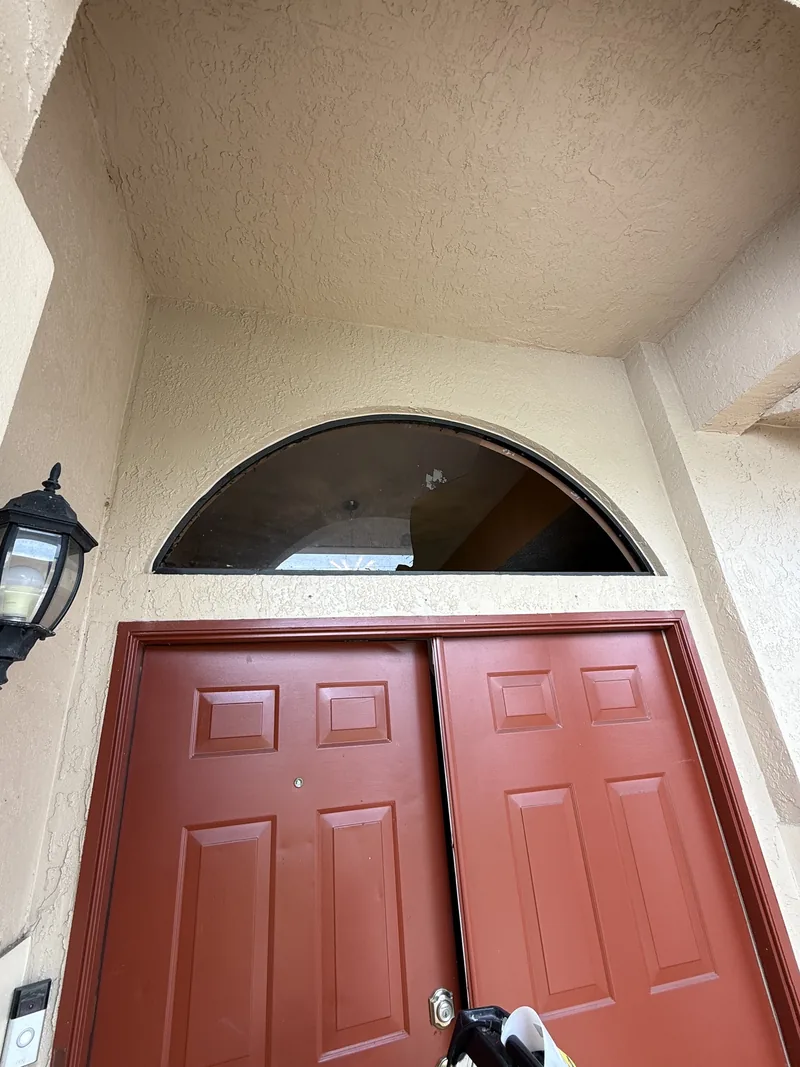
On the transom in these photographs, the replacement carries exactly that arrangement: bars radiating out to the arc, dividing the light into wedges. Getting them right is a second alignment problem sitting on top of the first. If the spokes are set from a centre that is a little off, they will not meet the curve at even intervals, and the eye reads the unevenness instantly even though no single bar looks wrong.

Grids also change how a repair is quoted. A plain curved pane is one piece of glass. A gridded one is a piece of glass plus a layout that has to match what was there, because the arch almost never stands alone — it usually sits above a door or window whose own grid pattern has to line up with it.

Safety glazing: the rule that decides the product

Glass in and around doors is generally treated as a hazardous location, which means it has to be safety glazing — tempered or laminated — rather than ordinary annealed glass. For a transom sitting directly above a front door, that question gets settled before shape is even discussed.

The reasoning is simple: glazing that someone could walk into, or that sits where a person could fall against it, has to break safely. Tempered glass fractures into blunt granules. Laminated glass holds together on its interlayer. Annealed glass breaks into blades, which is why it is the wrong answer next to a doorway.

The practical consequence for a curved job is lead time and cost. Tempered glass cannot be cut after it is toughened — the shape has to be cut first and then tempered, so the template genuinely is final. That is another reason the measuring stage carries so much weight on curved work: there is no recovery step downstream.

Where your specific opening falls is a question for the product and the inspector, not for a website. We identify it on site and specify accordingly.

Repair or replace: what a curved opening actually costs you

Re-glazing a curved opening keeps the frame, the stucco arch and the finish. Replacing the window means opening the wall. On a decorative arch, the second option is usually the more expensive and more disruptive path by a wide margin.

Curved windows are architectural features. They were built into the elevation, the stucco was floated around them, and the surround was finished to match. Pulling one out means cutting that surround, fitting a new unit that is very unlikely to be an off-the-shelf size, then rebuilding and refinishing the stucco so the repair does not announce itself. On a front elevation, that finishing work is often the largest line on the invoice.

Re-glazing avoids all of it. The trade-off is the ordering discipline described above — and that is a skill question, not a cost question.

SliderPro repairs start at $275, and every repair carries a 1–3 year warranty on parts and labor. Curved glass is priced on the piece, because it is made for your opening; we quote it after measuring, never before.

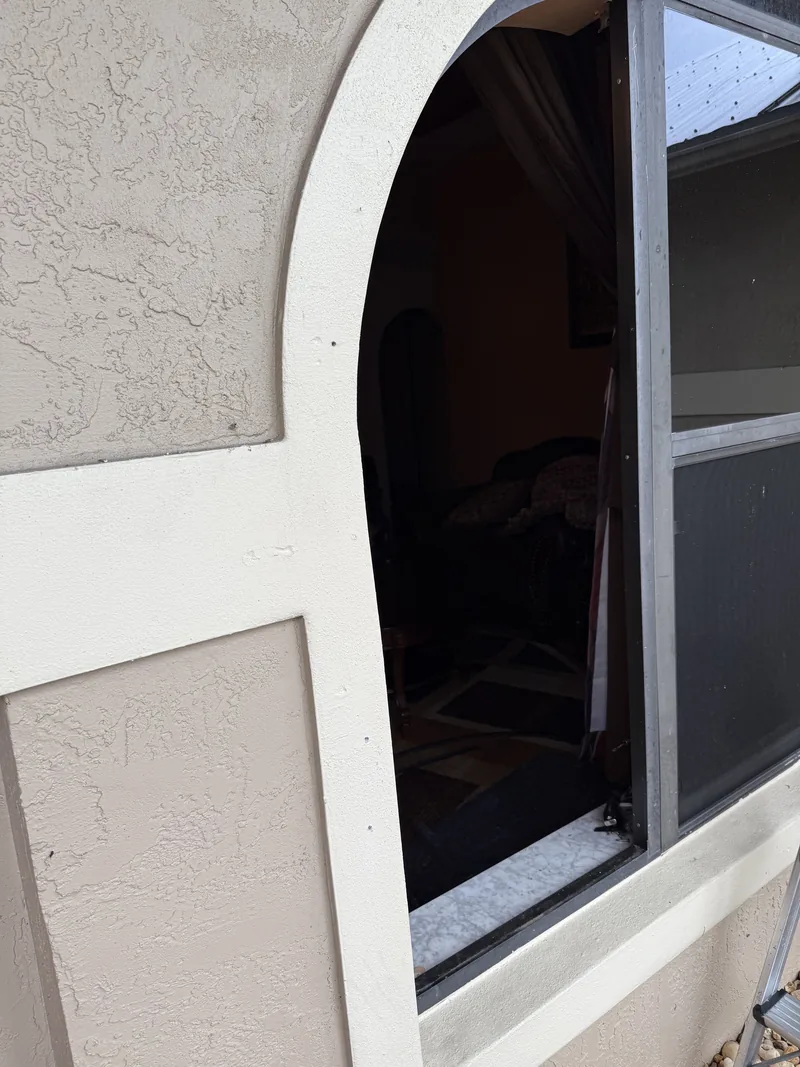
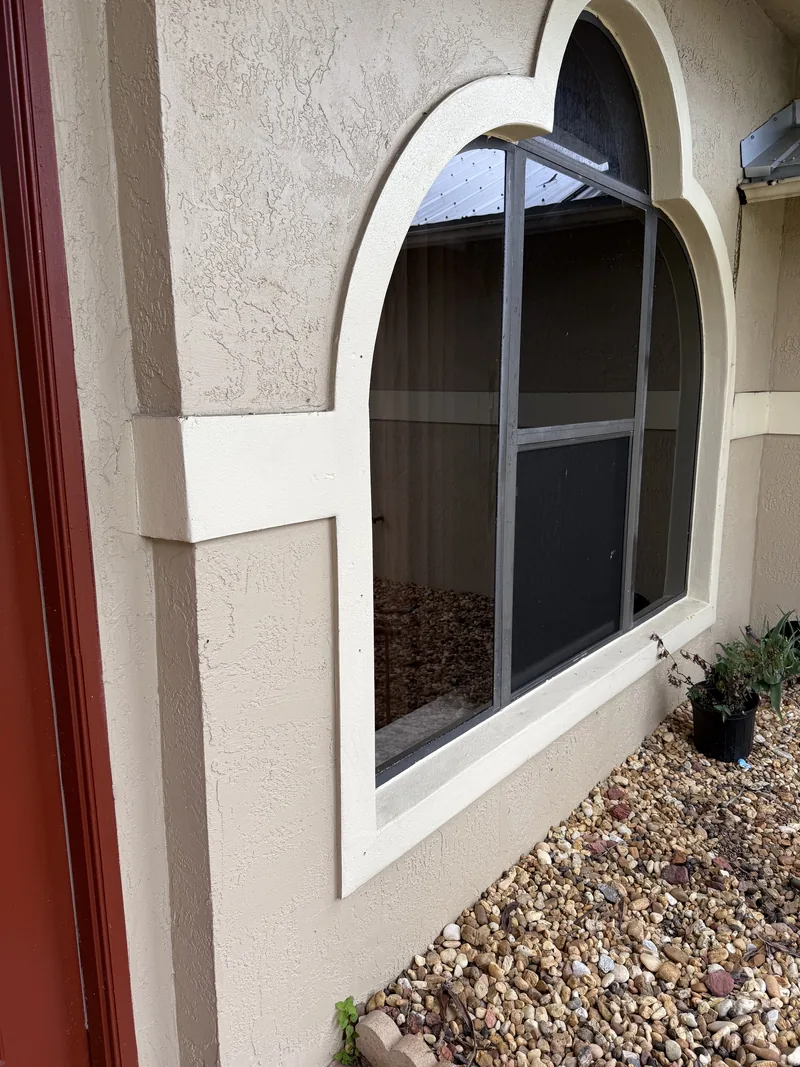
The job, photographed

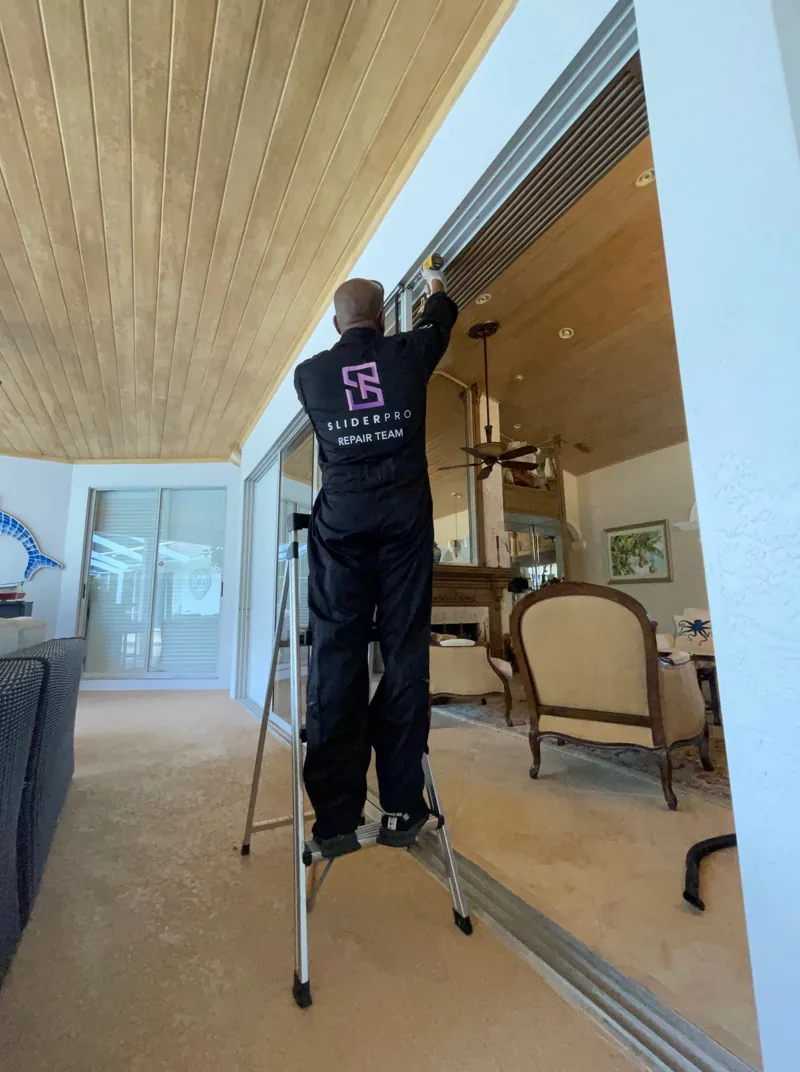
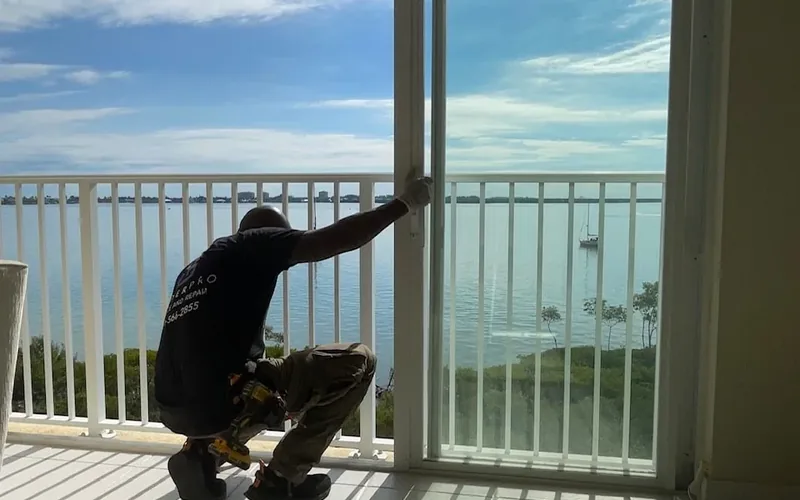
Photographed on site by the technician who did the work.

Curved and Arched Glass Replacement — your questions

Can curved or arched window glass be replaced without replacing the whole window?

Yes, in most cases. If the frame and the stucco surround are sound, the glass alone is replaced — cut to a template taken from your existing opening and bedded back into it. The wall is never opened, so there is no stucco cutting, re-flashing or repainting.

How do you measure an arched window for new glass?

By hand, on site. We establish the springing line, measure the chord across it, measure the rise at true centre, and derive the radius from R = c²/8h + h/2. Where the arc is irregular — which hand-floated stucco arches often are — we take a physical template and send that to the shop with the order.

What is the difference between a half-round and a segmental arch?

A half-round is a true semicircle, so its rise equals half its width. A segmental arch is a flatter slice of a larger circle, so its rise is less than half its width. The opening on this job measured 71 inches wide with a 26-inch rise; a true half-round that wide would rise 35.5 inches, so it is a segmental arch. Ordering the wrong one produces glass with entirely the wrong curve.

Why can't curved glass just be trimmed to fit on site?

Because there is only one position where a curve is tangent to its opening. Shifting the piece to close a gap at the top opens one at the spring line. Tempered glass cannot be cut after toughening at all, so on safety-glazed openings the template is genuinely final.

Will forcing a tight piece of curved glass into place cause problems?

Yes. A curved pane that has been persuaded into a slightly tight opening carries a stress point, and stress points do not stay local. They typically fail later during a temperature swing, which reads as bad luck rather than as a fitting error.

Do you replace circular and elliptical window glass too?

Yes. Full circles, ellipses, eyebrows, quarter-rounds and gothic peaked arches are all templated. Ellipses always need a physical template because they are not arcs of a circle and cannot be described by a single radius.

Can you match the bronze tint on my existing arched glass?

Usually. We record the existing thickness and tint at the measuring stage precisely so the replacement matches the glass either side of it. A mismatched tint on a front elevation is as noticeable as a crack.

Does arched glass above a front door have to be safety glass?

Glazing in and around doorways is generally treated as a hazardous location requiring safety glazing — tempered or laminated rather than annealed. We identify whether your specific opening falls into that category on site and specify accordingly.

Can you fit muntin bars or grids to replacement curved glass?

Yes. Radial muntins that fan out from the centre of the flat edge are common on half-round transoms. They have to be laid out from the same centre point the glass was cut around, or the spacing at the arc reads unevenly.

How much does curved glass replacement cost?

Repairs at SliderPro start at $275 and carry a 1–3 year warranty on parts and labor. Curved glass is priced on the piece because it is cut for your opening specifically, so we quote after measuring rather than over the phone.

How long does replacement curved glass take to arrive?

Longer than a rectangle, because it is being made to your template rather than pulled from stock. Tempered curved pieces take longer still, since the shape must be cut before toughening. We give you the lead time with the quote.

Do you cover arched glass work outside Port St. Lucie?

Yes — the same ten communities as our other work, from Vero Beach down to Palm Beach Gardens, including Fort Pierce, Stuart, Jensen Beach, Palm City, Hobe Sound, Port Salerno and Jupiter.

Documented work

The other job people are told to replace

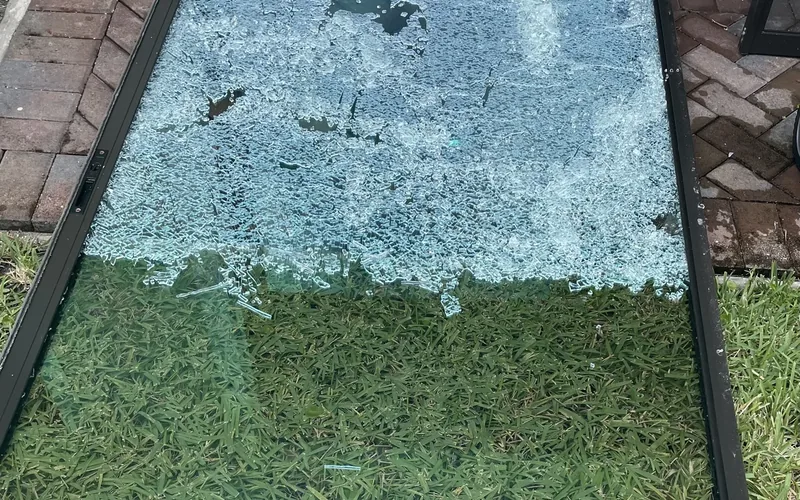
A struck impact pane, cracked but held in place by its laminated interlayer, replaced as a sealed low-E unit inside the original frame.

Send us the opening.

A photo and a rough measurement is enough to tell you whether this is a glass job or a window job. Free consultation, honest answer.

Call Now — 772-722-4036