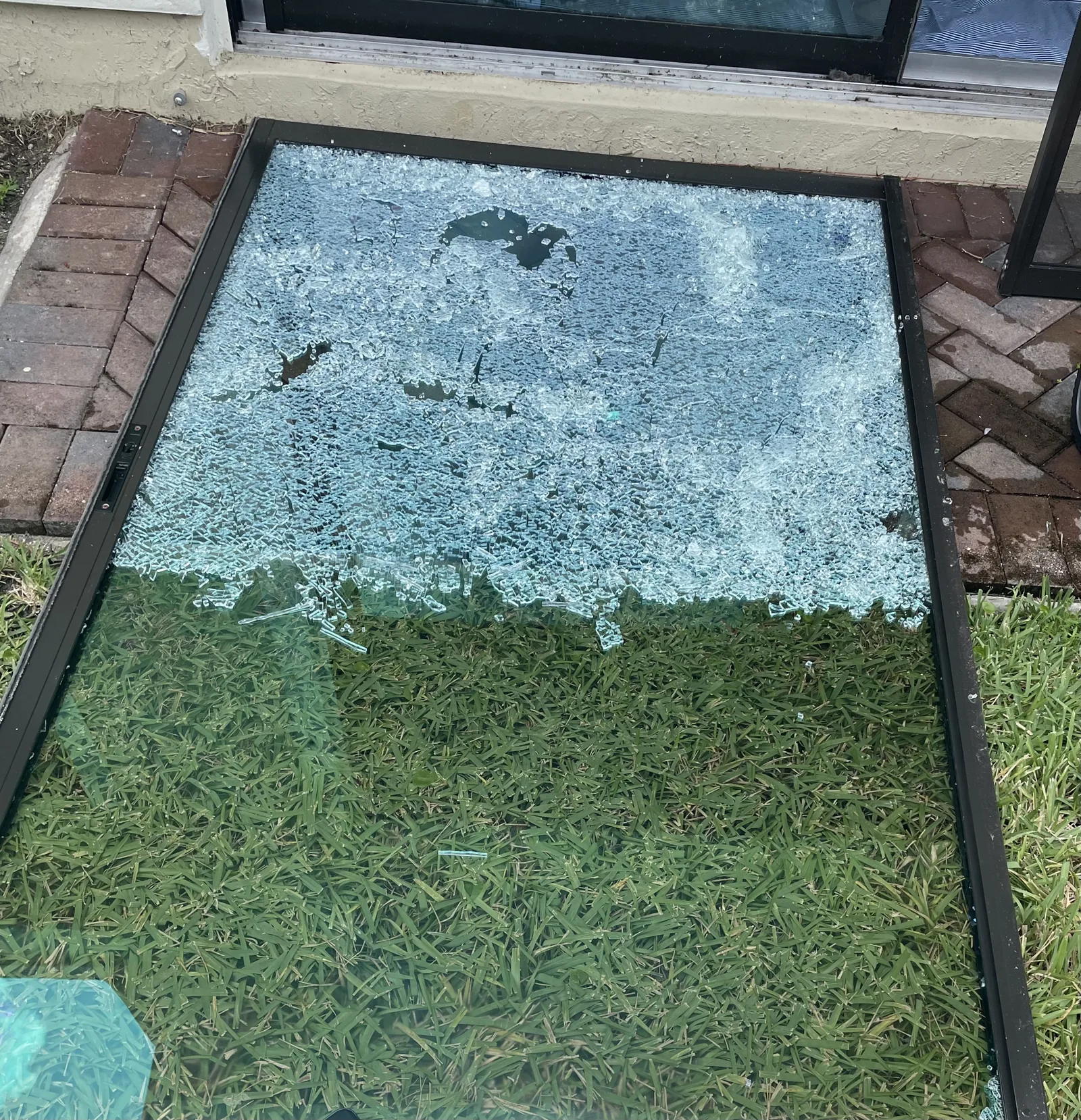
A sliding glass door that shatters by itself had a reason. It just wasn't the moment you heard the bang. Tempered glass carries a flaw quietly, sometimes for years, until that flaw grows past a critical size and the whole pane lets go at once. The three usual culprits are an old chip on the edge, a tiny nickel sulfide stone inside the glass, and a frame or sagging panel that's been squeezing the glass edge against metal.
If the pane went in the last hour, stop reading this and use our first-hour steps for a shattered pane: people and pets out, shoes on, photos before anything moves. Come back here once it's safe. This page is about why it happened, how to tell which cause you had, what to write down for an insurer or an association, and how to keep the replacement from doing the same thing.
Why did my sliding glass door shatter for no reason?
Because tempered glass doesn't fail at the moment of damage. It fails when an existing flaw finally grows big enough to breach the compressed outer skin, and that can happen on a calm afternoon with nobody near the door.
Most patio door glass in Florida is tempered. The surfaces are locked in compression and the core is in tension, which is what makes it strong. We cover how that works and where the fragments end up on our page about sliding door glass replacement, so we won't repeat it here. The part that matters for this question is simple: a tempered pane can't crack a little. Once a flaw reaches the tension zone in the middle of the glass, the stored energy runs the fracture through the entire sheet in a fraction of a second.
So the real question is what started the flaw. Pilkington, one of the large float glass makers, lists the usual starting points in its technical bulletin on spontaneous breakage of tempered glass: hard-body impacts, glass-to-glass or edge contact during installation, deep scratches, frame pressure when edge clearance is taken up, and nickel sulfide inclusions. Each of those shows up on Florida sliders, and each leaves different clues.
Why does a sliding glass door "explode" instead of just cracking?
The loud bang and the sheet of pebbles are what tempered glass is supposed to do. It's a safety design: small blunt cubes instead of long knives. Plain annealed glass, the kind in an old picture frame, can sit with a crack across it for months. Tempered glass has no middle state.
That's also why the word "exploded" tells you something useful. If your door broke into a spider web and stayed in the frame, it probably isn't plain tempered. Laminated and impact-rated units hold together on a plastic interlayer, even when one of the plies inside them is tempered and breaks into cubes. A cracked impact door is a different repair with different rules, and our page on impact glass replacement covers what happened inside that kind of unit.
If yours went to a pile of pebbles on the floor or the patio, you had a tempered pane, and one of the causes below started it.
What is a nickel sulfide inclusion, and can it really break a door years later?
Yes. A nickel sulfide inclusion is a speck of contamination trapped in the glass when it was made. Tempering freezes it in a smaller crystal form, and over months or years it slowly converts to a larger form, pushing on the glass around it until the pane bursts from the inside.
The mechanism is worth understanding because it's the one cause nobody did anything wrong to create. Trace nickel in the raw materials can combine with sulfur in the furnace and form tiny stones, usually well under a millimeter across. During tempering the glass is cooled so fast that the stone gets caught in its hot-temperature crystal phase. Later, sitting in your door, it slowly changes to its normal cool phase, which takes up slightly more room. If the stone sits in the tension zone at the center of the glass, that small growth is enough.
Pilkington's bulletin says this breakage can occur without any load on the glass, even five or ten years after tempering, and that warmer glass makes the change happen faster. It also says plainly that no float glass maker can guarantee the absence of these inclusions, because a stone big enough to break tempered glass is still too small for production scanners to find.
Two practical points follow. First, a nickel sulfide break is rare. Most "for no reason" breaks we're asked about turn out to have an edge or frame cause. Second, it isn't anyone's fault, and there's no maintenance that prevents it. Glass makers do offer a process called heat soaking, which bakes tempered panes to make the weak ones fail in the oven instead of in your house. The same bulletin notes it is never fully effective and carries a slight risk of reducing the temper. It's common on tall commercial buildings and uncommon on residential patio doors.
How do edge chips and stone strikes turn into a break months later?
An edge chip is the most common hidden cause, and the delay is what makes it feel random. Glass under constant stress can grow a crack very slowly, a behavior engineers call static fatigue. A nick that reaches just past the compressed skin can sit there, growing in tiny steps with every temperature swing and every time the door is slid, until one day it crosses the line.
Where those nicks come from on a sliding door:
- Installation. A bottom corner bumped on a slab or a metal frame when the panel was set. Nobody sees it, because the edge sits inside the sash frame.
- Thrown stones. A string trimmer or mower throwing a pebble from the lawn edge or a gravel bed at ankle height. The mark can be smaller than a pencil point.
- Things hitting the glass low down. Patio furniture legs, a pool skimmer pole, a dog's tag on a door that gets pawed every morning.
- Debris in the track. A stone or old fragment dragged along the sill can scuff the bottom rail and, on some door designs, the glass edge itself.
- Tools. A screwdriver or putty knife used to pry a stuck panel or scrape the edge seal.
If the pebbles were thickest and smallest near a bottom corner, or the break looks like it radiated from low on the panel, an edge cause is a good bet.
Can sagging rollers or a slammed door break the glass?
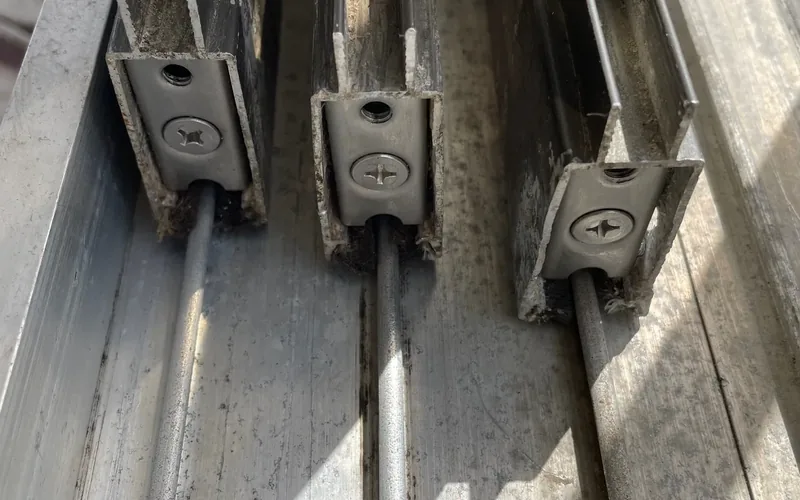
They can. Worn rollers let the panel drop and rack out of square, and a racked sash frame can close up the small clearance that's supposed to keep metal off the glass edge. Slamming a dragging door adds a shock load right where that edge is already pinched.
The glass in a sliding panel floats in its frame. It sits on small setting blocks and is held by a gasket, with a deliberate gap between the edge and the aluminum. Pilkington's bulletin names exactly this failure: movement that takes up the edge clearance and causes localized bearing pressure and crushing. On a house, that's usually slab movement. On a slider, it's usually the door itself.
Here's the sequence. One roller wears or seizes, the panel drops on that corner, and the sash frame twists. Corner screws loosen. Now the frame is a parallelogram, and the glass, which isn't, presses against metal at one or two points. Then someone fights the door because it drags, gives it a shove to get it closed, and it hits the jamb hard. The glass carries momentum the frame doesn't. That's a point load on an edge that's already pinched. If you've been dealing with a door that grinds, jumps or needs two hands, the roller wear signs are worth reading even if your glass is fine.
Doors that have come off the track belong in this category too. A panel that drops out of its rail and lands on one corner gets exactly the hard-body impact the bulletin describes. If yours has derailed even once, our guide to a sliding glass door off its track explains what to check before you lift it back.
Does Florida heat make tempered glass shatter?
Heat by itself rarely breaks a sound tempered pane. Tempering is partly done to make glass tolerate uneven temperatures, and a fully tempered door handles a sunny patio far better than ordinary glass would.
Heat matters in two indirect ways. It speeds up the nickel sulfide phase change, which is why the bulletin notes faster change in warmer glass. And uneven heating, such as the top of a west-facing pane in afternoon sun while the bottom sits in the shade of a lanai roof, adds stress to an edge that already has a flaw. A dark film, a tight blind pressed against the glass, or a grill parked too close concentrates that heat. None of those is likely to break a flawless pane. Each adds to a flaw that's already there.
So if you're told "it was the heat," treat that as part of the answer at most.
How can you tell which cause broke your pane?
Look before the cleanup goes too far. Tempered glass tends to hold together for a moment like a jigsaw puzzle, and the area where the break started often looks different from the rest. Breaks from a nickel sulfide stone often leave two slightly larger fragments side by side at the origin, which glass analysts call a butterfly, with the speck sitting between them. You won't confirm that without magnification, but you can photograph it.
Clues at the scene and the cause they point to
| What you see | Most likely cause | What it means for the replacement |
|---|
| Origin near a bottom corner or edge, door otherwise slid fine | Old edge chip or stone strike | Check what's thrown at ankle height outside; protect the low edge |
| Origin mid-pane, two larger fragments at the center of the break pattern | Nickel sulfide inclusion | Bad luck, not a door fault; no maintenance would have stopped it |
| Door had been dragging, sitting low, or hard to lock | Racked sash frame pinching the glass | Rollers and frame must be fixed first or the new pane is at risk |
| Broke as the door was slammed or forced | Shock load on a pinched or chipped edge | Same as above, plus the track and rollers |
| Door had recently come off its track | Corner impact when the panel dropped | Find out why it derailed before glazing |
| Cracked into a web but stayed in the frame | Laminated or impact unit, not plain tempered | Different product and code rules apply |
Two cautions. These are probabilities, not proof. And a pane that broke because of the frame will often look like a "random" break, because the pressure point was hidden inside the sash. That's why the door's behavior in the weeks before matters as much as the glass on the floor.
What should you document for insurance or your condo association?
Write down what happened while you still remember it, and photograph more than you think you need. We aren't insurance advisors, and what your policy covers is between you and your carrier, but every adjuster and every association manager we deal with asks the same questions.
- Date, time and weather. Note whether it was sunny, during a storm, or overnight, and whether anyone was near the door.
- Wide, medium and close photos of the pane, the frame, the track and the floor before anything is swept. Get the origin area if you can find it.
- The etched stamp in the corner of any remaining glass, and any label on the frame. That identifies the glass type and sometimes the maker.
- What was outside. Was the lawn being cut? Is there a gravel bed or a pool deck within throwing distance?
- The door's recent history. Had it been sticking, coming off track, or hard to lock? Any repairs or storm prep in the past year?
- Anything attached to the glass. Film, decals, a glued-on pet door insert. Pilkington lists stiff adhesives on tempered glass among the stresses that grow cracks.
- Keep a few fragments from the origin in a labeled bag, if they can be collected safely with gloves.
If you live in a condo, the next call after safety is usually the association, because the glass may or may not be your responsibility depending on your declaration. Our guide to who pays for condo sliding door repairs walks through how to find out before anyone orders a pane. Seasonal residents who get a call from a neighbor: ask for these same photos before anyone tidies up.
How do you keep the replacement pane from shattering too?
Fix the reason, not just the glass. A new pane set into a racked frame on dead rollers starts life with the same pinch point the old one had.
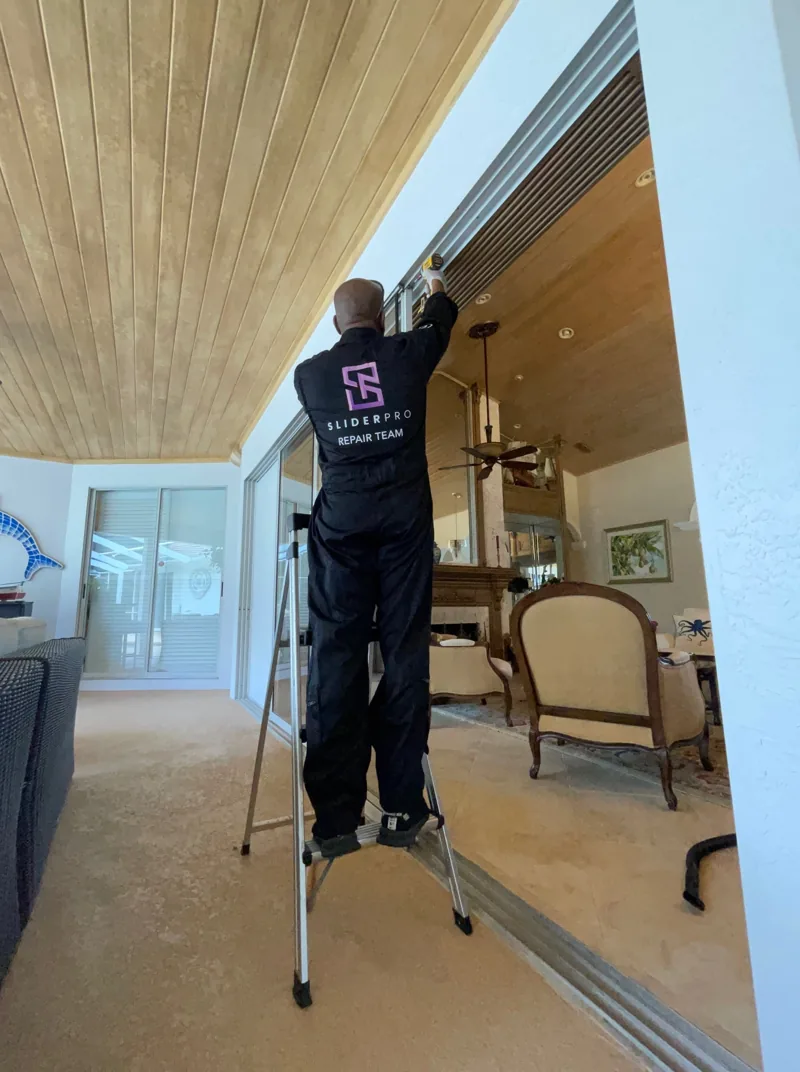
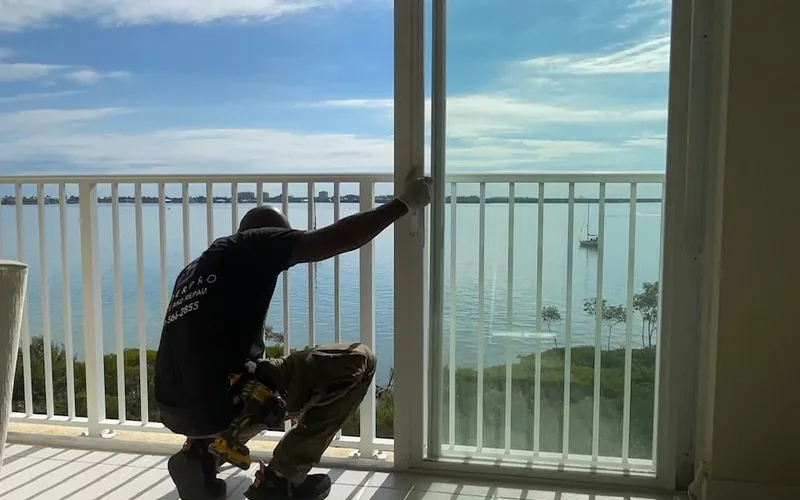
- Get the panel square before it's glazed. Worn or seized rollers should be replaced at the same visit so the sash sits level and the edge clearance is even all the way around. Our roller replacement service includes the track work that usually goes with it.
- Keep the track clean. Grit and old fragments make the door drag, and a dragging door gets shoved. A monthly vacuum and wipe of the track takes care of it.
- Stop slamming. If the door only closes with a shove, something is wrong with the rollers, track or alignment. Get that fixed instead of pushing harder.
- Protect the low edge outside. Point trimmer and mower discharge away from the house, and keep gravel beds back from the glass.
- Look at the edges twice a year. Run your eye along the bottom corners when you clean. A shell-shaped chip in the edge is worth a call.
- Ask about the glass. If a nickel sulfide break worries you, ask whether heat-soaked tempered glass is available for your pane size, and what it adds. Laminated glass is another route, since it stays in the frame when it breaks, though it's heavier and changes what the rollers have to carry.
One more thing on timing. A door with one pane missing has a panel that's lighter on one side, and in hurricane season (June 1 through November 30) an open or boarded opening is a weak point in the house. Don't let a broken pane sit into storm season.
Is the rest of the door ruined?
Usually not. The frame, track and other panels survive a broken pane unless fragments get dragged along the rail and score it, or the panel was forced closed with glass stuck in the track. A broken pane is a glass replacement, plus whatever roller, frame or track problem helped cause it.
The honest exception is an old aluminum door where the sash frame itself is corroded through, bent, or sized for glass nobody makes anymore. Then the conversation turns to whether the door is worth reglazing at all, and our repair versus replace guide lays out how we think about that.
When you're ready, send us photos of the opening, the frame and the track. Include a shot of the door's bottom rail and anything you noticed about how it slid before it broke. Repairs start at $275 and that includes parts, labor and a written 1–3 year warranty. We'll tell you plainly whether your door needs only glass or glass plus the fix that keeps it from breaking again.