A sliding glass door doesn't wear out all at once, so it doesn't have one lifespan. It's a frame, glass, rollers, a track, a lock, seals and a screen, and each of those ages on its own clock. The soft parts go first, the moving parts next, and a sound frame often outlives all of them several times over. So when someone tells you a door is "just old," the useful question is which part is old, because that part can almost always be replaced on its own.
How long does a sliding glass door last?
There's no honest single number, because the door is a dozen parts with different lifespans. Published guidance is thin and general, and the frame, which decides whether a door is worth keeping, routinely outlasts every other part on it.
The most-quoted reference, the 2007 NAHB study of home component life expectancy, doesn't list sliding glass doors at all. Its closest lines are general industry guidance: aluminum windows at 15 to 20 years, with a note that some parts may have to be replaced along the way, vinyl exterior doors at 20 years, and window glazing at 10-plus. The study calls itself a general guideline only, and says life expectancy depends on the quality of installation, the level of maintenance, weather and climate, and how hard the thing is used.
Read that list of conditions again, because it's the whole story. A door on a sheltered inland patio, opened twice a day and maintained, and the same door facing the Atlantic and slammed by renters every week, are not going to age alike. And "aluminum windows, 15 to 20 years" describes when people tend to replace a unit, not when the aluminum stops working. On Florida doors, the frame is very often still fine long after the rollers, seals and lock have been replaced once or twice.
What wears out first on a sliding glass door?
Weatherstrip and screen mesh usually go first, then rollers and lock parts, then the seals on insulated glass. The glass itself and a sound frame sit at the long end. Here's the order, by what actually ages each part:
Relative aging of sliding glass door parts in Florida (general order, not guarantees)
| Part | What ages it | Relative clock | When it fails, you replace |
|---|
| Weatherstrip and pile | UV, heat, compression, friction | Shortest | The strip, not the door |
| Screen mesh | UV, salt film, pets | Short | The fabric, in the same frame |
| Rollers | Weight, grit, salt corrosion of bearings | Short to medium | The roller pair |
| Lock and latch | Use, salt seizing the mechanism, panel sag | Medium | The lock body or keeper |
| Track surface | Worn or seized rollers riding it | Medium, if rollers are kept up | The track cap or a track repair |
| Insulated glass seal | Sun and heat cycling at the edge seal | Medium to long | The glass unit |
| Tempered glass itself | Edge chips, impact | Long, unless damaged | The pane |
| Frame | Galvanic corrosion at fasteners, settling, impact | Longest | The door, only when the frame fails |
Notice the last column. Every line but one is a part swap. That's the core of the argument for repair, and it's why "my door is twenty years old" on its own tells you very little.
How long do sliding door rollers last?
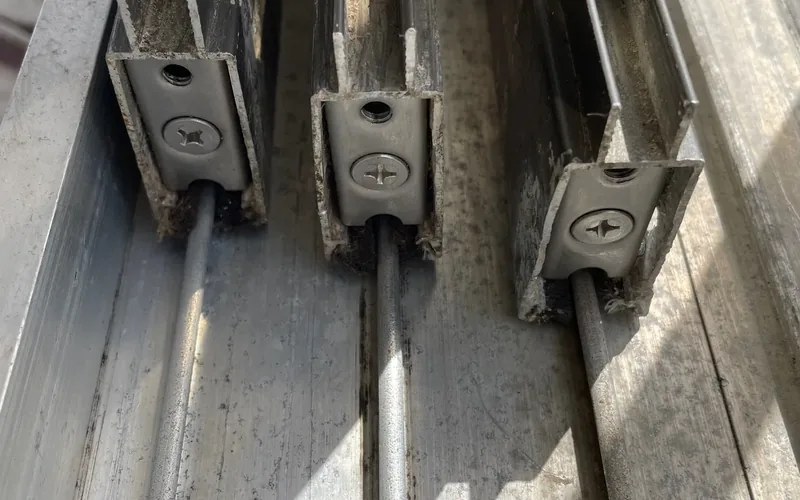
Roller life depends on the bearing type, the panel's weight, how much grit gets in the track and how close the door is to salt water. Open steel bearings near the coast fail soonest; sealed stainless rollers on a clean track last far longer.
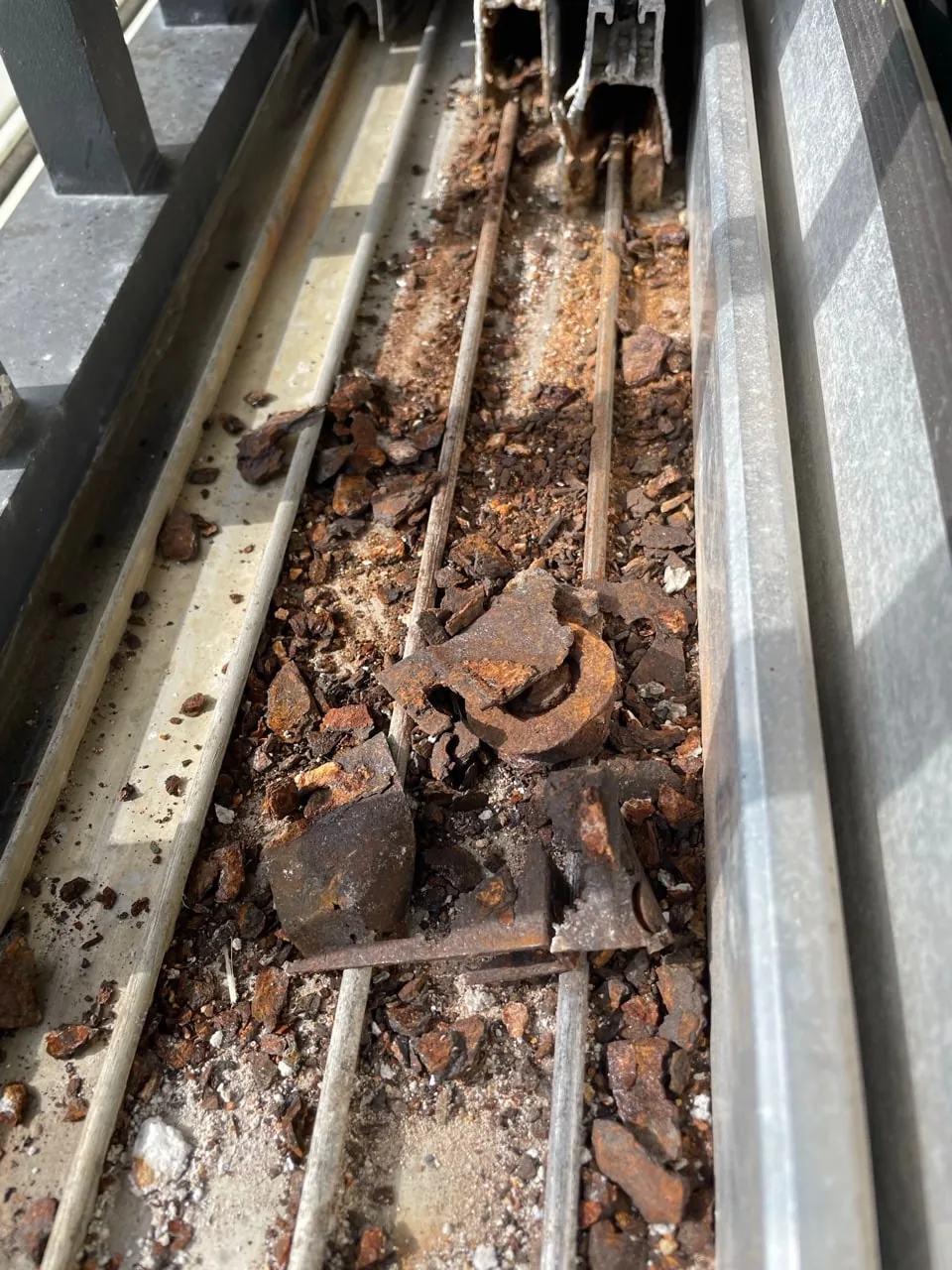
Rollers carry the full weight of the glass panel on a few small wheels, so they're the hardest-working part of the door. They usually die in one of two ways. Grit in the track grinds the wheel and the track against each other. Salt film gets into an open bearing, corrodes it from the inside, and the wheel stops turning and starts skidding. A skidding roller wears a flat, then cuts a groove in the track, and that's when a cheap part turns into a bigger job.
Weight matters too. Impact glass and oversized panels are heavy, and a roller sized for a light single-pane panel wears out quickly under them. If you want the warning signs, our list of signs your rollers need replacing covers them in order. The fix is a roller replacement, which on most doors is done in place without touching the frame.
How long do the glass and its seals last?
Single tempered glass doesn't wear out; it lasts until something chips or breaks it. Insulated glass has an edge seal that eventually lets moisture in, and when it does, the pane fogs. Either way, the fix is the glass unit, not the door.
An insulated glass unit is two panes held apart by a spacer around the edge, sealed, with a desiccant inside the spacer to soak up moisture. Every sunny afternoon heats the air between the panes and every night cools it, so the unit gently breathes against its seal, day after day. Florida sun on a west wall gives it a lot of cycles. Over time the seal lets in a little moist air, the desiccant fills up, and you start seeing haze or droplets between the panes that you can't wipe off. That's a failed seal. The glass is fine; the unit has lost its dry air.
Laminated impact glass has its own aging: the interlayer near the edges can cloud or separate where water has sat against it for years. Again, that's a glass unit problem. Fogged, hazy and cloudy are three different problems with one fix, and our glass replacement page explains the difference. For impact units, the same logic applies to the laminated unit. A fogged pane is not a reason to throw away a working frame.
Does a sliding door frame wear out?
Rarely on its own. A well-made aluminum or vinyl frame usually outlasts every other part on the door. Frames fail from corrosion at fasteners, settling of the opening, or physical damage, not from age alone.
Aluminum protects itself with a thin oxide layer, which is why a frame can look chalky and still be structurally fine. Its real enemy on the coast is contact between different metals. A steel screw in an aluminum frame, with a salty film between them, acts like a small battery, and one of the two metals corrodes into the other. You see it as white powder and swelling around screws and at the sill corners. Caught early, that's a fastener and sealant repair. Left for years, it can eat through the extrusion.
Vinyl doesn't corrode, but it doesn't like heat. Large vinyl sections on a sunny wall expand more than aluminum, and darker colors run hotter. Over years, that can show up as sag or a frame that's no longer quite square. If you're weighing the two materials for a future door, our vinyl vs aluminum comparison goes through the trade-offs.
Coastal or inland: which parts age faster where?
On the coast, salt shortens the life of every metal moving part, especially rollers, lock mechanisms and screws. Inland, heat and sun do more of the damage, mostly to weatherstrip, screen mesh, vinyl and glass seals.
Airborne salt from the Atlantic and the Indian River Lagoon settles on a door every day. Salt pulls moisture from the air and holds a damp, conductive film on metal, and that film is what corrodes bearings, lock springs and fasteners. It's worst on parts that rain never rinses, like the inside of a track and the lock edge of a panel. That's why a barrier-island condo door can need rollers years before an identical door a few miles inland. Our guide to why sliding doors stick in Florida explains the chemistry.
Inland homes around Orlando trade salt for heat, sun and afternoon storms. Rubber and pile weatherstrip hardens and shrinks, screen mesh goes brittle, and insulated glass gets hard thermal cycling. The moving metal parts generally last longer. So the same door model wears out different parts first depending on which side of the state it lives on.
One more factor shortens every clock: sitting closed. A door that doesn't move for six months while the owner is up north lets salt film sit undisturbed on bearings and lock parts. Seasonal homes often come back to doors that worked in April and won't budge in November.
How do you know when to replace a sliding glass door?
Replace the door when the frame itself has failed: corroded through, bent, split, or out of square because the opening has moved. Worn rollers, a stiff lock, tired weatherstrip, a torn screen or a fogged pane are all part replacements.
We cover the general difference between a tired door and a finished one in our guide to choosing a sliding door. Here are four specific checks you can run yourself:
- Measure the diagonals of the frame opening. Corner to corner, both ways, with a tape. If they're within about an eighth of an inch, the frame is square. A large difference that doesn't go away after the panel is adjusted points to an opening that has moved.
- Look at the sill corners and screw heads. White powder is normal surface oxidation. Metal that has swollen, flaked or holed through at the corners is corrosion that has gone structural.
- Sight down the frame. Stand at one end and look along the head and jambs. Straight is good. A bow or kink means impact or settling.
- Find where the water comes in. Water through blocked weep holes or a worn sweep is a repair. Water coming through the frame joints themselves is a frame problem.
Two other honest reasons to replace: the door is so old and obscure that no workable part can be matched or adapted, and several parts have failed at once on a door whose frame is also marginal. Or you simply want something the old door can't give you, like impact glass in a home without shutters. We're a repair company, so when replacement is the right answer we'll say so and tell you what to look for. The planned repair vs replace guide lays out the decision in full.
What makes a sliding glass door last longer?
Keep the track clean, keep the door moving, deal with dragging the week it starts, and on the coast, have the hardware serviced every year. Most of a door's life is decided by how long a worn roller is left running.
- Clean the track. Grit is the single biggest wear factor on rollers and tracks. A vacuum, a stiff brush and a damp cloth take about ten minutes.
- Skip the oil sprays. Oil holds sand against the parts it's meant to protect. Dry silicone on a clean track, or nothing.
- Act when it starts to drag. A roller replaced on time is a roller job. A roller ridden into the track is a roller and track job.
- Rinse salt off coastal doors now and then with fresh water, especially the track and the lock edge, and dry them.
- Keep the drainage open. Clear weep holes stop water sitting in the sill, which is where frame corrosion starts.
- Book a service visit before you close up for the season. Our maintenance and tune-up visits cover every slider in the house.
Your door is old. What's the next step?
Find out which part is old. On most Florida sliders that's rollers, weatherstrip, a lock or a screen, and the frame has years left. A repair that replaces the worn parts resets most of the clocks at once. Repairs start at $275 including parts, labor and a written warranty of 1 to 3 years. Send us photos of your door, including the bottom corners, the lock edge and any fogged glass, and we'll tell you honestly which parts are done and whether the frame is worth keeping.