Short answer: The seven signs, in the order they usually appear: the door takes more effort, it makes a faint grind, it shudders or bumps, it jumps the track, the latch stops lining up, metal dust or a groove shows in the track, and finally it barely moves. Confirm it with a one-minute lift test. The earlier the stage, the cheaper the repair, because the late stages damage the track.
Sliding door rollers almost never fail suddenly. They fail in a sequence — a progression of sounds and sensations that plays out over months or years, each stage a little more expensive to fix than the last. Homeowners live with the early signs so gradually that they recalibrate what "normal" feels like; we regularly service doors whose owners genuinely forgot a slider could move with one finger.
Here are the seven signs in the order they usually appear. Find where your door sits on this list, and you'll know roughly how urgent — and how big — the repair is.
1. The door needs a little more effort than it used to
The earliest sign is the subtlest: the door still works, but the one-finger glide became a one-hand push. This is bearing wear beginning — the rollers still turn, just with friction they shouldn't have. Caught here, the fix is the simplest version of a roller replacement, and the track is almost certainly still perfect.
2. A faint grinding or gritty sound
Sound is diagnostic. A healthy roller is nearly silent; a light grind or gritty shhh means either debris in the track (clean it — here's the routine) or bearings beginning to corrode internally. If the sound survives a thorough track cleaning, it's the bearings, and it will not improve on its own — Florida's salt air only pushes one direction (here's the chemistry).
3. Shuddering, bumping, or uneven travel
When the door bumps or shudders rhythmically as it moves, the roller wheels have developed flat spots — sections worn or corroded flat that thunk with each rotation, like a car tire with a flat patch. This is the sign that wear has become damage. The door still operates, but every cycle now hammers the track. This is the stage where acting saves real money.
4. The door jumps or derails from its track
A door that hops its track — even once — is telling you its rollers no longer hold it in stable alignment. Homeowners often muscle the panel back on and carry on, but each derailment bends track edges and stresses the frame, and the door will do it again with increasing enthusiasm. Repeated re-railing is how a roller job becomes a roller-and-track job.
5. The latch stops lining up
Worn rollers let the panel sag, and a sagging panel carries its latch below the keeper it's supposed to catch. First the lock needs a "jiggle," then a lift-and-hold, then it simply won't catch. Understand what this means: your home's largest entry no longer locks. It's also a genuine energy leak — the door isn't seating against its weatherstripping. (More on the alignment mechanics in our lock-alignment explainer.)
6. Visible metal dust or grooves in the track
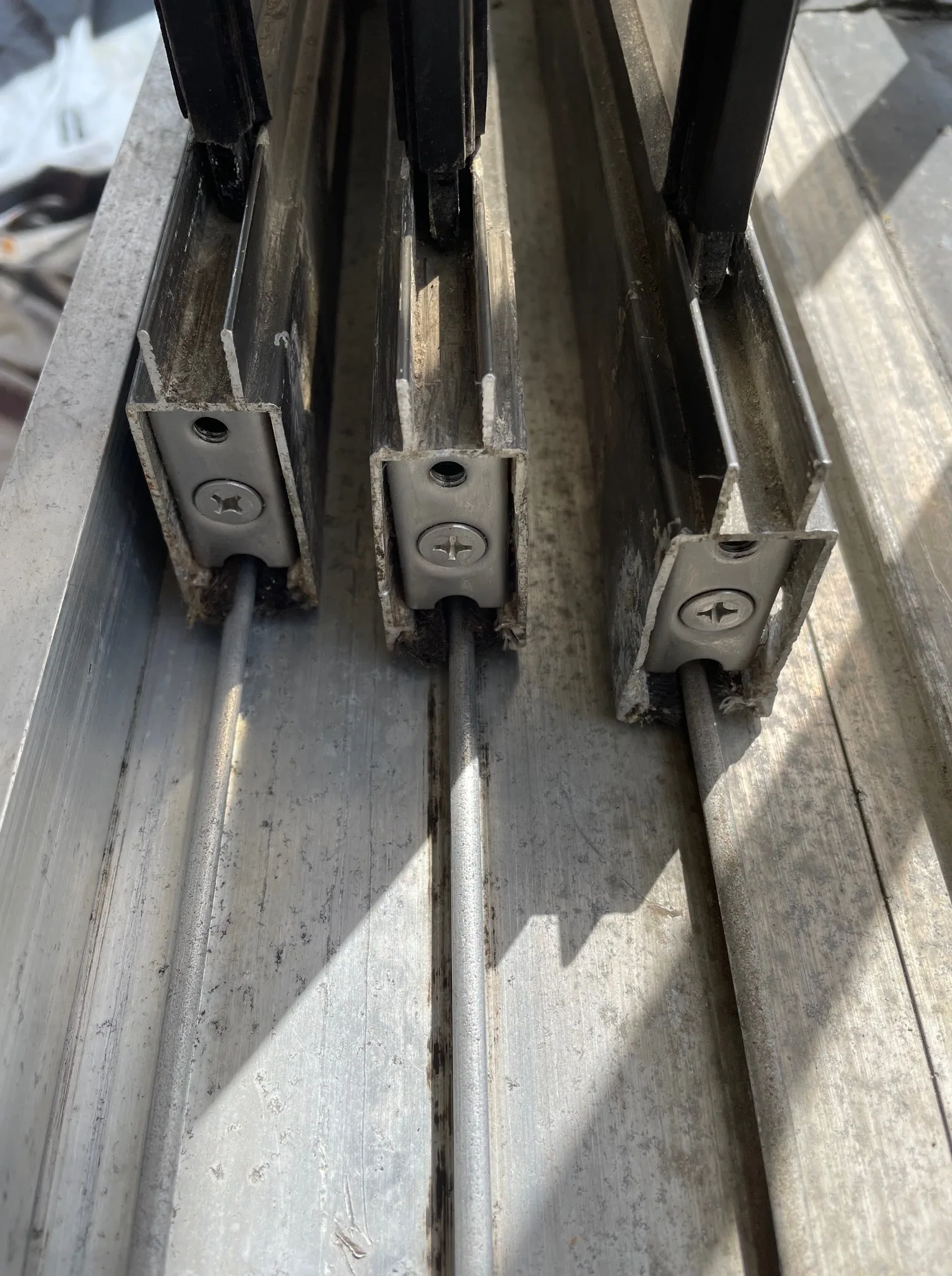
Look at the track: fine gray-black metal dust, shiny scraped lines, or an actual groove worn into the rail means the door has stopped rolling and started skidding — dead bearings dragging steel across aluminum with every cycle. The dust is your track, being machined away. Every operation of the door now adds cost to the eventual repair.
7. The door barely moves at all
The end state: bearings seized solid, wheels ground flat, often with corrosion fusing components. Owners describe "putting my whole body into it." At this stage the roller replacement is guaranteed and the only open question is how much track and frame damage accumulated on the way here. Even now, repair almost always remains far cheaper than door replacement — but it didn't need to get this expensive.
The honest summary
Stages one and two are maintenance-priced. Stages three through five are still routine repairs, with the track usually salvageable by dressing during service. Stages six and seven work fine too — we fix doors in that condition weekly — but the accumulated track damage is money that early action would have kept in your pocket.
Wherever your door is on this list, the trajectory only runs one way. Tell us which signs you're seeing — the symptom pattern usually tells us what we'll find before we open the door up, and the quote is free.
The one-minute lift test: is it really the rollers?
Before you buy anything, make the door prove the diagnosis. This takes a minute and needs no tools.
Open the door about halfway. Grip the leading edge with both hands and lift the panel gently — you are trying to take a little weight off the wheels, not to remove the door. Now slide it. If the panel that fought you a second ago moves easily while you hold weight off the rollers, the rollers are your problem. You have just unloaded them, and the door has told you what it wants.
Two variations sharpen it. With the door closed, lift the handle edge and try the latch: if it lines up when lifted and misses when released, the panel has dropped and the rollers dropped it. And with the door open, rock the panel gently side to side in its track. A healthy door barely moves; a panel that rocks or knocks has worn housings, not just worn wheels.
If lifting changes nothing at all, the drag is coming from somewhere else — packed track grit, a bent rail, a full head channel, or an opening that has settled. Those are covered in the sticking-door guide.
What do worn rollers look like when we pull them out?
Owners almost never see the parts that failed, which is part of why roller wear is so easy to live with for years. Here is what typically comes out of a Treasure Coast door.
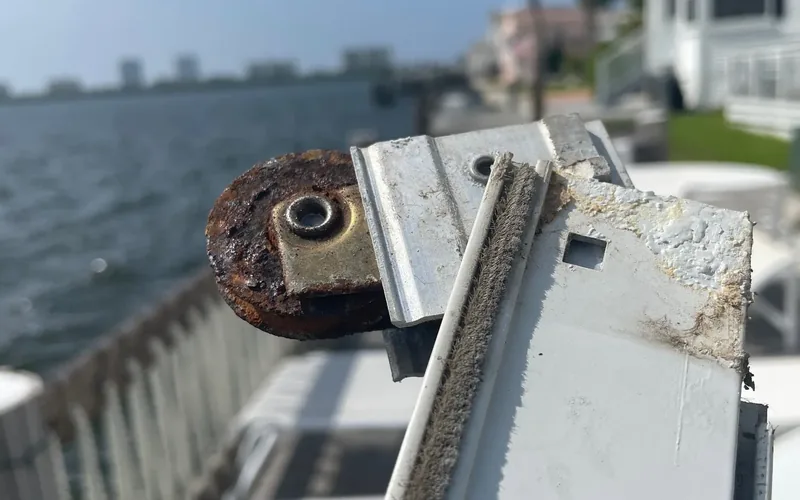
- Flat facets on the wheel. Nylon wheels do not wear round, they wear flat where the panel has rested. Those flats are what you feel as the rhythmic bump in stage three.
- A pitted bearing race. The steel raceway inside the housing loses its mirror finish and develops rust-brown pitting. This is the failure that matters and the one you cannot see from outside.
- A collapsed cage. On the worst cases the ball cage has broken up and some of the balls are simply missing, ground into the paste at the bottom of the housing.
- Gray paste packed solid. Sand plus old oil-based spray plus corrosion products makes a compound with roughly the character of valve grinding paste, and it fills the housing.
- A seized height screw. The adjustment screw corrodes into its own threads, which is why so many doors cannot be brought back up by adjustment alone.
The tell that trips people up: a roller can look perfectly serviceable from the wheel face while the race behind it is destroyed. If the wheel does not spin freely under finger pressure with the panel out, it is finished regardless of how it looks.
What if it isn't the rollers? Four things that imitate roller wear
A heavy door is a symptom, not a diagnosis. Four other faults produce almost exactly the same feel, and all four get misdiagnosed as rollers regularly.
- Packed track grit. The cheapest possible cause. If a proper dry vacuum and brush of the rail transforms the door, the wheels were fine. Our track routine settles this in ten minutes.
- A rolled or bent rail. The signature is different: the door runs normally for most of its travel and binds hard at one specific point. Roller wear is felt everywhere along the run; rail damage is felt at a place.
- A full head channel. The upper channel collects lint, cobwebs and paint overspray, and a dragging top edge feels identical to a dragging bottom one from standing height. Look for a bright rub line along the top edge of the panel.
- A settled opening. If the house has moved, the panel can be perfectly hung and still bind, because the frame is no longer square around it. Measure the diagonals of the opening; on a square opening they match.
The lift test above separates most of these in under a minute, which is why we run it before quoting anything.
Why does one failed roller mean replacing the pair?
A fair question, and the answer is not upselling. It comes down to three things.
They are the same age with the same exposure. Both rollers were fitted on the same day, in the same track, breathing the same salt air. When one has failed, the other is on the identical wear curve a few months behind it. Fitting one new roller alongside one four-fifths-dead roller buys you a short reprieve, not a repair.
A mismatched pair reintroduces the tilt. A new roller and an old one do not sit at the same height or roll with the same resistance, so the panel hangs slightly out of square from the moment the job is finished. That is the exact condition that pulls a latch off its keeper and drags a panel against its jamb.
The wheel is not the cost, the panel is. Nearly all the work in a roller job is safely removing and rehanging the panel and servicing the track while it is out. The second roller adds a few minutes to a job you are already paying for. Fitting one now means paying the whole labor again shortly, usually within the year.
On four-panel and pocket systems the same logic extends to the other moving panels, and we will say plainly which ones can wait.
What kind of rollers are on Treasure Coast doors?
There is no universal sliding door roller. There are hundreds of patterns, and choosing by wheel diameter alone is the most common way a homeowner ends up with a part that does not fit.
- Single versus tandem. A single roller carries one wheel per housing; a tandem carries two wheels on a pivoting frame so the load spreads across the rail. Heavier panels — impact glass especially — belong on tandems, and plenty of heavy panels left the factory on singles.
- Nylon wheels. Quiet, cheap, and prone to flat spots under sustained load. Common on boom-era builder doors.
- Plated steel. Harder wearing, but the plating is a coating over steel and in coastal air it fails from the bearing outward.
- Sealed stainless bearing assemblies. The specification worth paying for near the water. The seal keeps the salt film out of the race, which is the part that actually kills a roller.
The identification mistake we see most often is a homeowner pulling the inner roller out of its housing and taking that to a supplier, leaving the housing in the door. The housing is the part that has to match: its length, its mounting hole spacing, how it drops or slides into the stile, and where the adjustment screw is accessed. Photograph the housing in place before removing anything, and measure the wheel diameter as a check rather than as the answer. Our roller replacement page covers what we carry and how we identify a pattern on site.
What does your door's build era predict about its rollers?
Three generations of sliding door dominate this coast, and each one fails on its own schedule.
- 1970s and 1980s aluminum. Plated steel wheels in open housings, with no seal between the salt air and the bearing. The good news is that the frames were overbuilt and the panels are light, so these doors take new stainless hardware beautifully and run for another decade. The bad news is that whatever is in them now is decades past its design life.
- The 1998 to 2006 boom build. Rollers specified to a price across an entire phase, which is why sticking doors show up street by street rather than house by house. If two neighbors mention it in the same month, the cohort is aging out.
- Post-2005 impact glass. Laminated impact panels became normal after the statewide code took effect in 2002, and they are dramatically heavier than the single-pane doors most roller patterns were designed around. Fitted with hardware barely uprated from the standard-glass version, they flatten wheels early. The fix is a tandem assembly rated for the panel's real weight, not the catalog default.
A door whose rollers failed at five years old was under-specified. A door whose rollers lasted thirty simply reached the end. The repair is the same; the expectation you should have afterward is not.
Why do rollers die faster on the barrier islands?
Every competitor page asserts that salt air is hard on doors. Here is the actual mechanism, because it explains why the bearing goes long before the wheel does.
Surf generates an aerosol of salt water that settles on every exposed surface downwind. Salt is hygroscopic: it pulls moisture out of humid air and holds it against metal as a thin brine film. That film is an electrolyte, and an electrolyte between dissimilar metals makes a battery. Inside a roller you have exactly that — steel components sitting in an aluminum housing, in an aluminum track. The aluminum is the anode, so it corrodes preferentially and swells as it turns to oxide, which is why a seized roller often has to be driven out of a housing it once dropped into.
The bearing race makes it worse. It is a tight crevice, sheltered from rain, never rinsed, and permanently damp once the film establishes. Crevice conditions concentrate chloride and accelerate pitting well beyond what the exposed surfaces show. That is why a roller can look fine and be finished.
In practice, directly ocean-facing doors on Hutchinson Island and along A1A can seize in five to seven years without maintenance. Brackish lagoon and river frontage runs slower. Inland, west of US-1, rollers usually die of grit and use instead. Same part, three very different lifespans.
What happens if you just keep sliding it?
Doors in stage six or seven still work, after a fashion, and plenty of households live with them for years. It is worth being clear about what that costs.
A seized wheel is no longer a wheel. It is a skid, dragging a couple of hundred pounds of glass across soft aluminum, and it machines a groove into the rail a fraction deeper with every pass. Once that groove exists, new rollers dropped into the same track will run in it and fail early unless the rail is dressed or a cap track fitted. A roller job has quietly become a roller and track job.
Derailments do their own damage, rolling the lip of the rail over each time the panel is muscled back on. Forcing a heavy panel also loads the corner joints of the frame, and on older doors those joints do let go.
Then there are the consequences that have nothing to do with parts. A sagging panel does not seat against its weatherstrip, so conditioned air leaks continuously. And it does not present its latch to its keeper, which means the largest opening in your house is not locking. Households adapt to that faster than they realize. The alignment guide covers what that costs you.
Adjust, repair or replace: when is each the right call?
Three genuinely different answers, and the honest version is that only one of them is common.
Adjustment alone. Appropriate when the wheels still spin freely, the door glides without noise, and the panel is simply sitting a little low or slightly out of square. Turn the height screws, restore the reveal, done. If a height screw is seized in its threads, which is common in coastal doors, adjustment is off the table.
Repair — a roller pair plus a track service. This covers essentially everything else on the seven-sign list: noise, drag, flat spots, sag, derailment, seizure. It is what the overwhelming majority of doors need, and it restores the frame and glass you already own.
Replacement. Genuinely right when the frame has corroded far enough that fasteners no longer hold, when the sill or the structure behind it has rotted, when the opening has settled beyond what rehanging can correct, when you are adding impact glass and changing the whole assembly anyway, or when the system is genuinely orphaned with no aftermarket part available. That last one is rarer than replacement salespeople suggest, and we check before saying it.
We do not sell replacement doors, which means the recommendation costs us nothing to make honestly.
What does a roller replacement visit actually involve?
Most owners have never watched one, so here is the sequence.
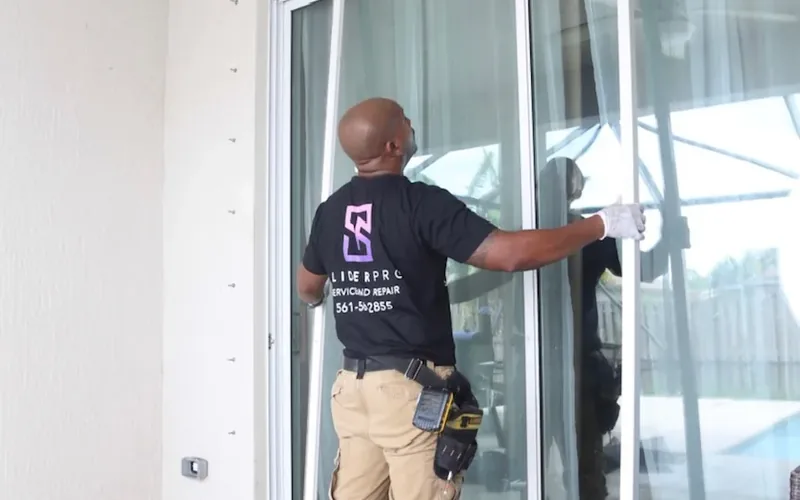
We start with the lift test and a look at the track, because the diagnosis decides the parts. Then the panel comes out: stops and anti-lift blocks released, the panel lifted up into the head channel and swung clear at the bottom. Impact glass is a two-technician lift and is treated as one, because a dropped laminated panel damages far more than itself.
With the door out, the track gets the clean it can never get in place — the roller channel, the corners, the underside of the rail, the weep passages. If the rail is grooved we dress it or fit a cap track, because dropping new rollers into an old groove wastes them. Roller pattern is identified from the housing, and sealed stainless assemblies rated for the actual panel weight go in.
Then the door is rehung, the height set on both screws until the reveal is parallel top to bottom, and the latch tested against its keeper with the panel where it now belongs. Nine times out of ten a lock that had stopped catching starts catching again at this point, because it was never broken.
Repairs start at $275, including parts, labor and a one to three year warranty. Same-day service is available and 96% of jobs are finished in one visit.
Condo, rental and seasonal doors: who calls, and when?
Three situations change the answer to "who deals with this" more than the door itself does.
Condo and association buildings. Florida declarations usually treat a balcony as a limited common element and split the door across the boundary. Operating hardware — rollers, latch, screen — most often sits with the unit owner, because it wears with your use of the unit, while the frame is more often association property. That means a roller failure is usually yours to fix, and owners routinely wait months on a board for a repair the board was never responsible for. This is general information, not legal advice; read your own declaration, and put anything touching the frame to management in writing. Our condo guide covers the clauses.
Rentals. Roller wear is the cheapest problem on a rental door and the one most likely to produce an evening phone call once it becomes a derailment. A 90-second glide check at each turnover catches it at stage one. The full routine is in the rental checklist.
Seasonal homes. Rollers corrode fastest in doors nobody moves, because motion is what wipes the salt film off the race. Service the doors when the house is closed up and check them at arrival, before anyone puts a shoulder into a seized panel and bends the rail.