Sliding doors have become a popular feature in modern homes, offering a stylish way to connect indoor and outdoor living spaces. They bring in natural light, enhance views, and add a sleek aesthetic to any property. However, choosing the right sliding door for your home involves considering a range of factors—from functionality and energy efficiency to security and design. In this guide, we will walk you through the key aspects to consider and help you make an informed decision that suits both your lifestyle and home design.
Understanding Your Needs
Before you start exploring the various options available, it’s important to understand what you need from a sliding door. Ask yourself the following questions:
- Purpose: Do you want the door primarily for aesthetics, or is functionality and security also a priority?
- Usage: How frequently will the door be used? A high-traffic area may require a more durable option.
- Space Constraints: Consider the layout of your home. Does the space require a door that maximizes natural light, or do you need extra insulation and security?
- Budget: Determine how much you are willing to invest. Remember, while some options may have a higher upfront cost, they might offer long-term savings through better energy efficiency and lower maintenance requirements.
Understanding these needs will serve as a guide when you’re reviewing the different features and options available.
Key Factors to Consider
When selecting a sliding door, there are several key factors you should evaluate:
1. Material and Durability
Sliding doors are available in various materials such as wood, aluminum, uPVC, and composite materials. Each comes with its own advantages:
- Wood: Offers a classic look with excellent insulation but may require more maintenance.
- Aluminum: Known for its strength and durability, it is also low-maintenance. However, it might not provide the best thermal performance unless properly insulated.
- uPVC: Provides good insulation and requires minimal maintenance. It is often more affordable than wood or aluminum.
- Composite: Combines the best features of different materials, offering a balance of strength, insulation, and low maintenance.
Consider the climate in your region and the amount of maintenance you’re willing to perform. A well-chosen material will not only enhance the look of your home but also ensure longevity and performance.
2. Energy Efficiency
One of the most important aspects of modern sliding doors is energy efficiency. Poorly insulated doors can lead to significant energy loss, impacting your heating and cooling costs. Look for doors with the following features:
- Double or Triple Glazing: Multiple layers of glass help trap air, providing better insulation.
- Low-E Coatings: These coatings reflect heat, helping maintain your home’s temperature while reducing energy consumption.
- Proper Sealing: Ensure that the door fits snugly within the frame to minimize drafts.
Investing in an energy-efficient sliding door can result in long-term savings and a more comfortable living environment. Professional installers, such as those at SliderPro, ensure that every door is fitted perfectly, maximizing its energy-saving potential.
3. Security Features
Security is a major concern for any home. Sliding doors can sometimes be a vulnerable entry point if not properly designed or maintained. When choosing a sliding door, consider these security features:
- Reinforced Frames: A strong frame is essential to prevent forced entry.
- Quality Locks and Deadbolts: Look for doors that offer advanced locking mechanisms, such as deadbolts that provide extra protection.
- Tempered or Laminated Glass: These types of glass are more resistant to breakage, offering an added layer of security.
A secure sliding door not only protects your home but also provides peace of mind. If you’re looking for professional advice or a security upgrade, contact SliderPro at 772-722-4036 or visit our contact page for expert guidance.
4. Aesthetics and Design
Sliding doors are often a focal point of a home’s design. They should complement your architectural style and interior décor. Consider the following design aspects:
- Color and Finish: Choose a finish that matches or enhances the exterior of your home. Whether you prefer a natural wood look or a modern metallic finish, there are plenty of options available.
- Glass Options: Clear, tinted, or frosted glass can affect the overall look and functionality. Clear glass offers unobstructed views, while tinted glass can reduce glare and heat gain.
- Frame Design: The design of the frame can add a unique touch to your sliding door, influencing both style and performance.
The right combination of aesthetics and functionality can transform your living space. A well-designed sliding door adds curb appeal and creates a seamless flow between indoor and outdoor areas.
5. Installation and Maintenance
Even the best sliding door will not perform well without proper installation and regular maintenance. Consider these points when making your decision:
- Professional Installation: Ensuring that your door is installed correctly is key to its longevity and performance. Professional installers can assess your space, ensure a perfect fit, and adjust the door for smooth operation.
- Ease of Maintenance: Look for doors that are easy to clean and maintain. Regular upkeep, such as cleaning the tracks and lubricating the rollers, will help prolong the door’s life and maintain its appearance.
SliderPro offers comprehensive installation and maintenance services to ensure that your sliding door continues to operate at its best. For more information, visit https://www.sliderpro.com/ or call 772-722-4036.
Making the Final Decision
Choosing the right sliding door for your home involves balancing a variety of factors including material, energy efficiency, security, aesthetics, and maintenance. Take the time to evaluate your needs and compare different options. Consider consulting with professionals who can provide expert advice tailored to your specific situation.
For homeowners who value quality, efficiency, and peace of mind, investing in a high-quality sliding door and professional installation is a decision that pays off over time. A well-chosen sliding door not only enhances the beauty of your home but also contributes to energy savings and overall safety.
Conclusion
In today’s market, there is no shortage of options when it comes to sliding doors. Whether you prefer a traditional wooden door or a modern aluminum or uPVC option, the right door can transform your home’s interior and exterior. By focusing on key factors such as durability, energy efficiency, security, design, and professional installation, you can choose a sliding door that meets all your needs and enhances your home’s value.
Remember, making an informed decision today can lead to long-term benefits. If you need further guidance or professional installation services, contact SliderPro Doors and Window Service at 772-722-4036, visit https://www.sliderpro.com/, or reach out through our contact page. Let us help you select and install the perfect sliding door that brings beauty, functionality, and value to your home.
Tags:
- Door Maintenance
- Home Improvement
- Home Security
- Energy Efficiency
- Window Service
- Architectural Trends
- Professional Installation
First, the question the brochures skip: does your current door actually need replacing?
Almost everyone who researches a new sliding door starts because the one they have has become unpleasant to use. It sticks, it grinds, it will not lock, the screen is torn. Those are hardware symptoms, and hardware is the part of a sliding door designed to be replaced.
The frame and the glass are the door. Rollers, tracks, latches, mortise locks, handles, weatherstrip and screen mesh are consumables sitting inside it, and on a sound frame every one of them is a repair rather than a reason to start over. A door built in 1998 with a straight frame and clear glass has decades left in it; what has expired is a set of wheels that cost a fraction of the assembly around them.
This matters because replacement is where the money in this trade is, and two of the strongest companies in most Florida searches sell installs rather than repairs. That does not make them dishonest, but it does mean the first opinion you get is frequently from someone whose product is a new door.
So before you read another word about frame materials: have someone look at what you own and tell you what is actually failing. We repair for a living, and we still say plainly when a door is finished. The section below is how you tell the difference yourself.
How do you tell a tired door from a finished one?
A tired door is unpleasant. A finished door is structurally past the point where fixing it makes sense. They feel similar from the handle and they are not the same thing.
Signs of a tired door, which is a repair:
- It drags, grinds or shudders, but the frame is square and the glass is clear.
- The latch misses its keeper because the panel has dropped a few millimeters.
- The track has a groove worn into it by failed rollers.
- Weatherstrip has gone hard, the screen mesh is chalky, water stands after rain.
- The handle is loose or the lock feels vague.
Signs a door may genuinely be finished:
- The frame itself is bent, split, crushed, or corroded through rather than just stained.
- The threshold or the surrounding structure has settled, so the opening is no longer square.
- Multiple panes are cracked or have failed seals on a door that also needs everything else.
- The system is old enough and obscure enough that no part can be matched or adapted.
- Water is entering through the envelope rather than through blocked weep holes.
Hold a straight edge along the outer frame and sight down it. Frames that read straight are worth keeping. If your door lands entirely in the first list, the repair economics will make the decision for you.
What does salt air actually do to each frame material?
Generic material advice assumes a generic climate. Within a few miles of the Atlantic or the Indian River Lagoon, the ranking changes, and it changes for reasons worth understanding.
Airborne salt aerosol settles on every exposed surface and is hygroscopic, meaning it pulls moisture from the air and holds a conductive film against metal long after the last rain has dried. That film is what drives corrosion here, and it treats each material differently.
- Aluminum forms a protective oxide layer and survives well as a frame. Its weakness is contact with dissimilar metals: a steel fastener in an aluminum frame, with a salt film between them, is a galvanic cell, and the screw corrodes into its hole. Anodized and quality powder-coated finishes hold up; bare mill finish pits and chalks.
- Vinyl does not corrode at all, which is a genuine advantage. Its Florida problem is heat and UV rather than salt. Large vinyl sections on a west-facing wall expand more than aluminum, and dark colors on unreinforced sections are where sag and racking come from.
- Fiberglass is dimensionally stable in heat and immune to salt, which makes it a strong coastal choice. It is the most expensive of the common options and the least widely stocked.
- Clad wood looks superb and asks the most of you. The cladding protects the wood only while it is intact; any breach near a coastal opening admits moisture into a material that has nowhere to dry.
Whatever the frame, the hardware inside it is a separate decision, and it is the one that decides whether the door still slides in year eight.
Impact, laminated and low-E: what does Florida sun and weather actually demand?
Glass gets discussed as a single upgrade, when it is really three separate decisions.
Impact rating is about wind-borne debris. Impact glass is laminated: two panes bonded around a tough interlayer, so a strike cracks the glass but the interlayer holds it in the opening. The door retains the building envelope rather than surrendering it mid-storm. Whether your opening requires it depends on your location and your permit history, and that is a question for your county building department rather than a salesperson.
Laminated without an impact approval is a different product. It brings the same interlayer benefits for security and sound and much of the UV blocking, without carrying a tested assembly approval. If a quote says "laminated," ask specifically whether the assembly is impact approved, because those words are not interchangeable.
Low-E coating is a microscopically thin layer that reflects infrared. In Florida the job is keeping heat out, not warmth in, so the useful specification is a low solar heat gain coefficient rather than the insulation-focused numbers quoted in northern markets. It matters most on west-facing glass, which takes the full afternoon load.
One honest caveat: glass upgrades do nothing about air moving around the panel. If the room is uncomfortable, run the leak test before you assume the glass is the problem, because seals and alignment are usually cheaper and often the real culprit.
Rollers, tracks and hardware: the parts that decide whether it still slides in year eight
This is the section missing from almost every buying guide, and it is the one that determines how the door feels for the rest of your ownership. Frames and glass rarely fail. Hardware always does, and how long it takes is a specification decision made before the door was ever installed.
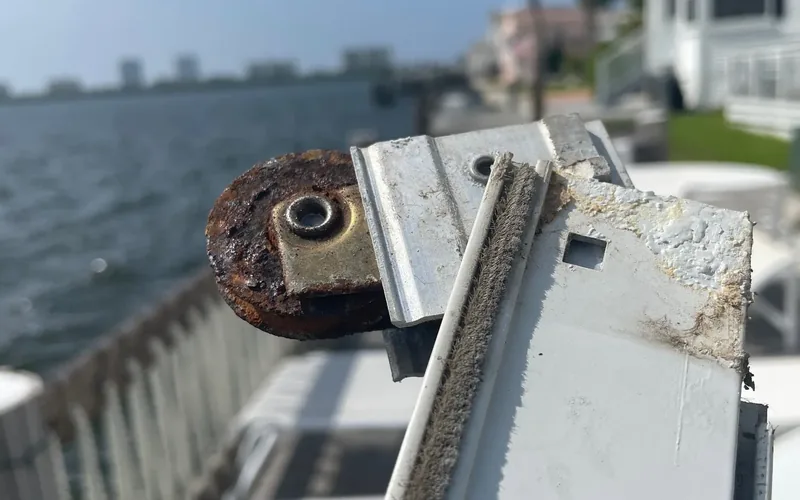
Rollers are where builder economy hides. Plated steel wheels on open bearings are perfectly adequate in a dry climate and are a countdown timer in coastal Florida, because salt film reaches the bearing and corrodes it from the inside where no lubricant goes. Sealed bearings keep that film out; stainless construction resists what gets past. Ask what is in the door you are buying, and ask whether the roller is rated for the weight of the panel it is carrying, because heavy impact panels are frequently fitted with hardware designed for light single-pane ones.
Tracks matter almost as much. A soft aluminum track is what a failing roller grooves. Stainless-capped or stainless-inserted tracks cost more up front and change the failure mode entirely.
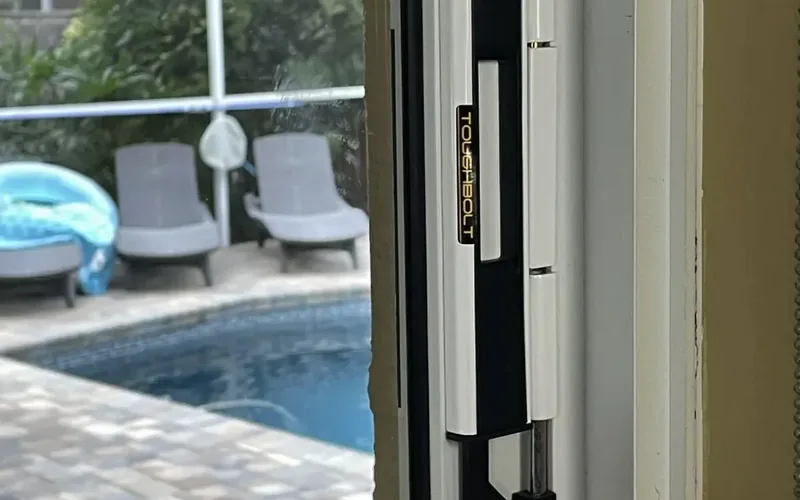
Locks come as mortise bodies buried in the panel edge. A vague, sticky factory latch on a new door does not improve with age. Security hardware is straightforward to upgrade later, but the mortise itself is easier to specify well now.
A well-specified door on ordinary hardware will disappoint you by year eight. It is the cheapest line item to get right and the most expensive one to fix afterward.
Screens for the Treasure Coast: mesh, no-see-ums and salt exposure
The screen is usually an afterthought on a quote and the component you will interact with most, because it is the one that stands open all season.
Mesh is the decision. Standard fiberglass mesh is the default and the cheapest, and it does the ordinary job. Its weakness here is UV: over a few Florida summers it chalks, loses tension and eventually tears at the spline. Tighter weaves stop no-see-ums, which ordinary mesh does not, at the cost of some airflow and visibility. Heavier pet-resistant weaves survive claws and children. Solar screen fabrics cut heat load on a west-facing patio and darken the view noticeably.
Which one is right depends on your micro-climate rather than your budget. Homes near mangroves and still water contend with no-see-ums that walk straight through standard mesh, while a breezy oceanfront balcony may not need the tighter weave at all. The mesh field guide walks through matching fabric to location.
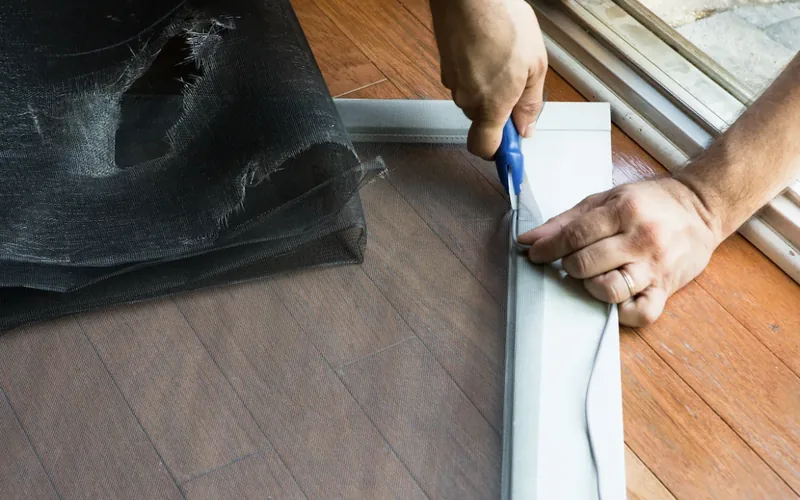
The frame underneath is nearly always worth keeping. Screen frames are light aluminum and rarely fail; what fails is mesh and spline. That makes re-fabricing one of the cheapest repairs in the trade, and it means a torn screen is never a reason to replace a door. Ask whoever quotes you whether their screen frames take standard spline, because non-standard grooves turn a simple future repair into a special order.
Two, three or four panels? Configuration in real Florida homes
Configuration is sold on the picture and lived with as mechanics. Three things change with every additional panel.
The number of moving parts. A two-panel door has one moving panel and one fixed. A three-panel usually has one or two moving. A four-panel commonly has two moving panels on separate tracks. Every moving panel is another set of rollers, another latch, another seal path, and another thing that eventually needs service.
Panel weight. Wider openings do not automatically mean wider panels, and that is the useful lever. Two enormous panels in a wide opening are heavier and harder to move than three moderate ones covering the same span. In impact glass this difference is substantial, and it is felt every single day by whoever opens the door.
How much actually opens. A four-panel slider looks like a wall of glass that opens completely. On a conventional bypass configuration it does not; you get roughly half the opening, same as a two-panel. Genuine full-width opening requires a pocket or a stacking system, which is a different product at a different price.
The practical advice for most Florida homes is to favor moderate panel widths and fewer moving panels than the showroom suggests. It is lighter to use, cheaper to maintain, and there is less to go wrong in salt air.
Retrofit into the existing opening, or full frame replacement?
If you have decided on a new door, there is a second decision that affects cost, disruption and permits more than the door itself.
A retrofit or insert fits a new door into the existing frame, which stays in the wall. It is faster, less invasive, leaves your interior and exterior finishes largely alone, and costs less. The trade-off is that you inherit whatever the old frame is: its anchoring, its condition, its exact opening size. You also lose a little glass area, because the new frame sits inside the old one. It is a sound choice when the existing frame is genuinely straight, sound, and well anchored.
A full frame replacement removes everything back to the structural opening. It costs more, takes longer, and disturbs stucco, drywall and flooring at the threshold. What it buys you is a fresh anchoring path and a properly detailed water management layer, which is why it is usually the correct answer where water has been getting in, where the frame has corroded, or where an impact approval depends on how the unit is anchored.
The honest test is whether the existing frame passes the same inspection you would apply before choosing repair. A frame too poor to keep is also too poor to retrofit into, and anyone proposing an insert into a compromised frame is solving a schedule problem rather than yours.
Condo and HOA approvals: what will your association require before anything is ordered?
In an association building, the door is rarely purely yours to change, and the order of operations matters. Approval comes before the order, not before the install.
Most Florida declarations treat the building envelope, meaning exterior surfaces and often the outer frame and glass as originally installed, differently from the parts serving only your unit. On top of that, most associations hold architectural standards governing anything visible from outside: frame color, glass tint, and frequently screen frame color too. Uniformity is the point, so an association may specify not just a performance level but an appearance.
What you will typically be asked for is a written scope with the product specification attached, an architectural review application, and evidence that whoever performs the work meets the association's vendor requirements. Buildings frequently also control access, elevator use and work hours, all of which affect scheduling rather than approval.
The sequence that avoids expensive mistakes: read the declaration's maintenance matrix, email management for the architectural standards in writing, get approval, then order. Doors ordered before approval are the single most common way condo owners lose money on this, because a custom unit in the wrong finish is not returnable.
The full condo and HOA guide covers who is responsible for what once the door is in.
Impact ratings and permits: what varies by county, and who to ask
This is the part of the decision where you should stop reading marketing material, including ours, and ask an authority.
Requirements for openings in Florida vary by jurisdiction and by the specific property, and they are enforced through permitting. What is required on one street can differ from another, and what applied when a house was built may not be what applies to work you do now. The authority is your county or municipal building department: St. Lucie, Martin, Indian River and Palm Beach counties each administer their own permitting, and the answer for your address comes from them.
Three practical points hold generally. First, an impact-rated door is a tested assembly rather than a set of parts, so the glass, frame, anchors and hardware were approved together and substitutions can take it outside its approval. Second, product approval documentation exists for rated products and you are entitled to see it before ordering. Third, whoever performs the installation is the one who pulls the permit, and asking who will pull it is a legitimate question at quoting stage.
We repair doors, so we do not permit installations. What we can tell you is whether the door you already have is worth keeping. For the code question, call the building department directly and get the answer for your address rather than from a brochure.
Choosing for a house that sits closed half the year
Seasonal ownership changes the specification, and almost nobody accounts for it at purchase.
A door that sits still corrodes faster than a door in daily use. Motion continuously wipes the salt film off the bearing surfaces of the rollers; a locked, unmoved panel lets that film sit against steel through the entire wet season. This is the mechanism behind a pattern we see every fall: doors that worked in April and are seized in November, in houses where nobody did anything wrong.
Three choices matter more in a seasonal home than in a full-time one. Sealed stainless rollers stop being an upgrade and start being the point, because they exclude the film rather than merely resisting it. Hardware that can be serviced, meaning accessible adjustment screws and a housing type that is still in production, matters because you will not be there to notice the early stage of a failure. And fewer moving panels means fewer things to seize in your absence.
Two habits complete it. Clean the tracks before you close the house, and leave the doors closed but not latched under tension. On arrival, test each door with light pressure only and stop at anything that resists, because the forceful pull that gets a stuck door open is what turns a roller job into a track job.
What should you ask any company quoting you a replacement?
Take this list to every quote, including the ones you like.
- Did you inspect my current door before recommending replacement? If nobody removed a panel or looked at a roller, no diagnosis has happened.
- What specifically is beyond repair? A frame, a threshold, glass, an unavailable part. "It's old" is not a finding.
- Is the assembly impact approved, and can I see the product approval? "Laminated" and "impact rated" are not the same claim.
- What rollers are in it, and are they rated for the panel weight? Sealed and stainless, or plated steel on open bearings.
- Retrofit or full frame, and why that one for my opening? The reasoning matters more than the answer.
- Who pulls the permit, and what inspections are involved?
- What is the warranty on the product and separately on the installation? They are usually different terms from different parties.
- What is the lead time, and what happens to the opening in the meantime?
If you would rather find out first whether replacement is even the right conversation, that is what we do. Describe what your door is doing and you will get a straight read on whether it needs hardware, needs work, or genuinely needs replacing.