Short answer: SliderPro repairs start at $275, which includes parts, labor and a one to three year written warranty. What moves the number is the door itself: panel weight and size, roller type, whether worn rollers have grooved the track, corroded fasteners and access. Nearly every repair costs a small fraction of a new installed door, and calling while a door only drags avoids paying for track work too.
Search "sliding glass door repair cost" and you'll find numbers scattered from under a hundred dollars to several thousand — which is technically true and completely unhelpful. The spread exists because "repair" covers everything from a fifteen-minute latch adjustment to extracting a seized multi-panel impact door from a corroded track. So instead of quoting one meaningless average, let's break down what actually drives the price — so you can read any quote (ours included) like someone who knows what they're paying for.
The repair-versus-replace math, first
Before any repair numbers: a new sliding glass door in Florida, installed, commonly runs into the thousands — and impact-rated or oversized systems well beyond that. Nearly every repair we perform costs a small fraction of the door it saves. That's the frame for every number below: the question isn't whether repair is cheap in absolute terms, it's that repair is almost always dramatically cheaper than the alternative, on a door whose frame and glass usually have decades of life left.
Companies that lead every conversation with replacement aren't doing math; they're doing sales. A repair-first assessment should always come before replacement talk.
What drives the price of a roller replacement
Roller replacement is the most common slider repair, and its cost varies with a few concrete factors:
- Panel weight and size. A standard single-pane panel is a routine two-person lift. Heavy impact-glass and oversized panels need more labor, more care, and heavier-duty roller assemblies.
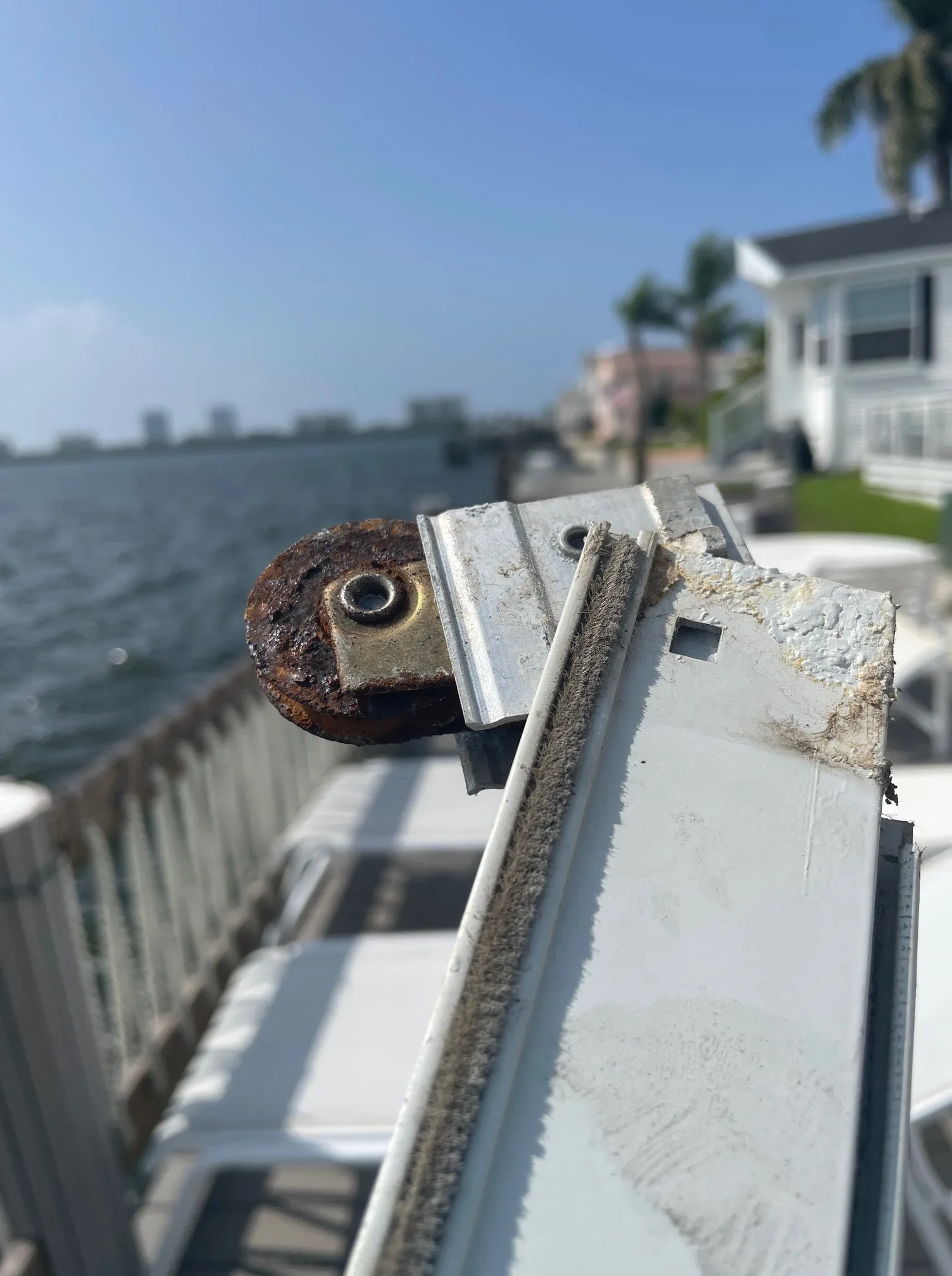
- Roller type. Basic replacement wheels cost little; sealed stainless-bearing assemblies cost more and are worth every cent in coastal air (see why salt kills standard rollers).
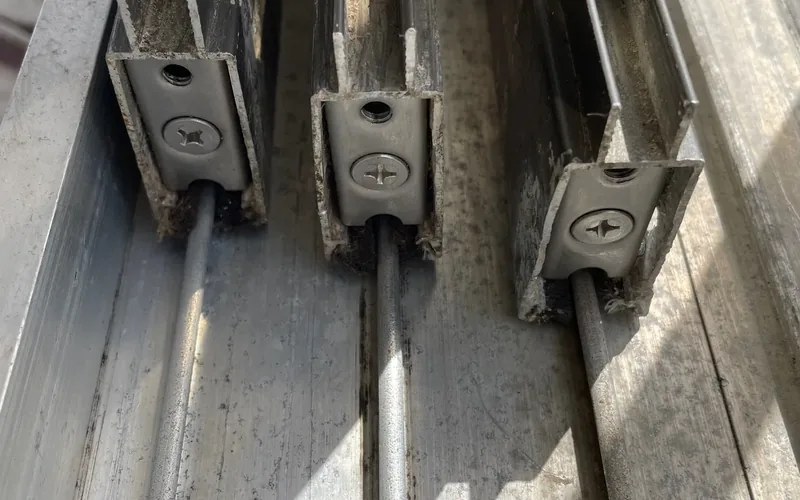
- Track condition. If failing rollers were ridden too long, they gouge the track. Minor wear gets dressed during service; a badly chewed track adds a track repair to the bill — the single most avoidable cost escalation in this trade.
- Access and condition. A door that lifts out normally is quick. A seized, corroded panel in a salt-exposed condo takes patience and time.
The takeaway: two neighbors can get honestly different prices for "the same" repair, because the doors' condition differs. What should be consistent is the explanation — you should be shown what's worn and told why the number is the number.
Screens, locks, tracks and tune-ups
Screen fabric replacement is among the most economical repairs in the trade — the aluminum frame is reused and only the mesh and spline are new. Cost scales with panel size and mesh choice: standard fiberglass is cheapest, pet-resistant and fine no-see-um mesh cost more and earn it.
Security lock installation is typically an hour-scale job priced mostly on the hardware you choose — a factory-latch replacement costs less than a keyed deadbolt system. It's the cheapest meaningful security upgrade in a Florida home.
Maintenance visits — cleaning, lubrication, inspection, alignment across all the home's sliders — are priced for what they are: prevention. One visit costs far less than one neglected roller failure, which is the entire argument for them.
Red flags when comparing quotes
- Replacement pushed before diagnosis. If nobody has removed a panel or examined a roller and you're already hearing about new doors, get another opinion.
- Prices quoted sight-unseen as certainties. Honest phone estimates come as ranges with the factors named; the firm number follows inspection.
- No parts specifics. "New rollers" spans junk to stainless sealed bearings. Ask what's going in — in coastal Florida, the answer matters enormously.
- Pressure tactics. A worn roller is urgent-ish, not emergency-tonight. Anyone manufacturing panic is selling something.
How to keep repair costs down — genuinely
Three habits do most of the work. Act early: the cost gap between "rollers only" and "rollers plus gouged track" is the biggest avoidable expense in this trade, and it's determined by how long a dragging door gets ignored. Bundle the visit: having every slider in the house inspected and serviced in one appointment spreads the visit cost across all your doors. Maintain coastal doors annually: for ocean- and river-exposed homes, the yearly service visit is the cheapest insurance a door can have.
We quote for free, we explain what we find, and if a five-minute DIY fix is all you need, we'll tell you exactly that — it's how a repeat-referral business stays one. Describe your door's symptoms and we'll give you a straight read on what it likely needs and what drives the cost.
Which symptom points to which repair, and which end of the price range?
Most people describe a feeling rather than a fault, which is fine. The feeling usually maps to one part. Here is the shortest route from what your door is doing to what it likely needs.
- Heavy, dragging, or it grinds as it moves. Rollers, nearly always. The failure runs through seven stages, and the price gap between stage three and stage seven is the track.
- It slides fine but the latch misses the keeper. Alignment, not the lock. A few millimeters of sag is the usual cause, and it is one of the cheapest fixes on this list.
- It bumps over the same spot every pass. A gouged or pinched track. Sometimes dressed in place, sometimes it needs a cap track fitted over it.
- The mesh is torn or sagging, or something is biting you through it. A screen fabric replacement. The aluminum frame is reused, so only mesh and spline are new.
- Water stands in the track after rain. Blocked weep holes, which is a cleaning job before it is a repair job.
- The door works but the room does not. Seals and sweeps. Run the five-minute leak test before anyone prices you new glass.
Two symptoms on one door usually mean one cause with a knock-on effect. A door that drags and then stops locking is a roller problem that has changed the panel's height, not two separate repairs on one invoice.
What does a track, cap-track or handle repair actually involve?
The track is the part homeowners think about least and pay for most when it is ignored. Aluminum is soft. A seized roller riding on it is effectively a steel skid under a couple of hundred pounds of glass, and it cuts a groove at a surprising rate. Weeks, not years.
Light wear gets dressed: the raised lips of the groove are worked back flat so a new roller runs true again. That is a small addition to a roller job. Deeper damage needs a cap track, a stainless channel fitted over the original aluminum so the door runs on steel instead of a worn extrusion. It costs more than dressing and far less than a frame, and on a coastal door it usually outlives the track it covers. Genuine structural damage, meaning a bent, split or crushed track, is a different conversation and one of the few points where replacement can honestly win.
Handles and latches sit at the cheap end. Most sliders use a mortise lock buried in the panel edge, operated by a handle set through-bolted to it. Swapping the handle fixes nothing if the mortise is what failed, which is why a competent visit tests the mechanism itself rather than guessing at it from the outside.
Glass sits on its own track entirely. A cracked or fogged pane is a question about that panel, not about the whole door, and damaged glass is worth having looked at before you assume the door is finished.
Why does a roller job on a 1970s Port St. Lucie door price differently to a 2015 one?
Build era tells you more about a Florida slider than its address does. Three cohorts cover most of the Treasure Coast.
- 1970s and early 80s aluminum. Thin extrusions, single-pane glass, light panels, and hardware that has not been manufactured in decades. The panel is easy to lift. The difficulty is identification, because roller housings from that era vary by manufacturer and often by production year. Some of these jobs get a modern assembly adapted to the original housing rather than a drop-in part, and that is labor time, not parts cost.
- 1998 to 2006 boom-build. Enormous volume, cost-optimized hardware, and whole streets fitted with the same roller in the same season. These doors fail as a cohort, which is why one call in a neighborhood is often followed by three more. Parts are generally available, panels are moderate, and these are the most predictable jobs of the three.
- Post-2005 impact. Laminated glass is heavy, and an impact panel can weigh more than double a single-pane one of the same size. That means heavier-duty roller assemblies, a more careful lift, and more time getting the panel in and out of the frame. Builders frequently fitted these doors with rollers rated for light panels, which is why a fifteen-year-old impact slider often feels worse than a forty-year-old aluminum one.
None of this changes how a quote should be explained to you. It changes how long the work takes and which part goes in, and those two things set the number.
Why are Florida repairs their own category? Salt, sand and sun, explained
Every company in this trade will tell you Florida is hard on doors. Very few explain the mechanism, and the mechanism is the part that explains your bill.
Salt is not only corrosive, it is hygroscopic. Airborne salt aerosol settles on the track and then pulls moisture out of the air, holding a thin conductive film against metal long after the last rain dried. That film turns the steel bearing inside a roller into a slow electrochemical cell, corroding it from the inside where no spray reaches. It is why lubricant buys days on a coastal door, and why sealed stainless assemblies cost more and earn it.
Steel fasteners in an aluminum frame are a galvanic couple. Two metals at different electrical potentials, with a salt film between them acting as the electrolyte. The result is a screw effectively welded into its hole by its own corrosion product. That is labor time, not a part, and it is the single biggest reason a coastal job runs longer than an inland one.
Sand is harder than the track. Quartz grit in the roller channel makes every pass a lapping operation against soft aluminum. Oil-based sprays turn that grit into paste and pack it into the housings.
Sun ages what you cannot see. UV chalks screen mesh, hardens weatherstrip until it no longer springs back, and shrinks spline until it lifts out of its groove.
Distance from open water moves the timeline more than anything else. A door in Jensen Beach ages on a different clock to one in western Port St. Lucie, and the repair histories look nothing alike.
Repair or replace? The five questions that settle it
We repair doors, so treat this as a framework you can use against us as readily as with us.
- Is the frame straight and sound? A frame that is square, unbent and not corroded through is a door worth keeping, whatever the hardware is doing. Rollers, tracks, locks, handles and screens are all consumables on a sound frame.
- Is the glass intact? Clear, uncracked glass with no failed seal represents decades of remaining life. A single fogged pane on an otherwise good door is a question about that panel, not about the door.
- Can the parts be identified? On most doors, yes. On a few very old or very obscure systems the honest answer is that no matched part exists any more and the adaptation costs more than it returns.
- How many separate things are wrong at once? One or two faults on a sound door is a repair. A door needing rollers, a cap track, a mortise lock, a threshold and glass in the same visit is telling you something, and we will say so.
- Are you actually solving a different problem? If the real goal is an impact rating, a wider opening, or a configuration the existing frame cannot give you, no repair reaches it.
Replacement genuinely wins on structurally failed frames, on badly storm-damaged systems, and when you want something the current opening cannot do. It loses, badly, on everything else, which is the overwhelming majority of what we are called to.
What should a fair, complete estimate contain?
An estimate is a document, not a number. A complete one tells you six things.
- What was found, in parts. "Rollers worn" is a symptom. "Both tandem assemblies seized, lower track grooved through the bearing path" is a finding.
- Which part is going in. Material and bearing type, not just "new rollers." In coastal air, the gap between a plated wheel and a sealed stainless assembly is the gap between three years and a decade.
- Labor separated from parts. You should be able to see which half of the number is which.
- What is not included. If the track may need dressing once the panel is out, that belongs in writing before work starts, with what it would add.
- The warranty, in writing. Ours runs one to three years on parts and labor depending on the work. Any warranty is worth reading for what voids it.
- One visit or two. Around 96% of our jobs finish in a single visit because the van carries the common failures. It is a fair question to ask anyone quoting you: is the part on the truck?
If a quote arrives as a single figure with no findings behind it, ask for the findings. Anyone who actually examined the door can produce them in a sentence.
What does a sliding door repair start at?
Repairs start at $275, and that figure includes parts, labor and a one to three year warranty covering both. It is worth stating plainly, because it sits above some advertised starting prices in this market and below what most people expect once they understand what is inside it.
A cheaper headline number usually means one of three things: it covers labor only and parts are extra, the component being fitted is the same builder-grade part that already failed once, or the visit is a diagnostic that turns into a second appointment. None of those are dishonest in themselves. They are simply not comparable to a finished, warranted repair on a door that then works.
What sits above the starting figure is the work itself. How many panels, how heavy they are, whether the track survived the rollers, and whether the fasteners come out cleanly or have to be drilled. Those are the variables described throughout this guide, and any of them can move a number.
What we will not do is publish a menu of per-repair prices we cannot honor on a door nobody has seen. Companies that do either pad every figure to cover the worst case, or quote the best case and revise it on the day. Describe the symptoms and you will get a range with the reasons attached to it.
Condo and HOA doors: who pays for the door, the frame and the screen?
In a condo the slider is often two things at once, and the split decides who pays for what. A very common pattern in Florida declarations treats the building envelope, meaning exterior surfaces, structural elements and frequently the glass and outer frame as originally installed, as association territory, while anything serving only your unit lands on the owner.
In practice that usually puts rollers, track wear, latches, locks, handles and screens on the owner, because they are operating hardware worn by your own use. It often puts glass and the outer frame on the association, although plenty of declarations assign the entire assembly to the owner. Water intrusion at the door is the genuinely contested category, because the cause decides the side.
Your declaration of condominium is the only document that answers this for your building. Most modern ones contain a maintenance matrix with its own row for windows and doors. Read it before commissioning anything glass, frame or leak related, and get a written answer from your manager where it is unclear. For clearly owner-side hardware, waiting on a board costs you weeks and improves nothing.
The full breakdown is here, including the sequence that stops owners paying twice for one door.
Seasonal and snowbird homes: what does six months closed up cost you?
A door that sits still corrodes faster than a door in daily use. Motion wipes the salt film off the bearing surfaces. A locked, unmoved panel lets that film sit and work through an entire wet season, which is why seasonal owners so reliably come back to a slider that was fine in April and immovable in November.
The cost consequence is specific. A bearing that was merely rough in spring is often fully seized by fall, and a seized roller does not wait politely. The first few forceful pulls on arrival are exactly what converts a roller job into a roller-plus-track job. The most expensive slider repairs we see are almost all doors that were forced open after a long vacancy.
Two habits change that arithmetic. Before you close the house, clean the tracks and lock every door, because an unlatched slider is neither secure nor storm-ready. On arrival, test each door with light pressure only. If one will not move easily, stop there. That is the cheap moment, and it stays cheap right up until somebody puts a shoulder into it.
Booking a service visit for the week you arrive, rather than the week something breaks, is the same repair at a lower number. Same-day appointments are available when a door has already gone.
After a storm: what can and cannot be swapped on an impact door?
Storm damage changes the rules in one specific way. An impact-rated door is a tested assembly, not a collection of interchangeable parts. The glass, the frame, the anchors and the hardware were approved together. Substituting an ordinary pane for a laminated one, or fitting hardware that was never part of that approval, quietly takes the door outside the rating it was installed under.
In practice, wear parts behave normally. Rollers, screens, handles and weatherstrip on an impact door are routine repairs and are priced like routine repairs. Glass and structural components are where the assembly and the permit history matter, and where your county building department is the authority rather than us or a salesperson. In St. Lucie, Martin, Indian River and Palm Beach counties that question is worth asking directly, before anything is ordered.
Insurance timing matters as much as the repair. Photograph the damage before anything is moved or cleaned up, and get the claim opened before a repair erases the evidence. Our hurricane checklist covers what to do before the season, and the same record-keeping applies afterward.
A plain-English glossary of the parts on your invoice
- Tandem roller assembly. The two-wheel carriage in the bottom edge of the panel. Most sliders carry two per moving panel.
- Housing. The metal body the wheel sits in. Housings vary by manufacturer and era, which is why matching a part matters more than merely fitting one.
- Adjustment screw. The screw at each end of the panel bottom that raises or lowers that corner. It is how a door is squared, and the first thing checked on a lock complaint.
- Cap track. A stainless channel fitted over a worn aluminum track so the door runs on steel instead of a chewed extrusion.
- Mortise lock. The lock body buried in the panel edge that the handle set operates.
- Keeper. The slot in the jamb the latch hooks into. A latch missing its keeper is an alignment fault, not a broken lock.
- Spline. The rubber cord holding screen mesh in its frame groove. It hardens and shrinks in UV until it lifts out.
- Weep holes. The small drains at the bottom of the outer track. Blocked weeps are why water stands after rain.
- Weatherstrip and sweep. The pile or fin seals along the panel edges and bottom that stop air and water.
If a line on your invoice is not on this list, ask what it is. Any technician who fitted the part can explain it in one sentence.