Short answer: Your declaration of condominium decides it. The common Florida split puts the glass and outer frame with the association as building envelope, and the operating hardware (rollers, latches, locks, handles, screens) with the unit owner. Read the maintenance matrix, ask the manager in writing about anything glass, frame or leak related, report storm damage before repairing, and fix clearly owner-side hardware without waiting on the board.
Your condo's balcony slider has gotten heavy, or won't lock, or grinds like a coffee mill — and before you can fix it, you hit the question every Florida condo owner eventually faces: is this door mine, or the association's? Guess wrong in one direction and you wait weeks for a board that was never responsible; guess wrong in the other and you pay out of pocket for something your dues already cover.
We work in condo buildings from Hutchinson Island to Jupiter weekly, so here's the practical lay of the land — with the honest caveat up front: your declaration of condominium is the only document that actually answers this for your building. What follows is how the split usually works, not legal advice about your unit.
Why a single door gets split in two
Florida condo law (Chapter 718, Florida Statutes — readable on the state's official legislature site) leaves the maintenance split between association and owner largely to each condominium's declaration. A very common pattern in those documents treats the building envelope — exterior surfaces, structural elements, often the glass and frame of windows and sliders as originally installed — differently from everything serving only the individual unit, which typically lands on the owner.
The result sounds odd but is everywhere: the glass and outer frame of your slider may be association-side (envelope), while the operating hardware — rollers, track wear, latches and locks, screens, handles — is owner-side, because it serves only your unit. One door, two responsibility zones.
What that means for the common repairs
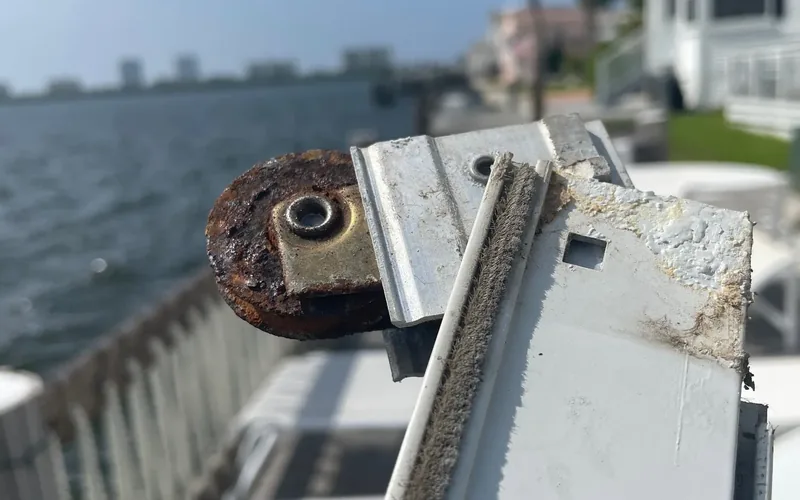
- Rollers, sticking, dragging: almost always owner-side under typical declarations. It's operating hardware, it wears with the unit's use, and it's the repair condo owners most often wait on a board for unnecessarily. (It's also the classic salt-exposure failure in oceanfront buildings.)
- Locks and latches: typically owner-side — and since it's your security, waiting is the worst option regardless of who pays.
- Screens: usually owner-side, though some associations maintain uniform exterior screens for appearance; check before assuming either way.
- Glass (fogged, cracked) and frame/envelope damage: this is where declarations genuinely differ — some put glass on the association, many put it on the owner, and hurricane-related damage often follows separate insurance rules entirely. This category is worth the email to your manager every time.
- Water intrusion at the door: the genuinely contested zone, because the cause determines the side — a failed envelope seal reads association; a track overflowing through owner-neglected weep holes reads owner. Document early and involve the association before repairs erase the evidence.
The process that avoids paying twice
First, read your declaration's maintenance matrix — most modern documents contain a table dividing components between association and owner; "windows and doors" usually has its own rows. Second, email the manager before commissioning work on anything glass-, frame-, or leak-related: a written answer either unlocks the association's obligation or documents that the repair is properly yours. Third, for clearly owner-side hardware, just fix it — a door that won't lock or barely moves is a daily security and livability problem, and no board meeting improves rollers.
How we fit into association buildings
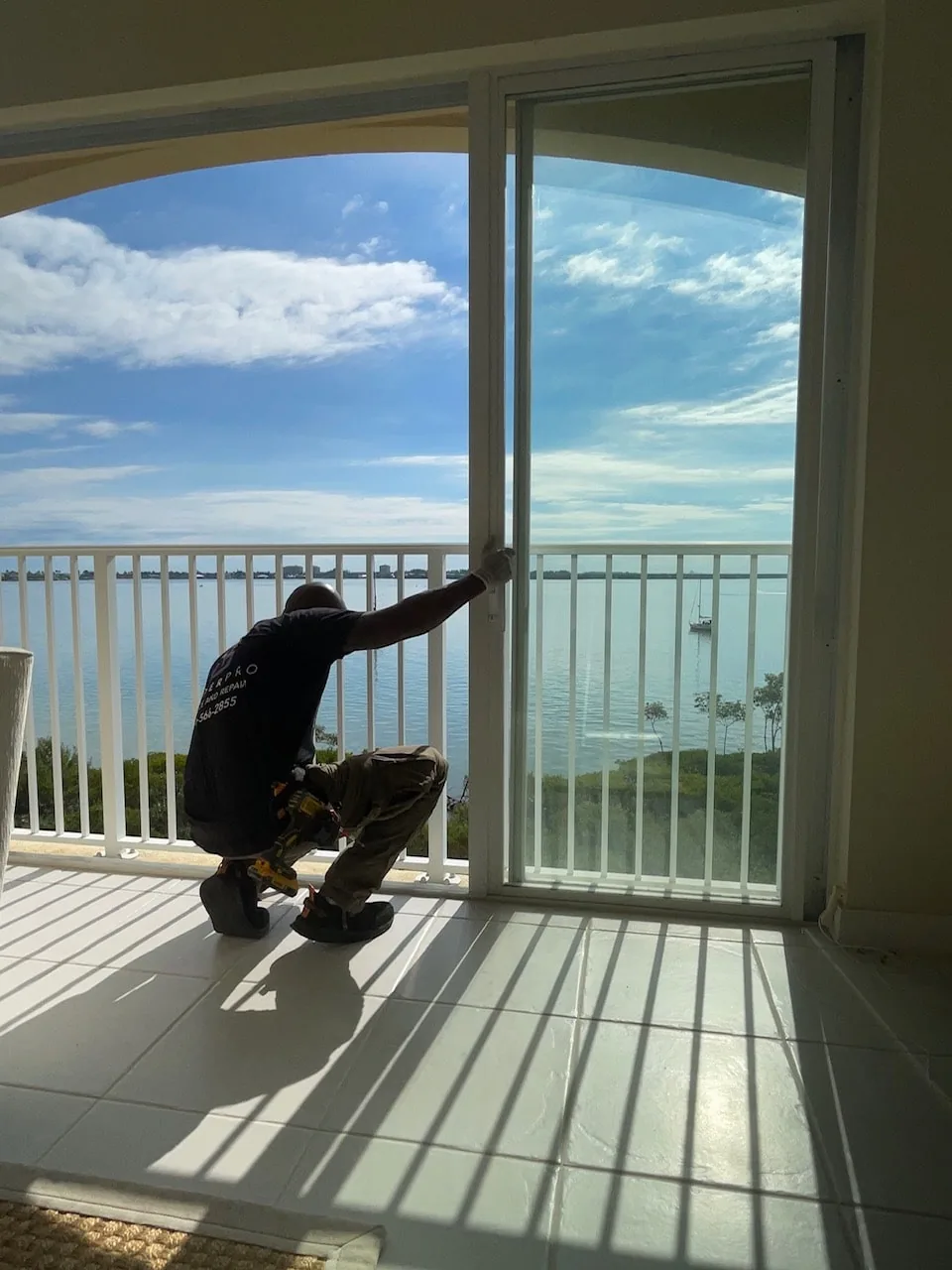
Owner-side slider work in managed buildings is our routine: we handle association logistics (certificates of insurance, elevator scheduling, protecting common corridors), we document condition with photos — useful the day an envelope question does arise — and where a repair straddles the line, we'll happily talk directly with your manager about which parts of the job belong to whom. Boards and managers also bring us in on the association side, servicing balcony doors across whole buildings on a maintenance cycle, which is by far the cheapest way oceanfront hardware ever gets maintained.
Stuck door, unclear responsibility, or a manager asking for a scope-and-quote in writing — send us the situation and we'll help you untangle the door from the paperwork.
What do common element, limited common element and unit boundary actually mean?
Three terms decide almost every slider argument in a Florida condominium, and they are worth learning properly because managers and boards use them precisely.
Common element. Everything owned by all the unit owners together — the structure, the roof, the corridors, the exterior walls. Maintained by the association, paid for out of everyone's assessments.
Limited common element. A common element reserved for the exclusive use of one unit or a few. Your balcony is the classic example: it belongs to everybody in the legal sense, but only you may stand on it. This is the category that causes the confusion, because exclusive use feels like ownership and is not. Declarations frequently assign the association the structural obligation for a limited common element while making the owner pay for its maintenance, or the reverse. It is a written choice, and every building makes it differently.
Unit boundary. The line the declaration draws around what you actually own, usually described in terms of the unfinished surfaces of walls, floors and ceilings. Where that line falls relative to a sliding door assembly is the whole question. Some declarations put the boundary at the interior face of the frame, leaving the door outside your unit. Others place it further out and pull the glass in with you.
When you email the manager, use these words. A question phrased as "is my balcony slider a limited common element, and who does the declaration assign maintenance to?" gets a specific answer. "Whose door is it?" gets a shrug.
What does Florida law fix, and what can your declaration change?
This section is general and conditional, and it is not legal advice about your unit. Read it as a map of where to look, then read your own documents.
Florida's condominium statute, Chapter 718, sets out the framework: it defines common elements and limited common elements, it requires the declaration to describe unit boundaries, and it sets baseline rules for how an association operates and how it may assess. What it largely does not do is dictate, component by component, who maintains a sliding glass door. That is left to the declaration, which is why two buildings on the same street can answer the question in opposite ways and both be correct.
So the hierarchy runs: statute first, then the declaration, then the bylaws and any properly adopted rules. A rule cannot contradict the declaration, and a declaration cannot contradict the statute. When a board tells you something verbally that is not in any of those documents, it is a position rather than an obligation, and it is reasonable to ask which section it comes from.
One more distinction that catches people out. The declaration in force is the one recorded for your building, including its amendments. Buildings amend maintenance provisions over the years, often after an expensive envelope project, and the version circulating as a PDF in an owners' group is not always current. Ask management for the recorded declaration and any amendments, and check the door provisions in that copy.
If real money turns on the answer, that is the point to involve a Florida community association attorney rather than a repair company.
Which four clauses should you find in your own declaration?
You do not have to read the whole document. Four places answer the door question in most Florida declarations, and finding them takes about twenty minutes.
- The unit boundary description. Usually early, often titled "Unit Boundaries" or folded into the definitions. Read where the boundary sits relative to windows and doors, and whether glass, frames and hardware are named explicitly.
- The limited common element schedule. Look for balconies, terraces and lanais, and check whether the door serving them is mentioned. Some declarations list "the sliding glass doors serving a unit" here in so many words.
- The maintenance, repair and replacement article. The core of it. Most modern documents contain a matrix or a numbered list splitting components between association and owner, and "windows and doors" normally has its own rows. Read the association column and the owner column both, since obligations sometimes appear only by omission.
- The insurance article. Separate from maintenance and answering a different question. It usually describes what the association's policy covers and what owners must insure, and it commonly treats windows and doors differently from the way the maintenance article does.
Photograph or copy those four sections and keep them with your unit file. You will be asked for them again — by a manager, by a contractor, by a buyer's attorney — and having them to hand is what turns a two-week email chain into a two-day one.
Who do you ask, in what order, and what goes in writing?
Order matters, because asking the wrong party first is what produces the six-week wait for an answer that was never theirs to give.
First, your own documents. Find the four clauses above. Half the time they settle it outright, and you save everyone the exchange.
Second, the property manager, by email. Managers deal with this weekly and can usually answer immediately. Describe the door, the symptom and the component you believe is at issue, quote the clause you found, and ask them to confirm or correct it. Email rather than a phone call, because you want the answer in a form you can attach to a quote later.
Third, the board, only if management defers. A board answer normally requires a meeting, so ask early rather than after the door has failed.
Fourth, an attorney, if the amount at stake justifies it and the association's answer conflicts with what you read.
What to put in writing, always: the manager's answer on responsibility, any approval to attach hardware or alter the door, and the scope of work before it is carried out. A one-line reply saying the hardware is owner-side and the work may proceed is what protects you from being told afterwards that it should have gone through the association.
If you rent the unit out or you are away for the season, name in that email who will provide access, so the approval and the logistics travel together.
Where does storm damage shift responsibility?
Hurricane damage is the one situation where the everyday maintenance split frequently stops applying, and owners get caught assuming it carries over.
The reason is that storm damage is usually an insurance question rather than a maintenance question, and the insurance article of your declaration answers it separately. It is entirely normal for a building to make a slider's hardware the owner's to maintain year-round while a storm-damaged door falls under the association's property policy, or for the reverse to be true. Deductibles complicate it further, since association hurricane deductibles are often large and may be assessed back to owners.
Three practical rules regardless of how your building falls:
- Report before you repair. Notify management in writing with photographs before commissioning anything. A repair carried out first erases the evidence of what happened and can put you outside the process entirely.
- Separate storm damage from pre-existing wear. A door with worn rollers before the storm still has worn rollers after it. Being clear about which is which protects you from an argument that the whole condition is wear.
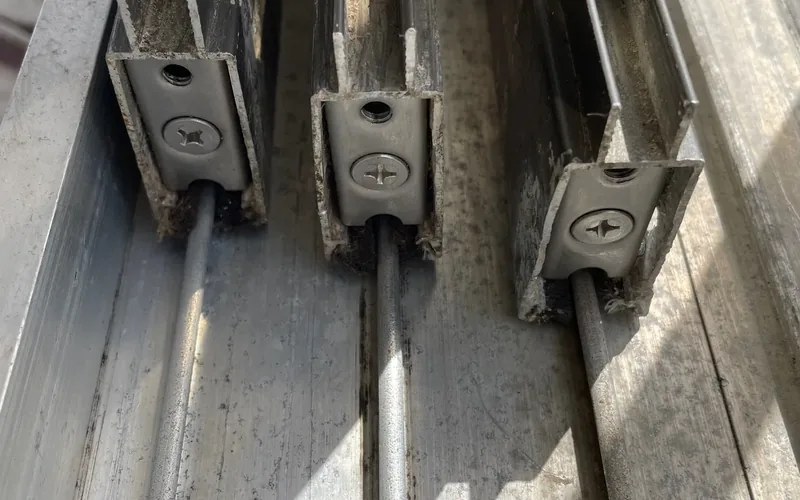
- Watch the water-intrusion cases. Where the cause decides the side, a failed envelope seal reads association and a track overflowing through blocked weep holes reads owner. Documenting the track condition early is what keeps that conversation factual.
Our hurricane prep guide covers what to photograph and when.
Five ways owners end up paying twice
These are the patterns we watch owners fall into, in rough order of how often we see them.
- Paying for something the association owed. The commonest version is glass. Owners assume the whole door is theirs, replace a fogged or cracked pane, and only afterwards discover the declaration put the glass on the building. Ask before you commission anything glass, frame or leak related.
- Waiting for a board on something the board never owed. The mirror image. Rollers, latches and screens are owner-side under most declarations, so an owner who waits six weeks for a decision is running a dragging door on failing rollers, which grinds a groove into the track and turns a roller job into a track job.
- Fitting hardware that has to come off again. A secondary lock or a film that violates a uniform-appearance or frame-penetration rule gets removed at the owner's cost, and the frame may need making good. One email prevents it.
- Repairing before documenting after a storm. The repair is paid for twice — once to the contractor, once in the claim or association process that no longer has evidence.
- Fixing the symptom instead of the cause. Moving the keeper so a sagging door latches again is the classic. It works for a season, the panel keeps dropping, and the same owner pays for the keeper, then the lock, then the rollers that were the problem all along. Our guide to a slider that won't lock explains why.