For most Florida doors, the best sliding door roller is a sealed-bearing assembly with a stainless or acetal (Delrin) wheel, in a tandem housing if the panel is heavy, with a wheel profile that matches the track. Plain steel wheels carry weight well and rust quickly near salt water. Nylon won't rust but deforms under heavy glass. And a perfect roller with the wrong edge shape will chew up your track anyway.
A roller is really four choices stacked together: what the wheel is made of, what bearing it spins on, how many wheels share the corner, and what shape the wheel's edge is. Here's how each compares.
Sliding door roller wheels compared by material
| Nylon wheel | Delrin (acetal) wheel | Plain or plated steel wheel | Stainless wheel and housing |
|---|
| Load | Light to medium; creeps under sustained weight | Medium; stiffer and holds shape better than nylon | High | High |
| Noise | Quietest | Quiet | Loudest, especially on grit | Louder than plastic, smooth when clean |
| Salt-air corrosion | Wheel can't rust; its bearing can | Wheel can't rust; its bearing can | Rusts; manufacturer warns against coastal use | Strong resistance, grade dependent |
| On an aluminum track | Gentle; wheel wears first | Gentle; wheel wears first | Hard wheel wears soft rail, fast once rusty | Hard wheel; needs a sound, clean rail |
| Weak point | Flat spots, heat and UV embrittlement, absorbs moisture | Can crack if overloaded or shock-loaded | Corrosion seizes the wheel into a skid | Higher cost; "stainless" label may mean housing only |
| Best for | Screen doors, light inland panels | Most residential glass panels on a decent track | Dry climates, heavy inland doors | Coastal doors, heavy and impact panels |
Bearings and wheel layout compared
| Open ball bearing | Sealed ball bearing | Single roller | Tandem roller |
|---|
| What it is | Balls visible or behind a loose shield | Rubber lip seals close the race | One wheel per corner | Two wheels in one housing per corner |
| Salt and grit | Gets in and stays in | Kept out of the race | Not affected | Not affected |
| Load | Not affected | Not affected | Whole corner on one bearing | Corner load split across two |
| Best for | Dry, clean, inland tracks | Anything near salt water or sand | Older, lighter panels designed for singles | Heavy, tall and impact panels |
Which roller type should you choose?
Match the roller to the panel's weight, your distance from salt water, and the track it runs on, in that order. Then match the housing so it actually fits the door.
- If you're within a few miles of the ocean or the Indian River Lagoon: sealed bearings, always. Stainless or acetal wheel. Never plain steel.
- If the panel is impact glass or taller than a standard door: tandem, if the door's bottom rail was built for tandems, with a load rating that covers the real panel weight.
- If the track rib is grooved or flattened: fix or cap the rail first. A new hard wheel on a damaged rail just finishes the job the old one started.
- If it's a screen door: a light nylon or acetal wheel is fine. Screens weigh almost nothing.
- If the door is inland and lightly used: a sealed-bearing acetal roller is a sound, quiet, sensible choice.
And in every case: the replacement has to fit the same pocket, adjust the same way, and have the same edge profile as the original. Fit comes before upgrades.
Nylon vs steel sliding door rollers: which lasts longer?
Near the coast, neither one on its own. Nylon fails by deforming and steel fails by rusting, and which one fails first depends more on the bearing inside and the weight on top than on the wheel.
Nylon's problem is creep. Plastics slowly deform under a constant load. A wheel holding up a corner of a heavy glass panel, parked in the same spot for months while you're away, settles into a slight flat where it touches the rail. When the door moves again you feel it as a bump, a thump or a door that wants to stop in one position. Nylon also absorbs moisture from humid air, which changes its dimensions slightly and softens it, and years of heat and sun make it brittle. Those are fine trade-offs on a screen or a light panel. They're poor ones under a heavy impact sash.
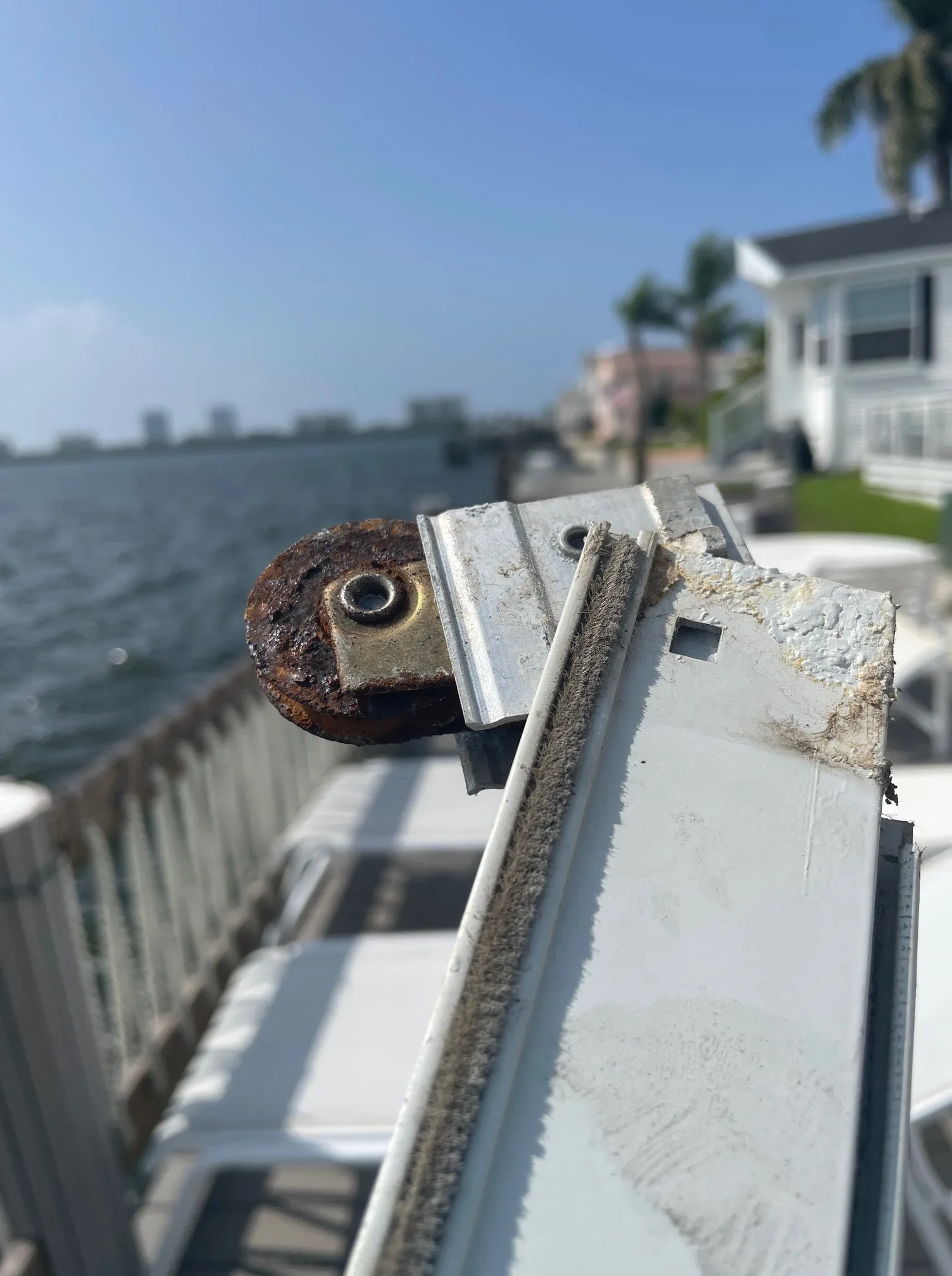
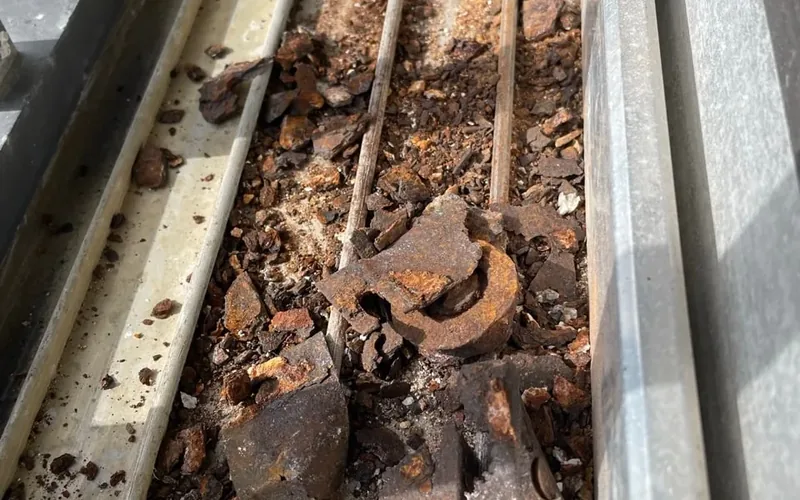
Steel's problem is rust. A plain or zinc-plated steel wheel is hard and strong, and in a dry climate it outlasts plastic. Salt film changes that. Once the plating is worn through by the rail, the wheel and its axle rust, and a rusty wheel stops turning. Then it skids. The manufacturer Prime-Line says it plainly on its own steel roller product page: those rollers will outlast plastic and nylon ones but shouldn't be used in coastal areas or where they're exposed to prolonged high humidity. That's most of Florida.
Delrin (acetal) sits between them. It's a stiffer, harder engineering plastic than nylon, it absorbs far less moisture, and it holds its shape better under load. That's why better replacement rollers often use it. It still won't rust, and it's still gentle on an aluminum rail.
Whatever the wheel is made of, remember it spins on a bearing, and on most rollers that bearing is steel. A nylon wheel on an open steel bearing still dies of salt. That point is the heart of our explanation of why Florida sliders stick, and it's why the bearing column in the table matters as much as the wheel column.
Are stainless steel sliding door rollers worth it?
On a coastal or heavy door, yes, provided you're getting stainless where it counts. Read the description carefully, because "stainless" on a package can mean the housing, the wheel, the bearing, or all three.
The parts that fail in salt air are the bearing and the axle. A stainless housing with a plated steel bearing inside will look great on the day it's removed, rusted solid. What you want is a stainless or sealed bearing as the priority, then a stainless or acetal wheel, then a corrosion-resistant housing.
Stainless isn't magic, either. It resists corrosion because of a thin chromium oxide layer on its surface, and chloride salts attack that layer, especially in crevices where salt water sits and dries over and over. That's why marine hardware uses the more chloride-resistant grades. A stainless roller near the beach will still show some surface staining after a few years. It won't seize the way plain steel does.
The trade-off is cost and hardness. A stainless wheel is hard, and on a worn aluminum rail it's unforgiving, which brings us to the track.
What are sealed bearing rollers, and do they matter?
A ball bearing is a ring of steel balls running between an inner and outer race, packed with grease. How that space is closed is the whole story in Florida:
- Open bearings leave the balls exposed. Sand gets in, salt water gets in, the grease washes out.
- Shielded bearings have a thin metal shield that nearly touches the inner race. They keep out large grit but leave a gap that moisture and fine salt get through.
- Sealed bearings use a rubber lip that actually contacts the race. The grease stays in and salt film stays out.
A sealed bearing has a touch more rolling resistance than an open one because the lip drags slightly. On a sliding door you'll never feel it. What you will feel is the difference two or three summers later, when the open-bearing roller has started to grind and the sealed one hasn't. Spraying lubricant into a door track doesn't reach the inside of a bearing anyway; on a sealed bearing it doesn't need to.
Can you put tandem rollers on a door that came with singles?
Sometimes, but not by choice alone. The roller housing has to fit the pocket in the panel's bottom rail, and a door built for short single housings often doesn't have room for a tandem's longer body.
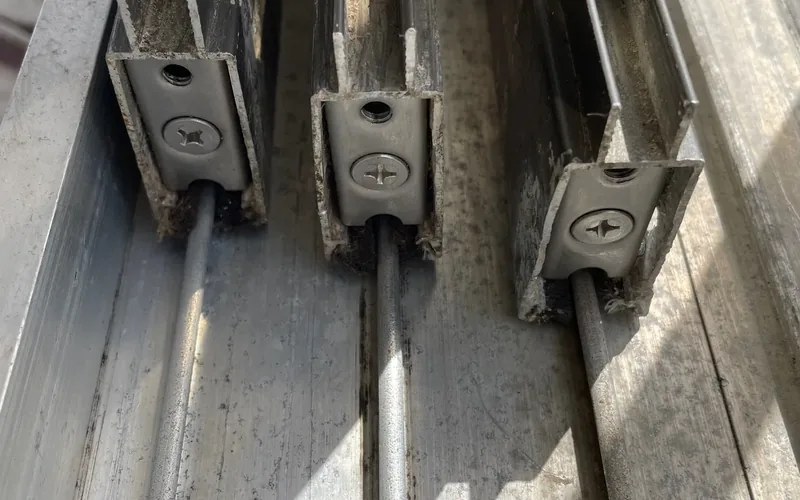
The reason you'd want to is load. A tandem carries two wheels per corner, so each wheel and bearing carries roughly half the weight and the panel rides more level across small dips in the rail. (Our roller replacement page covers how to tell which kind your door has.) For a heavy impact panel, that halving matters a great deal to bearing life and to how hard the wheel presses into the rail.
When a single is the only thing that fits, choose the heaviest-rated sealed-bearing single for that housing, keep the track clean, and check adjustment once a year. Forcing a tandem into a pocket that wasn't made for it, by cutting the rail or packing it, creates a weak corner and a panel that sits out of square.
Does the wheel profile have to match the track?
Yes, and it's the most common mistake in DIY roller swaps. The edge of the wheel has to fit the shape of the rib it rides on, or the load goes through a sliver of contact instead of the whole width.
Most patio door tracks have a raised rib, rounded or roughly pointed, running the length of the sill. The wheel that rides it has a concave or grooved edge that wraps over the rib and keeps the panel centered. Some tracks are flat, or carry a flat-topped cap, and use a flat wheel. A few systems use a convex wheel in a channel.
Put a flat wheel on a rounded rib and it balances on a line. The pressure on that line is enormous, so the wheel wears into a groove and the rib wears into a knife edge, and the panel tends to wander sideways and ride off. Put a concave wheel on a flat track and only its two outer edges touch. Either way the door may feel fine for a month. Then the wear rate shows. A wheel that doesn't track the rib is also one of the causes behind a door that keeps coming off its track.
So measure four things on the old roller before ordering: wheel diameter, wheel width, edge profile, and the housing's shape and adjustment screw position. Our guide to identifying your door's brand and parts helps with the housing side.
Will a steel wheel ruin a worn aluminum track?
It can, if the rail is already damaged. A hard wheel on a soft, scarred rib concentrates force on the high spots and digs in further at the low ones.
Aluminum is much softer than steel. A healthy rib and a smooth, free-spinning steel or stainless wheel get along fine, because the load is spread and nothing skids. The trouble starts with damage. When an old roller seized, it dragged across the rib instead of rolling, and that cuts grooves, flats and burrs into the aluminum. Drop a fresh hard wheel onto that and every pass hammers the same defects. The door may roll better for a while, then start bumping as the damaged spots get worse.
The fix is in the order of work. The rail gets dressed smooth if the damage is light, or capped or repaired if it's deep, and only then do new wheels go on. That's why our roller jobs include the track, and why our guide to sliding glass door track repair exists. On a marginal rail where a full repair isn't wanted yet, an acetal wheel is more forgiving than steel, because the wheel wears before the track does.
What actually decides how long a roller lasts?
The roller type sets the ceiling. These decide how close you get to it:
- Weight versus rating. A roller carrying more than it was rated for wears out early. Heavy impact panels sometimes leave the factory on hardware sized for lighter glass.
- Distance from salt water. Bearings on a beachfront balcony live a harder life than the same part ten miles inland.
- Grit. Sand in the track acts like grinding paste between wheel and rail. Our 10-minute track cleaning routine does more for roller life than any part you can buy.
- Adjustment. If one corner is set higher, that roller carries more than its share. If a panel is set too low, the bottom rail drags.
- Standing still. A door that doesn't move for months lets salt film sit on the bearings and lets plastic wheels flat-spot. Seasonal homes see both.
When it does wear out, the symptoms come in a predictable order, covered stage by stage in signs your sliding door rollers need replacing.
When we replace rollers, we fit sealed-bearing hardware rated for the panel, matched to your track's profile, and we deal with the rail at the same visit. Repairs start at $275 and include parts, labor and a 1–3 year warranty on both. Send us a photo of the door and the track and we'll tell you what's under there and what should replace it.