Roller Replacement
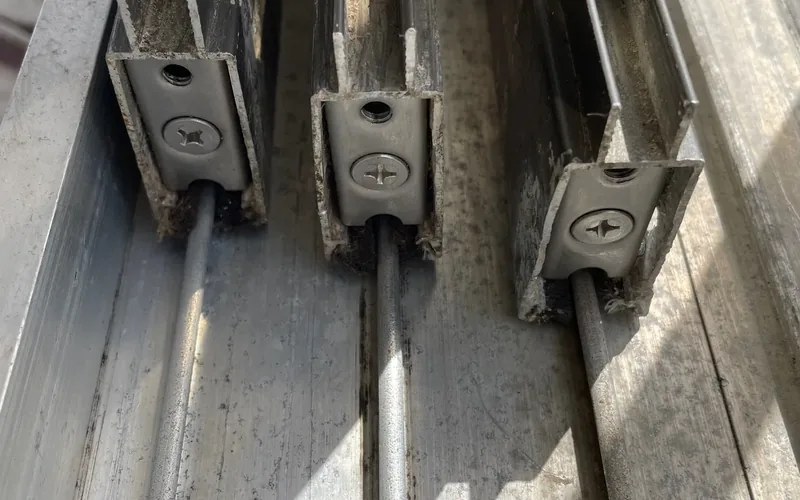
Doors that stick, grind, or jump the track almost always come down to worn rollers. We replace them with heavy-duty stainless rollers so your door glides with one finger again.
About this service
From island-side estates off A1A to the mainland neighborhoods west of the lagoon, Vero Beach doors get our full service — north end of the route, same standards.
Vero Beach anchors the north end of our service area, and it's worth the drive. The barrier island — from Castaway Cove and The Moorings up through Central Beach and the estates along A1A — holds some of the finest glass on the Treasure Coast: floor-to-ceiling sliders, multi-panel systems opening to ocean and lagoon views, and premium doors whose replacement cost makes proper repair the only sensible option.
Premium doors fail like any others; they're just more expensive to neglect. Ocean-side salt exposure on the island corrodes roller bearings on a five-to-ten-year clock, and the heavy impact-glass panels common in post-2004 construction accelerate wear on whatever hardware carries them. When a high-end multi-panel system starts dragging, owners are sometimes quoted eye-watering full-replacement figures — when what the door actually needs is new heavy-duty rollers, a track service, and realignment.
Mainland Vero has a different profile: established neighborhoods off Indian River Boulevard and around the country clubs run doors from every decade since the 60s, and the standard Florida wear pattern applies — gritty tracks, flattened rollers, sun-rotted screen fabric, and latches that drifted out of alignment years ago. We carry roller patterns and screen fabric for the full spread, and we schedule Vero Beach visits so the trip charge never surprises anyone: you'll know exactly how we handle the distance when you book.
Doors that stick, grind, or jump the track almost always come down to worn rollers. We replace them with heavy-duty stainless rollers so your door glides with one finger again.
About this serviceWe repair torn, sagging, or sun-damaged screens using your existing frames — for a fraction of the cost of a new screen, so bugs stay outside where they belong.
About this serviceBroken pane, cloudy seal, or stained glass? We replace the pane in your existing frame — safely removing the old glass and fitting new, so the fix is permanent, not a temporary shine.
About this serviceFactory latches are solid for everyday use. We add true deadbolts and secondary locks engineered for sliding doors, for an extra layer of security where it counts.
About this serviceDeep track cleaning, lubrication, alignment, and inspection — the tune-up that keeps small wear from turning into a seized door or a broken roller.
About this serviceA cracked arch is a glass problem, not a window problem. The new piece is cut to the shape of your existing opening — half-round, quarter-round or circular — so the frame and surround stay put.
About this serviceStruck impact glass cracks and stays put — that is the system working. In most cases the sealed unit is replaced inside the original frame, grids and all, instead of the whole window.
About this serviceVero Beach's barrier island holds the finest glass on our route. Castaway Cove, The Moorings, Riomar, John's Island, Sea Oaks and the estates along A1A were built around floor-to-ceiling sliders and multi-panel systems whose replacement cost runs well into five figures. That makes proper repair not just the cheaper option but the obviously correct one.
Premium doors still fail; they are simply more expensive to neglect. Ocean-side salt works on bearings on a five-to-ten-year clock regardless of what the door cost, and the heavy impact glass common in post-2004 construction accelerates wear on whatever carries it. When an expensive multi-panel system starts dragging, owners are sometimes quoted eye-watering replacement figures for what is, underneath, a worn set of rollers and a track that needs dressing.
Mainland Vero is a different job again. Grand Harbor, Bent Pine, Vero Isles and the established neighborhoods off Indian River Boulevard run doors from every decade since the sixties, with the ordinary Florida wear pattern — gritty tracks, flattened rollers, sun-rotted screen fabric and latches that drifted out of true years ago.
Not listed? Call 772-722-4036 — this is a sample, not a limit.
Our island-side Vero work is heavily preventive. Owners of high-end door systems increasingly book annual service — cleaning, lubrication, roller inspection, and alignment — because the arithmetic is unarguable: routine maintenance costs a small fraction of what corrosion damage does on doors of this class. For seasonal residents we time visits around arrivals and departures, and for oceanfront condos from Sea Oaks down to the Village Spires corridor we handle association logistics as a matter of routine.
Yes — Vero is the established north end of our route and we're up regularly. We batch northern appointments to keep scheduling efficient, and we're upfront about timing and any distance considerations when you book, so there are no surprises.
That's precisely our specialty. Premium multi-panel and impact-glass systems are heavy and unforgiving to handle, but their repair logic is the same as any slider — hardware wears, glass doesn't. We remove, service, and re-hang panels carefully, and repair is almost always dramatically cheaper than the replacement quotes owners are given.
For ocean-exposed doors, emphatically yes. Salt corrosion on the island runs on a short clock, and a yearly clean-lube-inspect visit catches it at the surface stage. It's the cheapest insurance a five-figure door system can buy.
Yes — a large share of our Vero Beach work happens for seasonal owners through their property managers or caretakers. We're happy to schedule access, complete the work, and report back with photos of what was done.
Both the island and the mainland — Central Beach, The Moorings, Castaway Cove, Riomar, John's Island, Sea Oaks and Indian River Shores on the beach side; Grand Harbor, Bent Pine, Vero Isles and the Indian River Boulevard neighborhoods inland.
Get a second opinion before you spend that. Glass and frames do not wear out; hardware does. The overwhelming majority of dragging multi-panel doors need rollers, a track service and realignment — a small fraction of a replacement quote. If yours genuinely is beyond repair we will tell you, but that is the exception.
Vero is an established part of our route, not an outlying extra. We batch northern appointments to keep it efficient and we are straightforward about timing when you book, so nothing about the cost or the schedule comes as a surprise.
Yes — a good share of our Vero work is arranged through property managers and caretakers. They provide access, we complete the work and report back with photographs of what was done, so you can approve everything without being in the state.
Most of it is done in one visit. Across the 1,600-plus doors we have repaired, 96% were finished in a single appointment, and same-day service is available when the schedule allows. A straightforward roller and track job on one door usually runs about an hour to ninety minutes. A house with four or five sliders is an afternoon. The jobs that take longer are the ones where the rail needs dressing, or where a panel has to come out and go back with two people on it. If we find something on arrival that changes the plan, you hear it before we start, not on the invoice.
We would not leave it. Grinding is not a noise, it is metal being removed. A flattened roller running on a pitted aluminum rail machines a groove into that rail every time the door moves, and once the groove is deep enough the repair stops being a set of rollers and starts being rail work as well. A door that grinds in March and gets left until December generally costs more in December. If you are leaving anyway, the cheap version is to have it looked at before you go rather than after you return.
Your declaration of condominium decides it, and the split is often unintuitive. A common pattern puts the glass and the outer frame with the association as part of the building envelope, and puts the operating hardware, meaning rollers, track wear, latches and screens, with the unit owner because it serves only your unit. That means a dragging or grinding door is usually yours to fix and does not need a board meeting, while anything about the glass, the frame or a leak is worth an email to your manager first. Our condo and HOA guide walks through the clauses to look for.
Usually, yes, though not by looking up a model number. Doors of that age are matched physically: we measure the roller housing profile, the wheel diameter and the way the housing sits in the rail, then fit the current equivalent. That is the same reason we ask you not to pull the old roller out and discard it before we arrive, because the part in your hand is the specification. Where a genuinely obsolete profile has no workable equivalent, we tell you that rather than forcing something close and leaving you with a door that binds.
Also serving nearby:
Sliding doors are built to let some water in and drain it back out. When that system clogs, sags or gets overpowered by wind, water ends up on your floor. Here's how to find which part failed, and which leaks are a door repair and which are a wall problem.
Read the guide
Impact glass protects the slider every hour of the year. Shutters protect it when someone closes them. Here's how the five common options compare on protection, effort, insurance and upkeep.
Read the guide
The ocean-facing balcony door takes salt spray the rain never rinses off, wind that grows with every floor, and the weight of impact glass. Here's what that does to the hardware, and how to plan a repair inside a condo building.
Read the guide
A door that doesn't move corrodes faster than one that does. Here's the week-before-you-leave routine for your sliders, how to handle shutters and storms while you're gone, and the order to check things when you come back.
Read the guideEvery company on this coast tells you salt air is hard on doors. Almost nobody tells you how it works, so here it is.
Airborne salt is hygroscopic. Sodium chloride crystals pull water vapor straight out of humid air, which means the salt that settles on your track at 2am does not dry out at noon. It sits there as a thin, permanently damp brine film. Brine is an electrolyte, and an electrolyte is the one thing corrosion needs that dry salt cannot supply on its own.
Two things then happen inside the roller housing. First, the steel in the bearing starts giving up metal to the brine, and the corrosion product that replaces it takes up more space than the steel did. The bearing swells before it ever looks broken, which is why a door can get heavy while the wheel still turns by hand. Second, a steel wheel sitting on an aluminum rail in a salt film makes a galvanic cell: two different metals plus an electrolyte. Aluminum is the more reactive of the pair, so the rail corrodes preferentially and pits. A rail that was smooth becomes a strip of fine sandpaper under your wheels.
Add windblown sand into that damp film and you have a grinding paste in the roller channel. Every pass of the door laps the wheel against the rail. That is the whole mechanism, and it is why an island door on a five-to-ten-year clock and a mainland door on a twenty-year clock can be the same door from the same builder.
The useful conclusion is mechanical rather than chemical. Get the film and the grit off the rail before they do the work, and the clock slows down sharply. That is most of what an annual service visit is actually for, and it is why roller replacement on an island door is worth pairing with a proper rail service rather than doing on its own.
Vero's housing stock reads like a timeline, and each era fails in its own way. Tell us roughly when the house went up and we already know most of what we will find.
Barrier island addresses in 32963 layer full ocean exposure on top of whatever era they were built in. Mainland Vero across 32960, 32962, 32966 and 32967 gets the same wear pattern on a slower clock. If you are unsure which side of that line you sit on, the answer is usually the lagoon, and the rest of the route is set out on our service areas page.
We are a repair company, so it is fair to ask whether we would ever tell you to replace. We would, and we do. Here is the test we run on the door in front of us, in order.
Pass all four and it is a repair, almost always finished on site. Fail one of the first two and we will tell you the door is finished, and we do not sell you the replacement. That is the honest version of what we do, and it is why we are comfortable putting it in writing.
There are real cases where replacement wins, and pretending otherwise would make this page useless. The ones we actually see:
What is not on that list is the one owners hear most often on the island: a heavy, dragging multi-panel system. When someone quotes five figures to replace one of those, the underlying fault is usually a flattened set of rollers and a rail that needs dressing. Glass and frames do not wear out from use. Hardware does. Get the diagnosis before you get the replacement quote.
If your slider is on a balcony or in a managed community, there is a paperwork question sitting in front of the repair question, and it is worth two minutes before you approve anything.
Florida condominium documents commonly split a single door in two. The building envelope, which usually means the glass and the outer frame as originally installed, often sits with the association. The parts that serve only your unit, which means rollers, track wear, latches, handles and screens, usually sit with the owner. One door, two owners, and your declaration of condominium is the only document that settles it for your building.
In practice this means dragging, grinding and a latch that will not catch are almost always yours to fix, and waiting on a board meeting for them costs you months of a door you cannot use. Anything involving the glass, the frame or a leak is worth an email to your manager first, in writing, before a repair erases the evidence.
Our full walkthrough of the vocabulary and the clauses to look for is in who pays for a condo sliding door. It is general guidance, not legal advice about your unit.
A large share of Vero Beach doors are used for part of the year and then left standing still. That is worse for them than heavy use, and the reason is mechanical rather than mysterious.
A door that gets slid every day wipes its own rail. Each pass scrapes off the damp salt film and pushes grit out of the roller channel. A door that has not moved since April leaves that film sitting on the same square inch of steel for six months, in a closed house where the humidity climbs and nothing ever dries. Corrosion that would normally be interrupted daily runs continuously instead.
Then comes November, and the first thing that happens is someone puts a shoulder into a seized wheel. That is the moment a cheap roller job turns into a bent housing, a panel off its track, or a torn screen. The damage almost never happens over the summer. It happens in the first ten seconds after you get back.
Two things prevent it. Have someone slide every door in the house a few times a month while you are away, which costs nothing. And book a check when you leave and again when you arrive, so the doors are serviced before they are forced. If a caretaker or property manager holds access, that is a normal arrangement for us and we report back with photos of what was done.
Repairs start at $275, and that figure includes parts, labor and a written 1–3 year warranty on the work. What moves it from there is not a mystery, and you should be able to see the reasoning on any quote you are handed.
A quote that gives you one number and no line items is telling you nothing. Ask what it covers, what happens if the rail is worse than it looks, and what the warranty actually says. Send us the door and we will give you the reasoning along with the number.
Honest quotes and repairs usually finished in a single visit — call or send the form.