On a Treasure Coast oceanfront condo, the balcony slider facing the Atlantic usually fails years before the doors on the parking-lot side of the same building. Three things stack up against it: salt spray that lands on it daily and never gets rinsed, wind that pushes harder the higher the unit sits, and heavy impact glass riding on small rollers. Here's how each one works, and how to plan a repair inside a condo building without wasting a trip.
Why do oceanfront balcony sliders wear out before the rest of the building?
Because the ocean-side door gets the most salt, the most wind and the least rinsing, all at once. Every other door in the building gets some of that. The balcony door facing the beach gets all of it, every day.
Walk the length of a building on Hutchinson Island and you can see it. The sliders on the west side, facing the river or the parking lot, mostly still glide. The ocean side is where the tracks are crusted white, the screens are torn and the doors take two hands. Same building, same installer, same year. The difference is exposure.
That pattern holds across the barrier islands we cover. The towers along the beach in Fort Pierce and South Hutchinson Island, the condos off the causeway in Jensen Beach, the buildings along the ocean in Stuart and the island condos in Vero Beach all share it. Around the St. Lucie Inlet and the Manatee Pocket in Port Salerno, the buildings are lower and the water is calmer, but units that face the inlet still see more spray than units facing inland.
What does direct salt spray do that ordinary salt air doesn't?
Salt air is a haze of fine particles that settles slowly on everything near the coast. Salt spray is different. It's actual droplets of seawater, torn off breaking waves and carried inland on an onshore breeze. On an ocean-facing balcony those droplets hit the door directly and dry into crystals right where they land: on the exterior track, in the weep slots, along the bottom of the screen and around the lock.
Here's the part most people miss. The balcony slab of the unit above you acts as a roof over your door. It blocks the rain that would rinse a ground-level door clean, but it does nothing to stop spray blowing in sideways. So salt goes on all year and almost never comes off. A house on the beach at least gets a rinse every time it storms. A sheltered balcony door just keeps collecting.
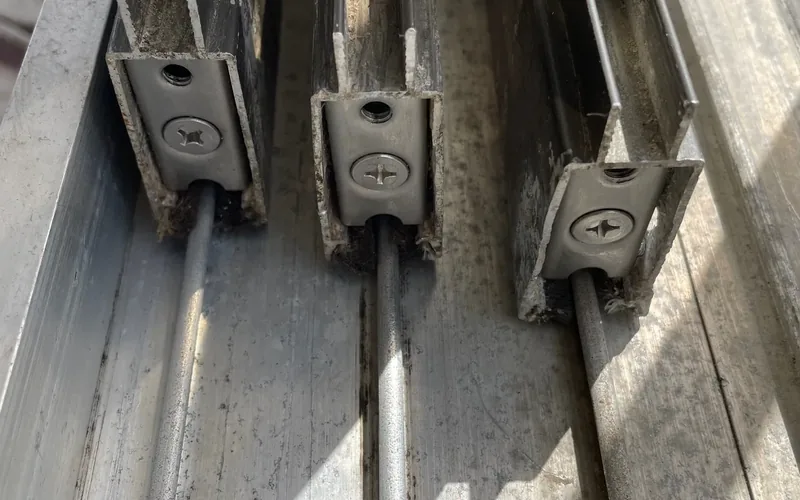
Salt crystals pull moisture out of the air, and in Florida's humidity they rarely dry out completely. That damp salt film is an electrolyte. On the steel inside a roller bearing it drives corrosion that pits the races and locks the wheel. On the aluminum track it eats the anodized finish and leaves white, chalky pitting. Once a roller stops turning, the panel skids instead of rolling, and a skidding panel grinds a groove into the track it rides on. That's how a roller job turns into a track repair.
Does wind really push harder on upper-floor doors?
Yes. Near the ground, wind is slowed by friction with trees, houses, dunes and everything else in its path. Ten floors up there's nothing to slow it. And the push on a sheet of glass rises with the square of the wind speed, so a modest increase in speed becomes a much larger increase in force. Corner units and the ends of a building tend to catch stronger gusts as air wraps around the structure.
You don't need a hurricane for that to matter. The afternoon sea breeze blows onshore most days, and on an upper-floor balcony it presses the sliding panel against one side of its track for hours at a time. Over months that does three things:
- It loads the rollers unevenly. A panel leaning on one leg of the track puts more of its weight on one side of each wheel, and the bearing wears out of round.
- It wears the interlock and weatherstripping. Where the sliding panel meets the fixed panel, the seals rub every time the panel flexes in a gust. Worn pile and fins let in air, noise and water.
- It drives water into the sill. Wind-driven rain gets pushed up into the bottom track. How the door handles that depends on its drainage, which is the next problem.
FEMA's recovery advisory on water intrusion through windows and doors describes most sliding doors as "contain and drain" products: they let some water in, hold it in a sill pan behind a raised riser on the inside, and drain it back out through weep holes. On an oceanfront balcony, those weep holes are exactly where salt crust and blown sand collect. Plug them, and the water that wind pushes into the sill has nowhere to go but over the riser and onto your floor. If yours already leaks, our guide to sliding glass door leaks walks through the causes in order.
Why are heavy impact panels so hard on small rollers?
Impact glass is laminated: two layers of glass bonded to a tough plastic interlayer so the pane holds together when something hits it. Add the heavier frame an impact panel needs, and the result is considerably heavier than the single-pane panels many older beachfront buildings started with. When buildings were retrofitted with impact doors, or when newer towers went up with them, the rollers didn't always grow to match.
A roller carries its share of the panel's weight on a very small contact patch where the wheel meets the track. A small-diameter wheel concentrates that load even more, and the bearing inside it is tiny. Put a heavy panel on undersized wheels, add the damp salt film from the spray, and the bearings develop flat spots, then seize. The panel starts to drag, then shudder, then refuse to move.
The fix is to put the panel on rollers sized for its real weight: tandem carriages that spread the load over two wheels, with sealed stainless bearings that keep the salt out. Our roller replacement page explains how we identify what your door takes. Matching an exact part matters more on these doors than on most, because the carriage has to fit the panel's bottom rail and still leave room for height adjustment.
What makes a balcony repair different from a ground-floor job?
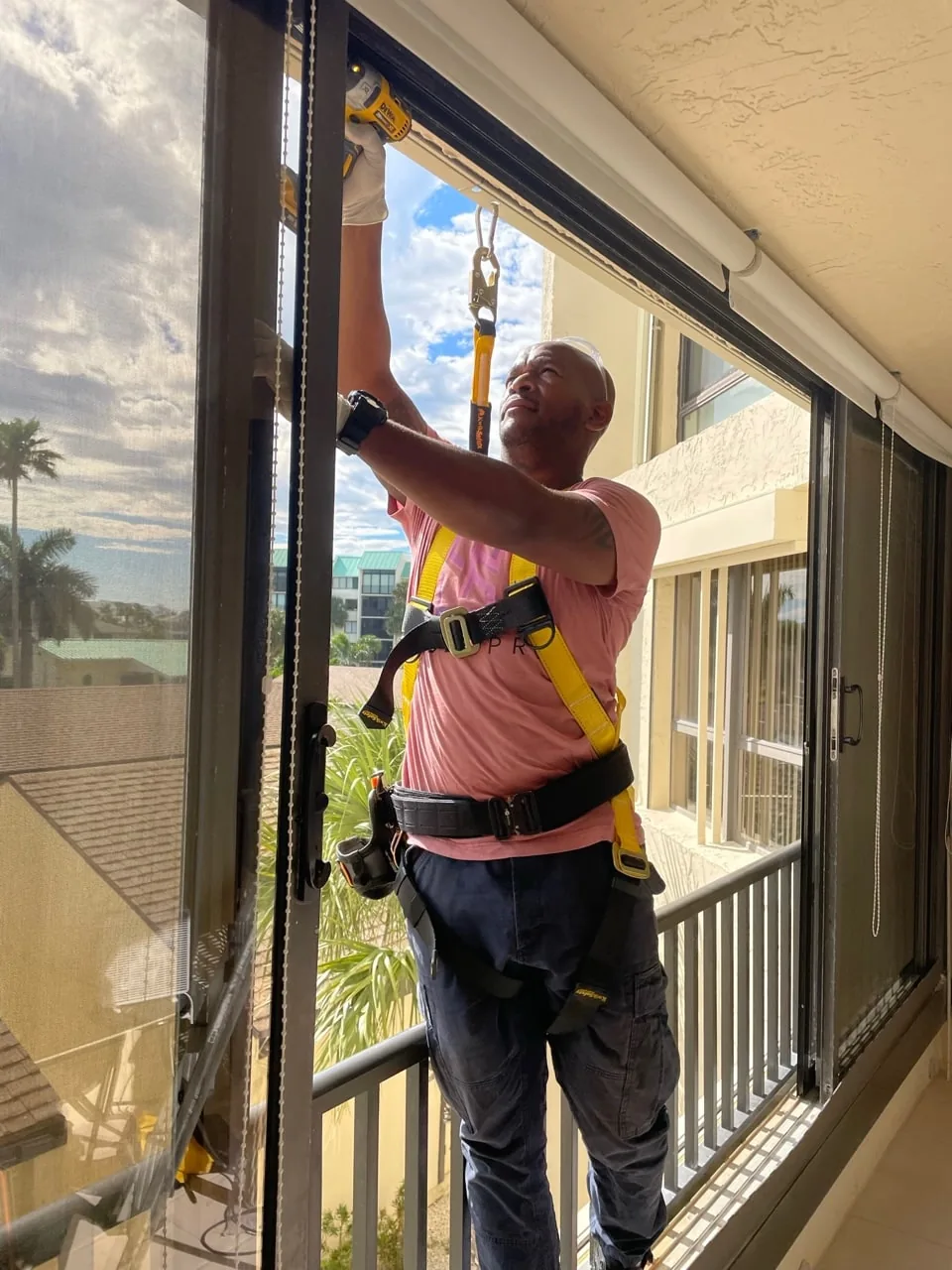
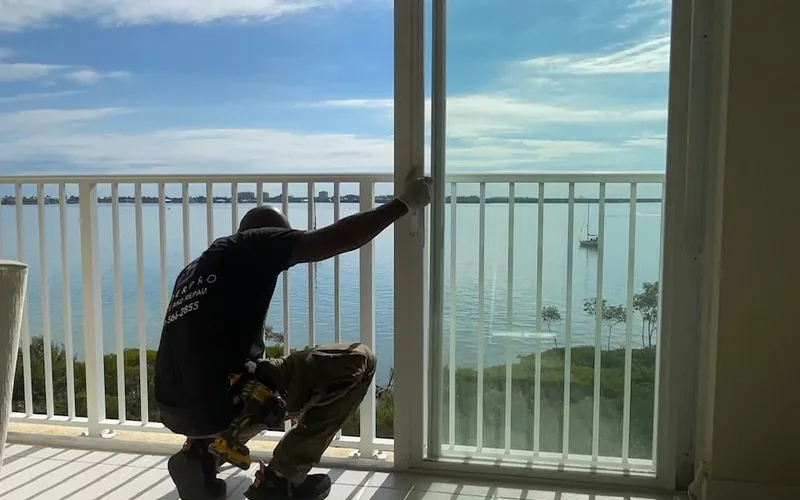
The repair itself is the same work. Everything around it isn't. A ground-floor patio door can come out and lean against a wall outside. A balcony panel can't go anywhere but into your living room, and on a windy afternoon you don't want it anywhere near the railing.
Here's what a well-run balcony visit looks like:
- Access is booked ahead. Many buildings want vendors to check in with management, use a particular elevator, or work within set hours. If parking is limited to a loading area, that matters too.
- The work happens from the inside. Panels lift out toward the unit, onto padding, never out onto a balcony where a gust can catch them. Screens come in first, because a screen panel will sail.
- Calm conditions are chosen when possible. Mornings are usually quieter on the beach side than afternoons, when the sea breeze builds.
- The track gets cleaned out properly. With the panel out, the full length of the track and the weep slots can be vacuumed, brushed and flushed, including the corners you can't reach with the door in place.
- The door is set, adjusted and tested. New rollers, height adjusted so the lock lines up, a check that the weeps drain, and a few dozen full slides before anyone calls it done.
If your balcony has roll-down or accordion shutters, open them before the appointment. A closed shutter blocks the exterior track and the weep slots, which are half the job.
What should you check with the building before anyone works on the door?
Responsibility for the door, the frame and the glass is set by your declaration, and it varies from building to building. We've written that up in detail in who pays for a condo sliding door, owner or association, so we won't repeat it here. What's worth sorting before a visit is the practical side:
- Vendor rules. Ask the manager what the building requires from any vendor before they arrive, and get it handled in advance so nobody is turned away at the front desk.
- Appearance rules. Some associations restrict visible changes, like hardware color or screen mesh color. Rollers and track work are hidden, but a new lock or screen may not be.
- Building-wide projects. If the association is planning work on the balconies or the facade, ask whether your slider will need to come out or be protected first. There's no point repairing a door that's about to be pulled for concrete work.
- Who has keys. If you're not in residence, decide who lets the technician in and who checks the door afterward.
How do balcony restoration projects and milestone inspections affect your slider?
Older coastal buildings are getting a lot more structural attention than they used to. Under Florida's milestone inspection law, condominium buildings three habitable stories or taller need a structural inspection by December 31 of the year they turn 30, and every 10 years after that. The statute also lets local officials move the first inspection to 25 years based on conditions such as proximity to salt water.
Those inspections cover the structure, not your door. But when they turn up balcony concrete that needs restoring, the slider sits right at the edge of the work zone. The sill, the track and the frame anchors all live where the slab meets the wall. If your building is heading into that kind of project, two things help:
- Find out the timeline before you spend money on the door. A roller job right before a balcony project may be wasted if the panels get stored for months.
- Get the door working before the panels go into storage. A door that's removed with seized rollers comes back with seized rollers. Doors that go back in after a long project often need adjustment anyway, because the sill may not be at exactly the same height it was.
What can an oceanfront owner do between service visits?
You can't stop the spray. You can stop it from piling up. These habits make the biggest difference on a beachfront balcony:
- Rinse the exterior track with fresh water. A spray bottle or a damp cloth along the outside leg of the track and the weep slots dissolves salt before it crusts. Dry vacuum first if there's sand.
- Keep the door moving. A slider that gets opened every day wipes some of the salt film off its own rollers. One that sits locked for weeks lets it work undisturbed.
- Skip oil sprays. Oil turns blown sand into grinding paste. If a clean track needs anything, use a dry silicone product, and keep it off the rollers.
- Clear the weep slots before storm season. A pipe cleaner or a thin plastic tie works. Never caulk them shut, even if you see water come in through them during a storm. That's them working.
- Book service on the salt clock, not the calendar. Oceanfront doors need attention more often than doors a mile inland. Our maintenance visits cover every slider in the unit in one appointment.
Oceanfront doors aren't doomed. They're just on a faster clock, and the hardware has to be chosen for that. If your balcony door is dragging, rattling in the wind or letting water in, send us photos of the door and the track. Repairs start at $275 and include parts, labor and a written warranty of 1 to 3 years. We'll tell you what's worn, and whether anything needs to be cleared with your building first.