Replacing a sliding door handle is usually a screwdriver job once you have the right part, and getting the right part comes down to three measurements and one honest question. The measurements are the handle type, the center-to-center distance between the mounting screws, and how the handle connects to the lock inside the door. The honest question is whether the handle is really what's broken, because a lot of "bad handles" are latches that can't reach their keeper.
This guide covers the handle side. For the locks themselves, mortise bodies, hook bolts, keyed cylinders and foot bolts, our sliding door lock repair page decodes each one, so we won't repeat that here.
What types of sliding door handles are there?
Most sliding glass door handles fall into two families: surface-mount pulls that only give you something to grip, and mortise handle sets whose thumb latch or key drives a lock body hidden inside the door's edge. Which one you have decides almost everything else about the replacement.
Common sliding door handle types and what decides the fit
| Type | How it works | What has to match | Where you see it |
|---|
| Surface-mount pull, no latch | A grip screwed to the face of the stile; locking is done by a separate latch or bolt | Screw spacing, plate size, stile width | Older aluminum doors, fixed-lock designs, screen doors |
| Mortise handle set with thumb latch | Inside handle carries a lever or turn that drives a tailpiece into a lock body in the stile | Screw spacing, latch position, tailpiece shape and length, handing | Most Florida patio doors from the 1980s on |
| Handle set with key lock | Outside handle carries a keyed cylinder that turns the same lock body from outside | All of the above, plus a lock body that accepts a cylinder cam | Doors used as a main entry, rentals, pool-facing doors |
| Flush or recessed pull | A cup set into the stile so the panel can pass a wall or another panel | Cutout size and depth | Pocket doors, multi-panel stacking doors |
| Integrated multipoint handle | Handle drives a gear that throws several hooks along the edge | Usually model-specific to the door series | Many impact and newer high-end doors |
A quick way to tell a pull from a mortise set: if the handle has a lever, flip or turn on it, and moving it makes something move in the door's edge, it's a mortise set. If the lock is a separate piece somewhere else on the stile, the handle is probably just a pull.
Why does hole spacing decide what fits?
Because the handle is bolted through the door, and the holes are already there. The inside and outside halves of most mortise handle sets are joined by screws that pass through the stile, and the lock body sits between them. A handle with the wrong spacing doesn't bolt up, and drilling new holes in a hollow aluminum stile next to a lock body is how a twenty-minute job becomes a door problem.
The number you need is the center-to-center distance: from the middle of one screw to the middle of the other, not edge to edge. Several spacings are common across door makers, and some differ from each other by a sixteenth of an inch. That's close enough to look right in a photo and far enough apart that the second screw won't start. Measure, don't eyeball.
Spacing isn't the only fit check. The latch or cylinder has to land at the right height relative to those screws, because it has to reach the lock body's slot. Two handles with identical spacing can have their thumb latches in different spots, and only one of them will drive your lock.
How do you measure a sliding door handle for a replacement?
Measure with the handle still on if it's intact, and again with it off if you can remove it safely. You'll want:
- Center-to-center screw spacing, inside handle, in inches to the sixteenth.
- Overall length and width of the handle base, so the new one covers the old screw holes and paint line.
- Stile thickness, the depth of the door edge front to back. Screws and tailpieces come in lengths, and the wrong length either won't reach or bottoms out.
- Latch position: the distance from the top screw to the center of the thumb latch, turn or cylinder.
- Tailpiece shape: the flat bar or square spindle that sticks out of the back of the handle. Photograph it next to a ruler.
- Handing: stand inside and note whether the door slides left or right to open. Many handle sets are reversible and some are not.
- Finish: white, bronze, black or mill aluminum, so the replacement matches the frame.
- Any label on the frame. The door maker and series narrow the options more than any measurement does.
If you're not sure who made your door, our guide to identifying a sliding door's brand from its parts shows where the clues usually are.
What's behind the handle, and why does it matter?
On a mortise set, the handle is just the part you touch. Its job is to move a tailpiece, and the tailpiece's job is to move the lock body in the door edge, which throws a hook into a keeper on the jamb. Three things go wrong at that connection, and they look like a broken handle from the outside.
- The thumb latch spins or flops. Often the tailpiece is worn, snapped, or the wrong length, so it no longer engages the lock body. Sometimes the handle is fine and the lock body's internal spring is broken.
- The latch is stiff, then suddenly works. Usually corrosion inside the lock body, not the handle. On the barrier islands and along the Indian River Lagoon, salt film gets into these mechanisms and binds them.
- The latch moves but the hook doesn't catch. That's almost never the handle. It's alignment, covered below.
A new handle on a seized or broken lock body fixes nothing. Before you order, take the handle off and work the lock body directly with a screwdriver in the slot. If the hook moves freely, the handle is your problem. If it doesn't, the lock body is.
Sliding door handle with key lock: can you add one?
Sometimes. A keyed outside handle only works if the lock body inside the door is designed to be turned by a cylinder from outside. Many lock bodies are made in versions with and without that provision, and the outside of the door may have a blank where the cylinder would go.
If your lock body accepts a cylinder, a matching keyed handle set is usually a straight swap. If it doesn't, adding a key means changing the lock body too, and that brings back all the fit questions: the size of the mortise pocket, the backset, the hook position relative to the keeper. That's where we'd want photos of the door edge before anyone buys anything.
A keyed handle is also not the same thing as a secure door. The latch on most sliders is a convenience lock. If the reason you want a key is security, read our sliding door security guide first; the bigger gains are usually alignment, a foot bolt and an anti-lift measure.
What's different about PGT sliding door handle replacement?
PGT is a Florida manufacturer, so its doors are common here, and the main thing to know is that "a PGT handle" isn't one part. Different door series, and different generations of the same series, use different handle sets, spacings and lock bodies. A handle that fits one PGT door can fail to fit, or fit but not match, another PGT door in the same house.
So work from the door, not the brand name:
- Find the manufacturer's label on the frame, often on an edge or along the head or sill, and photograph it.
- Measure the spacing and latch position as above.
- Photograph the tailpiece and the lock body slot.
- Check whether the door is an impact unit. Impact doors often use multipoint hardware that's specific to the series.
The same advice applies to every brand we see on the Treasure Coast. Whatever name is on the frame, the rule is the same: identify the exact hardware first, then match the part to it. What we do is diagnose the door, and if the handle is the actual fault, tell you exactly which part it takes.
Why do sliding door handle screws strip or keep coming loose?
Usually because the screws are threading into thin aluminum, and the aluminum loses. A few repeat causes:
- Overtightening. The stile is hollow. Crank the through-screws down and you can pinch the stile walls or bind the lock body between them, which makes the latch stiff. Snug is enough.
- Wrong length. A screw that's too long can bottom out or press on the lock body. Too short, and it grips two threads and pulls out.
- Corrosion. Plain steel screws rust in coastal air. Stainless resists rust but, in salt and moisture, can attack the aluminum around it, and the threads crumble. A dab of anti-seize on the threads helps.
- Pulling on a dragging door. A dragging door gets pulled hard by the handle every day, and that load goes straight into two small screws. Loose handle screws on a door that's hard to slide are a symptom of the rollers, not the handle.
A stripped hole can often be saved with a slightly larger screw of the same type, or a threaded insert, but don't go so large that the screw head no longer seats in the handle.
When is a handle problem really a latch, keeper or alignment problem?
When the handle and latch move normally but the door won't lock, or will only lock if you lift or push the panel. That's the hook missing its keeper, and it's usually caused by worn rollers letting the panel drop.
The test is simple. Close the door and try the latch. Then lift the handle side up slightly and try again. If it locks when lifted, the panel is sitting low and the hook is passing under the keeper. A new handle won't change that. The fix is in the rollers and the adjustment, which our guide to a sliding door that won't lock covers step by step, and in many cases a roller replacement is what brings the latch back.
The same applies to a keeper that's been "fixed" by moving it down to meet a sagging door. It works until the rollers wear further, and then you're moving it again, with more holes in the jamb each time.
What should you know about handles on pool-facing sliders?
If the slider opens onto a pool, the latch can be part of the home's pool safety setup, not just its convenience lock. Florida's Residential Swimming Pool Safety Act lists several ways a residential pool can meet its safety requirement. One of them, under section 515.27 of the Florida Statutes, is that doors with direct access to the pool have a self-closing, self-latching device with its release no lower than 54 inches above the floor. Another is an exit alarm on those doors.
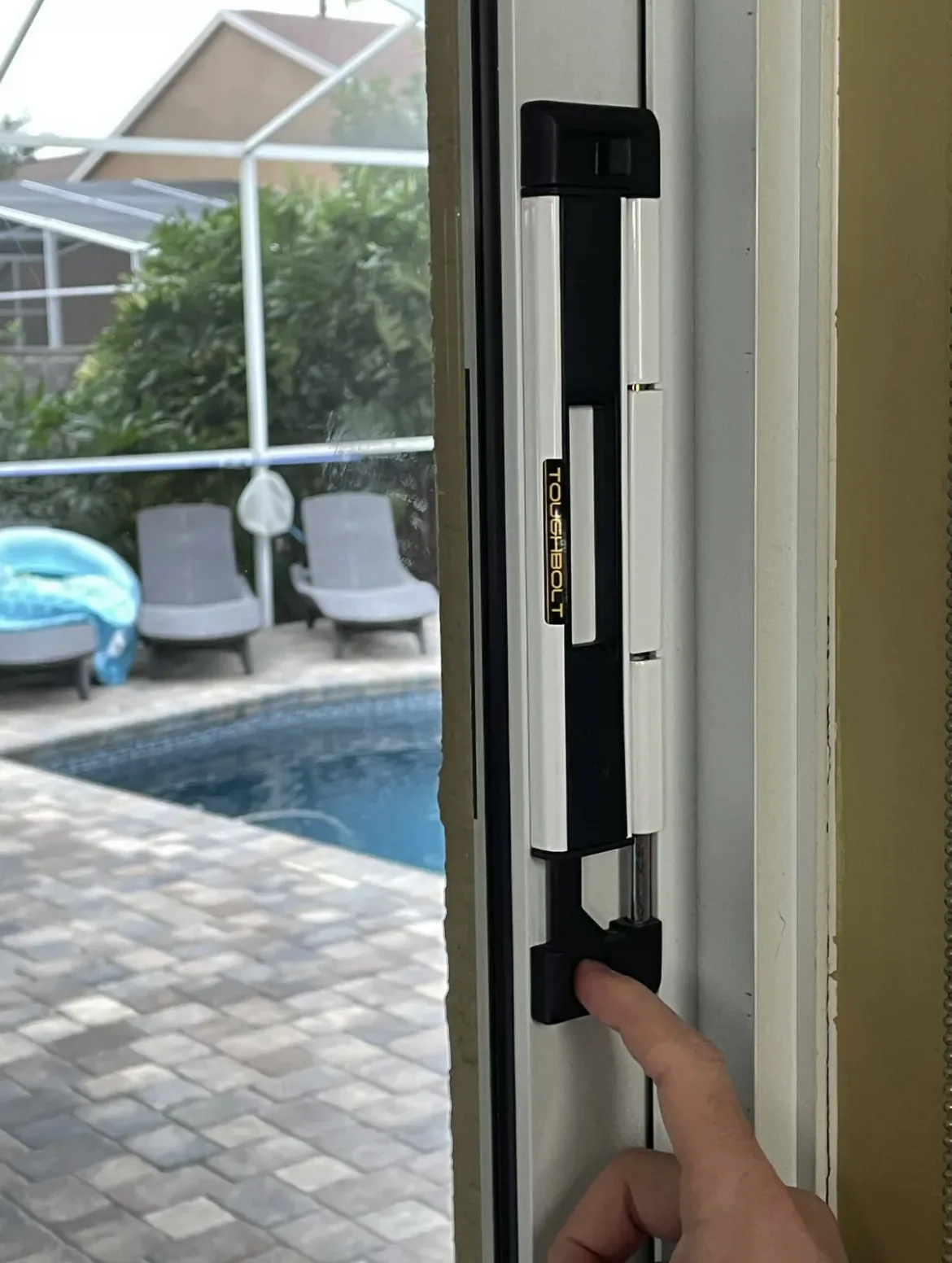
So before you swap hardware on a pool door, find out what your home relied on when the pool passed inspection. Removing a high latch or an alarm to put on a nicer handle can quietly undo it. A high-mounted auxiliary bolt like the one in the photo above is common on these doors and lives alongside the handle rather than replacing it.
Rentals have their own wrinkle: guests are hard on handles, and the replacement should be something that survives being yanked. Our rental sliding door checklist covers what to spec.
If you'd like a second set of eyes before ordering, send us photos of the inside handle, the outside handle, the door edge with the handle off if you can, and any label on the frame. Repairs start at $275 with parts, labor and a written 1–3 year warranty included. We'll tell you whether it's the handle, the lock body or the alignment that needs the work.