Short answer: A sliding door that won't lock usually has a sagging panel, not a broken lock. Worn rollers drop the panel a few millimeters, so the latch arrives below its keeper. Lift the handle edge and try the lock: if it catches, that's your diagnosis. The fix is new rollers and a height adjustment, after which the original latch usually works again. Moving the keeper only chases the sag.
Here's a pattern we see monthly: a homeowner has replaced their sliding door latch — sometimes twice — and the door still won't lock reliably. The new hardware didn't fix it because the hardware was never broken. The door itself has moved.
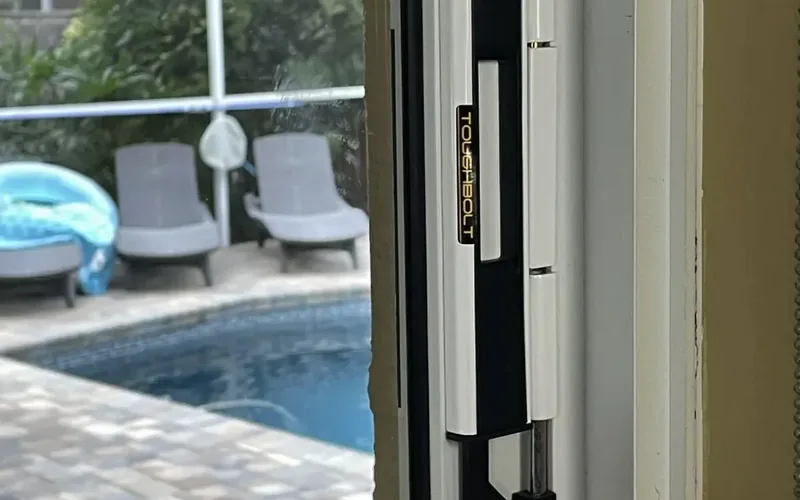
A sliding door lock is a precision rendezvous: a hook or bolt on the moving panel must meet a keeper on the frame, within a tolerance of a few millimeters. The latch doesn't know or care where the keeper is — it just throws to a fixed position on the panel. If the panel is no longer where it was when the door was installed, the rendezvous fails. And panels move for one overwhelmingly common reason.
The sag: how rollers move your lock
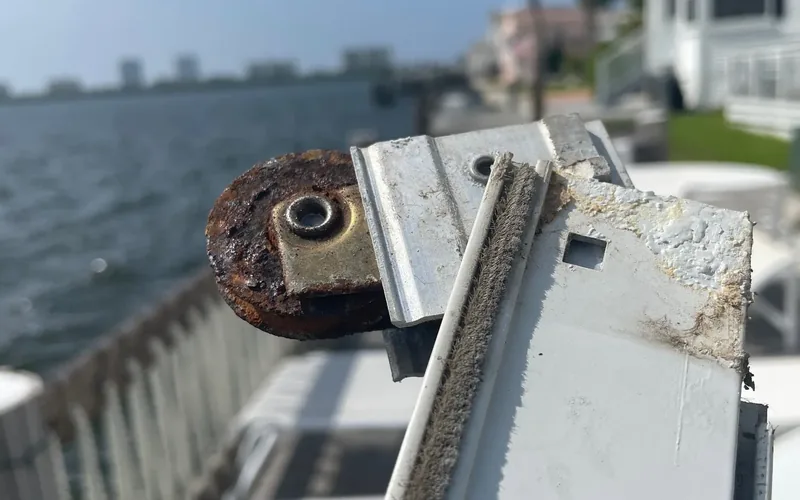
Your door's height is set by the rollers it rides on — adjustable wheels that hold the panel at the designed elevation in its track. As rollers wear, corrode, and compress, the panel settles lower. A worn set of rollers can drop a panel noticeably — and with it, the latch drops the same amount relative to the keeper that's bolted, immovably, to the frame.
The progression is unmistakable in hindsight: first the lock needed a firmer push. Then a lift of the handle while turning. Then the household developed The Technique — everyone knows you lift, wiggle, and hold just so. Finally, no technique works. At every stage, the latch was fine; it was simply arriving a few millimeters below its target.
The self-test: two minutes, no tools
- Look at the meeting point. Close the door and examine latch vs. keeper — in most doors you can see whether the hook aligns with its slot. Look for bright scrape marks above or below the keeper mouth: that's the latch physically telling you where it's actually arriving.
- Check the reveal. Look at the gap between the door's lead edge and the jamb, top to bottom. Wider at the top than the bottom (or vice versa) means the panel is sitting tilted — classic single-roller failure.
- The lift test. With the door closed, lift the handle edge of the panel gently. If the latch suddenly lines up when lifted — there's your diagnosis, live. The door wants its height back.
Why "just move the keeper" is the wrong fix
The tempting shortcut is to lower the keeper to meet the sagging latch — and some handymen do exactly that. It "works" briefly, and we'd rather you didn't: the sag that moved your latch is progressive (those rollers keep wearing), so the keeper chases the latch downward every year. Worse, chasing the symptom leaves the causes in place — a panel dragging on dying rollers, seating badly against its weatherstripping, leaking conditioned air, and grinding its track. The lock was your early-warning system; relocating the keeper unplugs the alarm instead of the fire.
The real fix, in order
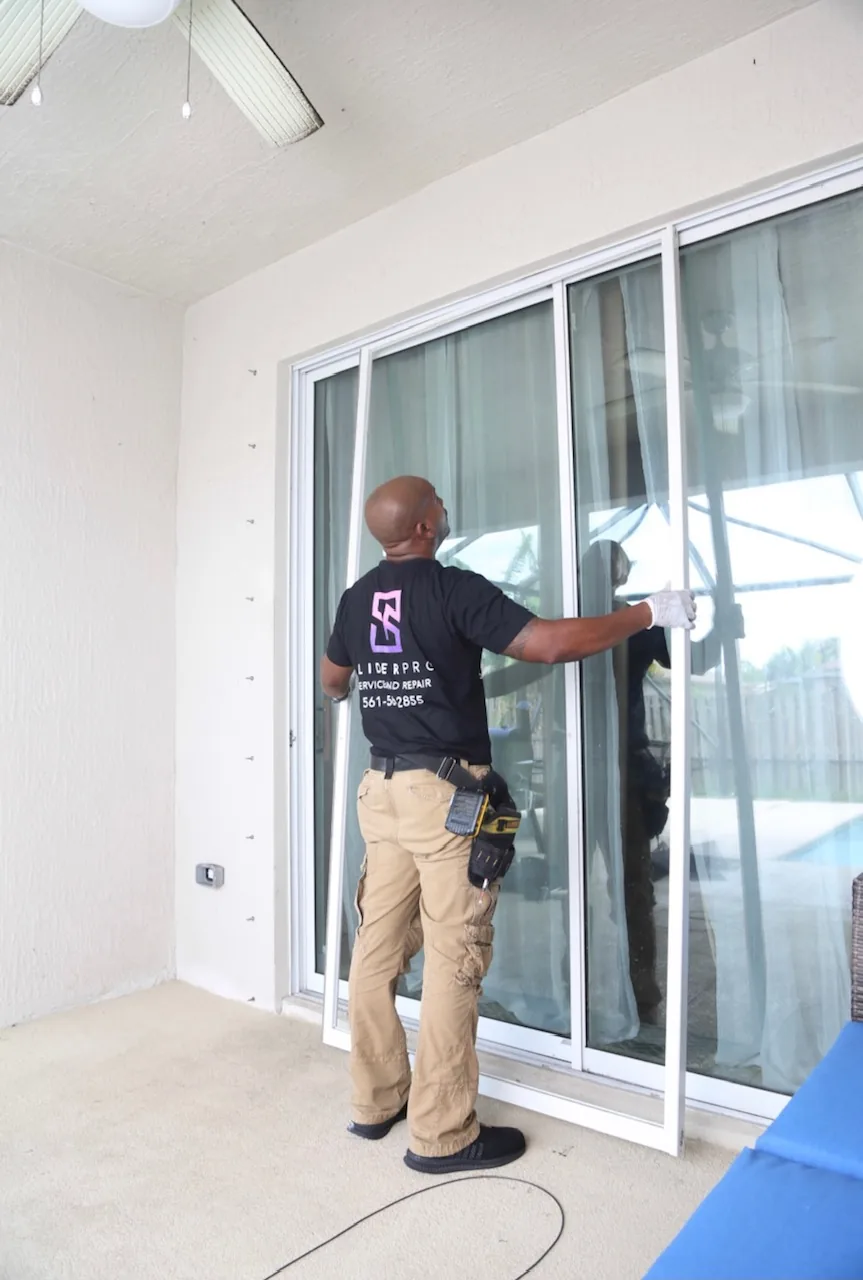
Proper repair reverses the causal chain. First, the rollers — replace the worn hardware that let the panel drop, restoring designed ride height. Second, adjustment — rollers have height screws, and we tune the panel level and square in its opening, with an even reveal. Third, only now, the lock: with the panel back where it belongs, nine times out of ten the original latch clicks home like the day it was installed. The times it doesn't, the latch genuinely was worn too — and we replace or upgrade it with the door properly underneath it, so the new hardware isn't inheriting an alignment problem.
Why this matters more than convenience
A slider that won't lock is your home's largest entry standing effectively open — the first door a burglar tests made trivially easy. And a household that's stopped locking a difficult door doesn't feel less secure, it just is. Misaligned doors also don't seal: that same sag holding your latch off its keeper is holding the panel off its weatherstripping, feeding a permanent leak your air conditioner pays for monthly.
If your door has developed The Technique, it's telling you something specific and fixable — usually in a single visit. Describe the ritual your lock requires and we'll tell you what we expect to find underneath it.
What do the wear marks tell you?
The door keeps a record of what has been happening, and reading it takes about a minute once you know where to look.
The keeper mouth. Look at the slot the hook is supposed to enter. Bright, polished scoring on the lower lip means the latch has been arriving below the opening and dragging up into it. Scoring on the upper lip is the rarer opposite, and points to a frame that has moved rather than a panel that dropped.
The hook itself. Throw the latch with the door open and look at the hook. A bright witness mark across its back edge shows where it has been striking the keeper face instead of passing into the slot. Rounding on the tip is different — that is a worn hook, not an alignment problem.
Paint and finish transfer. Aluminum rubbed against a painted keeper leaves a smear of paint on the hook, or a bare metal line on the keeper. The height of that line is roughly how far the panel has dropped.
The jamb. A vertical rub line on the jamb where the leading edge meets it means the panel is not only low but tilted, which is a single-roller failure rather than an even sag.
Photograph what you find before anyone starts adjusting things. It is the clearest evidence of what the door was doing.
The other causes, ranked by how often they're the real one
Sag accounts for the large majority of these calls, but not all of them. Here is the honest ranking, most common first.
- Worn rollers dropping the panel. The default, and the reason most replacement latches do not help.
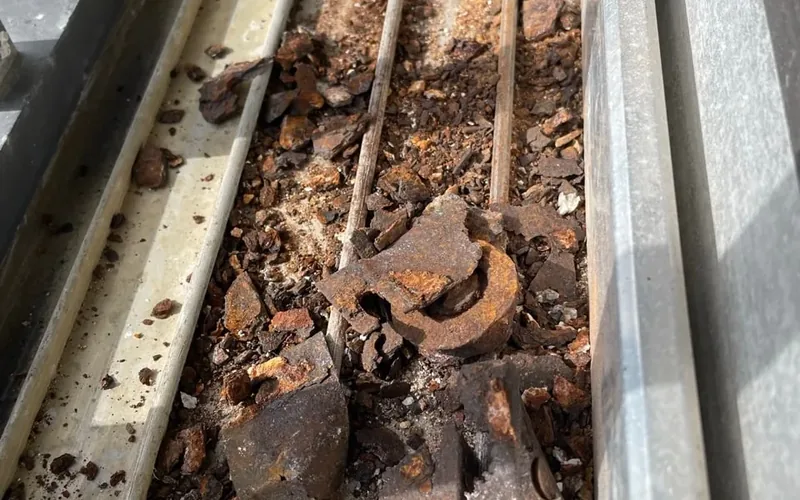
- Debris stopping the door closing fully. Packed grit at the closing end can hold a panel a few millimeters short of home, which leaves the latch short of the keeper with nothing actually worn. The cheapest possible cause, and worth ruling out first with a proper track clean.
- A loose or shifted keeper. Screws back out over years of vibration, and the keeper drifts or tilts in its slotted holes. Check whether it moves under thumb pressure.
- A single failed roller tilting the panel. Different from an even sag: the door binds at one corner and the reveal tapers rather than staying parallel.
- Worn linkage inside the handle. On mortise systems the handle drives the hook through a linkage that can wear or slip, so the handle turns further than it used to and the hook throws short.
- The frame itself has moved. Settlement racking the opening. Real, but the minority case.
- The lock body has genuinely failed. Last, not first, and it looks different from everything above.
Work down that list in order and you will not buy a part you did not need.
What can you safely do yourself, and where does DIY make it worse?
Some of this is genuinely a homeowner job. Some of it turns a modest repair into an expensive one, and the line between them is sharper than it looks.
Worth doing yourself. Clean the track thoroughly and dry, then retest the lock — debris is a real and free cause. Check the keeper screws and snug them if they have backed out. Confirm nothing is obstructing the closing end, including a security bar or a pet-door insert that has crept out of position. Run the lift test and note what it tells you.
Where it goes wrong. Roller height screws in coastal doors are frequently corroded into their threads, and a screwdriver leaned on hard shears the head off inside the housing. That converts a straightforward roller swap into extraction work. Drilling the keeper to a new position chases a moving target and leaves an oversized hole that will not hold once the panel is put back where it belongs. Prying at a latch that will not retract bends the hook. And removing a panel single-handed is how impact glass ends up on a tile floor.
The rule we would give a family member: cleaning, inspecting and tightening are yours. Anything that involves force, drilling or the panel coming out is not worth the risk on a door this heavy.
When has the lock genuinely failed?
Sometimes the hardware really is the problem, and it presents differently from sag. These are the signs that point at the lock itself rather than the door underneath it.
- The handle turns freely and nothing moves. The linkage between handle and hook has failed, or the spindle is stripped. The give-away is that the resistance you used to feel at the end of the throw has disappeared entirely.
- The hook extends but is visibly rounded or chewed. Years of striking a keeper it could not quite reach wear the tip. Even with alignment restored, a rounded hook may not hold under load.
- The hook throws only partway, or sticks out. Usually a broken return spring or corrosion inside the mortise body.
- A key cylinder that turns roughly or not at all. Salt-driven corrosion inside the cylinder, common on exterior-keyed sliders near the water.
- The lock works with the door open and not closed. That is the exception that proves the rule — if the mechanism operates freely in mid-air, the mechanism is fine and the alignment is not.
When the lock genuinely has failed we replace or upgrade it, but we do it with the panel back at its designed height first, so the new hardware is not inheriting the same alignment problem that destroyed the old one. Details on the lock repair page.
When has the frame itself moved?
A racked opening and a sagging panel both stop a latch reaching its keeper, and they need different work, so it is worth separating them before anyone orders parts.
Florida builds on sand with a high water table, and lanai slabs are frequently poured separately from the house slab. Over decades those elements can move relative to each other by a small amount, and a small amount is all a door opening has to give. Older housing stock has had the longest to do it — the 1970s and 1980s homes around Fort Pierce, the waterfront streets in Stuart and Sewall's Point, and almost any added-on Florida room.
The signatures differ. A sagging panel shows a tapering reveal at the leading edge and a keeper scored on its lower lip. A racked opening shows a head gap that is not parallel across its width, cracking in tile or stucco at one jamb, a door that binds against the head rather than the sill, and diagonals of the opening that do not match when you measure corner to corner.
Most settled openings can still be worked with. We rehang and adjust the panel to the opening as it is today rather than as it was built, which brings the latch back to its keeper. Where the movement is severe there are limits, and we will say so rather than take money for an adjustment that will not hold.
Why does salt air seize coastal lock hardware?
Everyone in this business says salt air is hard on hardware. Here is why it kills locks specifically, because the mechanism explains the pattern.
A mortise lock is a set of small steel components — hook, springs, linkage, cylinder — living inside an aluminum stile. Salt aerosol settles on the door and works into the lock pocket through the face plate and the handle cut-outs. Salt is hygroscopic: it pulls moisture out of humid air and holds it against metal as a thin brine film. That film is an electrolyte, and an electrolyte between two dissimilar metals makes a galvanic cell. Aluminum is the more reactive of the pair, so it corrodes preferentially and swells as it converts to oxide.
That swelling is what you feel. Aluminum oxide occupying more space than the metal it came from binds a steel hook in its slot, jams a spring in its housing, and locks a fastener into a thread it once turned freely in. Meanwhile the steel parts pit and lose their smooth finish. Nothing has broken; the mechanism has simply been packed solid from the inside.
Two practical consequences. Do not force a seized screw on a coastal door — a sheared head inside an aluminum stile is a much longer job than the repair it was guarding. And exercise every lock, including the ones on doors you never use, because motion is what keeps the film from settling.
What does the fix cost, and when is replacement the honest answer?
An alignment repair is one of the cheapest jobs on a sliding door and one of the highest-value, because it fixes security, sealing and travel in a single visit.
Repairs start at $275, and that figure includes parts, labor and a one to three year warranty on both. What moves the number is what is underneath: a roller pair plus a height and reveal adjustment on a standard door sits at the low end, while heavy impact glass, a pocket system, a grooved rail needing a cap track, or a lock body that genuinely has failed adds parts and time. Same-day service is available, and 96% of our jobs are finished in one visit.
Replacement is the honest answer in a small number of cases. If the stile around the lock pocket has corroded far enough that no fastener will hold, there is nothing left to mount hardware to. If the sill or the structure behind the frame has rotted, nothing bolted to it stays in adjustment. If the opening has settled beyond what rehanging can correct, the panel cannot be brought square. And if a proprietary lock is genuinely orphaned with no aftermarket equivalent and the stile is corroded as well, the two together can tip it.
Outside those, the door you have is the door worth fixing. We do not sell replacement doors, so it costs us nothing to say so.
Condo balcony doors and seasonal homes: who do you ask first?
Two situations change who acts on a door that will not lock, and both catch owners out.
Condo and association buildings. Florida declarations usually describe a balcony as a limited common element and split the door across that boundary. In the arrangement we see most often the operating hardware — rollers, latch, handle, screen — falls to the unit owner because it wears with your use of the unit, while the frame is association property and the glass depends on how the unit boundary is defined. Since a door that will not lock is almost always a hardware and alignment problem, it is almost always yours to fix, and owners routinely wait months on a board for a repair the board was never responsible for. This is general information rather than legal advice: read your declaration, put anything touching the frame to management in writing, and keep the reply. The condo guide covers the clauses that decide it.
Seasonal homes. A lock that worked in April and will not catch in November has not broken over the summer; the rollers under it corroded while nothing moved them, because motion is what wipes the salt film off a bearing. Leaving a slider unlocked in an empty house is the worst version of this problem. Have the doors checked at arrival before the house is left again.
How do you stop it happening again?
A door that has been properly realigned stays aligned for years, provided the things that dropped it are dealt with rather than worked around.
- Fix the cause, not the keeper. Relocating a keeper to meet a sagging latch guarantees you will be doing it again next year, and it removes the early warning that told you the rollers were going.
- Replace rollers in pairs, in sealed stainless. A new roller alongside a nearly dead one puts the panel back out of square within months, and unsealed hardware near the water restarts the same short clock.
- Keep the track clean and dry. Grit at the closing end holds a door short of home, and standing water in the track is what feeds the corrosion that drops the panel. The ten-minute routine covers it.
- Test the latch monthly. Lock the door and try to lift-and-pull it open. If it needs a lift, a wiggle or a technique, the panel has started to drop. That is the cheap end of the repair.
- Exercise every lock, including the ones on doors nobody uses. Motion keeps the salt film from settling in the mortise.
- Service annually near the water. Inland you can stretch it comfortably, and we will tell you honestly which side of that line your address falls on.
If your door has already developed the technique, describe what the lock is doing or call 772-722-4036, and we will tell you what we expect to find underneath it.