Sliding glass door seals are mostly pile weatherstrip: dense brush-like strips that slide into slots along the frame and the panel edges, often with a thin plastic fin down the middle. They seal the jambs, the head, the bottom rail and the interlock where the two panels overlap. When a slider gets drafty or noisy, the strips are worn out about half the time. The other half, the strips are fine and the panel has dropped on worn rollers until the strips no longer touch what they're meant to seal against.
This guide covers the seal types, how the seal line breaks, and what genuinely helps with drafts and noise. Water coming in under the door is its own problem with its own causes, so if that's what you're fighting, go to our guide on a sliding glass door leaking water. For the power-bill side and a simple leak test, our page on sliding door energy efficiency has it covered.
What seals does a sliding glass door actually have?
Four seal lines: pile along the vertical jambs where the panel meets the frame, pile across the head and bottom rail, a seal at the interlock where the two panels hook together, and a glazing gasket that seals the glass into its own frame.
A closed slider is a box with a moving lid, and every edge of that lid needs a seal that still lets it slide. That's why you won't find rubber compression gaskets like a car door on most sliders. They'd grab the panel and make it impossible to open. Instead, sliders use pile that brushes against the mating surface, closing the gap without much friction.
The U.S. Department of Energy's guide to air sealing lists the families you'll find on doors and windows, including tension seals, felt, foam, door sweeps, bulb or fin seals and interlocking metal channels. A slider uses several at once. The glazing gasket is the odd one out: it seals glass to sash, never moves, and is a glass repair rather than weatherstripping.
Pile, fin seal or bumper: what's the difference?
They do the same job in different spots. Knowing which is which helps you buy the right replacement, and stops you jamming a thick seal into a slot that wants a thin one.
Sliding glass door seal types and where each one belongs
| Seal | What it is | Where it goes | How it fails |
|---|
| Plain pile | Dense fibers woven into a narrow backing strip | Jambs, head, screen frames | Mats down flat, collects sand, frays at the ends |
| Fin-seal pile | Pile with a thin plastic fin down the center that blocks air through the fibers | Interlock, jambs and head on most modern doors | Fin cracks or tears from sun and age; pile mats |
| Bumper or bulb seal | Soft vinyl or rubber profile that the closing panel presses against | Interlock stile or lock jamb on some designs | Hardens, splits, or gets crushed if the panel hits it out of line |
| Bottom pile or sweep | Pile or a flexible fin on the underside of the panel's bottom rail | Between the panel and the sill | Worn by sand, torn by debris in the track |
| Glazing gasket | Vinyl or rubber strip that seats the glass in the sash | Around the glass inside the panel frame | Shrinks back from the corners in sun |
The slots that hold pile are sized precisely. Pile is sold by backing width and pile height, and both matter. Backing too wide won't slide in; too narrow, and it walks out of the slot every time the door moves. Pile too tall makes the door drag and can push the panel off its rail. Pile too short doesn't touch. Pull a short piece of the old strip from an end and take it with you, or measure it with calipers.
How do you replace the seal between the doors?
The seal between the doors lives on the interlock, the vertical stiles where the sliding panel and the fixed panel hook over each other when the door is closed. Each stile has a hook shape, and the pile on one wipes against the other. It's the seal people notice most, because it's at eye level and it's where daylight shows.
The general sequence:
- Find which stile carries the pile. Sometimes it's on the sliding panel, sometimes on the fixed panel, sometimes both.
- Check whether the slot ends are open. On many doors, pile slides in from the top or bottom of the stile. If the end is capped or hidden by the head or sill, the panel has to come out.
- Pull the old strip out and clean the slot. Sand and old fibers in the slot keep the new backing from seating.
- Match backing width, pile height and fin. Fin-seal replaces fin-seal.
- Feed the new strip in without stretching it. Stretched pile shrinks back later and leaves a gap at the end. Cut it slightly long, let it relax, then trim.
- Check the overlap. Close the door and look along the interlock from the side. The pile should brush the other stile along its full height.
That last step is where most interlock replacements disappoint. If the pile brushes at the top and misses at the bottom, or the other way round, the new seal isn't the problem. The panel is sitting crooked.
How does a sagging panel break the seal line?
Worn or seized rollers let the panel drop, usually more on one end than the other. The panel tilts in its frame, so a seal that was even along its length is now crushed at one corner and open at the other, and no new weatherstripping can close a gap that keeps moving.
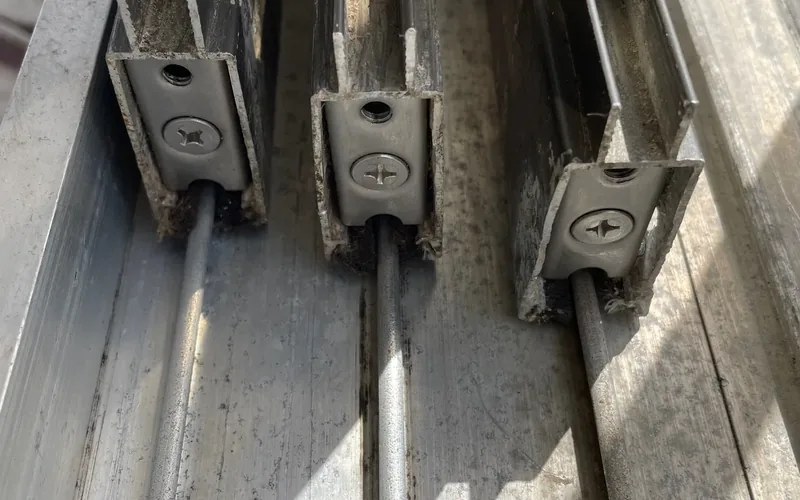
Look at the photo above: each panel rides on rollers set into its bottom rail, and the screw on the end of each rail adjusts the roller height. When those rollers wear, the bottom rail sinks closer to the track. The pile on the bottom of the rail gets pressed flat and wears faster. Up at the head, the top of the panel drops away from the head pile, opening a gap along the top.
It gets worse when one roller fails first, which is common, because the panel then tilts. The interlock stile leans. At one end, its pile is crushed against the other panel and mats down permanently. At the other end, it pulls away and leaves a sliver of daylight. The lock usually starts acting up at the same time, for the same reason.
That's why we look at the rollers before we sell anyone weatherstripping. New pile on a tilted panel looks great for a week, then takes the shape of the tilt. Lift the panel back to level with new rollers or a proper adjustment and the original pile sometimes recovers. If you've noticed the door getting heavier as it got draftier, the signs your rollers need replacing will look familiar, and our roller replacement service is where that fix starts.
What about the bottom seal on a sliding glass door?
The bottom seal has the hardest job on the door. It lives in the track, where sand, salt and grit collect, and it gets dragged across all of it every time the panel moves.
On most sliders the panel's bottom rail rides on rollers just above the track, with pile or a small fin on the underside of the rail to close the gap. Sand packs into that pile until it's a scrub brush, and the fibers wear unevenly. A torn or missing bottom seal shows up as a draft at floor level and, on the Treasure Coast, as sand that keeps appearing on the floor just inside the door.
One warning: the track has weep holes and drainage paths designed to let water out. A bottom seal is supposed to close the air gap under the panel, not seal the track shut. Caulking the sill, stuffing foam into the track or covering the weep holes turns a minor draft into standing water the first time an afternoon storm blows against the glass. Keep the track clean and the weep holes open; our track cleaning routine shows how.
Do draft stopper snakes work on a sliding glass door?
As a stopgap, a little. As a fix, no. A fabric snake laid along the floor blocks some air at the sill and does nothing about the interlock, the jambs or the head, which is where most slider leaks are.
They also cause their own problems on a slider:
- They sit in or against the track, holding sand and moisture right where the rollers run and the weep holes drain.
- The door has to be opened over or around them, so they get kicked into the track or dragged by the panel.
- Stick-on foam draft stoppers on the panel bottom add drag and often push the panel up off its rollers or rub the sill.
- They hide the symptom. A draft at the sill is often a sign the panel has dropped, and a snake lets that wear go on.
If you need something for a cold snap or a closed-up house, a snake on the inside of the sill is harmless enough. Just take it away before you use the door, and treat the draft as a reason to have the seals and rollers checked.
Can new seals reduce noise through a sliding glass door?
Seals help with noise that comes through gaps, and do little for noise that comes through the glass. Sound travels wherever air can go, so a door with matted pile and a daylight gap at the interlock leaks the sharp, high-pitched sounds: voices, a leaf blower, a neighbor's pool pump. Close those gaps and those sounds drop noticeably.
Low rumble is different. Traffic on US-1, a boat engine on the Intracoastal, aircraft: that energy passes through the glass and frame themselves, and the defense is mass, not weatherstripping. Thicker or laminated glass helps because the interlayer damps vibration. A single-pane aluminum slider with perfect seals is still a thin pane of glass.
A rough rule for your own door:
- If the noise is worst right at the interlock or a corner, and you can feel air there, it's a seal or alignment problem. Fixable.
- If the noise seems to come through the whole pane evenly and the door seals well, seals won't change much. That's a glass question, and sometimes the honest answer is a different door.
- If the panel rattles in the wind, it's loose in its frame or riding on worn rollers, and the rattle itself is part of the noise.
Why is my sliding door leaking cold air?
In Florida, "leaking cold air" usually means your air conditioning is escaping while hot, humid air comes in to replace it. You feel it as a cool draft on the outside or a warm, sticky one on the inside, and sometimes as condensation on the aluminum frame on humid mornings.
The DOE guide describes air sealing as one of the most cost-effective ways to improve a home's comfort and energy efficiency, and the slider is often the biggest single moving opening in the house. The leak points, in the order we find them: the interlock, the bottom rail, the top of the panel at the head, then the lock jamb. Our energy efficiency guide walks through a simple leak test, so we won't repeat it.
What wears seals out faster here: UV breaking down the fins on south and west exposures, sand packing the bottom pile, and salt film stiffening everything near the beach. A house closed up for the summer adds a twist, since pile left compressed against a closed panel for months can take a set. If you're leaving for the season, our guide to closing up a Florida home's sliding doors covers what to do before you go.
A seal and alignment check is part of every maintenance visit we do. If your slider has gone drafty, noisy or both, send us photos of the interlock from the side with the door closed, the bottom rail, and the ends of the panel where the adjustment screws are. Repairs start at $275 with parts, labor and a written 1–3 year warranty included, and we'll tell you whether it needs seals, rollers or both.