If your sliding screen door falls out, drags or won't latch, the mesh is almost never the problem. The panel rides on small wheels, at least one pair of them spring-loaded, and those wheels, the screw that sets their height, the frame that holds them square and the track they run in are where nearly every screen door fault lives. Fix the hardware and the screen behaves again. Torn or chalky fabric is a different job, covered on our screen fabric repair page and in the no-see-um mesh guide, so this page stays on the door itself.
How is a sliding screen door put together?
A sliding screen door is a light aluminum frame of four rails held square by plastic or metal corner keys, riding on two pairs of small wheels, with a pull handle, a latch and a strip of weather pile along its edges.
Each part has a job, and each job can fail on its own:
- The frame. Thin extruded aluminum, much lighter than the glass panel's frame. Its corners are pressed together over corner keys. Tensioned mesh helps hold it square.
- The wheels. Usually four: two at the bottom carrying the panel, two at the top keeping it in the upper channel. At least one pair sits in a spring-loaded housing, so the panel is pressed up and down at the same time. That squeeze is the only thing holding a screen in its track.
- The adjustment screw. A small screw near each spring-loaded corner that raises or lowers the wheel inside its housing. It sets how hard the springs press.
- The latch and pull. Usually a plastic or die-cast housing with a hook that catches a strike on the door jamb. Not a security device.
- Weather pile. The fuzzy strip on the edges that closes the gap against the jamb and the glass panel.
Once you see the screen as a spring-loaded panel wedged between two tracks, almost every symptom explains itself.
Why does a sliding screen door come off its track?
A screen comes off its track when the squeeze holding it in drops: the springs weaken, an adjustment screw backs out, the frame racks out of square, or the track lip is bent, so the top wheels sit too low to stay in the upper channel.
Think of the panel's working height as the distance from the bottom of the lower wheels to the top of the upper ones. When that height is right, the wheels press into both tracks and the screen can't lift out. When it shrinks, even a little, the top wheels sit at the bottom edge of the head channel, and a push on the frame or a gust of wind pops them free. Here's what shrinks it:
- Tired springs. The small steel springs in a wheel housing lose tension with years of compression, and on a Florida door they rust. A rusted spring that has thinned or snapped pushes nothing.
- A screw that has walked. Vibration and repeated slamming can turn an adjustment screw out over time. Some housings are plastic, and the screw strips its own threads.
- A racked frame. If the frame leans into a parallelogram, one top corner drops while the other rises. One wheel is in the channel, one isn't. This usually follows mesh going slack, a corner key cracking, or the panel being yanked from one end.
- A bent track lip. The screen's lower track is a thin raised rail on the outside of the sill. A heel, a dolly or a pool chair can fold it over, and the bottom wheel climbs out at that spot every time.
- Grit under the wheels. Sand packed into the channel lifts the bottom wheels, the panel rides high on one side, and the frame twists as you slide it.
The fix order follows the list in reverse: clean the track first, check the lip, then set the wheels. If the panel still won't stay in, the frame or the springs are the real problem. The glass panel jumping its track is a heavier, different problem; see sliding glass door off track for that one.
How do you adjust the wheels on a sliding screen door?
Find the adjustment screw near each bottom corner, turn it a quarter turn at a time to raise or lower that corner, and set both sides so the panel slides with a light push but won't lift out of the top channel.
On most screens the screws are in small holes on the face or the edge of the side rails, a couple of inches up from the bottom. Some doors put the springs and screws at the top instead. Here's the routine:
- Vacuum the lower track and the head channel. Adjusting a panel that sits on sand just sets it wrong.
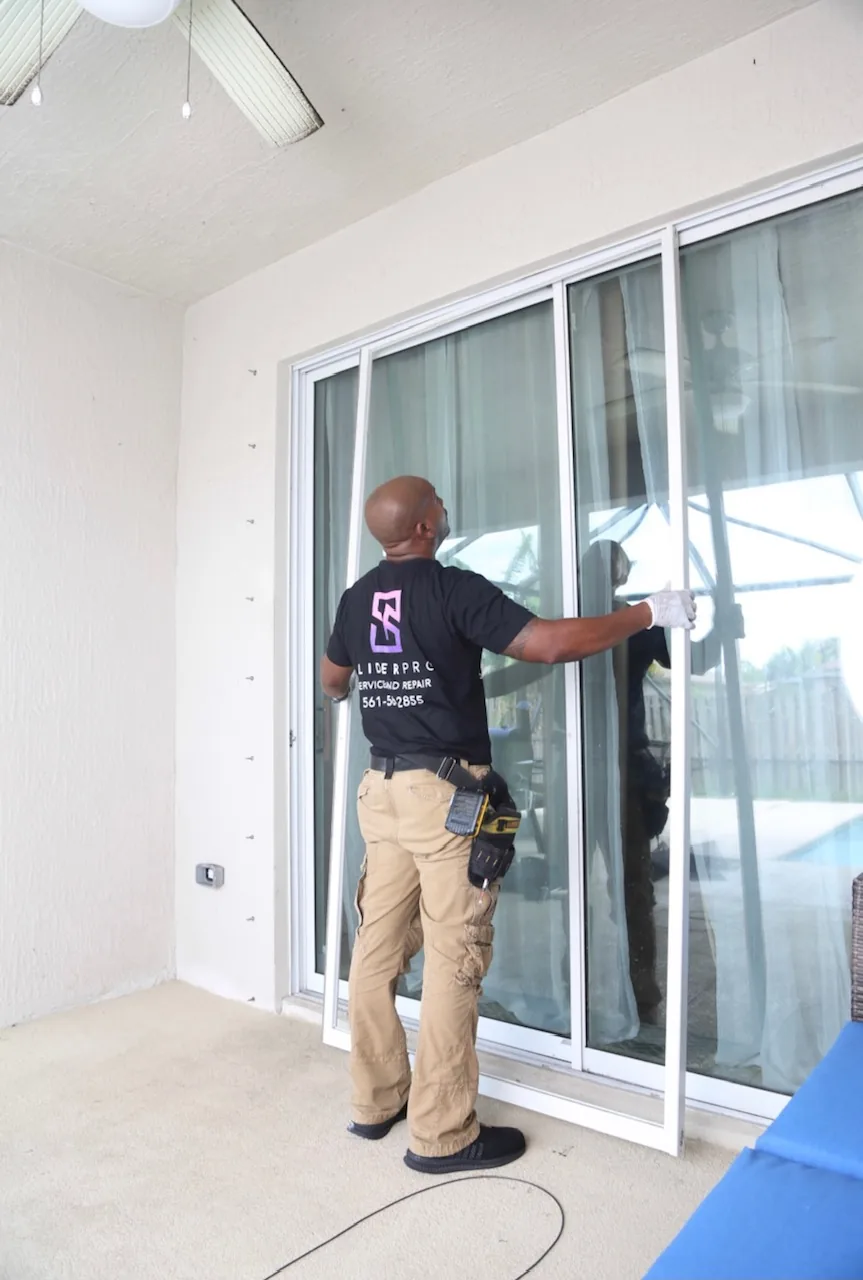
- Back both screws off until the panel drops enough to lift in. Tilt the top into the head channel, lift, and swing the bottom over the lower rail.
- Turn one screw a quarter turn and watch the corner. Direction isn't standard between makers, so let the panel tell you which way is up.
- Raise each side until the top wheels sit firmly in the channel. Grab the frame and try to lift it. It should move a little against the springs, not jump out.
- Check the gap at the jamb. The edge of the screen should meet the jamb evenly top to bottom. A wedge-shaped gap means one side is higher than the other.
- Slide it end to end. It should roll with two fingers. If it binds, you've gone too tight. Back off a quarter turn.
Don't crank a screw past snug. On plastic housings the screw strips out, and on steel ones you can bend the wheel axle. If a screw spins without moving the wheel, the housing is broken and needs replacing, not more turning.
When should you replace sliding screen door rollers instead of adjusting them?
Replace the wheel assemblies when adjustment can't fix the feel: the wheels are cracked, flat-spotted, wobbling on their axles, or no longer spin, or the springs are rusted thin. No setting makes a dead wheel roll.
Screen wheels are small and cheap compared with the main door's rollers, but they live in the worst spot on the door: right at the outside edge, closest to the rain, the salt film and the sand. A typical failure on a coastal door looks like this. The steel axle or bearing corrodes, the wheel stops turning, and it skids. A skidding plastic wheel wears a flat, the flat clicks and bumps, and soon the plastic splits. Meanwhile the spring behind it has rusted and lost its push. By the time the screen feels "rough," both are usually gone.
Replacing them means matching four things, and none of them is universal:
- Housing size and shape, so it fits the pocket in the bottom or top rail.
- Wheel diameter and edge profile, so it rides the track rail and sets the right height.
- Mounting, which can be a snap-in clip, a screw through the rail, or a housing held by the corner key.
- Where the spring is, top or bottom, which decides whether the adjustment screw ends up where you expect.
That's why the hardware-store "universal" wheel so often sits crooked or rides high. If you're trying to work out which parts your door takes, our guide to identifying your door's brand and parts walks through where the makers hide their names. On a repair visit we look at the screen wheels alongside the main door's roller replacement, since they wear on a similar schedule.
Can a bent sliding screen door frame be fixed?
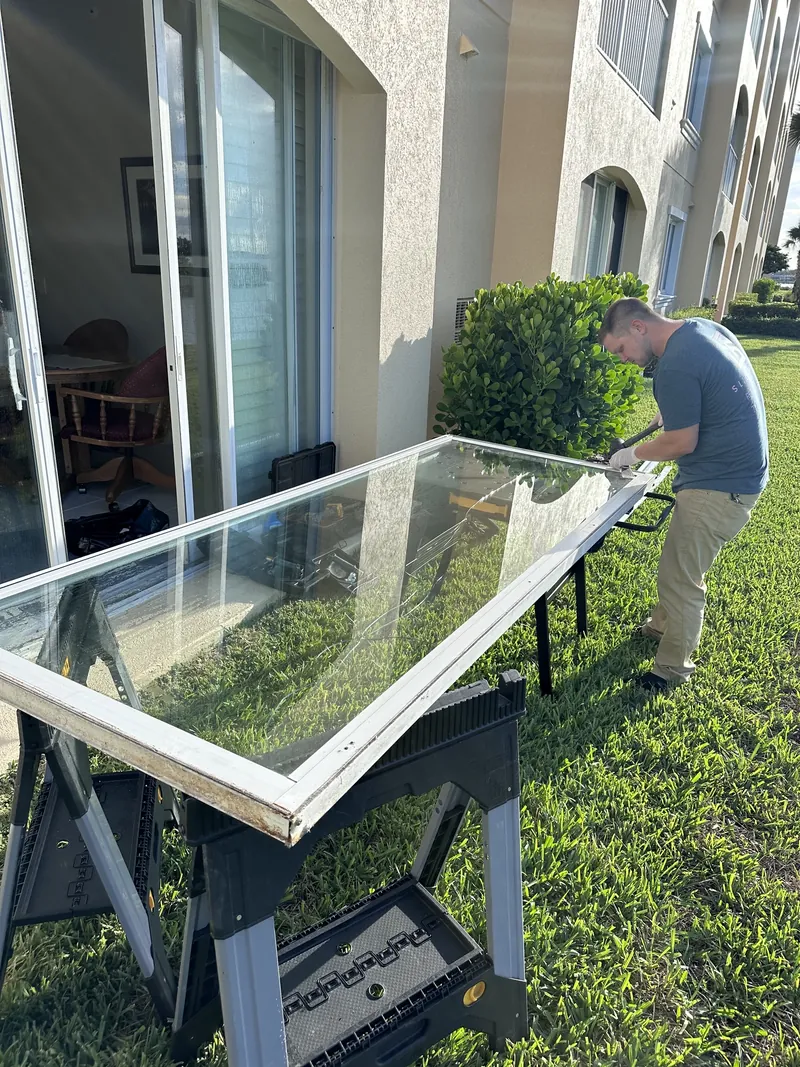
Often, yes. A frame that's racked out of square can usually be pushed back, and a cracked corner key can be replaced. A rail that's kinked or creased, rather than gently bowed, usually means a new rail or a new frame.
Screen frames are thin aluminum, and they take more abuse than people realize: dogs pushing through, kids leaning on them, wind slamming them against the end stop. There are three kinds of damage, and they look similar from across the room:
- Racking. The corners have shifted, so the frame is a slight parallelogram. Measure corner to corner both ways. If the two diagonals differ by more than about a quarter inch, it's racked. Squaring it and re-tensioning the mesh can bring it back.
- Bowing. A long rail curves in or out. A gentle bow can sometimes be eased straight. It matters most on the side rails, because a bowed rail leaves a gap at the jamb that lets bugs in no matter how fine the mesh.
- Kinks and creases. A sharp fold in the metal has work-hardened it. It won't straighten cleanly, and it will fold again at the same spot.
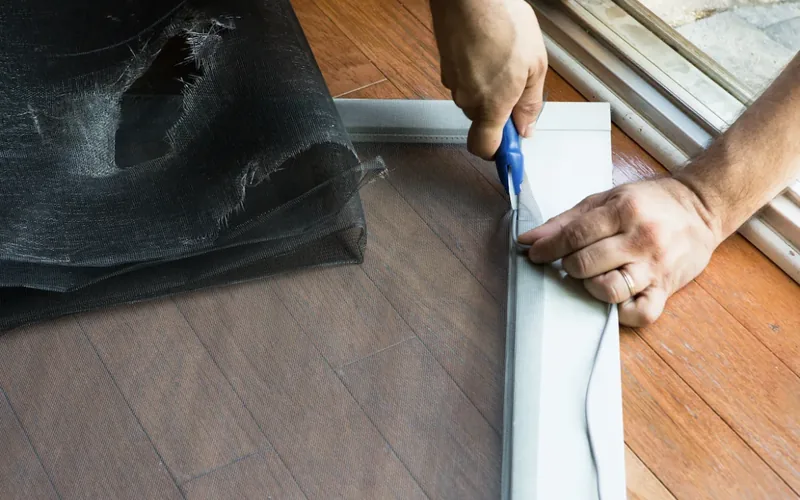
Here's the link to the mesh: tensioned fabric is part of what holds a screen square. When the mesh goes brittle and the spline shrinks, the frame loses that support and starts to rack, which drops a top wheel out of the channel. That's why a screen can start falling out the same season its mesh goes chalky. If the frame is worth saving and the fabric is tired, doing both together is the efficient fix; the screen fabric repair page covers the re-mesh side.
Why won't my sliding screen door latch?
A screen door usually stops latching because the panel has dropped or racked, so the hook no longer lines up with the strike on the jamb. Reset the wheel height first. Only replace the latch if the housing is cracked or the hook no longer springs back.
Screen latches are simple: a hook or tongue on the panel, a small strike plate or catch on the jamb. They depend completely on the panel sitting at the same height it did when the strike was mounted. Lose an eighth of an inch at the latch corner and the hook rides under or over the catch. So before you buy anything, close the screen slowly and watch where the hook meets the strike. If it's low, raise that corner with the adjustment screw. If it's tilted, the frame is racked.
The latch housing itself does fail, mostly from sun. Plastic latch bodies on a south- or west-facing screen go brittle, and the mounting tabs crack. The internal spring rusts on coastal doors. A replacement latch needs to match the screw-hole spacing in the rail, or you're drilling new holes in thin aluminum, which weakens the stile.
Two honest notes. First, a screen latch keeps a screen closed; it doesn't keep anyone out. Real security belongs on the glass panel, and our sliding door lock and latch work covers that. Second, pool homes: for a new residential pool to pass final inspection, Florida's pool safety law requires at least one of several safety features, and one option is a self-closing, self-latching device on doors with direct pool access, with the release no lower than 54 inches above the floor (Florida Statutes, section 515.27). If a pool alarm or a high latch is fitted to your slider or its screen, keep it working when hardware gets changed.
What about a broken screen door handle?
A loose or cracked screen pull is almost always a sun-damaged plastic handle or stripped screws in thin aluminum. Replace the handle with one that matches the hole spacing, and use slightly larger or through-bolted fasteners if the original holes have worn oval.
Screen handles get pulled at an angle, which levers the screws out of the rail. On many doors the handle and latch are one unit, so a cracked handle is really a latch replacement. If the glass panel's handle is the one giving out, that's a different set of parts with its own guide: see sliding door handle replacement.
How is the screen track different from the glass door track?
The screen runs on the outermost rail of the sill, a thin raised lip that's lower and more exposed than the glass panel's track. It fills with sand faster, gets stepped on more, and bends more easily, and a bent spot derails the screen every time it passes.
Because a screen weighs so little, its wheels can't grind through packed grit the way a heavy glass panel's rollers can. A dirty screen channel lifts the wheels, the panel rides crooked, and the frame twists. That's why vacuuming the outer channel fixes a surprising share of "broken" screens. A crevice tool and a stiff brush along the outer channel take two minutes.
A folded-over lip is different. You can sometimes ease a small bend back with care, but aluminum that's been bent and straightened is weaker at that spot. A badly damaged lip, or one that's corroded along its length near the coast, is track work: see sliding glass door track repair for what that involves. Don't run the screen over a bad spot. It chews up the wheels.
One Florida-specific point. On homes that get storm shutters or panels, the screen often gets pulled out for the season and stored, then put back in a hurry. That's when frames get bent and wheels get forced. Mark which side is up, store it flat, and put it back with the screws backed off.
Can you fix a sliding screen door yourself?
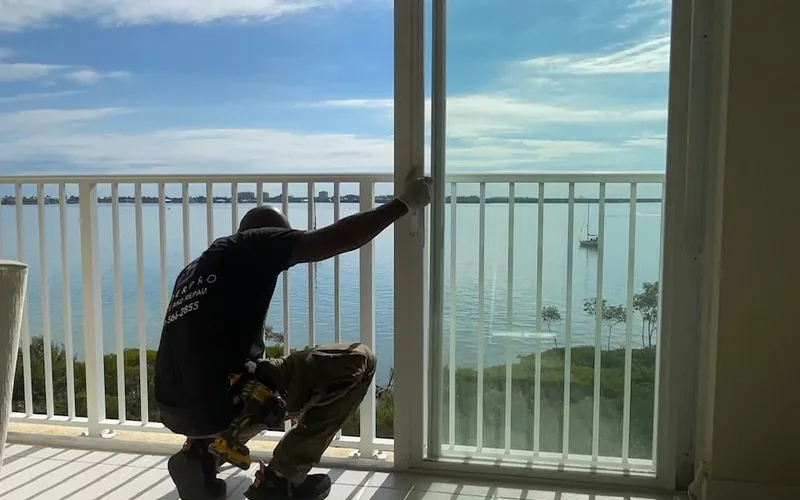
You can safely clean the channel, reset the wheels and swap a latch or handle with matching parts. Call for help when the wheels need identifying, the track lip is damaged, the frame needs squaring and re-meshing, or the screen is on an upper-floor balcony where a dropped panel is a hazard.
Screens are the friendliest part of a slider for a homeowner. They're light, nothing is under heavy load, and a mistake costs little. Where DIY goes wrong is parts guessing. Buying three sets of wheels to find the one that fits costs more than it should, and a mismatched wheel can sit the panel so high it scrapes the head track.
When the screen is part of a bigger problem, like a glass panel that's also dragging, a track that's corroding, or a door that won't latch either, one visit for the whole door is the sensible move. Repairs start at $275 including parts, labor and a written warranty of 1 to 3 years. If you'd like a straight answer first, send us photos for a quote: one of the whole screen, one close up of a bottom corner showing the wheel, and one of the latch and its strike. That's usually enough for us to tell you whether it's an adjustment, a set of wheels or a frame.