Most sliding glass door tracks can be repaired without replacing the door. Shallow grooves and dents get dressed flat, a grooved but straight rail takes a track cap, and only a kinked, cracked or rotted-out sill forces a bigger job. The catch is that track damage is nearly always a symptom of rollers that ran too long, so a track repair without new rollers is a repair you'll pay for twice.
This guide is about the metal itself. If your track is dirty rather than damaged, our track cleaning routine is the place to start, and we won't repeat it here.
What does sliding glass door track repair actually fix?
It fixes the rail the rollers ride on, and sometimes the sill around it. The goal is a straight, hard, smooth surface so the rollers can carry the panel without bumping, dragging or climbing off.
The bottom of a sliding door frame is the sill. Running along it is a raised rail, usually a short, thin fin of aluminum, and the rollers under the panel have a groove that sits on top of it. On a two-track door there's one rail for each panel, and often a third for the screen. When people say "the track," they usually mean that rail.
A healthy rail is straight, square on top and smooth. Everything that goes wrong with it is a change to one of those three things.
What kinds of damage does a sliding door track get?
Grooved or chewed rail from dead rollers
This is the most common by far. A roller whose bearing has seized stops turning and becomes a skid under a couple of hundred pounds of glass. Aluminum is soft, and a steel skid cuts it fast. You see a shiny trough worn into the top of the rail, sometimes with raised burrs along each side and gray metal dust in the sill. The door bumps or drags at the same spots every time.
Bent, dented or rolled-over lip
Something heavy lands on the rail or pushes it sideways: a dropped dumbbell, a dolly wheel, a ladder foot, a chair leg, a derailed panel that someone kept sliding. The top of the rail leans or flattens, and the roller groove has nothing square to grip. This is the damage behind most doors that keep coming off the track.
Corroded and pitted aluminum
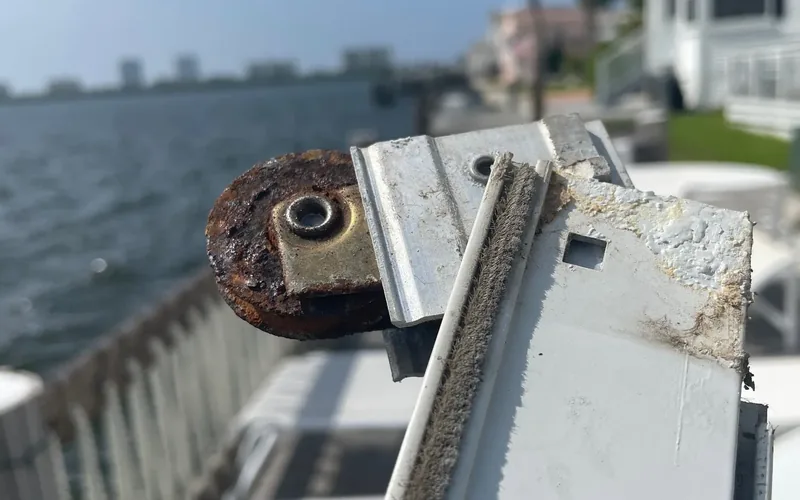
Aluminum protects itself with a thin oxide skin. Salt breaks that skin in small spots, and once chloride gets underneath, the metal corrodes downward in little pits filled with white or gray powder. Near the ocean or the Indian River Lagoon, a track that sits wet with salt film can pit badly enough that the rail top turns rough like sandpaper. Rollers riding on it wear out fast and the door feels gritty even when it's clean.
Cracked sill or a sill with no support underneath
The sill has to sit on a solid, level base. In a FEMA advisory written after Hurricane Ian, the agency warns that wood shims under a sliding door track rot quickly when wet and recommends leveling the bottom of the opening with grout instead, noting that an unlevel base can open cracks that let water in under the track (FEMA Hurricane Ian Recovery Advisory 3). When the support under a sill rots or settles, the sill flexes every time the panel rolls over that spot. Aluminum doesn't like being flexed over and over. Eventually it cracks, usually near a screw hole or a corner joint.
Dressing, capping or replacing: which fix matches which damage?
Sliding door track repair options compared
| Question | Dressing the rail | Track cap or repair kit | Sill or frame replacement |
|---|
| What it is | Working the existing rail back flat, straight and smooth with hand tools | A metal channel fitted over the old rail to give rollers a new running surface | Taking the frame apart in the opening to replace the sill, or replacing the door system |
| Best for | Light grooves, burrs, small dents and slight leans | Deep grooves or pitting on a rail that's still straight and solidly attached | Kinked or cracked sills, rails corroded to nothing, frames that have moved |
| What it doesn't fix | Deep troughs, kinks, cracks, thin corroded metal | A bent or wavy rail underneath, a cracked sill, a rotten base | Nothing on the track side, but it's the biggest job and it disturbs the wall seal |
| Does the panel come out? | Yes, to work along the full length | Yes | Yes, and often the fixed panel too |
| Changes panel height? | No | Yes, rollers need readjusting and the head needs clearance | Depends on the new parts |
| Main cost driver | Labor time, usually small when done with a roller job | Cap material, length and fit to the rail profile | Whether the old frame can be rebuilt or the door has reached the end |
The short version: dress what's only scuffed, cap what's grooved but straight, and don't cap over a problem that's underneath the rail.
Is a sliding door track repair kit or track cap worth it?
Yes, when the rail underneath is straight and solidly attached. A cap restores the running surface. It can't straighten a bent rail or support a cracked sill, so on those it just hides the problem for a while.
A track cap is a formed channel, usually aluminum or stainless steel, shaped to slip over the old rail like a sleeve. Some snap on, some get bedded in adhesive, some are screwed down. Hardware stores sell generic caps in kit form. They work when they match your rail and when the rail is sound. A few things decide whether one will last:
- Fit to the profile. Rails come in different heights and widths. A cap that's loose rocks under the roller and rattles. One that's too tight won't seat and stands proud at one end. Measure the rail's height and thickness, and check the cap's inside dimensions against them.
- A straight base. A cap follows whatever is under it. Put it on a wavy rail and you get a wavy cap.
- Panel height. A cap adds its own wall thickness to the rail, so the panel rides a little higher. The rollers have to be readjusted, and the top of the panel needs enough room in the head channel. On a door that's already adjusted high, that room may not exist.
- Two metals in salt air. Stainless sitting on aluminum in salty water is a galvanic pair, and aluminum is the side that gives up metal. A cap that's bedded properly and a sill that gets rinsed keep that slow. A cap screwed on bare with salt water trapped underneath can corrode the rail beneath it.
- The rollers. A cap under worn rollers gets chewed exactly like the original rail. Matching the roller groove to the cap shape matters too; our guide comparing sliding door roller types explains the profiles.
Done right, a stainless cap on a coastal door often outlasts the original aluminum rail by a wide margin, because stainless doesn't pit the same way. Done wrong, it's a shiny strip that clicks every time the door moves.
Can you straighten a bent sliding door track?
Sometimes. A rail that leans or has a soft dent can often be worked back with the right tools: a block on one side, controlled pressure on the other, and a file to clean up the top. That's dressing, and it's a normal part of a roller job when the damage is light.
What can't be straightened is a sharp kink or crease. Aluminum work-hardens when it's bent. Bend it back and the metal at the crease gets harder and more brittle, and it can crack right there, either during the repair or a few months later. A rail with a creased kink usually needs a cap over a section that's been dressed as straight as it will go, or a sill replacement if the kink is in the sill body itself.
Skip the hammer. Hammering a thin rail spreads it, flattens the top and almost always makes the lean worse in the next spot over.
Can you replace just the track on a sliding glass door?
On most aluminum sliders, the rail is part of the sill extrusion, and the sill is one of the four pieces of the frame. It's screwed to the side jambs at the corners and sealed to the wall and floor. Replacing it means taking the frame partly apart in the opening, which disturbs the seal between the frame and the building. That seal, and any sill pan under it, is what keeps water out, as we explain in our guide to sliding glass doors leaking water.
Some doors are different. A number of designs use a separate rail that snaps or screws into the sill, and those rails can be swapped. Some vinyl doors run on an aluminum or stainless rail set into a vinyl sill. If yours has a separate rail, replacing it is a reasonable repair.
If the sill itself is cracked, corroded through, or sitting on a rotted base, be realistic. On an older door that's also showing failed glass seals or a racked frame, that's often the point where a new door system makes more sense than rebuilding the old one. We're repair-first, so when we say a door has reached that point, it's because it has. Our repair or replace guide covers what to look for when you shop for a replacement.
What makes a sliding door track fail early in Florida?
- Rollers ridden too long. The single biggest cause. A seized roller can cut a visible groove in weeks.
- Sand. Quartz sand is harder than aluminum. Every pass of the door laps grit between the roller and the rail.
- Salt film that never dries. Blocked weep holes keep the sill wet, and a wet salty sill pits fastest.
- Heavy panels on light rails. Impact glass added weight that many original rails and rollers weren't sized for.
- Traffic. Moving furniture, appliances and pool equipment across the sill dents rails. Lay a board across the track on moving day.
- Settling and rot under the sill. A base that gives way lets the sill flex until it cracks.
What does track repair cost, and what drives the price?
Dressing is usually a small add-on to a roller job. A cap adds material and fitting time, and costs more on long or multi-panel tracks. Sill or frame work is the big one, and it's quoted on its own after someone has seen it. Panel weight matters for all three, since the panel has to come out either way. Our repair cost guide walks through the other factors.
At SliderPro, repairs start at $275 including parts, labor and a written 1–3 year warranty. Track work is usually quoted alongside the rollers, because that's almost always how it shows up. If the honest answer is a new door, you'll hear that before we touch anything.
How do you keep a repaired track from getting chewed again?
- Replace rollers the moment the door starts to drag, not when it stops.
- Vacuum the sill regularly and keep weep holes clear.
- Rinse coastal sills with fresh water after storms and windy salt days.
- Keep oil sprays off the rail. They glue sand into a paste.
- Book a yearly maintenance visit for doors near salt water so rollers get caught early.
If you can see a groove, a dent or white crust on your rail, take a close photo of the worst spot with a coin next to it for scale, plus one of the whole door. Send them for a quote and we'll tell you whether it's a dress, a cap or something bigger.