A sliding glass door that's off track has either dropped its rollers off the bottom rail or swung its top edge out of the head channel. Bottom derails almost always come from worn rollers, uneven roller height or a bent rail. Top jumps usually mean the panel is sitting too low to stay captured. Both are fixable, but the panel is heavier and less stable than it looks, so don't wrestle it.
This guide is about the derail itself: telling which kind you have, why it happened, what you can safely try, and where to stop. If your rollers turn out to be the cause, the replacement process is covered on our sliding glass door roller replacement page, so we won't repeat it here.
Is your sliding door off the track at the top or the bottom?
Look at the bottom first. If one or both rollers are sitting beside the rail instead of on it, it's a bottom derail. If the rollers are on the rail but the top of the panel has pulled away from the frame, it's off at the top.
Here's the quick read, standing inside with the door closed as far as it will go:
- Bottom derail. The panel sits lower at one end, it scrapes or grinds when you push it, and you can see the bottom of the panel resting on aluminum instead of riding on the rail. The top usually still looks normal.
- Top jump. There's a visible gap between the top of the panel and the head of the frame, the panel leans toward you or away from you, and it may wobble when touched. The rollers can still be on the rail.
- Both. The panel is leaning and one end is off the rail. This is the dangerous version, because the only thing holding the panel upright may be friction.
If the panel is leaning at all, stop here. Keep kids and pets away from it, don't slide it, and skip ahead to the section on when to call. A panel that's still upright and captured at the top gives you more options.
Why does a sliding glass door come off the bottom track?
The rollers under the panel have a groove that rides on a raised rail in the sill. As long as the groove stays wrapped over the rail, the panel can't move sideways. A bottom derail happens when something lets that groove climb out. On Florida doors, these are the usual reasons.
The rollers are worn flat or seized
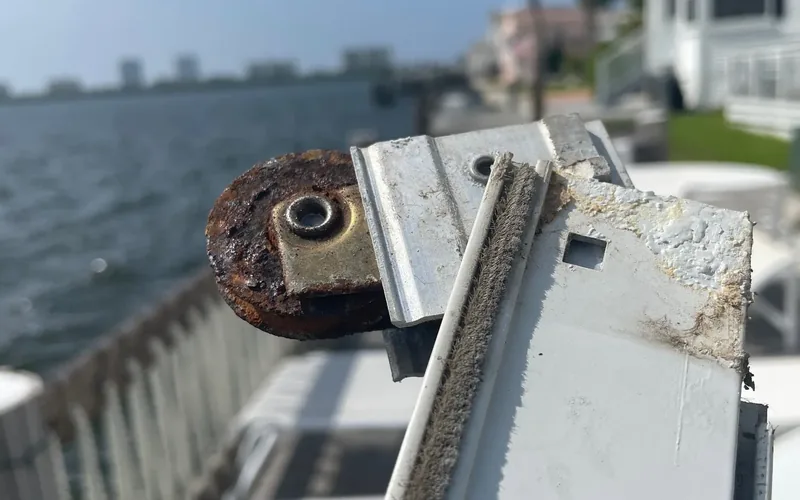
A new roller has a crisp, concave groove. Years of sand and salt grind that groove shallow, and a shallow groove has less wall to hold it on the rail. A seized roller is worse: it stops turning and becomes a skid, and a skid doesn't follow the rail, it slides over the top of it. Once the bearing is gone, the next firm push can walk the panel right off. Our guide to the signs your rollers need replacing covers how to confirm this stage.
One roller is set higher than the other
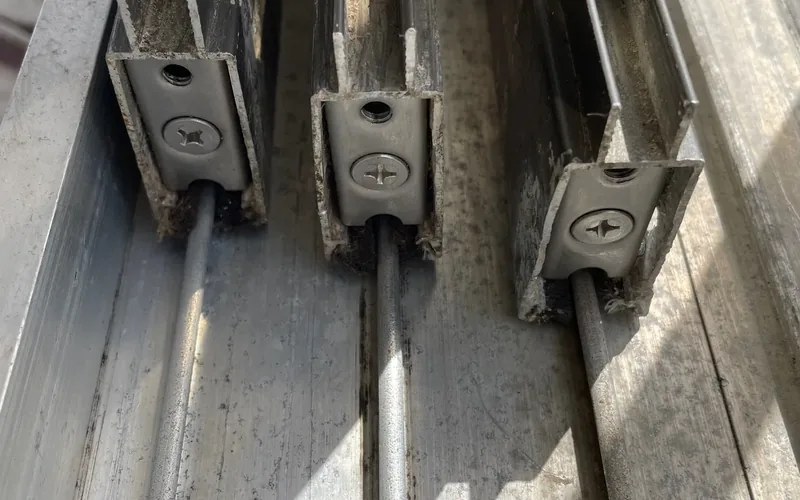
Most sliding panels have an adjustment screw at each bottom corner that raises or lowers the roller. If one end is cranked down too far, that end sits low and drags while the other end carries the weight. The panel rocks as it travels, and a rocking panel is the one that hops. Uneven height often follows an earlier repair or someone adjusting just one side to make the lock catch.
The rail lip is bent or rolled over
Aluminum rails are thin. A dropped weight, a dolly wheel, a chair leg or years of a dead roller grinding on it can push the top of the rail sideways or roll it flat. A rail that isn't straight and square gives the groove nothing solid to hold. Each derail tends to bend it a little more, which is why doors that come off once tend to keep coming off.
Debris made a ramp
Packed sand, a pebble, a pet-door insert edge or a lump of salt crust can lift a roller just enough to let it slide sideways. This is the one cause a homeowner can fully fix with a vacuum and a brush, and our 10-minute track cleaning routine covers it.
Someone leaned on it or it got hit
A sliding panel resists sideways force at the bottom only through that roller groove. A person leaning a shoulder into the glass, a kid running into it, a dog hitting it at speed or a gust catching a half-open door can shove the bottom sideways hard enough to pop a worn roller off. On a door with healthy rollers and a straight rail, that's rare. On a tired door it's the usual last straw.
Why does a sliding door come off the top track?
A sliding panel stays upright because its top edge sits inside a channel in the head of the frame. If the panel drops too low, or the channel is damaged, the top loses that grip and the panel can swing out.
On most doors the top edge is captured by only a small overlap. That's by design: the panel has to lift up into the head for removal, so the head has extra room above the panel. The trade-off is that if the panel sinks, the overlap at the top shrinks. The common causes:
- Collapsed or wound-down rollers. When rollers wear, break or get adjusted all the way down, the whole panel drops. Lose enough height and the top edge barely sits in the channel. A little sideways push and it's out.
- Missing anti-lift blocks. Many doors have small blocks or screws in the head that limit how far the panel can rise. They're there for security and to keep the top engaged. They often get left out after a previous panel removal. Our sliding door security guide explains why that also makes the door easy to lift out from outside.
- A bent or opened-up head channel. Ladders, furniture and storm debris can bend the head. A channel that's been spread wider holds nothing.
- Hurricane shutter work. Accordion shutter tracks and storm panel headers are often fastened right above or beside the slider. Screws that run long into the head channel, panels leaned against the door during install, or a door left unlatched behind closed shutters can all knock the top out. Hurricane season runs June 1 to November 30, according to the National Hurricane Center, so shutter installs and takedowns happen twice a year on a lot of Treasure Coast homes. That's a good time to check the slider is still sitting right.
How heavy is a sliding glass door panel, and why does that matter?
Heavier than most people expect. Glass weighs roughly 3.3 pounds per square foot for every quarter inch of thickness. A typical patio panel is around 20 square feet of glass, and a laminated impact panel often carries half an inch or more of glass. Add the aluminum frame and panels run from about 100 pounds on a small dual-pane door to well over 200 on impact units, and large impact panels can pass 300.
That weight is the whole safety story. A panel that's off at the top isn't stable. It's a tall, narrow slab that can tip in either direction, and once it starts going, one person can't stop it. Tempered glass breaks into small pieces, but a falling panel doesn't need to break to hurt someone. The aluminum edge alone can crush a foot.
So the rule is simple. One person never lifts a sliding panel. Two people can reseat a panel that's still upright and captured at the top. A panel that's leaning, out of the head, or made of impact glass belongs to people who do this every day and bring the right gear.
What can you safely try yourself?
If the panel is upright, the top is still in the head channel, and the glass isn't chipped or cracked, these steps are reasonable for two careful adults:
- Stop sliding it. Every push on a derailed panel grinds the roller housing into the sill and bends the rail more.
- Clear the rail. Vacuum the sill and pick out anything sitting on the rail near the derailed roller.
- Find the adjustment screws. Look for small holes or plugs at the bottom corners of the panel, on the face or the edge. Turning the screw raises or lowers the roller at that corner. Note which way you turn so you can undo it.
- Lift and set. One person on each side of the glass, hands flat on the frame, not the glass. Lift the panel straight up a fraction of an inch, guide the roller back onto the rail, and lower it slowly.
- Even the height. Adjust both screws so the panel sits level with an even gap along the bottom, then slide it slowly through its full travel.
If it rolls smoothly and stays on, watch it for a week. If it grinds, rocks, or comes off again, the rollers or the rail are damaged and adjustment won't hold. That's a repair, not a reset.
Things not to try: prying the panel back with a screwdriver or a bar, hammering a bent rail, or adding a bead of lubricant to "help it slide back on." Prying chips glass edges, and a chipped tempered edge can let the whole pane fail later. Our alignment guide explains why just moving parts until the lock catches leads to a door that derails again.
Why won't my sliding door lift out of the track?
Usually because the rollers are still set high, anti-lift blocks are in the head, or you're working on the fixed panel. Lower both rollers fully first, then lift the panel up into the head and swing the bottom toward you.
When people search for a sliding door that won't come out, it's normally one of these:
- The rollers aren't retracted. The panel needs room to rise into the head channel and clear the rail at the bottom. If the rollers are cranked up, there isn't enough room. Wind both adjustment screws down first.
- Anti-lift blocks or screws are in place. They're doing their job. They usually come out from the inside with the panel slid to a specific point.
- It's the fixed panel. On a standard two-panel door, one panel slides and the other is fastened to the frame with brackets or screws. The fixed panel doesn't lift out without unfastening it, and on many doors you shouldn't try.
- The head was never designed for lift-out. Some impact doors and heavy multi-panel systems need a stop or head piece removed first. Forcing these bends the head.
- A seized roller is jammed. If a roller has rusted solid in its housing, the adjustment screw may turn without moving anything. At that point the panel comes out with a lot of care or not at all.
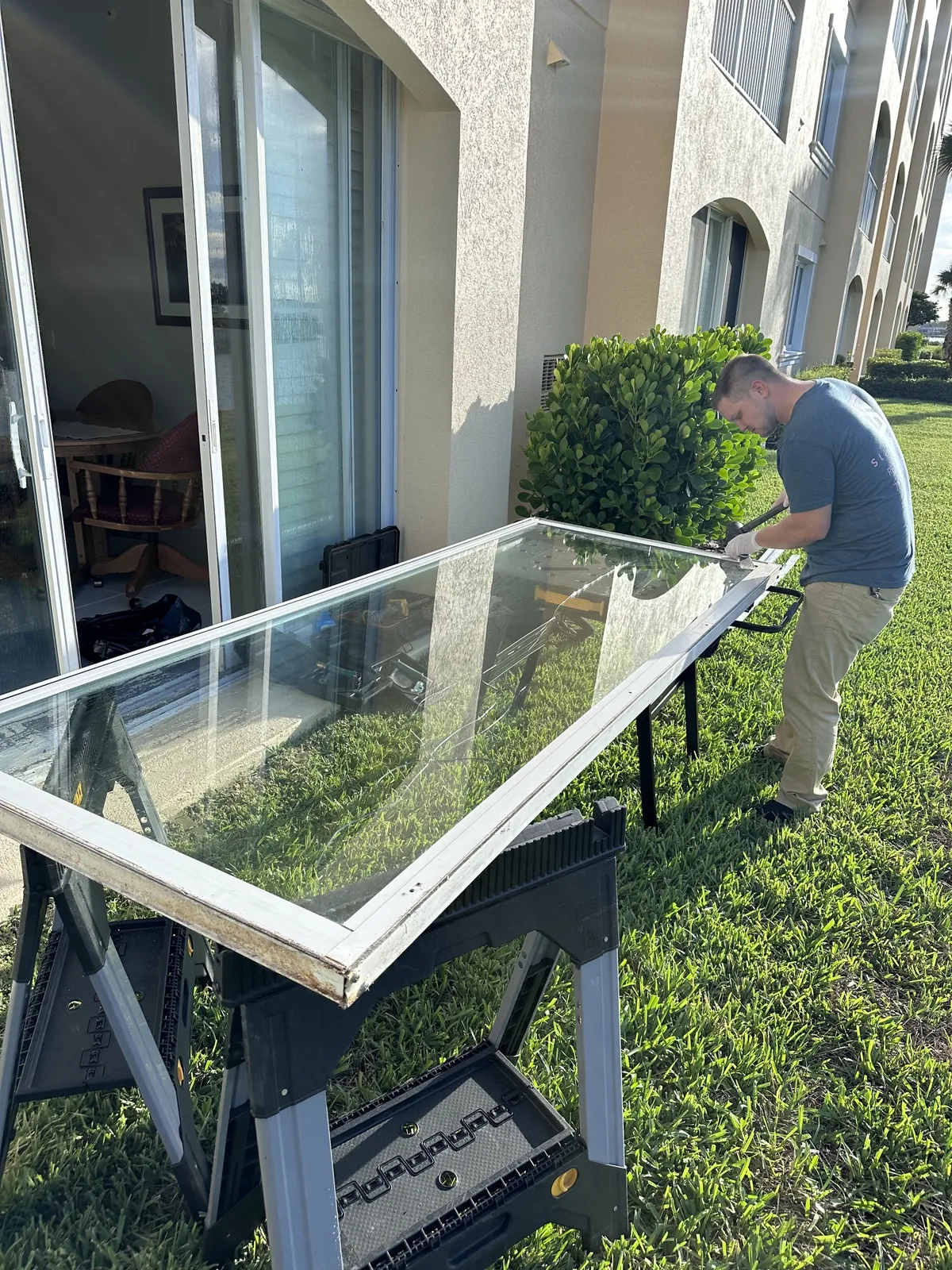
One more reason to think twice: if you get the panel out, you then have a 100-plus-pound pane of glass in your house with nowhere safe to put it. Professionals set panels on padded sawhorses or a padded A-frame, never leaned against a wall on tile.
When should you stop and call someone?
Call before you touch it again if any of these are true:
- The panel is leaning or the top is out of the head channel.
- The glass has a chip, crack or scratch on an edge. Our glass replacement page explains why edge damage on tempered glass matters.
- The rail is visibly bent, rolled or chewed.
- The adjustment screws spin but the panel doesn't move.
- It's an impact panel or an oversized door.
- It's a condo balcony door several floors up. Check who's responsible first in our condo and HOA guide.
- This is the second or third time it's come off.
Until someone arrives, leave it where it is. If it's leaning, a strip of painter's tape from the top of the panel to the frame is a reminder to keep people away, not a support. Don't lean furniture against it.
What does sliding door off-track repair cost?
It depends on what put it off track, not on the derail itself. Reseating and adjusting a panel with healthy rollers is a short job. Worn or seized rollers mean new rollers. A bent or grooved rail adds track work, which we explain in our guide to sliding glass door track repair. A chipped or cracked pane adds glass. That's why an honest quote waits for a look at the rollers and the rail.
For SliderPro, repairs start at $275 including parts, labor and our written 1–3 year warranty. Most derails trace back to the rollers, and 96% of our jobs are finished in one visit. If photos show you only need the panel reseated and adjusted, we'll tell you that too.
How do you stop it from coming off again?
Fix the cause, then keep the rail clean. A door that jumped because of seized rollers will jump again until the rollers are replaced, no matter how carefully it's reseated. Once the hardware is right:
- Vacuum the sill every few weeks, more often near the beach or a pool deck.
- Keep both rollers adjusted evenly so the panel sits level.
- Make sure the anti-lift blocks are back in after any panel removal.
- Check the slider after shutters go up and come down.
- Have coastal doors looked at once a year. Our maintenance and tune-up visit covers rollers, rail and alignment on every slider in the house.
If your door is off the track right now, take three photos: the bottom corner where it came off, the top of the panel, and the whole door from inside. Send them to us for a quote and we'll tell you what you're looking at and whether it's safe to leave until we get there.