For a coastal Florida sliding glass door, aluminum is usually the right frame, as long as it has a thermal break and a proper factory finish. Vinyl is a fair choice for smaller openings out of the hard afternoon sun, and fiberglass is the stable, salt-proof option if the budget stretches. The frame is rarely the part that fails first, though. The rollers, screws and locks inside it are, and that's where most of this decision really plays out.
We repair sliders made of all of these materials. What follows is how each frame behaves after a few Florida summers, from the side of the door you see when the panel is out on the sawhorses.
Sliding glass door frame materials compared for Florida homes
| Factor | Aluminum | Vinyl (PVC) | Fiberglass | Aluminum-clad wood |
|---|
| Stiffness for wide, tall panels | High. Thin frames carry big glass | Low. Wide panels need metal reinforcement inside | High; far stiffer than vinyl | Good, wood core does the work |
| Carrying heavy impact glass | The most common choice for large impact sliders | Available, usually in smaller sizes | Available, mostly premium lines | Less common in impact sliders |
| Heat flow through the frame | Conducts heat; needs a thermal break | Low conduction | Low conduction | Low conduction |
| Salt air | Frame holds up well with anodized or powder-coat finish; bare metal pits | Frame can't corrode; its metal hardware still can | Frame can't corrode; hardware still can | Cladding is fine; any breach lets water reach the wood |
| Afternoon sun and expansion | Moderate expansion, stable shape | Expands most; dark colors run hottest | Moves at close to the rate of glass | Stable |
| Repairs and parts | Easiest. Panels come apart, parts widely available | Welded corners, brand-specific rollers | Mostly manufacturer parts | Hardware fine; rot repair is carpentry |
| Typical Florida use | Most coastal and impact sliders | Smaller openings, budget replacements | Premium projects | Occasional, mostly custom homes |
Is aluminum or vinyl stronger for a big sliding glass door?
Aluminum, by a wide margin. Aluminum is many times stiffer than rigid vinyl, so an aluminum frame can stay slim and still hold a tall, heavy panel flat and square. A vinyl panel of the same size needs steel or aluminum reinforcement hidden inside its hollow chambers to do the same job.
Stiffness matters on a slider for a reason people don't think about: the panel is a moving beam. It's carried on two rollers near its bottom corners, and everything above them has to stay rigid or the panel racks out of square every time you push on the handle. A frame that flexes a little lets the corners drift. Then the interlock (the vertical meeting stile where the two panels overlap) stops lining up, the latch misses its keeper, and the weatherstrip only seals along part of its length.
Now add Florida glass. Impact glass is laminated, two layers bonded around a tough interlayer, and an impact panel is far heavier than the single-pane glass in a 1980s door. That weight goes straight down through the bottom rail into two small rollers. A stiff frame spreads the load evenly. A softer one lets the rail bow between the wheels, which loads the rollers unevenly and wears them faster. This is why the wide, multi-panel impact sliders you see across the Treasure Coast are mostly aluminum.
Vinyl isn't weak for normal openings. A standard two-panel vinyl door with modest glass works fine for years. It just runs out of stiffness sooner as the panels get taller and the glass gets heavier.
Does an aluminum sliding door waste energy in Florida?
Only if it lacks a thermal break. Aluminum conducts heat readily, so a frame made of one solid piece of metal carries outdoor heat straight to the inside face. Modern doors solve this by splitting the frame into an inner and outer section joined by a strip of low-conductivity material. ENERGY STAR's guidance on framing materials notes that aluminum frame design typically includes thermal breaks to reduce conductive heat loss through the metal, and describes vinyl and fiberglass frames as providing good insulation on their own.
In Florida, keep this in proportion. The frame is a thin strip around a large sheet of glass, and on a sunny wall most of the heat comes through the glass as sunlight. A low solar heat gain glass package in a thermally broken aluminum frame usually does more for your power bill than plain glass in a vinyl one. If you're comparing doors, compare the whole-unit ratings on the label rather than the frame material alone.
Two easy checks on an existing door. Look at the frame edge with the panel open: a thermal break shows as a dark, non-metal strip running the length of the profile. And on a hot afternoon, touch the inside face of the frame. If it's warm to the touch while the room is cool, there's probably no break. That door can still be perfectly repairable, but it's worth knowing when you weigh repairing it against replacing it.
Which frame really survives salt air, and what actually corrodes?
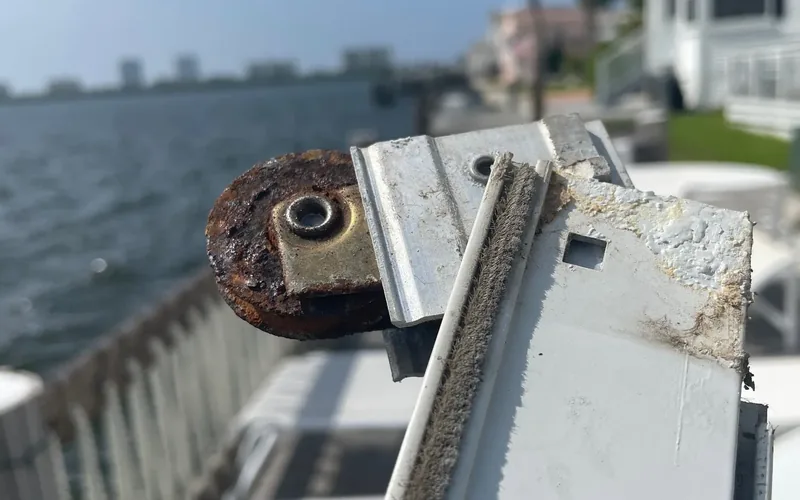
The frame material matters less than people expect. On most failing coastal doors, what has corroded is the hardware: steel roller bearings, screws, lock bodies and reinforcement. A vinyl or fiberglass frame can't rust, but it still runs on metal rollers and locks with metal parts, and those see the same salt film an aluminum door does.
Salt settles out of the air as a fine film, pulls in moisture and keeps a conductive layer against metal long after a rain has dried. On aluminum, the finish is the defense. A good anodized or powder-coated frame shrugs this off for many years. Bare mill-finish aluminum pits and turns chalky. The bigger risk is where two metals meet, because a steel screw in an aluminum frame with salt between them corrodes into its hole. We go through how each material handles this in our guide to choosing a Florida sliding door, so we won't repeat it all here.
The practical point: when you shop for a coastal door, the frame material is one question and the hardware spec is another. Ask what the rollers are made of, whether the bearings are sealed, and whether the fasteners are stainless. A vinyl door on cheap steel rollers will seize just as fast as an aluminum door on cheap steel rollers. When we fit replacement rollers on a salt-exposed door, the material of the wheel and bearing is the decision that sets how long the door glides, whatever the frame is made of.
Why does a vinyl slider stick in the afternoon but not the morning?
Because rigid vinyl grows noticeably when it heats up, and a west-facing door can swing a long way in temperature between a cool morning and full afternoon sun. Every material expands with heat. Vinyl simply expands more than aluminum, and much more than glass, for the same rise in temperature. Over the length of a tall panel and a wide frame, that difference adds up.
Here's how it shows up. The frame and panel lengthen slightly while the glass inside barely moves. Clearances that were fine at 8 a.m. close up by 4 p.m. The interlock rubs, the panel drags against the head track, or the latch suddenly won't engage, then everything works again after sunset. Dark-colored vinyl absorbs more sun and runs hotter, which is why manufacturers often restrict dark colors or require extra reinforcement on large vinyl units.
Aluminum moves too, but it's stiff and holds its shape, so the change in clearance is smaller and more even. Fiberglass is the stable one. Marvin says its Ultrex fiberglass expands at virtually the same rate as glass, which means the frame and the glass it holds move together instead of fighting each other. That's the property you're paying for with fiberglass on a hot wall.
If your vinyl door has this time-of-day pattern, a repair can often help. Correct roller height, re-squaring the panel and fresh weatherstrip restore some clearance. It won't change the physics, though, so a dark vinyl door on an unshaded west wall may always be a little tighter on summer afternoons.
Which is easier to repair: aluminum, vinyl or fiberglass?
Aluminum, clearly, and this is the factor most buyers never think about until year eight. A typical aluminum slider panel is screwed together at the corners. We can open it, swap rollers, replace a damaged stile, re-glaze it and screw it back together square. Roller assemblies for common aluminum doors are widely made, adjustable from the end of the bottom rail, and often interchangeable across brands within a size range.
Vinyl panels are usually heat-welded at the corners, so the panel itself doesn't come apart. Rollers are still replaceable, but they're often shaped for one manufacturer's extrusion, so finding the right part depends on identifying the brand and series. Glass replacement on vinyl is normally done through removable glazing beads, which is doable, but a cracked or warped vinyl sash can't be rebuilt the way an aluminum one can. Our guide to identifying your door's brand for parts walks through where to find the markings.
Fiberglass doors are well built but mostly use manufacturer-supplied parts, so repairs depend on parts availability from that company. Aluminum-clad wood doors have serviceable hardware, but if water has reached the wood at the sill, that's carpentry and rot repair, not slider repair.
None of this makes vinyl a bad door. It means the cost of keeping a door running over 20 years differs by material, and aluminum usually costs the least to keep alive. If you're curious what's in your own bottom rail, our comparison of sliding door roller types shows the common designs.
Where does aluminum-clad wood fit on the coast?
Briefly: it looks beautiful indoors and asks a lot of you outdoors. The aluminum cladding protects the wood only as long as it stays intact and the joints stay sealed. On a coastal opening, any scratch, failed sealant joint or blocked drain lets water in behind the cladding, where the wood can't dry out. The sill is where it usually starts. Clad wood makes sense on a sheltered opening under a deep overhang, in a home where someone will keep up with the sealant. On an exposed oceanfront wall it's a maintenance commitment most owners don't want.
Vinyl vs aluminum vs fiberglass: which should you choose in coastal Florida?
These are the rules we'd give a friend. They assume you're buying from a reputable installer and the door carries the product approval your opening needs.
- If the opening is wide (roughly three panels or more) or the glass is impact-rated, choose aluminum with a thermal break. Stiffness and roller loading favor it, and it's what the big impact systems are built around.
- If the door faces the ocean, the Intracoastal or the Indian River Lagoon, choose aluminum with an anodized or high-grade powder-coat finish, or fiberglass. Either way, insist on stainless or sealed-bearing rollers and stainless fasteners.
- If the opening is a standard two-panel door on a shaded or east-facing wall, vinyl is a sensible, lower-cost choice. Pick a light color.
- If the door faces west with no overhang, avoid dark vinyl. Choose aluminum or fiberglass, or a light-colored vinyl unit with internal reinforcement.
- If budget allows and you want the frame that moves least, fiberglass is the strongest all-round performer in heat and salt.
- If you plan to keep the house a long time, weight repairability heavily. Ask the seller who makes the rollers and whether parts are sold separately.
- If you're in a condo, check the association's rules first. Many specify frame color and material for exterior openings.
What if you already have the "wrong" frame material?
Probably keep it. A vinyl door that drags or an aluminum door with no thermal break isn't automatically a replacement job. Most of what makes a slider miserable is fixable: worn rollers, a dirty or gouged track, tired weatherstrip, a lock knocked out of line. If seals are the issue, our guide to sliding door seals and weatherstripping covers what wears and why. Replacement becomes the honest answer when the frame itself is cracked, badly warped, or corroded through at the sill, or when the opening now legally needs impact protection the door can't provide. Our guide to how long sliding glass doors last covers the signs.
When we repair a slider, the work starts at $275 including parts, labor and a written 1 to 3 year warranty on both. If you'd like a read on your door before deciding anything, send us a few photos of the panel, the bottom rail and the track, and we'll tell you whether it's worth fixing.