A sliding door that sits closed for five months corrodes faster than one that gets used every day. Motion wipes the salt film off the rollers and track; stillness lets it sit and work. So the week before you leave is when you set the doors up to survive the summer: clean and dry the track, clear the drainage, lock and bar the door, and decide who will look at it after a storm. Here's the routine, and what to check when you get back.
Why does a sliding door that never moves corrode faster?
Because motion is the only cleaning a roller ever gets. Each time the door slides, the wheels roll through and push aside some of the salt and grit on the track, and the bearing turns over so no single spot sits under load. A still door gets none of that.
Several things happen in a closed house over a Florida summer:
- The salt film sits undisturbed. Near the coast, salt settles on the track all season. Salt pulls moisture from the air, so in summer humidity it forms a damp film that acts as an electrolyte on the steel inside the roller bearings.
- The rollers sit on the same spot for months. The weight of the panel rests on one small point of each wheel and one spot on the track, with corrosion working on both.
- Grit settles where the wheels park. Sand and dust blown under the exterior of the door collect in the low points of the track, often right under the rollers.
- Seals take a set. Weatherstripping compressed in one position for months can stiffen in that shape.
None of this is dramatic on its own. Together, over five months of heat and humidity, it's the reason so many seasonal owners come back in the fall to a door that's heavy, gritty or seized. It applies to a beach condo in Vero Beach or Cocoa Beach, a riverfront home in Stuart or Jupiter, and a house on a canal in Port St. Lucie. The closer to salt water, the faster it happens.
What should you do to the sliders in the final week before you leave?
Do this a few days before departure, not the morning you fly out, so you have time to deal with anything you find. One pass per door, about fifteen minutes each.
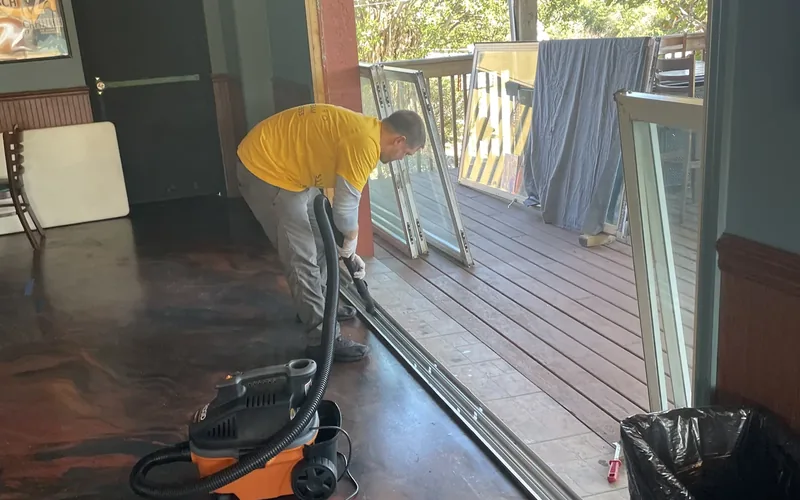
- Vacuum the track dry. Get the sand and grit out before anything gets wet, or you'll turn it into mud in the corners.
- Wash and dry it. A damp cloth with a little mild soap along both legs of the track, then a dry cloth. If you're near the ocean or the river, wipe the exterior leg with fresh water to dissolve the salt.
- Clear the weep holes. These are the small slots in the exterior side of the track that let water drain out. Poke them through with a pipe cleaner and pour a little water in the track to confirm it drains outside.
- Treat the clean track with dry silicone. A light coat of a dry silicone spray on the track rail, not the rollers, helps the door start moving again in the fall. Skip oil sprays. Oil plus five months of dust is grinding paste.
- Slide the door fully open and closed several times. Listen for grinding and feel for heavy spots. If something's already wrong, you want to know now, while you can still get it fixed before you go.
- Check that the lock engages fully. The latch should catch with a firm click, and the door shouldn't pull open with the lock set. A lock that only catches if you lift the handle is an alignment problem worth fixing before leaving.
- Add a secondary block. A bar or dowel in the track, or a foot bolt, stops the panel from being slid open even if the latch is defeated. A wooden dowel cut to length works fine.
For the full cleaning method, our 10-minute track cleaning routine has the step-by-step version.
Two more things worth doing on the way out the door. First, take a photo of each slider, inside and out, with the track visible. If anything happens over the summer, you'll have a record of what the door looked like when you left, which helps with any repair and any insurance conversation. Second, leave a short note for whoever has keys: which doors have bars in the track, where the shutter hardware is kept, and the number to call if something looks wrong. A house-watcher who has to guess how your doors lock is a house-watcher who forces one.
If you rent the house out over the summer instead of closing it, the routine is different, because the doors get heavy use from people who don't know them. Our rental property sliding door checklist covers the turnover version.
Where should the screen panel be when you leave?
Either slide it fully to one side, over the fixed glass panel, or take it out and store it flat indoors. Don't leave it halfway across the opening. A screen parked in the middle catches every gust, can be blown off its track in a storm, and its small rollers sit in the dirtiest part of the screen track all summer.
If the mesh is already torn or the screen is hard to slide, that's a good thing to sort out before you leave, not after. Screens left damaged all summer usually get worse. Our screen fabric repair page covers when a re-mesh is enough and when the frame or rollers need work too.
Shutters and impact glass: what changes when you're gone in hurricane season?
Most seasonal owners are away for the heart of hurricane season. The National Hurricane Center puts the Atlantic season at June 1 to November 30, with the peak around September 10 and most activity between mid-August and mid-October. If you leave in April or May and return in November, your house is on its own for all of it.
That changes how you leave the sliders:
- If you have impact glass, the door is its own protection, but only when it's fully closed and locked. An impact panel that isn't latched can still be forced along its track by wind pressure. Check the lock before you go and make sure the secondary bar is in place.
- If you rely on shutters or panels, decide in advance whether they go up when you leave or only when a storm threatens. Shutters up all summer protect the glass but block light and airflow, and they mean nobody can see the door from outside. If they go up only for storms, someone local needs to be able to do it on short notice.
- If you have neither, talk to someone who installs protection before next season. That decision is outside what we do, but it matters more for an empty house than an occupied one.
Our hurricane season checklist for sliding glass doors covers the storm-specific prep in detail, including what to photograph before you leave so you have a record of the door's condition.
Who should check the house after a storm while you're away?
Someone with a key, a phone camera and a short list. A neighbor, a property manager or a house-watch service all work, as long as they know what to look for at the sliders. Arrange it before you leave, not after the storm is already in the forecast.
Give them this list:
- Water on the floor at the door, or stains on the baseboard or carpet edge nearby. Wind-driven rain can get past a sliding door sill, especially if the weep holes have clogged.
- Any crack, chip or break in the glass. Photos from inside and out.
- Whether the door is still closed and locked, and whether the panel looks like it shifted in the frame.
- Debris packed in the exterior track, like leaves, sand or roof grit, which should be brushed out so the weep holes can drain.
- Shutters still secure, if you have them.
Ask them not to force a door that won't slide. A stiff door after a storm is usually debris in the track or a panel that's shifted, and muscling it can bend the track or pop the panel off its rollers. Photos are enough for us to tell you what's likely wrong. If glass is broken, keep everyone away from the door and get it boarded or covered until it can be replaced.
What should you check on the sliders when you get back in the fall?
Look before you slide. The order matters, because the first few strokes after months of sitting are when you can do the most damage to a dry, gritty track.
- Look at the track. White crust, sand drifts or debris along the rail tell you what the door has been sitting in.
- Look at the floor and baseboard. Water stains near the sill mean water got in at some point.
- Vacuum and wipe the track before the first full slide. Same as before you left: dry first, then damp, then dry.
- Open the lock and slide gently. Use steady, light pressure. If it moves smoothly, run it the full length several times.
- Listen. Grinding means grit or a rough bearing. A rhythmic bump means a flat spot on a roller. Silence and smooth travel mean you're fine.
- Re-test the lock. The latch should catch cleanly. If the door sagged over the summer, the latch may now miss its keeper.
- Check the screen and the seals. Stiff weatherstripping, torn mesh or a screen that won't roll are all easier to fix early in the season.
How do you tell a dirty track from a seized roller in the first five minutes?
Clean the track and try again. That one step separates most of the possibilities.
- If the door gets noticeably easier after cleaning, grit was the main problem. Keep the track clean for the next few weeks and watch whether it stays easy.
- If it's still heavy on a clean track but moves smoothly, the rollers are probably rough or worn, not seized. That's a roller replacement, and it's better done soon than after a season of forcing.
- If it shudders, bumps or grinds on a clean track, one or more bearings has flat spots or is starting to seize.
- If it barely moves at all, stop. A fully seized roller is skidding, and every forced stroke grinds the track. That's when a roller replacement is the next step, and forcing it is how a roller job becomes a track repair too.
Is a service visit before you leave worth it?
If your doors are near salt or brackish water, or they already felt heavy over the winter, yes. A spring visit catches worn rollers and misaligned locks while there's still time to fix them, and it gets every track cleaned down to the corners you can't reach with the panel in place. A door that leaves in good shape has a much better chance of coming back that way.
Our maintenance and tune-up visits cover every slider in the house in one appointment. Book a few weeks before your departure date, so there's room to come back if a part needs ordering.
If you're closing up soon, or you just came back to a door that won't cooperate, send us photos of the door and the track. Repairs start at $275 including parts, labor and a written 1 to 3 year warranty, and we'll tell you honestly whether it needs a repair or just a good cleaning.