Short answer: Burglars use three weaknesses: lifting the panel out, popping the spring latch, and working out of sight at the back of the house. Close them in order: fix the alignment first, add a real slider deadbolt, block the track with a fitted bar, pin the panel against lift-out, make the approach visible and noisy, and lock the door every time. Hardware on a sagging panel doesn't secure it.
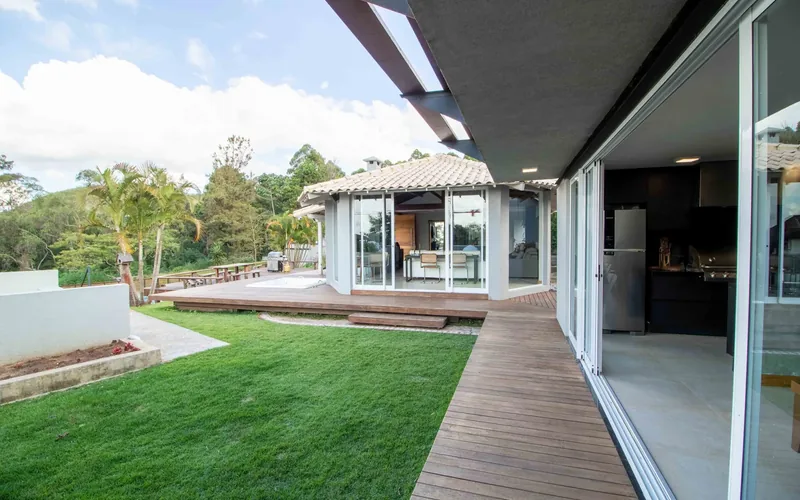
Most burglary isn't cinematic. It's opportunistic, quick, and it goes through whatever entry offers the least resistance with the least visibility — and in Florida homes, that description fits one opening above all others: the sliding glass patio door. Out of street view, screened from neighbors by the pool cage or fence, and secured (in most homes) by a spring latch that was designed as a convenience catch, not a lock.
FBI Uniform Crime Reporting data has consistently shown that a large share of residential burglaries involve entry through doors and first-floor openings rather than dramatic methods — the burglar's actual toolkit is boring: test the handles, exploit the weak latch, stay out of sight. The slider hands them all three. Here's how the weaknesses work, and the practical order in which to close them.
The three weaknesses burglars actually use
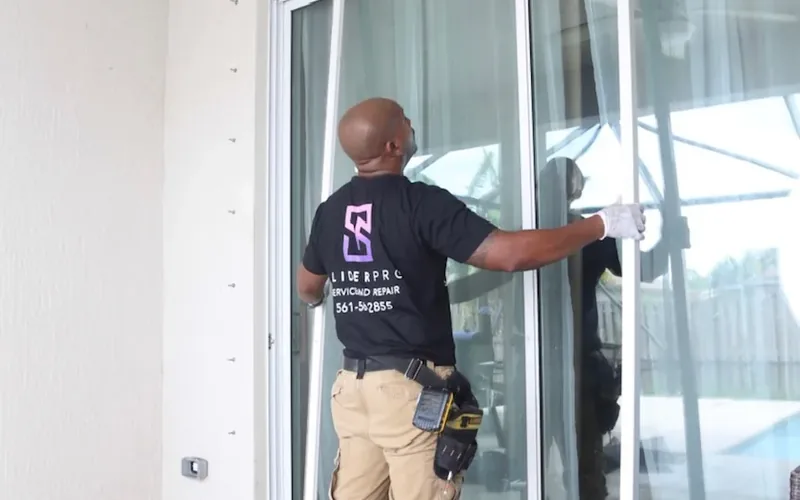
The lift-out. Sliding panels hang on rollers and are installed by lifting up and swinging in — which means many can be removed the same way, from outside, in seconds, especially when worn rollers have dropped the panel low in its track. No breaking, no noise.
The latch pop. The factory latch is a small spring-loaded hook. A flat tool worked into the gap, a sharp jerk on the handle, or simple flexing of the door frame is frequently enough to disengage it — particularly on a misaligned door where the latch barely catches to begin with.
The blind spot. The back slider faces the yard, the preserve, the canal — anywhere but the street. A burglar working a patio door has cover, time, and privacy that no front entry offers.
Hardening step 1: Fix the alignment first
Security hardware mounted on a sagging, rattling door is security theater. A panel riding on worn rollers sits loose in its frame — easier to lift, easier to flex, with a latch barely meeting its keeper. Before adding anything, make the door itself solid: proper rollers, proper alignment, latch meeting keeper squarely. Half the security problems we see are really alignment problems wearing a disguise.
Step 2: Install a real deadbolt for sliding doors
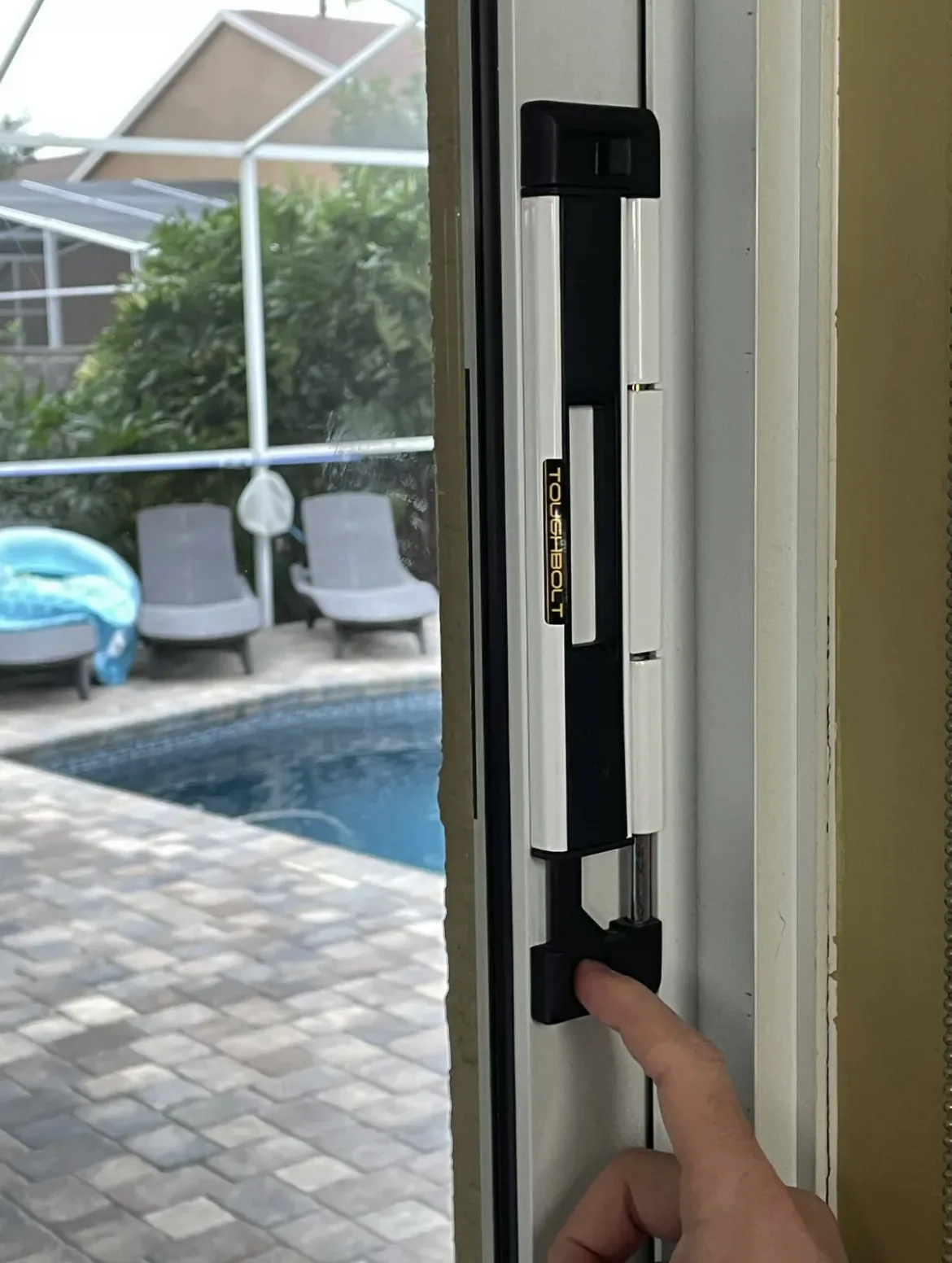
Purpose-built slider deadbolts throw a solid steel bolt through the panel into the frame or track — defeating both the latch pop (there's no spring latch to flex open) and the lift-out (the bolt mechanically pins the panel down and in). This is the single highest-value hardware upgrade on the list, and it's an hour-scale professional install.
Step 3: Block the track — properly
The classic broomstick has real logic: a blocked track means the panel can't slide even with the latch defeated. Do it properly with a fitted track bar or keyed track lock rather than a dowel that can be flipped out by flexing the door. Cost is trivial; combined with a deadbolt it forces an intruder to defeat two independent mechanisms.
Step 4: Pin against the lift-out
Anti-lift pins or plates stop the panel rising far enough to clear its track. Some slider deadbolts include anti-lift function inherently (the bolt itself pins the panel); where they don't, dedicated pins close this path for a few dollars of hardware. Ask whoever services your door to check lift clearance — a correctly adjusted panel shouldn't have removal room in the first place.
Step 5: Make the approach expensive
Burglars price jobs in seconds-of-exposure. Motion lighting on the patio, gravel or landscaping that's noisy to cross, a visible camera pointed at the slider, and — genuinely — a dog of any size all raise the price. None of it replaces hardware; all of it makes your door a worse bet than the next street's.
Step 6: Don't forget glass and habits
Impact-rated glass, where present, is a real (if unintended) security layer — smash-through entry on laminated glass is loud, slow work. But every layer above depends on one habit: actually locking the door. A striking share of slider entries involve no defeat of anything — the door was simply unlocked, or so hard to latch that the household had stopped bothering. If your door has trained you not to lock it, that's a repair, and it's the one to book first.
The realistic bottom line
You can't make a glass wall into a vault, and you don't need to. You need the slider to stop being the obvious first choice — a solid, aligned panel with a real deadbolt and a blocked track defeats the quiet, quick methods that account for most attempts. We install and service every layer described above, and a security check rides free on any service visit: ask us to look at yours.
Does your panel still sit square in its frame?
Every lock sold for a sliding door assumes one thing: that the panel still hangs where the factory hung it. On a door more than a few years old in Florida, it rarely does.
The panel's whole weight rides on two rollers, and rollers wear down. As they do, the panel sinks. The drop is usually two to five millimeters, which is nothing to look at and everything to a latch. The hook that used to swing deep into the keeper now catches on its lip, and a sharp pull on the handle is enough to flex it back out.
The same sag opens a second path. A slider is installed by lifting the panel up into the head channel and swinging the bottom in. That lift clearance never disappears; it just sits above the panel, and a panel that has dropped has more of it than it left the factory with. So a sagging door is both easier to pop and easier to lift out, and no hardware you screw on afterwards changes either fact.
Two checks tell you where you stand. Look at the gap between the top of the panel and the head track — if you can get a finger in, the panel has room to rise. Then watch the latch hook as it meets the keeper: if it strikes low, or if the household has learned to lift the handle to make it catch, the door has already moved.
Fix that before you buy anything. Our guide to a slider that won't lock covers the mechanics, and roller replacement is usually the repair underneath it.
Can you check your own door in two minutes, with no tools?
You do not need a technician to find out whether your slider is an easy target. Run these five checks on the door itself, in this order.
- The lift test. Close and lock the door, then grip the panel low and try to lift it straight up. Any meaningful rise means the panel can clear its track while locked.
- The rack test. With the door locked, push and pull the handle side horizontally. A solid door barely moves. Rattle means the latch is holding by its fingertips.
- The keeper look. Open the door a few inches and look at the keeper slot in the frame. A bright wear mark below the slot means the hook has been striking low for a while.
- The one-hand test. Open and close the door with one hand, slowly. Grinding, shuddering or a section where it suddenly gets heavy is roller wear, and roller wear is what causes the sag.
- The habit test. Ask the household honestly whether they lock the patio door every time. If the answer is no because the door is awkward, that is the finding that matters most.
Any failure on the first four points to alignment and rollers rather than to a lock. That is good news, because it is the cheapest thing on the list to correct and it makes every other fix here work as designed.
Why does coastal security hardware fail years early?
Rivals will tell you salt air is hard on doors. Here is what is actually happening inside your hardware.
Salt aerosol drifts off the ocean and the Indian River Lagoon and settles on everything, including the inside of a lock housing and the bearing race of a roller. Salt is hygroscopic: it pulls water vapor out of humid air and holds a thin brine film against metal. That film is an electrolyte, and it turns small assemblies of dissimilar metals into weak batteries.
That matters more on a slider than almost anywhere else in the house, because the standard construction is plated-steel hardware fastened into an aluminum frame. In a brine film, aluminum is the metal that gives way. It corrodes at the contact point into a white, powdery oxide that takes up more room than the metal it replaced, so it swells behind the keeper plate, seizes the screws and locks up mortise cylinders from the inside. The lock does not wear out. It gets glued shut, and then it gets forced.
Build era tells us most of what to expect before we arrive. Thin-wall aluminum frames from the 1970s and 80s have light hardware and generous tolerances that get looser as the frame ages. Boom-build homes from roughly 1998 to 2006 carry volume builder-grade rollers and latches under heavy panels, and whole streets fail on the same schedule. Post-2005 impact doors have excellent glass and much heavier panels, which loads the hardware harder than anything before it.
The mechanism is explained in full in why sliding doors stick in Florida, and lock repair is the service that undoes it.
How do you secure a slider in a condo or HOA that restricts visible hardware?
In most Florida condominium buildings the balcony slider sits on a boundary. The glass and outer frame usually read as building envelope, while the operating hardware serves your unit alone. That split shows up in what you are allowed to bolt to the door.
Restrictions in association documents are almost always about two things: what is visible from outside, and what penetrates the frame. Uniform appearance rules exist so the building reads as one building from the street, and frame penetration rules exist because the frame is often not yours to drill.
What usually passes without a fight, because it is interior and reversible:
- Alignment and roller work, which is hardware service on your side of the line
- A secondary lock mounted to the inside face of the panel
- A fitted track bar or track lock, which touches nothing structural
- Anti-lift devices set into the head channel above the panel, out of sight from outside
What normally needs written approval first: anything through the exterior frame, anything visible from the balcony or the street, a lockset in a different finish from the building standard, and glass film, which changes how the facade reads and can affect a manufacturer's glass warranty.
Ask the manager in writing before the work, not after. A one-line email that describes the hardware and gets a yes in reply is the difference between a repair and a violation letter. Our full guide to who pays for a condo slider walks through the vocabulary and the approval order.
What about renters, snowbirds and homes that sit empty for months?
Two situations break the standard advice, and both are common here.
Renters generally cannot drill, and should not have to. That rules out most permanent hardware and leaves the non-penetrating layer: a fitted track lock, a clamp-style secondary lock on the inside face, and a landlord conversation about the door itself. A slider that will not latch without being lifted is a maintenance issue, not a decorating preference, and it is reasonable to put that request in writing.
Seasonal owners face the opposite problem. A door that sits locked and unmoved for five humid months corrodes faster than one used daily, because motion is what wipes the brine film off the bearing surfaces. Nothing moves, so nothing gets wiped, and the film works all summer. The classic November call is a snowbird who returns to a door that will not latch, will not slide, or both, and who now needs it fixed on the day the family arrives.
The circuit that avoids that: have whoever checks the property cycle every slider fully, both directions, once a month, and lock it afterwards. Book the service check before you fly back rather than after you land. Same-day service is available when a returning owner finds a seized door, but a scheduled visit in October is a calmer conversation than an urgent one in November.
Rental owners and property managers should also read our rental slider checklist, and seasonal homes are what our maintenance service is built around.
What can a repair visit fix on a security call, and what can't it?
It is worth being clear about the boundary, because plenty of security spending goes to the wrong side of it.
A repair visit can put the panel back where it belongs with new rollers and a height adjustment, so the hook meets the keeper at full depth. It can replace a worn latch, a rounded hook or a seized mortise lock. It can reset or shim a keeper that has been chased out of position over the years. It can close the lift clearance so the panel cannot be raised off its track while locked. It can free and service hardware that corrosion has stiffened, and it can tell you plainly whether your particular door can be lifted out by someone standing on your patio.
It cannot turn ordinary annealed glass into laminated impact glass — that is a glazing change, not a repair. It cannot substitute for a monitored alarm or a camera. And it cannot override an association's rules about what may be attached to your door.
Across five years and more than 1,600 doors, the pattern has held: most security calls turn out to be alignment calls wearing a disguise. Repairs start at $275 including parts, labor and a one-to-three-year warranty on both, 96% of jobs finish in a single visit, and you will get told when the honest answer is that your door is already fine.
If your door failed any check on this page, send us the symptom or call 772-722-4036 before you buy hardware.