A sliding glass door is usually the better pick for a Florida patio or lanai: it takes no floor space to open, puts the most glass in the wall for the money and has few moving parts. French doors win when you want the full opening clear, a tighter seal against wind-driven rain, or a traditional look, and out-swing French doors are the version that suits Florida weather. Bifold and multi-slide doors are for people who want the whole wall to disappear and accept more upkeep for it.
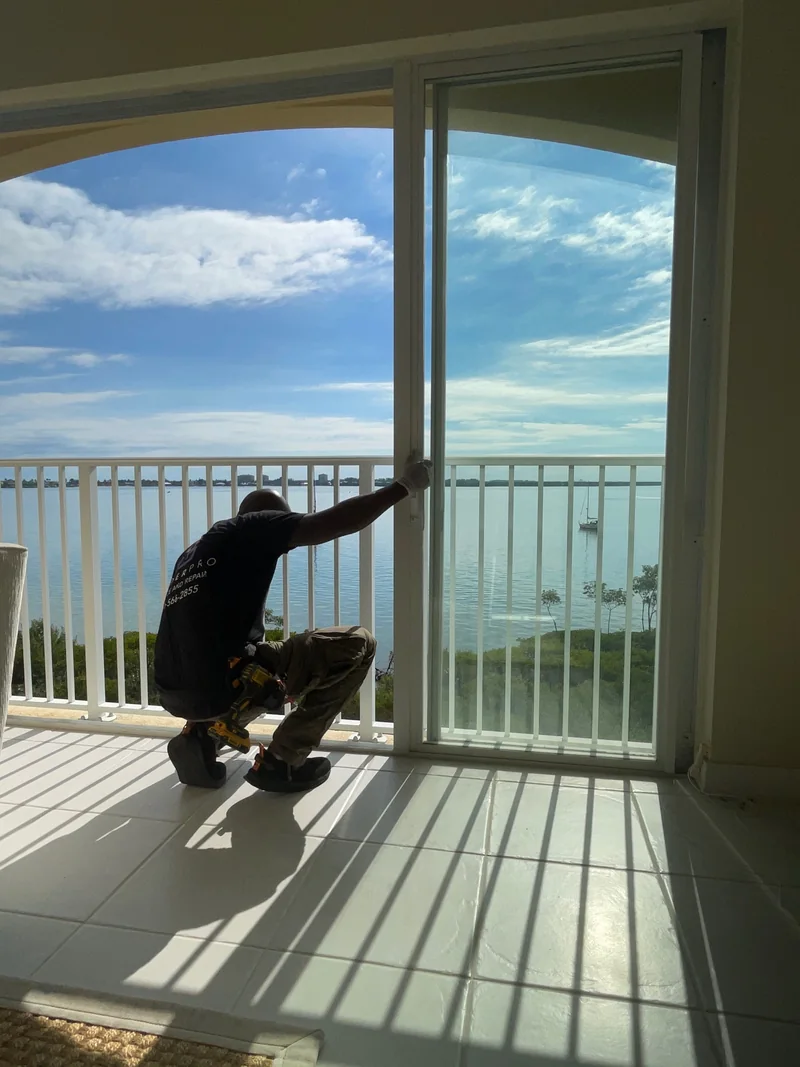
We repair sliders, locks and hardware for a living, so this is a view from the maintenance side. That includes the places sliders honestly come up short.
Sliding glass doors vs French doors vs bifold and multi-slide doors in Florida
| Factor | Sliding glass door | French doors, in-swing | French doors, out-swing | Bifold | Multi-slide / pocket |
|---|
| Floor space to open | None | A full door arc indoors | A full door arc on the patio | Stacked panels at one or both ends | None; panels stack or hide in a pocket |
| Clear opening | About half the width | Nearly full width | Nearly full width | Nearly full width | Most or all of the width |
| Glass and view when closed | Large panes, slim interlock | Smaller panes, two thick stiles | Smaller panes, two thick stiles | Many stiles across the view | Large panes, several interlocks |
| Wind pressure | Rides in a track; depends on interlock and lock engagement | Pressure pushes it toward opening; latch and bolts resist | Pressure seats it against its stops | Many hinge and seal points to hold | Like a slider, multiplied by panels |
| Wind-driven rain | Track and sill are the weak point | Hardest to keep water out | Seals tighter under pressure | Many seals, more paths for water | Long sill, many interlocks |
| Security weak point | Lift-out and a misaligned latch | Inactive leaf and astragal | Exposed hinges plus inactive leaf | Hinge and carrier points | Many panels to secure |
| What wears out | Rollers, track, weatherstrip | Hinges, multipoint lock, seals | Hinges, multipoint lock, seals | Carriers, hinges, track, seals | Rollers, long track, pocket debris |
| Main cost drivers | Size, glass type, panel count | Size, lock hardware, glass | Size, lock hardware, impact approval | Panel count, hardware, header | Panel count, pocket framing, header |
How much space does each door type need?
A slider needs none: the panel moves along the wall. A pair of French doors needs a clear arc as wide as each door leaf, inside the room for in-swing doors or on the patio for out-swing doors. That arc is the single biggest reason Florida builders put sliders on lanais.
Think about where furniture sits. An in-swing French door on a living room wall means a strip of floor about three feet deep that has to stay empty. Out-swing doors move that strip outside, where it collides with patio chairs, grills and the pool deck. Bifolds fold into a stack that sits in the opening or just beside it, so you lose some width and need somewhere for the stack to live. Multi-slide doors either stack panels behind one another or slide them into a wall pocket, which takes no floor space but needs a thick wall to receive them.
Which handles Florida wind and rain better, a slider or French doors?
Out-swing French doors, generally. Under storm pressure they press harder into their weatherstrip, while a slider relies on a track and sill that water can be driven across. In-swing French doors are the weakest of the three in wind-driven rain.
The mechanism is simple. During a storm, wind pushing on the windward side of a house tries to shove each door inward. An out-swing door closes against stops on its inside face, so that push squeezes it tighter against its seals, like a lid pressed onto a jar. An in-swing door does the opposite: the same push tries to open it, and only the latch, bolts and a thin seal are holding it shut. Water follows the pressure, so the in-swing door leaks first.
A slider sits in between. Its panels ride in a track, with the interlock and a sill dam keeping water out. Under strong wind, rain is pushed across the sill and through the track faster than the weep holes can drain it. This isn't a theory. A 2024 report to the Florida Building Commission on wind-driven rain through sliding door tracks summarizes FEMA's post-Hurricane Ian findings: water intrusion came primarily through sliding glass doors and soffits, in older and newer homes alike, and some doors lacked adequate sill risers.
That's a real point against sliders. It's also partly a maintenance point. A slider with clean weep holes, a sill riser where one is called for and healthy interlock weatherstrip leaks far less than a neglected one. Our guide to why sliding glass doors leak covers the fixes, and the hurricane season checklist covers the pre-storm steps.
Should French doors swing in or out in Florida?
Out, for an exterior door that faces weather. Beyond the pressure-and-seal advantage above, an out-swing door doesn't need a tall interior sill to stop water, and it doesn't swing into the room. That's why out-swing patio doors are common in hurricane-prone construction.
Out-swing has two trade-offs. The hinge pins sit on the outside, so they need security hinges or non-removable pins (more on that below). And the door swings into the patio, where wind can catch it while it's open. Good out-swing doors use a hold-open or a stay to stop that. If your door opens onto a covered lanai inside a screen enclosure, the weather argument is weaker, and an in-swing door can be a reasonable choice there.
Are sliding glass doors less secure than French doors?
Not inherently. Each has a specific weak point. A slider's is the lift-out and a latch that has drifted out of line. A French door's is the inactive leaf held by flush bolts, plus exposed hinge pins on out-swing doors. Both can be made solid with the right hardware.
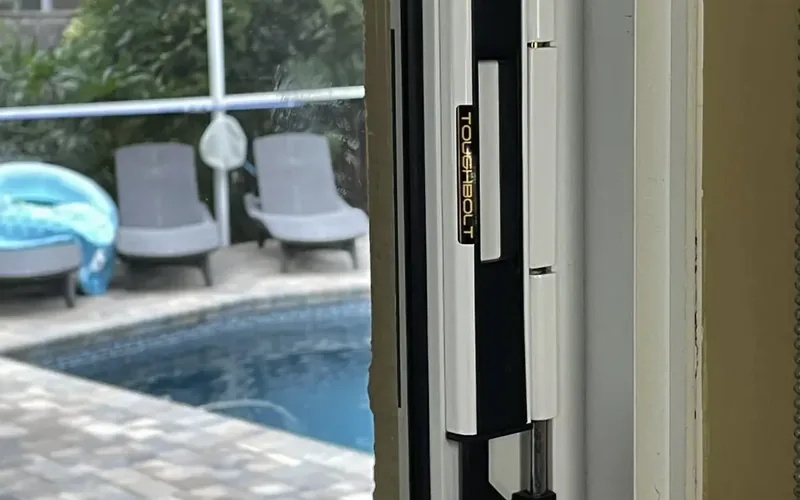
A slider latch is a hook catching a keeper. When rollers wear and the panel drops, the hook rides low and only half-engages, so a firm pull or a pry bar beats it. A panel with too much vertical play can also be lifted off its track from outside. The fixes are restoring roller height so the latch engages fully, adding a secondary lock or foot bolt, and anti-lift blocks in the head track. Our sliding door security guide goes step by step, and our security lock and latch service covers what we fit.
A pair of French doors is only as strong as the leaf that doesn't have the handle. That inactive leaf is held by flush bolts into the head and sill, and if those bolts are short or the strike holes are worn, both doors can be forced together. A multipoint lock that throws bolts top, bottom and center fixes most of it. On out-swing doors, the hinge pins are on the outside, so ask for non-removable pins or security studs that keep the door in place even with a pin knocked out.
Either way, the lock is only as good as the alignment. A door that doesn't close square won't lock square. That's why our first step on a slider that won't latch is checking alignment, not swapping the lock.
What wears out on each type of door?
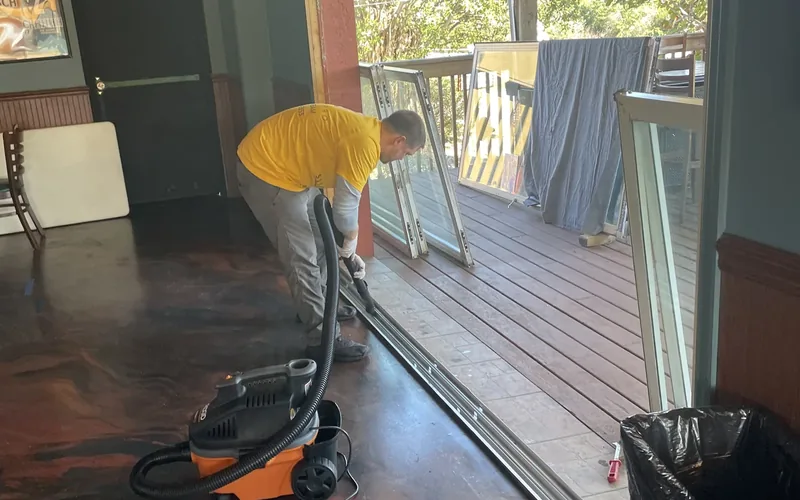
On a slider, almost all wear happens at the bottom: two rollers carry the panel's whole weight, and the track they run on collects sand and grit. Rollers are a routine replacement, and when they're done before the track is chewed up, the door goes back to gliding. Weatherstrip on the interlock and jambs flattens over time and lets in air and water. Handles and latches are the other usual suspects.
French doors wear at the hinges and locks. A heavy glass leaf hangs off one edge, so over years the hinges loosen and the door sags at the latch side. Then it drags on the sill, the multipoint lock binds, and the seals stop meeting evenly. Hinge adjustment and seal replacement are the usual fixes, and a multipoint lock gearbox is a part that eventually fails.
Bifolds combine both: top-hung or bottom-rolling carriers, a hinge between every pair of panels, a track and a long run of seals. More parts means more maintenance. Multi-slide and pocket doors are sliders with more panels, so they have more rollers, a longer track and, for pocket designs, a cavity that collects debris you can't easily reach. Our guide to multi-panel and pocket sliding door repair covers those systems. For standard sliders, roller replacement is the repair we do most.
Sliding glass doors or bifold: which suits a Florida lanai?
For most lanais, a slider or a multi-slide. Bifolds are impressive when they're fully open, but in Florida you spend much of the year with doors closed and the air conditioning running, and then a bifold puts a stile every few feet across the view. Sliders show more glass when closed.
Weather favors sliders too. A bifold has a seal at every panel joint and a hinge or carrier at every fold, which means more places for wind-driven rain and salt to work. Near the beach, that's a lot of hardware to keep corrosion off. Bifolds make the most sense on a covered, sheltered opening where the doors will spend real time open, such as an outdoor kitchen under a deep roof.
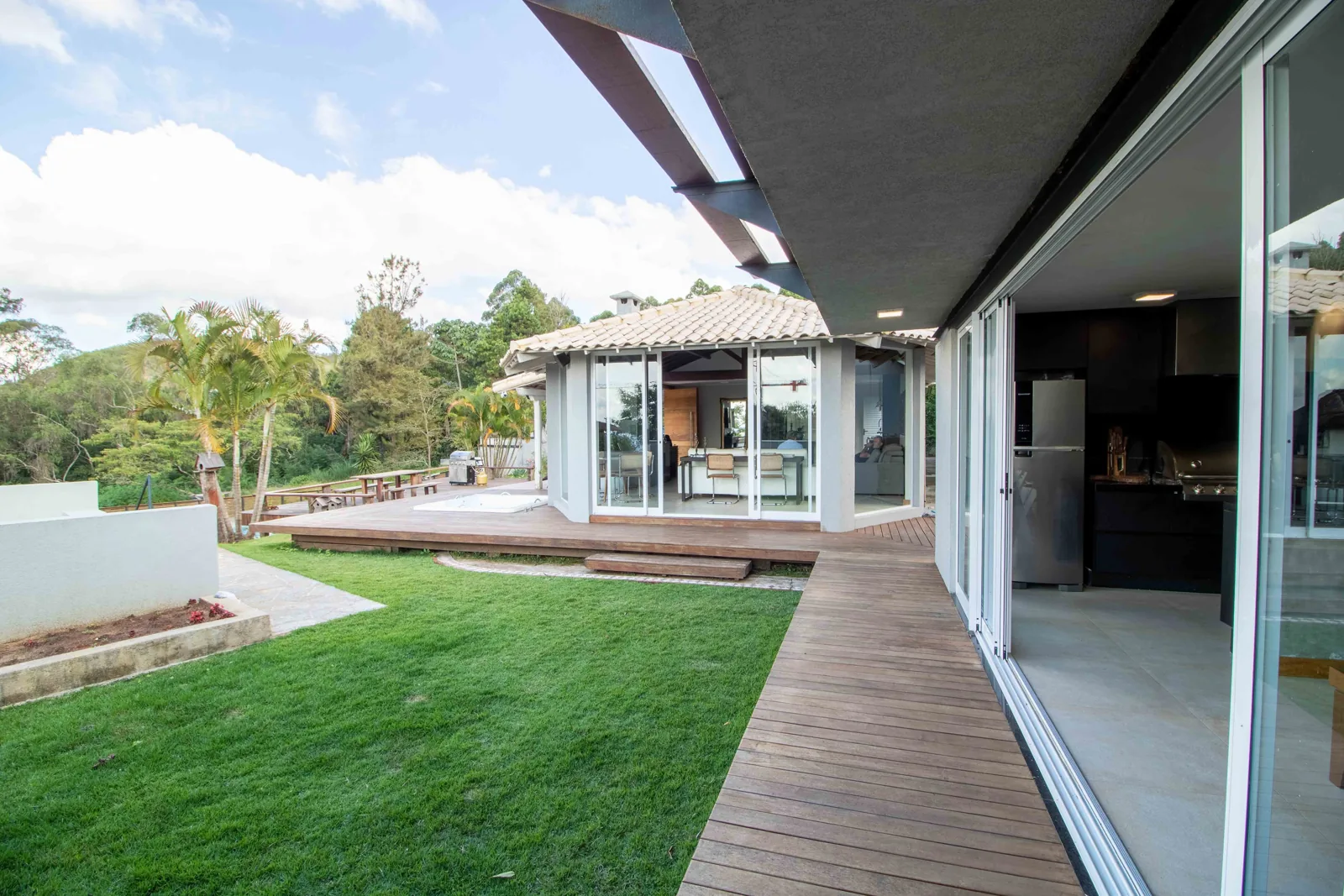
If you want an almost-full opening without bifold upkeep, a multi-slide with a pocket or a stacking design gets close. It costs more to frame and has a longer track to keep clean, but each panel behaves like an ordinary slider.
What drives the price difference between sliders and French doors?
New-door prices vary too much by size, glass and installer to quote one fair figure. What we can tell you is what moves the number, so you can compare quotes on equal terms:
- Impact rating. Laminated impact glass and a tested assembly add cost to every panel, and many Florida openings require it.
- Number of panels. Each extra panel adds glass, hardware and installation time. Bifolds and multi-slides scale up fastest.
- Opening width and the header. Widening an opening for a big multi-slide or bifold can mean a new structural header and engineering.
- Lock hardware. A multipoint lock on French doors costs more than a slider latch. Security upgrades on either add cost.
- Frame material and finish. Aluminum, vinyl and fiberglass price differently, and coastal finishes cost more. Our vinyl vs aluminum comparison covers the trade-offs.
- Permits and approvals. Exterior door replacements in Florida often need a permit, and condo associations may have their own approval process.
Where does a sliding glass door honestly lose?
- Half the opening is always blocked. If you want a wide-open doorway for parties or carrying furniture, a slider can't do it.
- Wind-driven rain through the track. As the FEMA findings above show, the sill is a real weak spot in big storms.
- The slide itself depends on two small wheels. Neglect the rollers and track, and a slider becomes a two-hand door. French doors don't have that failure mode.
- Air sealing. Sliding weatherstrip brushes past the frame rather than being compressed, so even a good slider tends to let more air through than a good hinged door with compression seals.
- Looks. In a traditional-style home, a pair of French doors can simply suit the architecture better.
Slider, French doors or bifold: which should you choose?
- If floor space is tight or furniture sits near the door, choose a slider.
- If the door faces open weather and you want the tightest seal, choose out-swing French doors with a multipoint lock and security hinges.
- If the door opens onto a screened lanai or covered porch, a slider is the practical default. In-swing French doors become reasonable here too.
- If you want the whole wall open and the space is sheltered, choose a multi-slide or bifold and budget for annual service.
- If you're near salt water, favor fewer moving parts: a slider or out-swing French door over a bifold.
- If you already have a slider that works poorly, fix it before replacing it. Most problems are rollers, track, weatherstrip or alignment.
That last point is where we come in. Our repairs start at $275 including parts, labor and a written 1 to 3 year warranty. If your slider is dragging, leaking or not locking, send us photos of the door and track and we'll tell you whether it needs a repair or whether replacement really is the better call.