Multi-panel and pocket sliding doors need a different kind of repair than a standard two-panel patio door. The panels pull each other open through interlocks, so one worn roller throws off every panel after it, and a pocket door hides part of its track inside the wall where sand and water collect unseen. Fixing them usually means matching heavier rollers, cleaning the hidden track and realigning all the panels in order.
These doors are common in the waterfront and golf-community homes we work in around Jupiter, Palm Beach Gardens, Hobe Sound, Palm City and Stuart. They open a whole wall to the lanai and the pool. When they work, they're the best feature in the house. When they don't, they're the heaviest problem in it.
Why do multi-panel and pocket doors need a different kind of repair?
Because they're systems, not single panels. A standard slider has one moving panel on one pair of rollers. A four-panel stacking door has four panels on separate tracks, each linked to the next, and a pocket door adds a track you can't see.
Three things make them harder than a patio door:
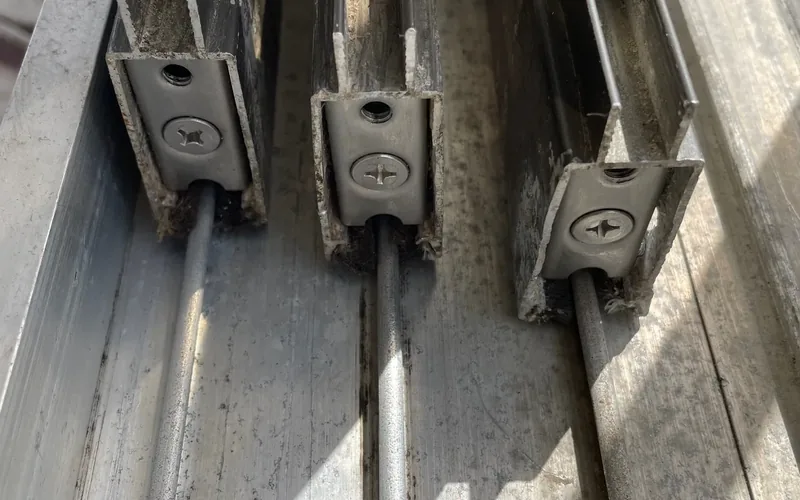
- More moving parts. Every panel rides on its own roller carriages. A four-panel door has at least eight carriages, and on heavy glass they're often tandem units with two wheels each. More bearings means more chances for one to seize.
- Panels that depend on each other. If one panel drops out of line, the panels it pulls and the panels that pull it all bind.
- Weight and width. Big panels of impact glass are heavy, and a long track over a wide opening has more room to settle, flex or collect debris.
How do the panels in a stacking sliding door work together?
On a typical stacking (or bypassing) multi-slide, each panel runs in its own channel, side by side in a wide sill. Where two panels overlap, their vertical edges hook together through an interlock: an interlocking profile with weatherstripping that seals the joint when the door is closed.
When you slide the lead panel, it travels alone for most of its run. Near the end, a catch on its interlock picks up the next panel and drags it along. That one picks up the next, and so on, until all the panels are stacked at one end. Closing reverses it. So the force you put into one handle travels through every interlock catch in the chain.
That's why the details matter so much. If one panel sits even slightly lower than its neighbor, its interlock rides low against the next panel's. The catch may miss, or engage at an angle and pull the panel diagonally, which racks it in its channel and loads one roller far more than the other. You feel that as a door that moves fine for two feet, then suddenly gets heavy.
Why does one bad roller throw off a four-panel door?
A seized or flattened roller lets its end of the panel drop. On a single patio door that just makes the door drag and the lock miss. On a multi-panel door it changes the height of that panel's interlock relative to the panels on either side, and the problem travels:
- the low panel's interlock scrapes or binds against its neighbor;
- the catch that pulls the next panel engages late or at an angle;
- the next panel gets dragged slightly crooked, wearing its own rollers unevenly;
- weatherstripping at the interlocks gets torn where it rubs.
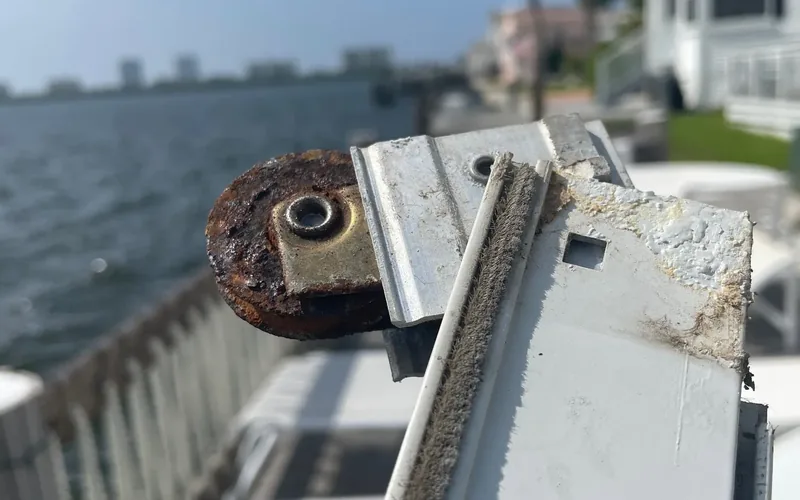
Left alone, one failed carriage can wear out the carriages on the next panel too. It's the same principle as the usual advice about worn rollers, multiplied by the number of panels. Catch it at the first heavy spot in the stroke, and it's usually a carriage or two plus an adjustment. Catch it after a season of forcing, and the track may be grooved under several panels.
What collects inside a pocket door cavity, and why is it so hard to get out?
A pocket slider disappears into a hollow wall when it opens. The bottom track continues into that wall, out of sight. Everything that blows across the sill when the door is open (sand, leaves, grass clippings, pool grit, insect debris) gets pushed toward the pocket by the panels themselves every time they open. It ends up at the back of the cavity, on the track, right where the rollers park.
The cavity is also dark, has almost no airflow and stays damp. Water that wind pushes across the sill during a storm can run into the pocket, and if the drainage there is blocked, it sits on the hidden track. Salt and grit in a damp, closed space is ideal for corrosion. The first sign is usually a door that slides easily until the last stretch into the pocket, where it grinds or stops short.
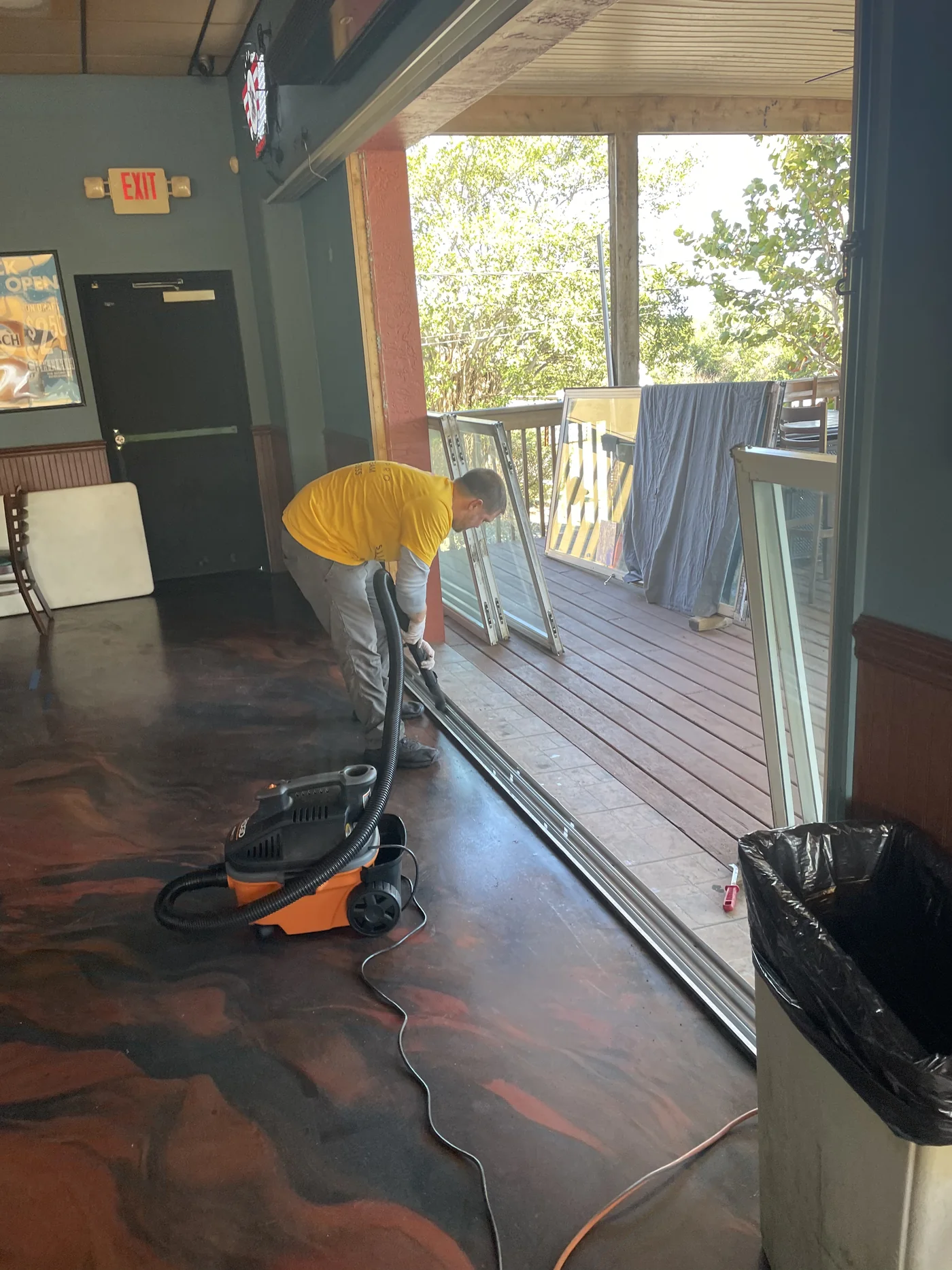
Getting it out is the hard part. You can't reach the back of a pocket track with a vacuum wand while the panels are parked in it. Done properly, the panels come out so the full length of the hidden track can be vacuumed, brushed, flushed and inspected for pitting. On some systems there's an access panel or removable jamb at the pocket; on others the panels have to come out through the opening. Either way, it's a job worth planning, not forcing.
What are the early warning signs on a big multi-panel door?
Big systems rarely fail all at once. They give you a season or two of hints first, and catching them early is the difference between a carriage swap and a grooved sill. Watch for these:
- A heavy spot at the same point in every stroke. That's usually where one panel picks up the next, and it means an interlock is riding at the wrong height.
- Panels that don't stack evenly. If the stacked panels sit at slightly different heights, or one sticks out past the others, a carriage has dropped.
- Uneven gaps at the head. Look up at the top of each panel with the door closed. A gap that tapers from one end to the other means that panel is leaning.
- Torn or flattened seals at the interlocks. Weatherstripping that rubs where panels meet is a sign they're out of line, and it lets in air and water.
- Metal dust or fine grooves in the sill. That's a roller that has stopped turning and started skidding.
- A lock that only catches if you push or lift. The last panel isn't sitting where the keeper expects it.
Any one of these is worth a look before the next storm season. Two or more together usually means the whole sequence needs resetting.
Are 4-panel sliding door rollers different from standard rollers?
Usually, yes. Panels in big multi-slide systems tend to be taller, wider and heavier than a standard patio panel, especially with impact glass, so they ride on heavier carriages. Many use tandem rollers, two wheels in one housing, to spread the weight. Most have a height-adjustment screw so each panel can be leveled against its neighbors.
What matters when replacing them:
- Load rating that matches the panel. A carriage that's fine on a light panel will flatten under heavy impact glass.
- Exact fit in the bottom rail. The carriage has to fit the panel's channel and leave the full adjustment range. A close-enough part limits how well the panel can be leveled.
- Wheel profile that matches the track. A wheel that doesn't match the rail shape wears a new groove into it.
- Sealed bearings and stainless construction for anything near salt or brackish water.
- Replacing a panel's carriages as a set, so both ends wear at the same rate.
Identifying the system first saves a lot of grief. Our guide to identifying your door's brand and parts shows where to look for labels, and the roller replacement page covers how we match carriages. For the trade-offs between wheel materials, see sliding door roller types compared.
How is a three- to six-panel door realigned?
Alignment on a multi-panel door is done in sequence, because every panel's position depends on the one next to it. The general order:
- Check the sill. If the sill itself has settled or bowed, adjusting panels just chases the problem. A level or a string line across the full width shows whether the track is true.
- Clean the track first. Adjusting a panel that's sitting on a pile of grit sets it at the wrong height.
- Start from the fixed or last panel. Whichever panel the others close against becomes the reference. Each panel after it is set to match.
- Level each panel with its carriages. Both ends get adjusted so the panel is plumb and its interlock sits at the same height as its neighbor's.
- Check the reveals. The gaps at the head, the jambs and between panels should be even from top to bottom. A tapering gap means the panel is still leaning.
- Run the full stroke repeatedly. Open and close the whole door several times, listening for the catches engaging cleanly and feeling for heavy spots.
- Finish with the locks. Multi-panel locks and the latch at the pocket or end jamb only line up once everything else is right.
That sequence is why we're wary of adjusting one panel in isolation. Raising the one that drags may fix that panel and push the misalignment onto the next one.
Why do multi-panel and pocket doors need service every year?
Because everything that wears on a patio door is multiplied on these, and some of it is hidden. More carriages, more interlocks, more weatherstripping, a longer sill with more weep holes, and on a pocket door, a track nobody sees.
Manufacturers who build these systems say the same. Western Architectural Openings, which makes moving glass walls, recommends keeping tracks clear of dust and debris, inspecting doors once a year, and cleaning monthly in coastal areas. Its care page also says not to lubricate the wheels on its sliding doors, because they run on sealed ball bearings. That matches what we tell owners: keep the track clean and leave the oil spray in the garage.
Drainage matters as much as rollers. FEMA's recovery advisory on water intrusion through windows and doors explains that sliding doors are built to contain and drain water through weep holes, and that those holes must be kept clean and never caulked shut. A wide multi-panel sill has more of them, and the ones near the stacking end or the pocket are the first to clog with the debris the panels push there.
An annual visit for a big system covers every carriage, the hidden track, the weeps, the interlock seals and the locks. Our maintenance and tune-up service handles that in one appointment.
When is replacing a multi-panel system the honest answer?
Most multi-panel and pocket doors we're asked about are repairable. Rollers, interlock seals, locks and track cleaning cover the bulk of it. Replacement starts to make sense when:
- The sill is corroded through or structurally failed, not just dirty or grooved.
- The pocket framing is rotted or water-damaged after years of standing water in the cavity.
- The system is discontinued and the carriages or interlocks can't be matched, so a proper repair isn't possible.
- The opening itself has moved, from settling or storm damage, beyond what adjustment can correct.
If you're in that situation, look for a system with sealed stainless rollers sized for the panel weight, a sill designed to drain, and an installer who'll explain how the pocket drains. Our guide to repair versus replacement lays out the checks.
If your multi-panel or pocket door has gotten heavy, grinds near the end of its travel or no longer locks at the end, send us photos of the door, the sill and any labels you can find. Repairs start at $275 with parts, labor and our written 1 to 3 year warranty included, and a big system will tell us a lot from good pictures before we arrive.