Tempered glass is heat-treated glass that breaks into small, blunt cubes, and it's the standard safety glass in most sliding doors. Laminated glass is two sheets bonded to a plastic interlayer, so it cracks but stays in the frame. Impact glass is laminated glass that passed missile and wind-pressure testing as part of a complete door. All three can be legal in a slider. Only the last one counts as hurricane protection.
We replace sliding door glass and repair the doors around it, so this comparison leans on what each type means once it's installed: how it fails, what it weighs, and what it takes to put right.
Tempered vs laminated vs impact glass in a sliding glass door
| Tempered | Laminated | Impact |
|---|
| What it is | One sheet, heated and rapidly cooled | Two or more sheets bonded to a plastic interlayer | Laminated glass in a door assembly that passed missile and pressure tests |
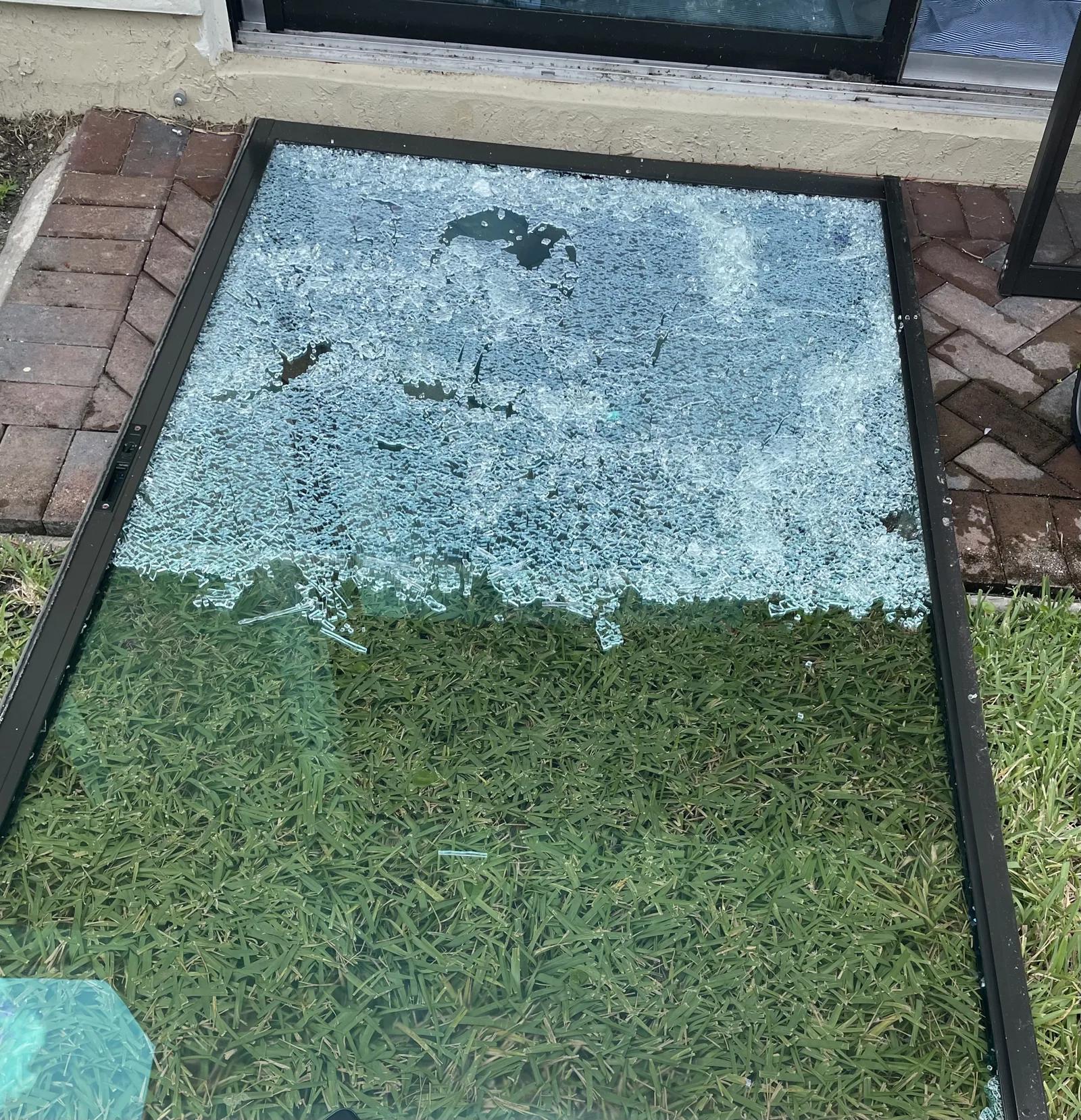
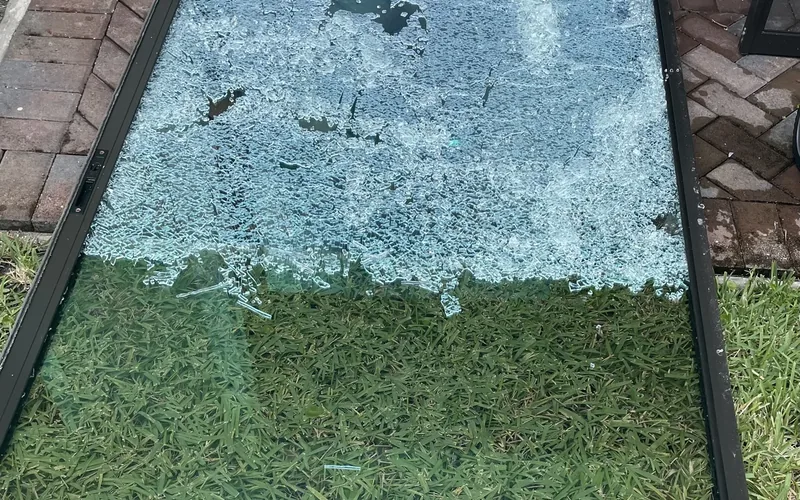
| How it breaks | All at once, into small cubes; usually falls out | Cracks in a web; pieces stick to the interlayer | Cracks in a web; opening stays closed |
| Federal safety glazing | Yes, when it meets 16 CFR 1201 | Yes, when it meets 16 CFR 1201 | Yes |
| Hurricane debris protection | No | No, unless part of an approved assembly | Yes, as tested with its frame |
| Break-in resistance | Low once struck: the whole pane clears | High: has to be hacked through | High |
| Noise and UV | Least help | Interlayer damps sound and screens most UV | Same benefits, usually more of them |
| Weight on rollers | Lightest | Heavier | Heaviest, often by a wide margin |
| Can it be cut after it's made? | No. Made to exact size | Only if built from untempered sheets, and only in a shop | No field changes; must match the approval |
Which should you choose?
Start with what the opening has to do. If it has to stop hurricane debris, only an approved impact assembly does that. If it only has to be safe when someone walks into it, tempered is the standard answer and laminated is the upgrade for security, sound and UV.
- If you're replacing one broken pane in a sound door: match what was there. A tempered pane in a non-impact door gets a tempered replacement. An impact unit gets a unit that matches the door's approval. Changing type inside an existing frame changes thickness, weight and sometimes what the door legally is.
- If your house needs opening protection and the slider isn't impact: laminated glass alone won't satisfy that. Compare an impact door with shutters instead, and our guide to impact sliding doors vs hurricane shutters walks through that choice, including the insurance form.
- If the slider faces a busy road, a pool deck or a boat channel: ask about laminated. The interlayer quiets a room in a way a single tempered sheet can't.
- If break-ins worry you more than storms: laminated. A struck tempered pane is gone in a second. A laminated one has to be beaten and cut.
- If budget and weight are the limits: tempered. It's the lightest, the easiest on rollers, and fully legal in a non-impact slider.
- If you're on a high floor of a condo: the building's documents and the existing door's approval decide this, not taste. Ask the association before anything is ordered.
- If heat and fading are the real complaint: glass type is the smaller lever. A coating is the bigger one, which we cover in low-E vs clear glass for sliding doors. The two choices are separate and can be combined.
How is each type of glass made?
All three start as ordinary float glass, the plain annealed kind in an old picture frame. What happens next is the difference.
Tempered glass is cut to its final size and edged first, then heated and cooled fast. Vitro Architectural Glass explains in its technical document on heat-treated glass that the glass is heated to about 1,200°F and then quenched with rapid forced cooling, which locks the surfaces in compression. The same document puts tempered glass at roughly four to five times the strength of annealed glass of the same thickness.
Laminated glass is two or more sheets bonded to a plastic interlayer under heat and pressure. The sheets themselves can be annealed, heat-strengthened or tempered. What makes a laminate useful isn't really the glass. It's what the interlayer does after the glass breaks.
Impact glass is laminated glass built to a recipe that passed testing as part of a complete door or window: the glass, the frame that holds it, and the anchors that hold the frame to the wall. In practice that usually means a thicker interlayer than ordinary laminated glass, and often a second pane with an air space to make an insulated unit.
One fact about tempering shapes every repair. Vitro's document states that neither heat-strengthened nor tempered glass can be safely cut after heat treatment. So every tempered pane is made to order at its finished size. That's why a broken slider pane gets measured first and replaced days later, not cut from stock while you wait.
Why does tempered glass crumble while laminated glass cracks in place?
Tempered glass stores energy. When anything breaches its compressed skin, that energy releases through the whole pane at once and it breaks into cubes. Laminated glass can crack just as hard, but the interlayer holds the pieces where they are.
Picture a tempered pane as two tight skins squeezing a core that wants to pull apart. That balance is why it shrugs off a knock that would crack ordinary glass. It's also why it has no partial failure. A chip deep enough to reach the core lets the tension run, and the crack branches across the entire sheet in a fraction of a second. Vitro describes the result as innumerable small, roughly cubical pieces, and notes that because of that break pattern tempered glass is much more likely to leave the opening immediately.
That's the safety trade. Cubes hurt people far less than the long shards annealed glass makes. But the doorway is now a hole. On a Florida patio in August, that means afternoon rain on the floor, insects in the house and a door that can't be locked until it's boarded.
Laminated glass breaks into a spider web. The fragments stay bonded to the interlayer, the sheet may bow, and the opening stays more or less closed. It still has to be replaced. It just doesn't have to be replaced tonight.
If your tempered pane broke with nobody near it, the cause is almost always an old edge chip, frame pressure from a sagging panel or a nickel sulfide stone. We explain how to tell which in why a sliding glass door shatters for no reason, so we won't repeat it here.
Does a sliding glass door have to be safety glass?
Yes. The federal safety standard for architectural glazing, 16 CFR 1201, names sliding glass doors (patio-type) among the products whose glazing must meet it. Tempered and laminated glass can both qualify. Plain annealed glass can't.
The scope section of 16 CFR 1201 lists storm doors, doors, bathtub and shower enclosures, and sliding glass doors. Its findings explain why: people fall into and through glazed doors, lacerations are the most common injury, and children 14 and under are at particular risk. Local building codes add their own safety glazing rules for glass in and beside doors, and your building department applies those.
Two practical points follow. First, a hardware-store sheet of plain glass cut to fit is not a stopgap for a broken slider pane. It's the exact hazard the standard exists to prevent. Board the opening instead. Second, the legal question doesn't pick between tempered and laminated for you. Both pass. Your choice between them is about security, sound, weight and cost.
Safety glass in a door is normally identified by a small etched mark in one corner. Our guide to identifying your sliding door's brand and parts explains what that mark does and doesn't tell you.
What makes laminated glass "impact" glass?
Testing, not the glass on its own. Impact glass is laminated glass that survived a missile strike and then a series of wind-pressure cycles while installed in a specific frame. Outside that tested assembly, it's laminated glass, not an impact door.
Guardian Glass lays the tests out in its guide to hurricane impact resistance. In the large missile test, a length of 2x4 timber at a set weight and speed is fired at the whole glazing system (glass, frame and anchorage), which then goes through cyclic pressure loading to simulate the storm. In the small missile test, 2-gram steel balls are fired at 130 feet per second, followed by the same pressure cycling. Large missile products are required for glazing within 30 feet of grade, small missile above that. The guide also notes that a minimum 0.090-inch interlayer is commonly specified for large missile resistance and 0.060-inch for small missile, which is one reason impact laminate is heavier than the laminated glass in an ordinary door.
The same guide notes that Miami-Dade and Broward counties require glazing to be tested to Florida's own TAS protocols. Those two counties are Florida's High-Velocity Hurricane Zone, the strictest part of the state for glazing.
What that means for your slider:
- A ground-floor slider is a large missile opening. A balcony door high up a condo tower may only need small missile glazing. Same building, different requirement.
- Thickness doesn't make glass impact. A glass shop can sell you laminated glass the same thickness as an impact unit. Without the tested frame and the approval, it's still not impact.
- The approval belongs to the product. A door's Florida product approval or Miami-Dade Notice of Acceptance lists the glass makeup it was tested with. A replacement unit has to match that, which is why struck impact glass is its own job: see our impact glass replacement service.
Is laminated glass better for noise, UV and break-ins?
Compared with one sheet of tempered glass, yes on all three. The interlayer damps sound, screens out most ultraviolet light, and holds the glass together when someone tries to break through.
Noise. A single stiff sheet of glass vibrates like a drum skin and passes sound straight through. A soft interlayer between two sheets turns some of that vibration into a tiny amount of heat, so less reaches the room. Acoustic interlayers made specifically for sound control exist, so ask for one by name if noise is the reason you're buying. One catch: sound also leaks through gaps, so worn weatherstrip around the panel can undo a lot of what better glass buys you.
UV. The interlayer screens out most of the ultraviolet that drives fading. Visible light and heat fade fabrics and floors too, so laminated glass slows fading rather than ending it.
Break-ins. Tempered glass is strong against a blunt bump, but a sharp, hard strike in the right spot breaks the whole pane and clears the opening in a second, quietly enough on a busy street. Laminated glass cracks, holds, and has to be hit again and again and then cut. It's slow and loud, which is the point. The glass is only half of it, though: a door that won't latch or can be lifted off its track is the easier way in, and our sliding door security guide covers that side.
A laminated pane that isn't part of an approved impact door may well hold up better in a storm than tempered glass. It still isn't rated, and it won't count as protection on an insurance form or for code purposes.
How much does the heavier glass matter for the rest of the door?
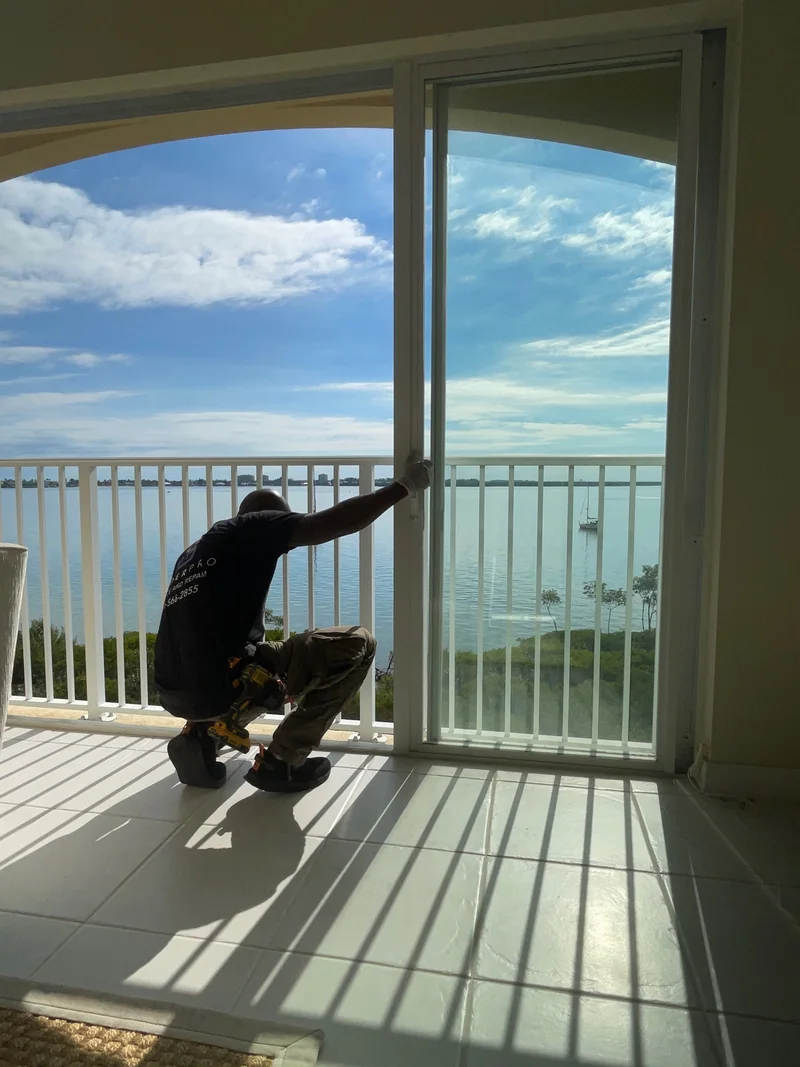
More than most buyers expect. Every extra sheet and every extra fraction of an inch of interlayer adds weight, and that weight lands on two small rollers in the bottom rail. An impact panel can weigh a good deal more than the single tempered panel in a 1980s door of the same size.
That has three consequences. Rollers have to be sized for the panel's real weight, and undersized ones wear early on impact doors (our comparison of sliding door roller types covers what heavy panels need). Tracks wear faster under a heavy panel on failing rollers. And you can't always drop heavier glass into a frame built for lighter glass, because the glazing pocket was sized for a certain thickness and the frame, rollers and track for a certain load.
So if someone suggests "just putting laminated glass in" your existing tempered door, ask two questions: will the new glass fit the frame's glazing pocket, and are the rollers rated for the new weight? If either answer is fuzzy, the upgrade isn't really a glass job.
What drives the price difference between tempered, laminated and impact glass?
Layers, testing and handling. Each step from tempered to laminated to impact adds material, adds process, and adds weight, and every one of those shows up in the quote.
We won't print figures for "tempered vs laminated glass price," because the honest number depends on size, makeup and supplier, and a figure without those is a guess. These are the drivers that move it:
- Number of sheets and interlayer. A laminate is at least two sheets plus the interlayer and the bonding process. Impact interlayers are commonly thicker.
- Insulated unit and coatings. A second pane, a sealed air space and a low-E coating each add cost, and they're common on impact units.
- Made to order. Tempered glass can't be cut after tempering, so nothing comes off a shelf. Unusual sizes on older doors can add lead time.
- Matching an approval. An impact replacement has to match the tested makeup, which narrows the supply.
- Weight and access. Heavy panels mean more hands. A tenth-floor balcony door adds time compared with a ground-floor lanai.
- Matching the look. Tint and coating have to match the other panels, or the new pane stands out.
- Glass only or whole door. Replacing a pane in a sound frame is a glass job. Changing glass type often turns into a door replacement with frame, permit and finish work.
What happens when each type breaks and needs replacing?
Tempered: the opening is clear and the room is full of cubes. Safety and cleanup come first, then the opening is secured, measured and the pane ordered to size. Our sliding door glass replacement page covers the first hour, the cleanup, and how the pane goes back in.
Laminated: the pane cracks and stays put. You usually have a little time, but don't leave it for months. Water and salt get into the broken edges, and a cracked laminate is weaker for the next knock.
Impact: a cracked impact pane did its job. The unit is replaced inside the existing frame to match the door's approval, and the frame and rollers get checked while the panel is out.
Whichever you have, a photo of the break, the etched corner mark and the whole door tells us most of what we need. Send us the photos and we'll tell you what's in the frame and what it needs next.