After a hurricane, look at your sliding doors in a set order: glass and panel safety first, then water, then the track, then rollers and locks, then the paperwork. A leaning panel or cracked glass is the only thing on this list that can hurt someone today. Everything else is about stopping further damage and keeping a clean record of what the storm did.
This guide is for the days after the wind drops. Getting ready before a storm is a different job, and it's covered in our hurricane season prep checklist, including the pre-storm baseline photos and the fresh-water salt flush. We won't repeat those here. This is what to look for once the storm has been through.
What should you check first on a sliding door after a hurricane?
Check whether anyone could get hurt. That means cracked or shattered glass, a panel that's leaning or has come out of its track, and water pooled near outlets or cords. Don't slide a damaged door to "see if it works." Look first, touch later.
Walk every slider and window from inside before you go out on the lanai. Keep kids and pets in another room while you do it. For each opening, you're answering three questions:
- Is the glass whole? Look for cracks, a spiderweb pattern, chips at the edges, or a pane that looks clouded where it used to be clear.
- Is the panel standing straight? Sight along the frame. A panel that leans toward you or away from you, or shows a gap at the top, may no longer be held in its head channel.
- Is there water near power? Wet carpet against a floor outlet or a power strip behind the drapes is a separate hazard from the door. FEMA's Ready.gov hurricane guidance says plainly not to touch electrical equipment if it's wet or if you're standing in water.
If all three answers are fine, move on to water. If any of them isn't, deal with that opening first and leave the rest of the list for later.
Is the glass cracked, and is it safe to stand near it?
That depends on what kind of glass it is, because the three common types fail in completely different ways. Most sliding door panels are tempered, laminated, or an impact unit that includes a laminated layer.
- Tempered glass doesn't really crack. It breaks all at once into small cubes. If you see a tempered pane with a crack line in it, that's unusual, and it can let go without warning. Treat it as already broken: keep people away and don't slide the panel.
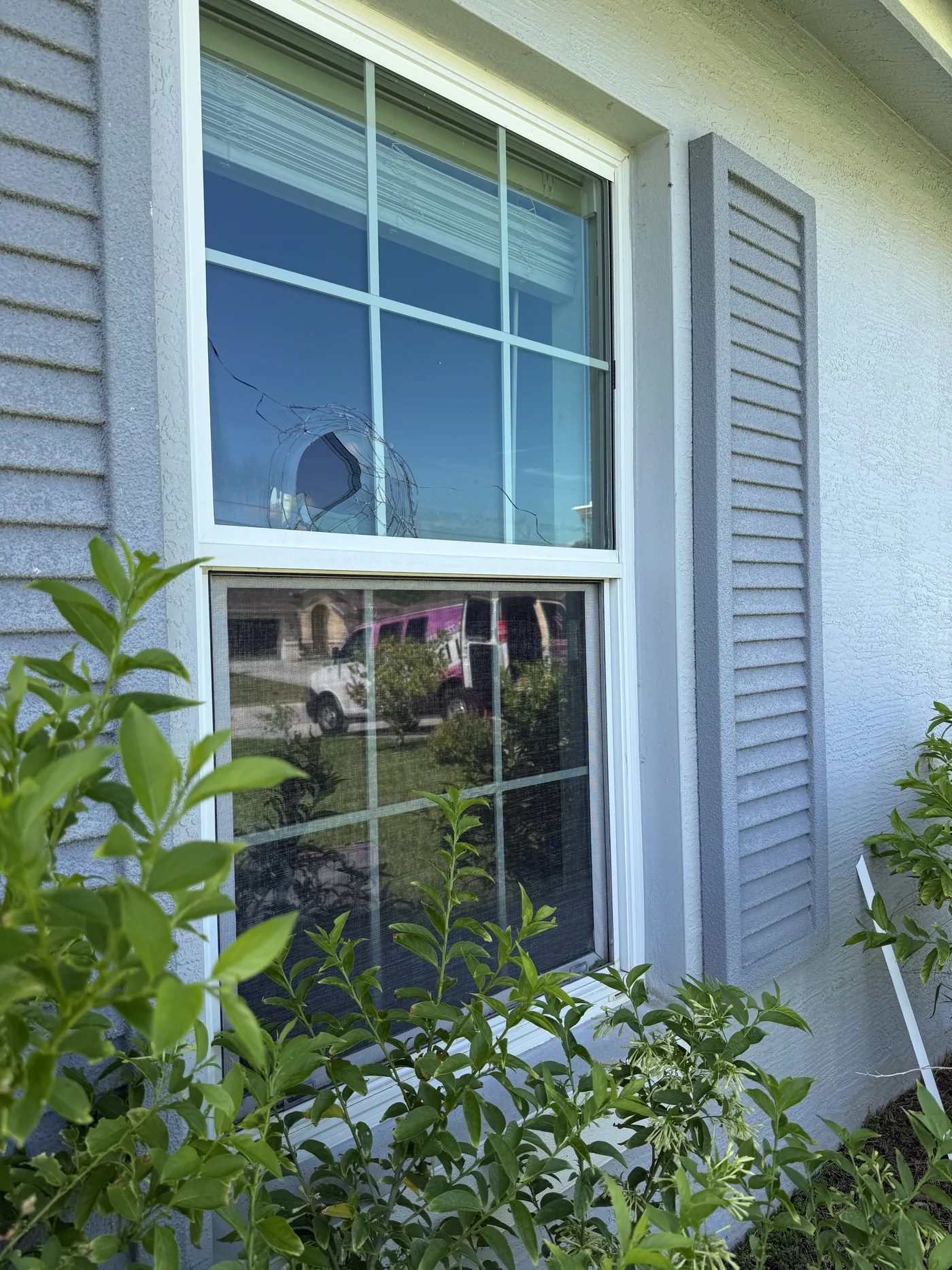
- Laminated and impact glass is built to crack and stay put. The plastic interlayer holds the pieces together, so you'll see a strike point and lines running out from it while the pane stays in the frame. That's the glass doing its job. It isn't about to fall out, though you still shouldn't press on it.
- Older annealed glass, which you'll mostly find in windows rather than doors, breaks into long, sharp shards. Cracked annealed glass is the most dangerous of the three to handle.
If tempered glass has already shattered, the cleanup has its own rules, because the cubes travel into the track, under the carpet edge and out across the pool deck. Our guide to why tempered sliding door glass shatters covers what to keep and what to photograph from the break itself, which matters if the storm wasn't obviously the cause.
Don't tape a cracked pane and call it fixed. Tape doesn't hold tempered glass together, and on a laminated pane it's not adding anything the interlayer isn't already doing. If the opening is now exposed, cover it from outside with plywood or a storm panel until it's repaired.
Is the sliding panel still in its track?
A sliding panel stays upright because its top edge sits in a channel in the head of the frame and its rollers sit on a rail at the bottom. Hurricane winds push and pull on a closed panel for hours, and debris can hit it at the bottom. Either can knock it out of one or both.
Signs a storm moved the panel:
- A gap between the top of the panel and the head of the frame that wasn't there before.
- One bottom corner sitting lower than the other, or a roller visibly beside the rail instead of on it.
- The lock won't line up with its keeper, even though nobody touched it.
- A panel that rocks or knocks when the wind gusts after the storm.
If the panel is leaning or out at the top, don't try to slide it and don't try to lift it alone. Panels on impact doors are heavy, and a tall panel that's lost its grip at the top can tip either way. Our guide to a sliding glass door that's come off its track explains how to tell a top jump from a bottom derail and what's reasonable for two adults to try on a panel that's still captured at the top.
Where did the water get in, and is it still getting in?
Find the path the water took before you dry anything. Storm water at a slider usually comes in one of four ways, and each points to a different fix.
- Over the sill. Wind-driven rain fills the track faster than it drains and spills inward. You'll see a wet line straight along the inside of the door. This is the most common storm leak and often means nothing on the door is broken.
- Back through the weep holes. When the drainage slots on the outside face of the track are blocked by sand or leaves, or when water outside is higher than the track, they can't empty it.
- At the interlock, where the two panels meet in the middle. Pressure forces rain through a worn seal there, and you'll see water running down the inside of the glass at the center of the door.
- Around the frame, not through the door at all. Water showing up at the corners of the frame, or below the drywall beside it, may be coming through the wall or the flashing. That's a building problem, and a door repair won't solve it.
The useful question isn't only "did it leak in the storm?" It's "does it leak in a normal afternoon storm now?" A door that took water during the hurricane and stays dry in the next heavy rain may have simply been overwhelmed. A door that leaks every time it rains now has something new wrong with it. Our guide to a sliding glass door leaking water walks through each leak path and what fixes it.
Pull back the carpet edge or lift a baseboard corner near the door if you can do it without damage. Wet padding and wet drywall don't dry on their own behind a closed wall, and moisture you can't see is the kind that turns into mold later.
What's in the track and sill now?
Expect sand, salt, leaves, bits of shingle grit, mulch, and on an exposed door, small pieces of whatever broke nearby. A hurricane packs it into the track harder than any normal week does, and it sits right where the rollers run.
Clear it before you run the door hard. A roller rolling over grit or a glass fragment can chip, and a chipped roller starts grinding a groove into the rail. Work in this order:
- Photograph the track as you found it. What's in there can show how the water and debris arrived.
- Vacuum it dry with a crevice tool. Glass fragments go in the vacuum, not in your fingers.
- Check each weep hole on the outside face of the track. A thin wire or pipe cleaner should pass through freely.
- Then do the fresh-water salt flush described in our hurricane prep guide, dry the rail, and slide the door gently a few times.
If the area flooded with seawater or brackish water from the Indian River Lagoon, the salt load is far higher than spray alone, and it's inside places a rinse can't reach, like roller bearings and lock mechanisms. Those doors are worth having serviced within a few weeks even if they seem to work today, because salt corrosion takes a little while to show up as drag.
Do the rollers and locks still work the way they did before the storm?
Once the track is clean, run each door slowly through its full travel and pay attention to what's different from before the storm. You know your doors. Trust that.
- New grinding or crunching usually means grit got into the roller housings, or a roller chipped. Keep using the door lightly and get it looked at. Don't spray oil into the track; it binds grit into a paste.
- A heavy door, or a door that drags at one end, can mean a roller seized or collapsed under the load of a panel that was pushed around for hours. Our roller replacement and track repair page covers that work.
- A lock that won't engage, or a latch that now catches only if you lift or push the panel, means something moved: the panel, the keeper, or the frame. This one matters right away, because a slider that doesn't lock is the easiest way into a house that's sitting empty while you deal with everything else. Our security lock and latch work covers keepers, latches and secondary locks.
- A door that slides fine but won't close fully against the jamb can point to a frame that's been pushed out of square, which is less common but worth knowing before any glass gets ordered.
Check the screen panel too. Torn mesh and bent screen frames are common after a storm. They're not urgent, but they're easy to forget until the bugs come back.
My impact glass cracked but held. Is it still protecting the house?
It did protect the house in that storm, which is exactly what it's for. But a cracked impact pane shouldn't be counted on for the next one. Plan to replace the glass unit before the next storm reaches you, and keep it photographed until then.
An impact unit cracks the way it's designed to: the outer glass breaks, the interlayer stretches and holds, and the opening stays closed. The pane in this post's photo looks like that. The trouble is that a cracked unit has already used up part of its strength. The broken glass layer no longer shares the load, and the edges where the crack lines reach the frame can let water and air into the unit over the following months.
How urgent it is depends on what else is going on:
- Cracked, but tight in the frame and not leaking: book it, but it's a weeks problem, not a tonight problem. The glass unit can usually be replaced in the existing frame.
- Cracked and the unit has moved in the frame, or water is getting past it: sooner, and cover the outside if more rain is coming.
- Glass punched through the interlayer: the opening is no longer closed. Cover it from outside today.
Our page on impact window glass replacement explains what's inside a modern impact unit and why the fix is usually the glass, not the whole window or door.
How do you document sliding door damage for an insurance claim?
Build a record that a stranger could follow a month from now, then talk to your carrier about what your policy actually requires. We're not insurance advisors and can't tell you what's covered. That's between you and your insurer, and the answer lives in your policy, not in a blog post.
What a useful record looks like for each damaged door or window:
- Photos before cleanup, from far enough back to show which opening it is, then close up on the damage. Our prep guide has the full photo list for before and after a storm, so we won't repeat it.
- A written damage log. The opening (for example, "family room slider, east wall"), what you saw, the date you first noticed it, and anything that changed later. A crack that grows or a leak that starts a week later belongs in the log with its own date.
- Every temporary measure, with dates and receipts. Plywood over an opening, a tarp, towels and a fan running on wet carpet. Photograph it in place.
- The damaged parts. If a broken latch or a cracked roller comes out during a repair, ask for it back and keep it with your photos.
- The door's history. Pre-storm photos, any past repair invoices, and whether it had impact glass or shutters, and which were closed.
One timing fact is set by Florida law rather than by policy wording. As of November 2026, section 627.70132 of the Florida Statutes bars a property insurance claim unless notice was given to the insurer within one year after the date of loss, and for a hurricane, the date of loss is the date it made landfall. Supplemental claims have an 18-month limit. Don't let a door that "seems okay" sit unreported past that window if you think the storm damaged it. FEMA's Ready.gov guidance says the same thing in fewer words: document damage with photographs and contact your insurance company.
If you live in a condominium, the association may be responsible for some or all of the glass and frame, depending on your declaration. Read our guide to who pays for condo sliding door repairs before you order anything, and notify the association in writing with the same photos.
What's urgent after a hurricane, and what can wait?
Sort every problem by whether it can hurt someone, let more water in, or let someone in. Those go first. Everything else can be booked in the normal way once the roads and the schedules settle.
Post-storm sliding door and window problems, by urgency
| What you see | Urgency | Why | What to do now |
|---|
| Panel leaning or out of the head channel | Today | Can tip; heavy and unstable | Keep people away, don't slide it, call for help |
| Tempered glass cracked or shattered | Today | Cracked tempered can let go without warning | Clear the area, cover the opening from outside |
| Door won't lock | Within a day or two | Security, especially in an empty house | Secondary lock or track bar, book the repair |
| Water still coming in during normal rain | Before the next storm | Hidden water damage in walls and floors | Clear the weep holes, note where it enters |
| Impact glass cracked but tight and dry | Weeks | Reduced protection for the next storm | Photograph, book glass replacement |
| New grinding or a heavy door | Weeks | Salt and grit wear the rollers and rail | Clean and rinse the track, use it lightly |
| Torn screen mesh | Can wait | Comfort and bugs, not safety | Keep the frame; the mesh is replaceable |
| Haze between panes that wasn't there before | Can wait | Seal failure; a performance issue | Note the date it appeared in your log |
The last row trips people up. Fog between the panes of an insulated unit sometimes shows up weeks after a storm, once moisture has worked into a seal that was stressed during it. That's why the log needs dates, not just a single set of photos from the morning after.
What's the next step once the door is safe?
Get the urgent rows handled, then get the rest assessed while your photos are fresh. After a storm, everyone in the trade gets busy at once, so a clear set of pictures saves a trip and gets you a straighter answer faster. Repairs start at $275 including parts, labor and a written 1 to 3 year warranty, and most jobs are finished in one visit.
Send us photos of each damaged door or window with a line about what it's doing now, and we'll tell you which items are real repairs, which are worth watching, and which ones are glass work that needs measuring first.