Short answer: Most sliding door problems trace back to worn rollers: a heavy or grinding door, a panel that drops out of square, a latch that misses its keeper, a door that jumps its track. Water on the floor after rain usually means blocked weep holes, fog between the panes means a failed glass seal, and a torn screen is a re-screen. Nearly all of it is repairable hardware inside a sound frame.
Sliding doors are a stylish and practical feature in many modern homes, offering an abundance of natural light and seamless access to outdoor spaces. However, like any mechanical system, sliding doors can develop issues over time. In this blog post, we will explore some of the most common sliding door problems, discuss simple solutions you can try, and explain when it might be best to call in the experts at SliderPro Doors and Window Service. For more details about our services, visit https://www.sliderpro.com/.
1. Sticking or Hard-to-Slide Doors
One of the most frequently encountered issues is a sliding door that refuses to move smoothly. This problem is often caused by a buildup of dirt, debris, or even weathering of the rollers. When a door sticks or becomes difficult to slide, it not only disrupts the ease of access but also signals that maintenance is needed.
DIY Tips: Begin by inspecting the door’s track and rollers. Use a soft brush and a mild cleaning solution to gently remove any dirt or grime from the track. Avoid harsh chemicals that might damage the finish. Once the track is clean, lubricate the rollers with a silicone-based lubricant to reduce friction.
When to Call the Professionals: If cleaning and lubrication do not restore smooth movement, or if the rollers appear worn or damaged, it’s time to contact experts. SliderPro has extensive experience in diagnosing and repairing these issues. Reach out to us at 772-722-4036 or visit our contact page to schedule an appointment.
2. Dirty or Damaged Tracks
Over time, the track of your sliding door can become clogged with debris such as dirt, dust, and even small pebbles. A dirty track can lead to poor door performance, including uneven sliding and unnecessary noise. In some cases, the track itself may become damaged or bent, exacerbating the problem.
DIY Tips: Regularly vacuum the track to remove loose debris, and use a damp cloth to wipe away stubborn dirt. For best results, perform this maintenance routine monthly to prevent buildup. Inspect the track for any signs of damage, and if you notice any bends or deformities, do not force the door open as this may cause further issues.
When to Call the Professionals: If the track is severely damaged or if your attempts to clean it do not restore proper function, professional repair is recommended. The skilled technicians at SliderPro can realign or replace damaged track sections quickly and efficiently. For more information about our repair services, visit https://www.sliderpro.com/ or call 772-722-4036.
3. Worn-Out or Misaligned Rollers
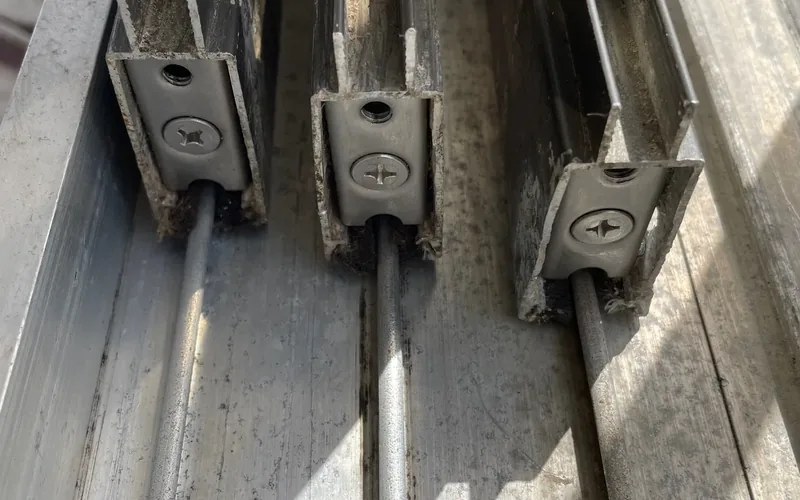
The rollers of a sliding door are designed to facilitate smooth movement along the track. With repeated use, these components can become worn or misaligned, resulting in jerky motion, noise, or even complete failure of the door to operate properly.
DIY Tips: Examine the rollers closely for signs of wear, such as cracks or flattened surfaces. If the rollers appear to be in poor condition, lubricate them to see if that improves the door’s performance. However, lubrication is only a temporary fix if the rollers are significantly degraded.
When to Call the Professionals: For lasting results, worn-out or misaligned rollers should be replaced. SliderPro offers high-quality replacement parts that are designed to match your door’s specifications. Contact our team at 772-722-4036 or through our contact page for a professional roller replacement service.
4. Bent or Damaged Tracks
A bent or otherwise damaged track can cause a sliding door to operate unevenly, leading to gaps or misalignment when closed. This issue might be the result of accidental impacts, natural settling of the structure, or simply the wear and tear of regular use.
DIY Tips: If you suspect a minor bend in the track, you might attempt a gentle adjustment using a flat tool. However, caution is advised because improper handling can worsen the damage.
When to Call the Professionals: For significant track damage, it is best to leave the repair to the professionals. At SliderPro, we have the necessary tools and expertise to realign or replace your door’s track without causing further damage. For expert assistance, visit https://www.sliderpro.com/ or dial 772-722-4036.
5. Broken Handles or Locks
The security and ease of use of a sliding door depend largely on its handles and locking mechanisms. Over time, frequent use can cause these components to wear out or break, compromising both the functionality and security of your door.
DIY Tips: Inspect the handles and locks regularly to ensure they are secure and operate smoothly. Sometimes, tightening screws or cleaning the locking mechanism can solve minor issues.
When to Call the Professionals: If a handle or lock is broken, replacement is necessary. Professional installation not only ensures that the replacement parts are fitted correctly but also that they match the overall design and security level of your door. For quality replacement services, contact SliderPro at 772-722-4036 or through our contact page.
The Importance of Regular Maintenance
Routine maintenance is key to extending the lifespan of your sliding doors. Simple, regular checks can prevent minor issues from developing into major problems. We recommend scheduling a professional maintenance service at least once a year. Our team at SliderPro can perform thorough inspections, clean and lubricate all moving parts, and provide necessary repairs to keep your door operating at its best.
Conclusion
Sliding door issues can often be resolved with a bit of effort and routine maintenance. However, when problems become persistent or more severe, professional help is invaluable. At SliderPro Doors and Window Service, we pride ourselves on offering comprehensive sliding door repair and maintenance services. Whether it’s cleaning a dirty track, replacing worn-out rollers, or fixing a misaligned door, our experts are here to help.
For more information about our services, visit our homepage at https://www.sliderpro.com/. If you have any questions or need to schedule a service, please don’t hesitate to call us at 772-722-4036 or visit our contact page.
Regular maintenance and timely repairs ensure that your sliding doors continue to enhance your home’s beauty and functionality for years to come. Trust SliderPro to keep your doors sliding smoothly!
6. Why does my sliding door keep coming off its track?
A panel that hops its track is telling you the rollers no longer hold it in stable alignment. Healthy rollers keep the panel seated with its own weight; worn or collapsed ones let it ride high enough at one point in its travel to climb off the rail.
The instinct is to lift it back on and carry on, and that instinct is what turns a modest repair into a larger one. Each derailment rolls the lip of the rail over a fraction, and a rolled lip makes the next derailment easier. Doors that have come off once come off again, with increasing enthusiasm.
There is a second cause worth ruling out. Some panels are held down by anti-lift blocks or stops at the head, and if those have been removed during a past repair or a screen swap and never refitted, nothing is stopping the panel lifting.
What it usually means: worn rollers, sometimes with rail damage already accumulated. Confirm the stage with the seven-sign roller guide, and stop re-railing it in the meantime.
7. The handle turns but the latch won't catch — what's wrong?
This is the most misdiagnosed fault on a sliding door, and it is the reason people buy two or three latches for a lock that was never broken.
A sliding door lock is a precision meeting: a hook on the moving panel has to arrive at a keeper bolted immovably to the frame, within a few millimeters. The latch throws to a fixed position on the panel. If the panel has dropped, the latch arrives below the keeper and misses, no matter how new the latch is. Households develop a technique for it — a lift, a wiggle, a firm push — and then one day the technique stops working.
The confirming test takes two minutes. Close the door, lift the handle edge of the panel gently, and try the lock. If it engages when lifted and misses when released, the panel has sagged and worn rollers sagged it.
What it usually means: roller wear, not lock failure. The full mechanics, including why relocating the keeper is the wrong fix, are in the alignment guide.
8. Why can I feel a draft or see daylight around the door?
Gaps around a closed slider come from two different places, and they need different fixes.
The first is the panel sitting out of position. A door riding on worn rollers hangs low and often slightly tilted, so it no longer presses evenly against its weatherstrip. The seal is present and intact; the door simply is not reaching it. That is why owners who replace weatherstrip on a sagging door are usually disappointed within the month.
The second is the weatherstrip itself. Fin seals and pile weatherstrip flatten, harden and pull out of their grooves, and Florida sun does it faster than most climates. Run a hand along the interlock stile and the jamb with the door shut: missing sections, compressed pile that no longer springs back, and brittle fins are all visible to the touch.
Neither is cosmetic. A permanent gap is a permanent air-conditioning load, and it is also how wind-driven rain and insects get in.
What it usually means: alignment first, seals second. Our energy guide covers the five-minute leak test.
9. Why is there water on the floor after heavy rain?
Water inside the house after a storm almost never means the glass failed. It means the track filled faster than it drained.
A sliding door sill is designed as a shallow gutter with small drainage slots — weep holes — in its outer face. Wind-driven rain does not fall into a track, it is pushed in horizontally, and the weeps are the only route back out. Packed with sand, lint and grass clippings, they stop working, the track fills, and the water goes over the inner lip onto your floor.
Two other contributors show up regularly. A pet-door insert sitting over the weeps blocks drainage exactly where it is needed. And a sagging panel that no longer seats properly lets water past the interlock that would otherwise have shed it.
What it usually means: blocked weep holes, sometimes with alignment behind it. Test by pouring a cup of water into the outer channel and watching it leave. Clearing them is step four of the track routine, and it is a homeowner job.
10. Why is there fog or condensation between the panes?
If the moisture is between the two panes of glass rather than on a surface you can wipe, the insulated glass unit has lost its seal. The spacer around the perimeter of a sealed unit holds a desiccant and keeps the cavity dry; when that seal fails, humid air enters, the desiccant saturates, and moisture condenses inside where nothing can reach it.
It is worth being clear about what this is and is not. It is not a repair. There is no spray, coating or vent that restores a failed seal, and the units advertising drilling and drying leave you with a unit that is no longer sealed at all. It is also not urgent in a safety sense — the glass is intact and the door still works.
What it costs you is visibility, appearance and some thermal performance. A failed unit is replaced as a glass unit, not as a whole door, and the frame and hardware around it carry on.
What it usually means: a failed insulated glass seal, most often on units well past a decade old. Our glass service page covers what we do with damaged and failed glass.
11. Why does the screen door fall off or refuse to roll?
Screen doors get treated as the trivial part of the assembly, which is why their two failure modes are so common.
The first is the channel. A screen runs in a shallow outer track that catches everything the wind carries, and its small wheels have almost no weight behind them to push through packed grit. A screen that will not roll is usually running in a dirty channel, not broken, and a vacuum with a crevice tool fixes a good share of them.
The second is the frame going out of square. Screen frames are light aluminum held square largely by the tension of the mesh itself. As mesh goes brittle under UV and the spline shrinks in its groove, that tension is lost, the frame racks into a parallelogram, and the top wheels no longer sit in their channel. That is when the screen falls out when someone pushes it.
What it usually means: a dirty channel, tired mesh, or both. Re-screening an existing frame is one of the cheapest repairs on a sliding door — see the screen repair page, or the mesh guide if you are choosing fabric.
12. What should I do about cracked, chipped or shattered glass?
Glass is the one item on this list where the first step is safety rather than diagnosis.
Tempered glass, which is what most sliding door panels use, does not crack and hold. It breaks all at once into a sheet of small fragments, sometimes hours or days after the impact that damaged it, because a chip at the edge relieves the tension the whole pane is under. That is why an edge chip on a slider is treated more seriously than a chip in the middle of a pane: the edge is where tempered glass is vulnerable, and a chipped edge is a pane waiting for a temperature change.
Laminated impact glass behaves differently. It cracks and stays in place because of the interlayer, so a damaged impact panel is not an immediate hazard in the same way, but its protective function is compromised and it should not be relied on through a storm season.
What it usually means: keep people and pets away from a chipped or cracked panel, do not tape it and carry on, and get it looked at. Our glass clean-up service covers clearing broken glass safely and telling you plainly what the panel needs next.
13. Why does the door lean or sit crooked in the frame?
A panel that is visibly out of square has one of two causes, and they need different work, so telling them apart is most of the job.
The panel dropped. The common case. Rollers rarely wear at the same rate, and when one collapses faster than the other the panel tilts. Look at the gap between the leading edge of the door and the jamb it meets, from top to bottom. On a square door that gap is parallel; if it tapers into a wedge, the panel has tilted and at least one roller has failed.
The opening moved. The less common case. Florida builds on sand, lanai slabs are often poured separately from the house slab, and over decades the two can shift relative to each other. Signs are different: a head gap that is not parallel, cracking in tile or stucco at one jamb, and binding against the head rather than the sill. If you can reach the corners, measure the two diagonals of the opening — on a square opening they match.
What it usually means: roller wear far more often than structure. Most settled openings can still be worked with, by rehanging and adjusting the panel to the opening as it is today.
14. What about corroded, seized or missing hardware?
This one is specific to where you live, and it is worth understanding the mechanism because it explains why coastal hardware fails so much earlier than the rest of the door.
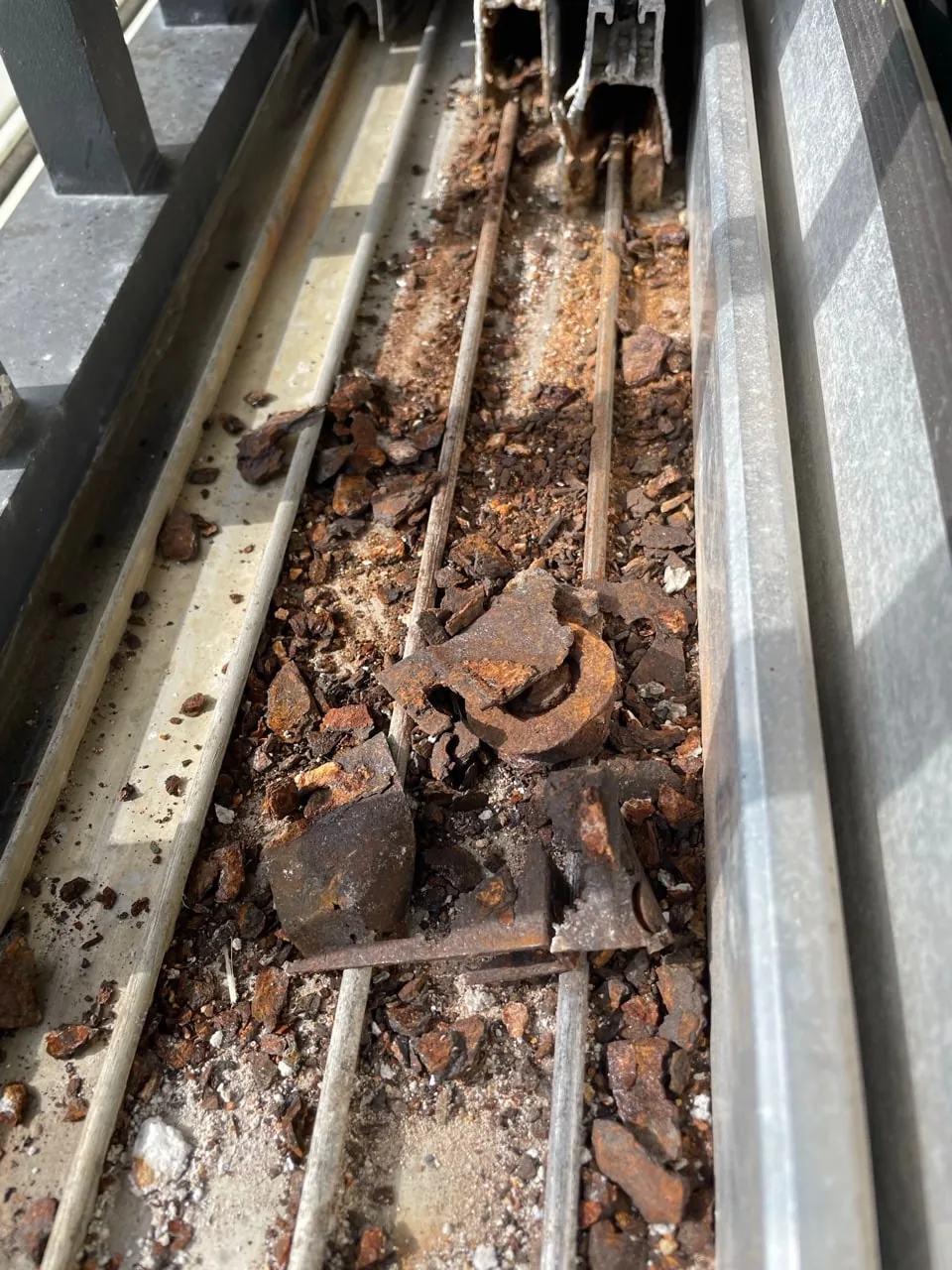
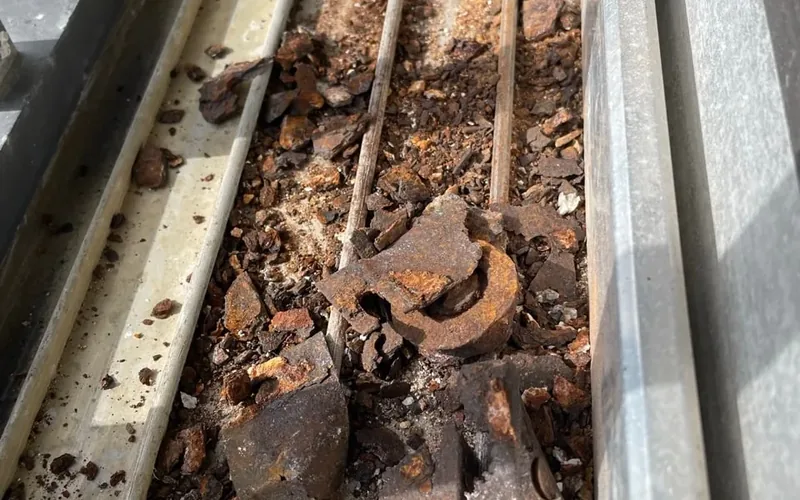
Salt is hygroscopic: it pulls moisture from humid air and holds it against metal as a thin brine film. That film is an electrolyte, and an electrolyte sitting between two different metals makes a battery. A sliding door is full of exactly that arrangement — steel latch components inside aluminum stiles, steel roller parts in aluminum housings, steel fasteners through aluminum extrusion. The aluminum corrodes preferentially and swells as it turns to oxide, which is what seizes a screw in its thread or locks a roller into a housing it once dropped into.
Practically, this shows up as adjustment screws that will not turn, handle screws that shear rather than back out, latch hooks that no longer retract smoothly, and foot bolts frozen into their keepers.
What it usually means: parts at end of life rather than damage. Do not force a seized fastener — a sheared screw head inside an aluminum stile is a much longer job than the repair it was protecting. Lock and latch hardware is covered on our lock repair page.
Which of these are safety issues rather than annoyances?
Most of this list can wait a few weeks without consequence. Four items on it cannot, and it is worth separating them clearly.
- A door that will not lock. This is the largest opening in your house standing effectively open, and it is the entry a burglar tests first because it is out of street view and usually held by a small spring hook. Households stop noticing surprisingly quickly. The security guide covers what actually works.
- Chipped or cracked tempered glass. An edge chip relieves the tension the whole pane is under, and tempered glass fails all at once rather than gradually. Keep people and pets clear until it is dealt with.
- A panel that has come off its track more than once. A large sheet of glass held in place by nothing but its own weight is a genuine hazard, particularly with children or pets in the house.
- Damaged impact glass before a storm season. A laminated panel that has been struck may still look serviceable while no longer performing as rated opening protection.
Everything else on this page — noise, drag, screens, drafts, fogged units, blocked weeps — is a repair that gets more expensive the longer it waits, not a hazard. Same-day service is available if you are in one of the four categories above.
Repair or replace: why most of this list is a repair
Almost every symptom above is a hardware problem sitting inside a perfectly sound door, and that is the single most useful thing to understand before you take a quote.
The economics are lopsided. Glass and frame are the expensive components and, in this climate, the durable ones. Rollers, track, latch, screen and weatherstrip are consumables that cost a fraction of the assembly they sit in and wear out on a predictable schedule. Replacing a whole door because its wheels wore flat is like replacing a car because it needs tires.
There are five cases where replacement genuinely wins, and we would rather name them than pretend otherwise:
- The frame has corroded far enough that fasteners no longer hold, or the extrusion flexes where it should be rigid.
- The sill or the structure behind it has rotted, so the frame is no longer anchored to anything sound.
- The opening has settled beyond what rehanging and adjustment can correct.
- You are adding impact protection you do not currently have, in which case glass, frame and hardware should change together.
- The system is genuinely orphaned, with proprietary parts and no aftermarket equivalent. This is far rarer than replacement salespeople suggest, and it is checkable.
We do not sell replacement doors, so the recommendation costs us nothing to make honestly.
Replacement claims worth questioning before you buy
If a company quoting you a new door says any of the following, it is fair to ask for the reasoning behind it.
- "Parts aren't available for this door." Ask which part, and what identifies it. Aftermarket roller and latch patterns cover the overwhelming majority of doors on this coast, including 1970s aluminum. Genuinely orphaned systems exist but are uncommon.
- "The track is worn, so the whole door has to go." A grooved rail is usually dressed or fitted with a cap track. It is a component, not the assembly.
- "A new door will fix your electric bill." Ask them to identify where the leak is first. A sagging panel that is not reaching its weatherstrip leaks the same whether the glass is single-pane or the newest available, and the alignment fix is a fraction of the cost.
- "It's out of square, so it's finished." Ask whether the panel dropped or the opening moved. Those are different problems and the first one is routine.
- "You need impact glass for insurance." That is a question for your county building department and your own policy, not for a salesperson at your door.
A straightforward test: ask what the repair would cost and why it will not hold. A company that cannot answer the second half has not diagnosed the door.
What do these problems cost you before you fix them?
Waiting is not free, and the costs are more concrete than most owners assume.
The repair grows. A seized roller is no longer a wheel; it is a skid dragging a couple of hundred pounds of glass across soft aluminum, machining a groove into the rail with every pass. Once that groove exists, new rollers dropped into it fail early unless the rail is dressed or capped. A roller job quietly becomes a roller and track job, and derailments roll the rail lip on top of that.
The house leaks. A panel that is not seating against its weatherstrip runs a continuous air-conditioning load, and the Treasure Coast cooling season is most of the year.
The door stops locking. Sag pulls the latch off its keeper, and the largest entry to the house stops securing. That is the point where an annoyance becomes a liability.
Water gets in. Blocked weeps and a badly seated panel are how storm water reaches flooring and baseboards.
Caught early, this is maintenance-priced work. Repairs start at $275 including parts, labor and a one to three year warranty, and 96% of jobs are finished in one visit. Our cost guide explains what moves the number.
What's specific to the Treasure Coast: salt, sand and build era
The same twelve symptoms occur everywhere. What changes here is how fast they arrive and which cause is behind them.
Distance from salt water sets the clock. Directly ocean-facing doors on Hutchinson Island and along A1A collect salt aerosol daily, and roller bearings there can seize in five to seven years without maintenance. Brackish lagoon and riverfront exposure along Indian River Drive and through Stuart is slower but still far harder than inland. West of US-1, in Palm City, White City, Lakewood Park and the western Port St. Lucie neighborhoods, salt becomes secondary and track grit takes over.
Build era predicts the fault. The 1970s and 1980s aluminum doors have overbuilt frames and hardware decades past its life, which makes them excellent repair candidates. The 1998 to 2006 boom build put better glass on rollers specified to a price across whole phases, so streets develop sticking doors together. Post-2005 impact panels are far heavier than the doors most roller patterns were designed around and drag sooner than owners expect.
If you want the version for your street, the city pages break it down, and the salt-air guide explains the chemistry in full.
Condo, rental and seasonal doors: who handles what?
Three situations change who is responsible for the symptoms above, regardless of what the door is doing.
Condo and association buildings. Florida declarations usually describe a balcony as a limited common element and split the door across the boundary. In the arrangement we see most often, operating hardware — rollers, latch, handle, screen — falls to the unit owner because it wears with your use, the frame is more often association property, and the glass depends on how the unit boundary is written. Most of this page's symptoms are therefore the owner's, and owners routinely wait months on a board for a repair that was never the board's. This is general information rather than legal advice. The condo guide covers the clauses.
Rentals. Guest use compresses the whole wear sequence, and a 90-second glide, latch and screen check at each turnover catches faults while they are still cheap. See the rental checklist.
Seasonal homes. Doors that sit unused corrode fastest, because motion is what wipes the salt film off the bearings. Service at close-up, check at arrival, and never force a panel that will not move.