
Keep your doors operating smoothly and looking great
Regular professional maintenance prevents issues before they start and extends the life of every sliding door in your home — thorough cleaning, lubrication, and track care from the Treasure Coast's door specialists.
What does a full sliding door tune-up cover?
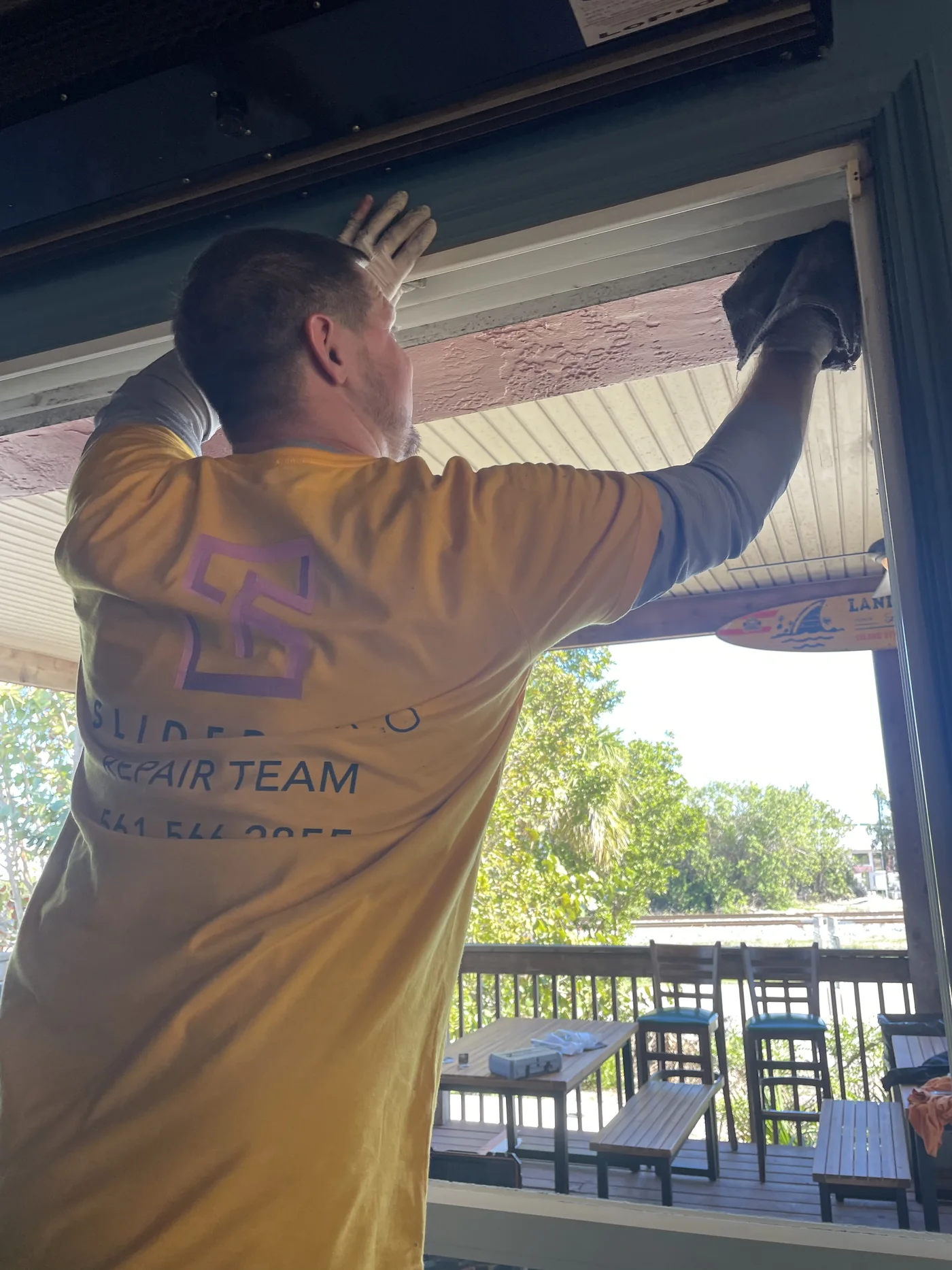
Thorough cleaning. When necessary we remove the door entirely to allow a genuine deep clean — all surfaces, frames, and tracks, including the debris that builds up where you can't see or reach it.
Lubrication. Rollers, hinges, and every moving component get properly lubricated with the right products — not household oils that attract grit — ensuring smooth operation and dramatically reducing wear.
Track maintenance. We clean and inspect the tracks that your door's life depends on, correct developing issues, and leave you with simple upkeep guidance for between visits.
What happens during a maintenance visit, step by step?
Initial assessment
We evaluate the condition of the whole door system — rollers, track, frame, screens, and locks.
Deep cleaning
Doors come off when needed for a proper clean of every surface, frame, and track.
Lubrication & adjustment
Targeted lubrication and fine adjustments bring back smooth, quiet, aligned operation.
Final inspection & advice
We test everything, flag anything developing, and share honest maintenance advice — no upselling.
Why does regular maintenance pay for itself?
- Prevent costly repairs — early detection turns big problems into small corrections.
- Better performance — clean, lubricated doors glide effortlessly and seal properly.
- Longer lifespan — protect the investment you've made in your doors and frames.
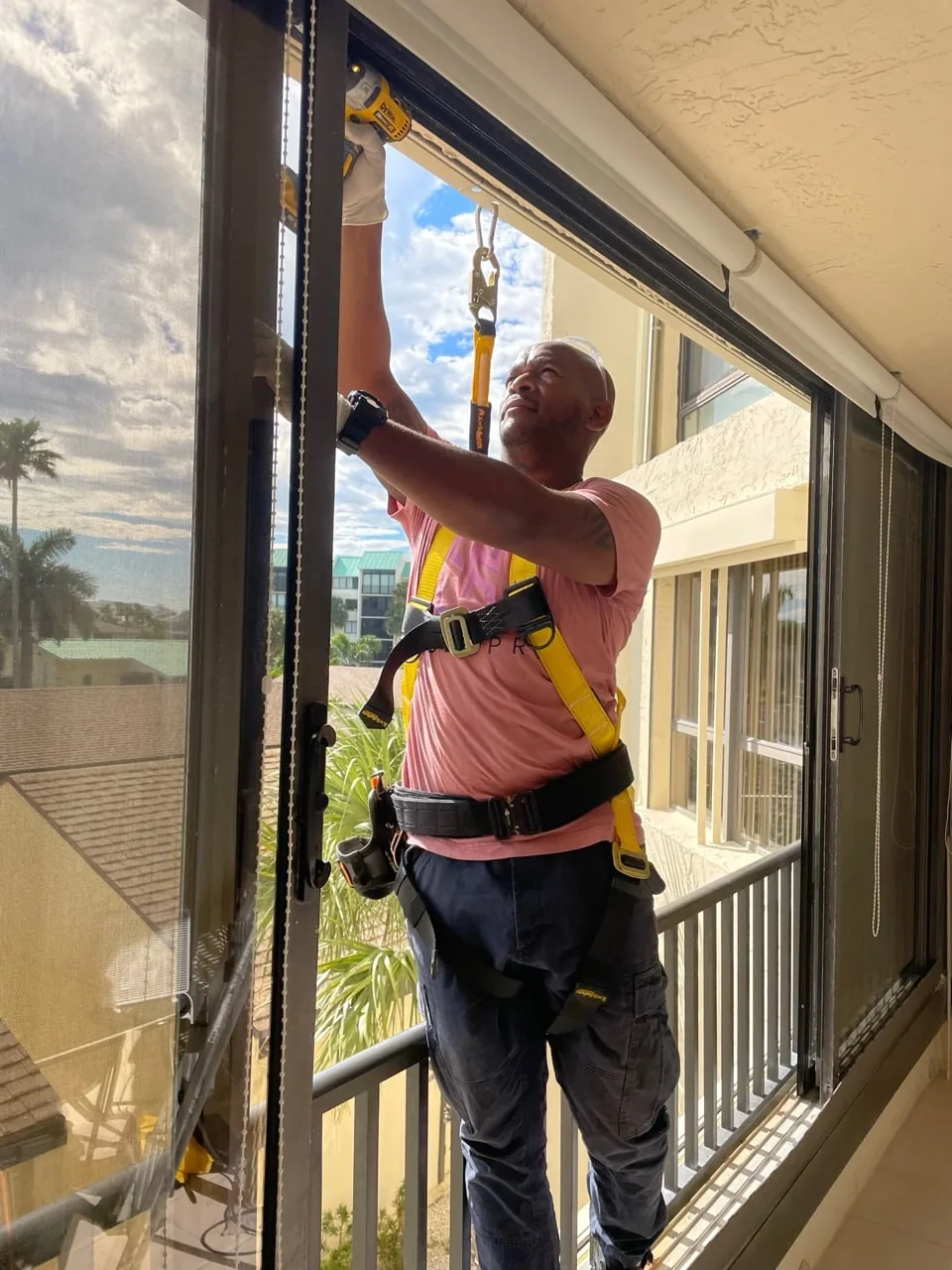
- Improved safety — regular inspections catch alignment and lock issues before they become risks.
Sliding door maintenance questions
How often should sliding doors be serviced in Florida?
For coastal homes we recommend a professional service about once a year — more often within a few blocks of the water, where salt exposure is heaviest. Between visits, keeping the track vacuumed and free of debris is the single best thing you can do, and we show you exactly how during the visit.
What does a maintenance visit include?
A full clean of surfaces, frames, and tracks — removing the door when necessary for a proper deep clean — followed by lubrication of rollers, hinges, and moving components, track inspection and upkeep, alignment checks, and a final inspection with honest advice on anything we spot developing.
Is maintenance really cheaper than just fixing things when they break?
Substantially. A seized roller that's been grinding for months usually takes the track with it, and a door that drops out of alignment stresses the lock and frame. Early detection during routine maintenance means small, inexpensive corrections instead of major repairs.
Do you offer recurring maintenance plans?
Yes — we offer customized maintenance plans for homes and rental properties, scheduled around your needs. One visit covers every slider in the house, and plan customers get priority scheduling when something does go wrong.
Why do salt and sand shorten the service interval here?
Every repair company on this coast will tell you salt air is hard on doors. Almost none will tell you what salt air actually does, so here it is.
Salt does not arrive as salt water. Breaking surf throws up droplets that evaporate in the air and leave behind micron-scale salt particles. Wind carries those inland, and they settle on any surface facing the weather, including the inside of your bottom track. This happens on clear days with no rain and no spray anywhere near your house.
Those particles then pull water out of the air. Sea salt is hygroscopic, so above roughly 75% relative humidity it deliquesces and turns into a droplet of concentrated brine. On the Treasure Coast, that is most nights. The practical result is that your hardware sits under a damp, chloride-rich film even when everything looks bone dry.
Chloride attacks metal where you cannot reach. Aluminum and stainless both rely on a thin passive oxide layer for protection, and chloride ions break that layer down locally, which starts pitting. Pits begin in the places that never get rinsed: inside the roller bearing race, under the housing, in the keeper pocket of the lock. Put a steel component in an aluminum track with a conductive salt film bridging them and you have also built a small galvanic cell, which is where the white powder and the chalky track surface come from.
Sand finishes the job. Quartz sand is harder than aluminum. Mixed into any oily film in the track it becomes a lapping compound, and every pass of a 200-pound panel grinds a little more sill away.
Maintenance works because it interrupts that chain in the two places you can reach: it removes the abrasive, and it strips the damp salt film off the metal before pitting takes hold. That is the whole argument, and it is why the service interval here is shorter than the one in a manufacturer's manual written for the rest of the country.
How often should your doors be serviced, by how close you are to salt water?
Salt aerosol falls off sharply with distance from the surf and rises with wind exposure, so two houses in the same city can be on completely different schedules. Treat this as a working rule, not a law of nature.
- Oceanfront and barrier island, or anything with a clear line to open water. Roughly twice a year. These doors take deposition continuously and the track never gets a genuinely dry week.
- Within about a mile of the ocean, or facing the Intracoastal or a wide canal. Once a year, which is where most of our maintenance customers sit.
- Inland, sheltered, and screened lanais. Every 18 to 24 months is usually enough, with a track vacuum in between.
Three things pull any of those intervals shorter. Heavy impact glass loads the rollers harder, so post-2005 doors wear faster than the single-pane doors they replaced. A pool deck feeds chlorinated splash and grit into the track daily. And a house that empties for the summer builds problems specifically because nothing moves for months, which is covered further down.
If you cannot remember the last service, the door will tell you. Run it slowly and listen. Silence means the rollers are healthy. A dry rasp is grit in the track. A rhythmic tick or grind is a bearing that has already started to flatten, and at that point you are booking a roller replacement rather than a tune-up.
What can a tune-up fix, and what can it not?
A maintenance visit is not a repair with a friendlier name, and pretending otherwise wastes your money. Here is the honest line between them.
A tune-up fixes wear that has not become damage yet. A door that is stiff, noisy or drifting out of square usually comes back to one-finger operation from a deep track clean, correct lubrication, a height adjustment on the rollers and a lock realignment. Screens that have loosened in the frame, weep holes that have silted up and gaskets that have flattened are all in scope too.
A tune-up will not resurrect a collapsed part. Once a bearing has pitted and flattened, no amount of cleaning or lubricant restores it, and spraying it simply buys a week or two of easier sliding while the wheel keeps cutting the sill. A gouged track needs dressing or a stainless cover, not a service. A mortise lock body that has corroded internally is a replacement.
And sometimes the door itself is the answer, not the service. On a 1970s or early 80s aluminum door with a worn-through sill, seized adjustment screws and obsolete lock hardware, maintenance is money spent propping up a unit that has reached the end of its parts supply. We will say so. We do not sell replacement doors, so that recommendation costs us the job rather than earning us one.
What you will always get is the distinction made out loud, before any work starts: this is service, this is repair, and this is the part where you should think about the door itself. If it turns into a repair, the services page covers what that involves.
Do you service seasonal homes and snowbird properties?
Yes, and seasonal houses need it more than year-round ones, for a reason most owners never see coming. The doors do not fail while you are here. They fail in July, in an empty house, and you meet the result in November.
A door that never moves for five months keeps its rollers resting on the same two contact points. The salt film stays damp right through a Florida summer, corrosion products build up in the bearing race, and the wheel effectively bonds to its axle at the one spot carrying the load. That bond leaves a flat, and the flat is permanent. Meanwhile the track fills with pollen, leaf litter and blown sand through storm season, the weep holes silt up, standing water keeps the sill wet, and the gasket takes a set against the jamb.
Then someone arrives, finds the door stuck, and shoves it. That single shove is what scores the sill and turns a roller job into a track job.
Two visits solve the whole pattern. A close-up service before you fly north leaves the tracks clean, the hardware free of salt film and the drainage clear, so the summer has less to work with. An open-up service in the first weeks after you return catches anything that set over the vacancy, before the door is forced. In between, ask whoever checks the house to slide every door a few times a month. It costs nothing and it is the single most effective thing anyone can do for an empty house.
Rental and second-home owners should also see the rental property checklist.
Who maintains a sliding door on a condo balcony?
Balcony sliders are the most neglected doors on the coast, and it is rarely because nobody cares. It is because nobody is certain whose door it is.
The answer lives in your declaration rather than in the type of door. Most Florida declarations set the unit boundary at the unfinished interior surface of the perimeter wall, which puts the opening itself on the building side of the line, and many classify a balcony slider as a limited common element: it serves your unit alone but belongs to the building. That classification does not decide who pays. The maintenance article does, and plenty of declarations assign glass, screens and hardware to the owner while keeping the frame and envelope with the association. Insurance responsibility is a separate question again, with its own answer.
Two practical notes. Anything that changes the door's appearance from outside, including a visible auxiliary lock, usually needs architectural approval before the work rather than after. And high floors need service sooner than ground floors on the same building, because the wind-driven aerosol washes the face of the tower and the upper balconies collect more of it.
Tell us at booking that it is an association building, and mention any rules on working hours, parking or elevator use so the visit is planned around them. The full walkthrough is in who is responsible for a condo sliding door.
When should you book maintenance around hurricane season?
Before it, not during it. The Atlantic season runs June through November, and the useful window for door work is the spring.
There are three reasons the timing matters. First, drainage. Your bottom track is designed to shed water through weep holes, and a track that is silted up in May will push wind-driven rain over the interior threshold in August. Clearing it is a five-minute job in the spring and a flooded floor later.
Second, the lock is structural during a storm. A slider resists pressure by staying seated in its frame, and the lock hook engaging its keeper is part of what holds the panel there. A door that has dropped on worn rollers and only latches when you lift it is not fully locked, which means the panel has more freedom to move than the design allows.
Third, a sagging panel is a slow panel. If you have to fight a door, you will not be closing and securing it quickly with a band approaching.
So book the tune-up in spring, keep the tracks clear through the wet season, and deal with any lock that misses before June rather than after. Our hurricane season prep guide covers the rest of the checklist, and lock and hardware work covers the part that needs a technician.
Which lubricant belongs on a sliding door, and why does WD-40 make it worse?
Wrong lubricant is the most common self-inflicted injury we see on Florida sliders, and it is worth understanding rather than just being told.
Use a dry-film PTFE or a silicone spray, applied to clean metal. Both leave a slick, non-tacky film that sand does not stick to. Clean the track first, because lubricating over grit just distributes the grit. Put the product on the rollers and the moving hardware, and use it sparingly on the track surface itself.
Do not use petroleum oils, grease or WD-40. WD-40 is a water-displacing solvent, not a lubricant. It thins and strips whatever film was there, evaporates, and leaves a light oily residue behind. The door feels better for a week, then feels worse than when you started, because that residue is tacky enough to capture blown sand. Sand plus oil in an aluminum track is a lapping compound, and the panel does the lapping. Heavy grease is the same mistake at higher viscosity, and over time solvents and oils can soften nylon roller wheels and the spline holding your screen mesh.
And lubricant is not a diagnosis. If a door needs spraying every few weeks to stay usable, the bearings are already going and you are lubricating your way toward a track repair. The track cleaning guide covers the correct sequence, and the roller warning signs covers the point where cleaning stops being the answer.
What do the weep holes in your track do?
Look at the outside face of your bottom track and you will find small slots or covered openings. Those are weep holes, and they are the reason a sliding door can sit in horizontal rain without water crossing the threshold.
The sill is designed to collect water and drain it back outside through those openings. Block them with sand, pollen, spider webs, mulch or a well-meaning bead of caulk and the sill turns into a trough. Three things follow. Water crosses into the room during wind-driven rain. The salt film on your hardware stays permanently wet instead of drying between showers, so corrosion runs continuously rather than intermittently. And standing water at the threshold works on the interior flooring and the frame over time.
The test takes a minute. Pour a cup of water into the bottom track and watch the outside face. It should appear outside within a minute or so. If it pools instead, the drainage is blocked.
Clearing them safely. A plastic zip tie or a soft brush and a rinse is the right tool. Do not drill them out or open them up with anything metal. The size and geometry are part of how the sill sheds water, and widening them lets water in as readily as it lets water out. Some doors have small flapper covers that stick shut with salt deposits and simply need freeing.
What can you do yourself between visits, and what should you leave alone?
Most of the value in maintenance is in habits, not in the visit. These are worth doing.
- Vacuum the track. A crevice tool, both tracks, roughly monthly and more often if you are on sand. This is the single highest-return two minutes in the whole list.
- Wipe the track down afterward. A damp cloth lifts the salt film that the vacuum leaves behind. Dry it rather than leaving it wet.
- Rinse the exterior frame with fresh water. On coastal and island homes, monthly. You are washing chloride off metal before it starts pitting.
- Check the weep holes. The cup-of-water test above, at the start of the wet season and again after any big storm.
- Listen to the door. A new tick, rasp or grind is information. Call while it is still cheap to act on.
These are worth leaving alone.
- The roller adjustment screws. They set panel height, not ease of sliding. Winding them because a door feels heavy cants the panel, dumps the load onto one wheel and speeds up the failure you were trying to fix.
- Lifting a panel out. An impact panel can run to a couple of hundred pounds, and out of the frame it is an unsupported sheet of glass. This is a two-person job with the right technique.
- Forcing a seized door. One hard shove is what turns a roller replacement into a track repair.
- Grease, oil and caulk in the track. Covered above. All three make things worse.
Where the line sits for your own door is laid out in DIY versus professional repairs.
Where does SliderPro service sliding doors on the Treasure Coast?
Maintenance visits run across all fourteen cities we cover — the Treasure Coast run below, plus Palm Bay, Merritt Island, Cocoa Beach and Orlando on the northern route — from Vero Beach in Indian River County through Fort Pierce and Port St. Lucie, across Martin County in Stuart, Jensen Beach, Palm City, Port Salerno and Hobe Sound, and down into northern Palm Beach County in Jupiter and Palm Beach Gardens.
Your address matters more than your city here. An oceanfront condo, a canal-front house on the Intracoastal and a home several miles inland sit in genuinely different exposure zones, and that changes the service interval as much as the age of the door does. Each city page covers the local housing stock and exposure, and the service areas page lists the full map.
One visit. Every slider in the house.
Book a maintenance visit or ask about a recurring plan — and stop thinking about your doors entirely.