Sliding doors are a popular feature in modern homes, offering an attractive blend of style and practicality. Over time, however, these doors may experience issues like sticking, misaligned rollers, or worn-out tracks. When problems arise, homeowners often face a crucial question: should they attempt to fix the door themselves, or is it better to rely on professional repair services? In this blog post, we’ll explore the pros and cons of DIY repairs versus professional repairs and help you decide which option best suits your needs.
The Appeal of DIY Repairs
Many homeowners are naturally inclined to handle repairs on their own. DIY repairs can be appealing for several reasons:
Cost Savings
One of the main attractions of DIY repairs is the potential for cost savings. By purchasing the necessary tools and replacement parts, you might avoid labor costs. For those on a tight budget, this can be an attractive option if the repair is relatively straightforward.
Sense of Accomplishment
There’s a genuine sense of satisfaction in diagnosing and fixing a problem yourself. For homeowners who enjoy hands-on projects, tackling sliding door repairs can be both a learning experience and a source of pride.
Immediate Action
Sometimes, a quick fix can prevent further damage. If you notice minor issues—like a slight misalignment or minor track debris—addressing them immediately can stop the problem from worsening. A simple DIY repair might be just what you need to keep your door functioning until you’re ready to invest in professional services.
Tools and Resources
Today’s online resources, including video tutorials and how-to guides, make it easier than ever to learn the basics of sliding door repairs. With the right information, you might feel confident enough to take on the task.
The Limitations of DIY Repairs
While DIY repairs have their benefits, there are also some limitations and risks to consider:
Lack of Expertise
Even with detailed instructions, there’s a steep learning curve when it comes to more complex sliding door issues. Without professional training, you might misdiagnose the problem or inadvertently cause further damage. For example, attempting to realign a bent track without the proper tools and experience could worsen the issue.
Safety Concerns
Sliding door repairs sometimes involve heavy or delicate components. If you’re not careful, you could risk injury to yourself or others. Professional technicians have the training and equipment necessary to perform these repairs safely, reducing the risk of accidents.
Incomplete Repairs
A DIY fix might offer a temporary solution, but it could lead to recurring issues if the underlying problem isn’t fully addressed. In some cases, a professional repair not only fixes the immediate issue but also helps prevent future problems through a thorough inspection and proper maintenance.
Time and Effort
DIY repairs can be time-consuming, especially if you’re not experienced. The time spent researching, purchasing the correct parts, and learning the repair process might outweigh the benefits of doing it yourself. In contrast, professional services can often complete the repair quickly and efficiently, allowing you to focus on other priorities.
The Advantages of Professional Repairs
When it comes to ensuring that your sliding door operates smoothly and safely, professional repair services offer several distinct advantages:
Expertise and Experience
Professional technicians at SliderPro Doors and Window Service have years of experience in diagnosing and repairing sliding door issues. Their expertise allows them to quickly identify the root cause of a problem and implement a long-lasting solution. With specialized training, they can handle a range of issues—from worn-out rollers to damaged tracks—with precision.
Comprehensive Service
A professional repair service doesn’t just fix the visible problem; it includes a thorough inspection of your sliding door system. This comprehensive approach means that technicians can spot and address potential issues before they become major problems. Whether it’s cleaning the tracks, lubricating the rollers, or replacing damaged parts, professional maintenance ensures that every aspect of your door is in optimal condition.
Quality Parts and Tools
Professionals use high-quality replacement parts that are specifically designed to match your sliding door’s specifications. This commitment to quality ensures that repairs are durable and reliable. Additionally, professional technicians have access to specialized tools that may be required for complex repairs—tools that most homeowners do not possess.
Safety and Peace of Mind
Hiring professionals not only guarantees a quality repair but also offers peace of mind. You won’t have to worry about the risks associated with DIY repairs, such as injury or inadvertently damaging the door further. Instead, you can trust that the repair will be completed safely and effectively.
Time Efficiency
Time is often a critical factor when dealing with home repairs. Professional services can complete repairs quickly, reducing the inconvenience of a malfunctioning sliding door. For busy homeowners, this time efficiency is a significant advantage.
When to Choose DIY Repairs
DIY repairs may be suitable for minor issues such as:
- Cleaning debris from the door track.
- Applying lubricant to smooth the door’s movement.
- Tightening loose screws on handles or minor components.
If the problem seems minor and you have some experience with home repairs, you might successfully tackle the issue on your own. However, if the repair involves significant misalignment, damaged parts, or if you’re unsure about the process, it is advisable to consult professionals.
When to Call in the Experts
For complex issues or if you’re uncertain about your ability to perform the repair safely, it’s best to rely on professional help. SliderPro Doors and Window Service is ready to assist with any sliding door repairs. For a hassle-free, reliable repair service, visit https://www.sliderpro.com/ or call us directly at 772-722-4036. You can also reach out through our contact page to schedule an appointment.
Conclusion
Deciding between DIY and professional repairs for your sliding door depends on the complexity of the issue, your level of expertise, and your comfort with home repair projects. While minor repairs might be successfully managed on your own, more complex problems warrant professional attention. By understanding the pros and cons of each approach, you can make an informed decision that ensures your sliding door remains functional, safe, and aesthetically pleasing.
Remember, investing in professional repair services not only saves you time and effort but also ensures that the repair is done right the first time. Trust the experts at SliderPro Doors and Window Service to deliver the quality and reliability your home deserves. Whether you decide to try a DIY approach or call in the professionals, taking action promptly can prevent further damage and extend the life of your sliding door.
What can you diagnose in two minutes, before you buy a single part?
Most wasted DIY money is spent on the wrong part, bought before anyone worked out what was actually wrong. Three checks separate the common faults, and none of them needs a tool.
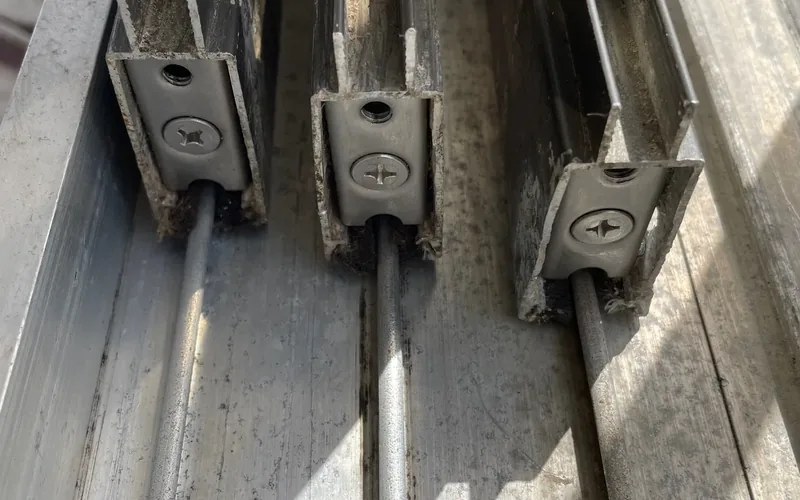
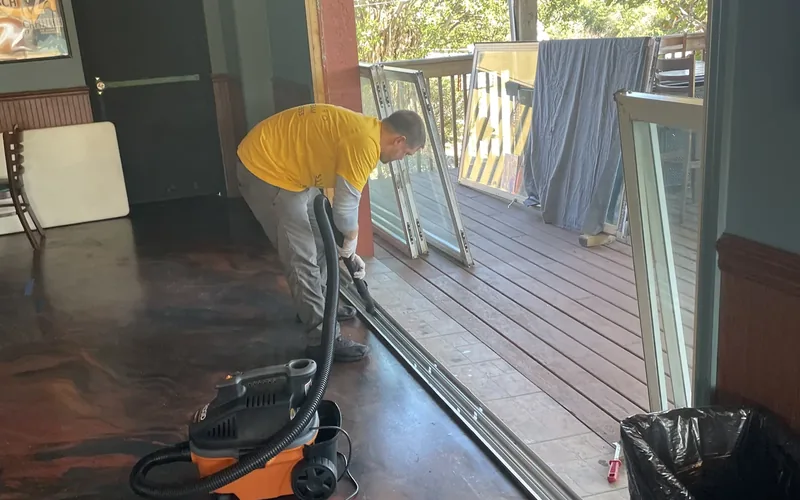
- Clean a short stretch of track, then slide the door. Vacuum and wipe about a foot of the lower track and run the door over it. If it noticeably improves across that section, grit is a live factor and a proper clean is your first job. If it feels identical, the problem is under the panel, not on top of the track.
- Lift the panel gently at its handle edge while pushing it. If it suddenly moves more easily when unweighted, the rollers are carrying load they can no longer carry. That is hardware, and no spray fixes it.
- Close the door and look at the gap along the latch stile, top to bottom. A gap that is wider at the top than the bottom means the panel has dropped out of square. That is why the latch misses its keeper, and it is why replacing the lock changes nothing.
Two minutes of that tells you whether you are looking at a cleaning job, a hardware job, or an alignment job. Everything below assumes you have done it, because the honest answer to "should I do this myself" depends entirely on which of the three you have.
Why is the panel heavier and more awkward than it looks?
Almost every DIY roller job fails at the same moment: getting the panel out. A standard single-pane slider panel is commonly in the region of a hundred pounds. A laminated impact panel of the same size can be more than double that, because laminated glass is two panes bonded around an interlayer. It is not the weight alone that catches people out, it is the shape. The load is spread across a tall, thin, rigid sheet of glass with almost nothing to grip, and it wants to twist as soon as one corner leaves the track.
A twisting panel is how glass gets broken and how frames get racked. It is also how backs get hurt, because the natural instinct when a panel starts to go is to catch it, and you cannot catch a hundred pounds of glass at arm's length.
Beyond the lift, there is the head channel. The panel has to be raised into the upper track before its bottom edge clears the lower one, and on some doors an anti-lift block or a security screw has to come out first. Miss that and you will be levering at a panel that was never going to move, which is where bent tracks come from.
This is the honest reason panel removal sits on the professional side of the line, and it is a two-person job even for us.
Where does DIY quietly cost more than the repair would have?
The expensive DIY outcomes are rarely dramatic. They are slow, and they show up on the invoice later.
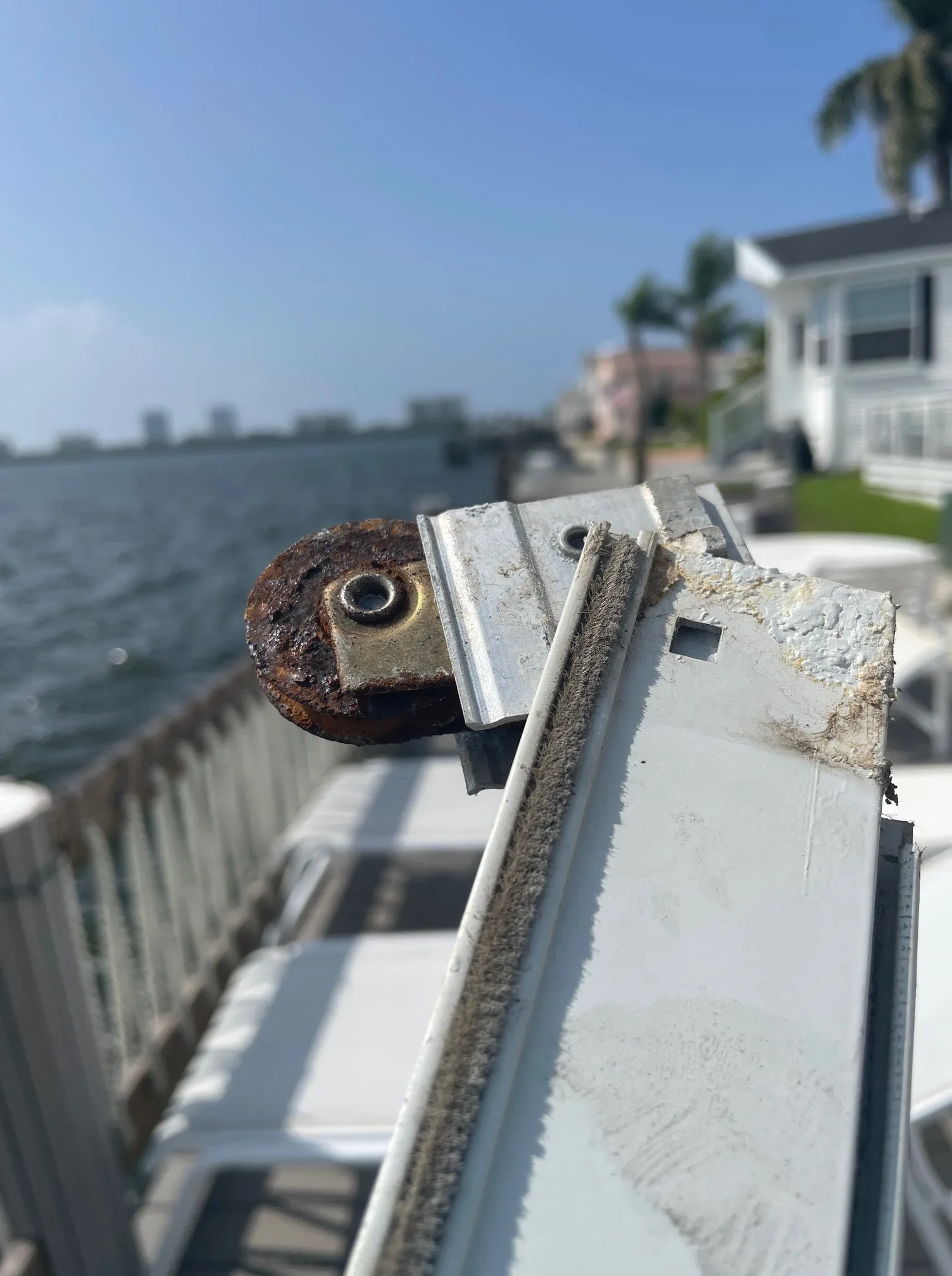
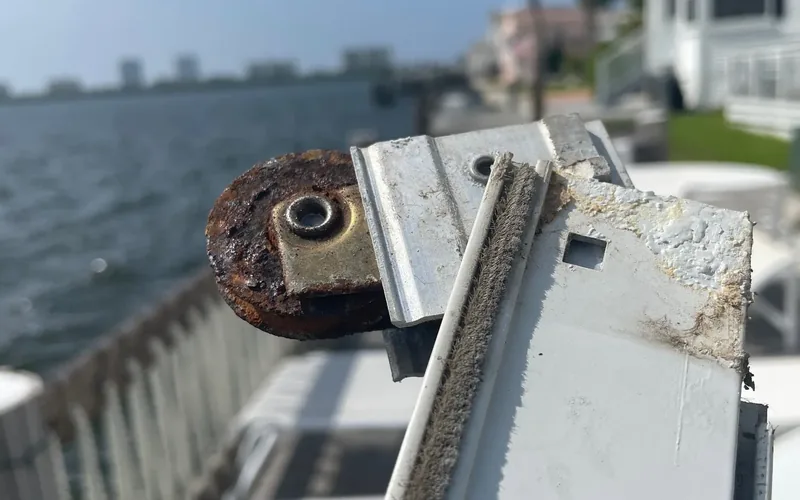
- Riding a failed roller while you research. A seized wheel is a steel skid under the panel, and it grooves soft aluminum in weeks. The gap between "rollers" and "rollers plus a cap track" is the largest avoidable number in this trade, and waiting is what creates it.
- Oil-based lubricant on a sandy track. The door feels better for about a week. Then the oil has bound the grit into an abrasive paste and packed it into the roller housings, and you have accelerated exactly what you were trying to stop.
- Winding the adjustment screws to make a lock reach. It works, briefly. It also tilts the panel so the rollers carry load unevenly, which wears the new ones faster than the old ones went.
- The parts drawer. Two or three online roller sets that did not fit, plus a lock that was never the fault, adds up quietly to real money with a door that still drags.
None of this is an argument against doing your own maintenance. Track cleaning, re-screening and sensible lubrication are genuinely worth your time. It is an argument against forcing a diagnosis you have not made yet.
What goes wrong on a Florida door that does not go wrong anywhere else?
Two Florida-specific traps end more DIY attempts than anything else, and both have a mechanism worth understanding before you start.
Seized fasteners. A steel screw in an aluminum frame is a galvanic couple: two metals at different electrical potentials. Add the salt film that coastal air deposits and holds against metal, and you have an electrolyte between them. The screw corrodes into its own hole until the corrosion product is effectively welding it in place. What happens next in a DIY attempt is predictable: the driver cams out, the head rounds off, and now the screw cannot be turned or gripped. Removing it without wrecking the frame means drilling on an axis you cannot see, next to glass.
Sand-packed housings. Florida yards are sand with grass on top, and quartz grit is harder than both the steel wheel and the aluminum track. It works into the roller housing and sets there, especially if oil has been sprayed on it. A housing packed solid will not release its wheel, and forcing it usually destroys the housing, which on an older door is the part that cannot be bought.
Neither trap is visible from standing height. Both are why a job that reads as a twenty-minute swap in an online video becomes an afternoon and a broken frame on a door within a few miles of the water.
Older Treasure Coast doors: why matching a part matters more than fitting one
On a door built in the 1970s or early 80s, the hardest part of a roller replacement is not the wrench work. It is finding out what you have. Roller housings from that era vary by manufacturer, and frequently by production year within the same manufacturer, and most of those companies no longer exist. There is no model number stamped anywhere useful, and photographs of the wheel tell you very little, because the wheel is the part that is standard and the housing is the part that is not.
A part that physically drops into the pocket is not necessarily the right part. Wheel diameter changes where the panel sits, which changes whether the latch reaches its keeper. Housing depth changes how much adjustment range you have left. Fit the wrong one and the door slides, the lock misses, and no amount of screw-turning brings both back at once.
This is also why homeowners in the older neighborhoods of Fort Pierce and Stuart so often end up with a drawer of near-misses. On these doors the practical answer is frequently a modern sealed assembly adapted to the original housing, which is a judgment made with the panel out and the pocket in front of you, not from a product listing.
Rental, condo and HOA doors: when is DIY not actually your call?
Sometimes the question is not whether you can do the repair but whether you are permitted to.
In a condo, the door is often split between owner and association. A very common pattern in Florida declarations puts the building envelope, including the outer frame and frequently the glass, on the association, while operating hardware serving your unit alone stays with you. Doing your own work on the association's side of that line can complicate a claim later, and doing it on anything leak-related erases the evidence of where the water came from. The responsibility split is worth reading before you buy anything.
In a rental, a door that does not lock is a habitability and security matter, and a self-performed repair that fails is your liability rather than a contractor's. Landlords generally want the paperwork trail more than they want the savings. The landlord checklist covers what to inspect between tenancies.
In an HOA community, changes visible from outside, including screen frame color and any hardware that alters the door's appearance, may need approval before rather than after. Repairs that restore the original condition rarely do. It is a short email either way, and considerably shorter than an architectural review after the fact.
Snowbird homes: what should you check on arrival before you touch anything?
A door left standing still for six months is in worse condition than the same door used daily, and the reason is not neglect. Motion continuously wipes the salt film off the bearing surfaces. A locked, unmoved panel lets that film sit against steel through the whole wet season, and corrosion inside a bearing does not need anyone to be home.
So the first rule on arrival is the one people break within a minute of walking in: do not force the door. A seized roller that is merely stiff can usually be saved. The same roller after three hard shoves has scored the track, and you have converted a hardware job into a hardware-and-track job in the time it took to open a patio.
Run this sequence instead. Vacuum the visible track before the door moves at all, so you are not grinding six months of grit under the wheels. Test each door with light pressure only, and note which ones resist. Check the latch on every slider, because a panel that has dropped will not lock and that is a security matter on an empty house. Look for standing water or a chalky white line in the track, which points at blocked weep holes.
Anything that will not move under light pressure is a call, not a project. Same-day appointments are available, and arrival week is the cheapest week to make it.
Can you safely do this one yourself? Five questions that settle it
Rather than sorting repairs into lists, run the job you are facing through these five.
- Does it require the panel to come out of the frame? If yes, stop. That is the line, and it is about weight and glass rather than skill.
- Do you know which part you need, specifically? Not "rollers" but which housing, which wheel diameter. If you are guessing from a photograph, you are buying a diagnosis, not a repair.
- Will a fastener have to come out? On a coastal door, assume the screw is corroded into its hole and ask yourself what your plan is when the head rounds off. If the honest answer is "drill it," that is next to glass.
- Is anything above your head or overhead? Head channels, upper tracks and anti-lift hardware are where ladders, gravity and glass meet. Not a solo job.
- What does failure cost? A failed track clean costs an afternoon. A failed panel removal can cost the panel, the frame and a trip to a doctor. Weigh the downside, not the upside.
Two or more uncomfortable answers means the job is not a DIY job on your door, whatever it is on somebody else's. There is no shame in that. Half of what we do is work that would have been simple three weeks earlier.