
Sliding Glass Door Roller Replacement
The number one reason sliding doors stop sliding. We replace worn, corroded rollers with heavy-duty stainless hardware and get your door gliding with one finger — usually in a single visit.
What do sliding door rollers actually do, and why do they fail?
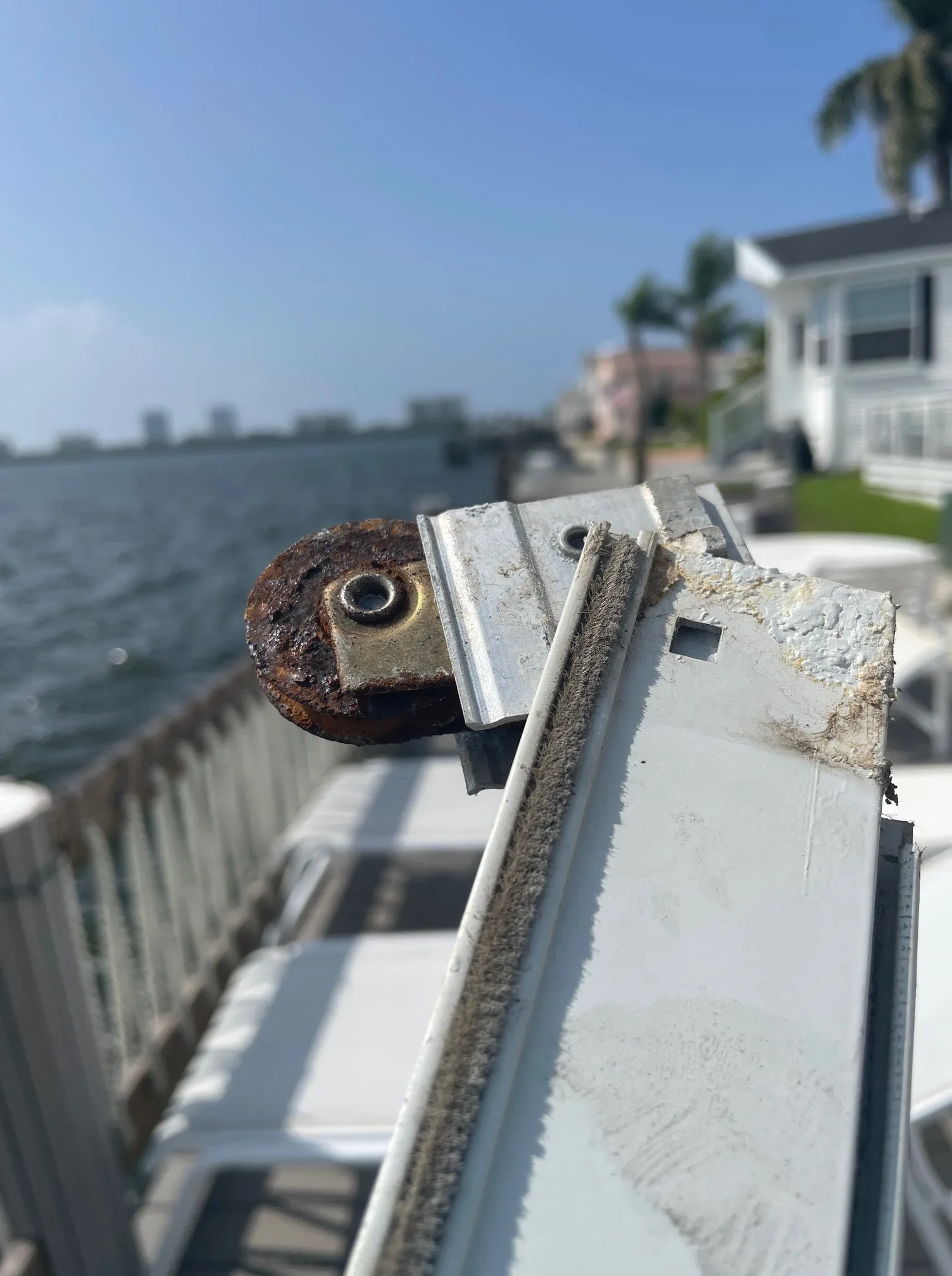
Every sliding glass door rides on a pair of rollers not much bigger than a coin. In Florida's coastal climate, those rollers live in the worst environment in your house: a track that collects salt air, sand, pet hair, and rainwater. Over time the bearings corrode and flatten — and the full weight of the glass starts dragging on metal.
That's when you feel it: sticking and jerky movement that makes the door a two-hand job, misalignment that opens gaps around the frame and hurts your energy bill, and a latch that no longer lines up — which means the door doesn't truly lock. Left alone, a failed roller gouges the track itself, turning an affordable repair into a bigger one.
Our technicians replace worn rollers with precision — restoring smooth function and the security of a properly seated, properly locking door.
How is a sliding glass door roller replaced, step by step?
Thorough inspection
We check the door's overall condition — rollers, track, frame, and lock alignment — so nothing gets missed.
Precise diagnosis
We identify the exact wear pattern and match the optimal replacement rollers for your door's brand and weight.
Expert replacement
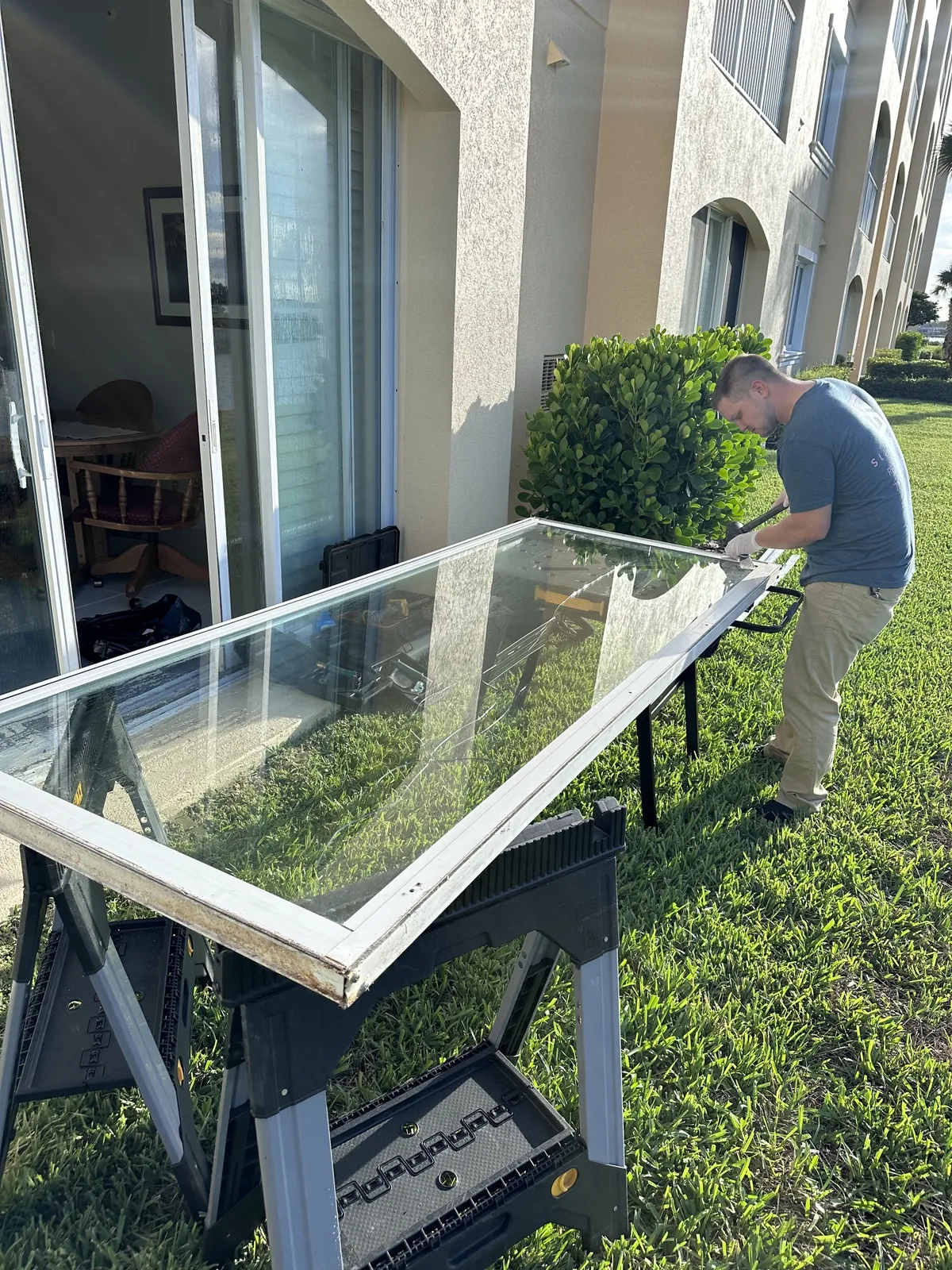
The panel comes out, high-quality stainless rollers go in, and the track gets cleaned and dressed while we're there.
Final glide test
We re-hang, align, and adjust the door, then have you slide it yourself — effortless, quiet, and locking true.
What difference do new rollers actually make?
- Smooth, quiet operation — one-finger gliding instead of shoulder-checking your own patio door.
- Real security — a properly aligned door seats and locks the way it was designed to.
- Lower cooling bills — no more gaps leaking conditioned air out of the frame.
- Long-term savings — replacing rollers early protects the track and avoids far costlier repairs.
Roller replacement questions we get asked every week
How do I know my rollers are worn out?
The classic signs are a door that needs two hands or a shoulder to move, grinding or scraping noises, a door that bounces or jumps as it travels, and visible aluminum shavings in the track. If the door has dropped and now scrapes the track, the roller wheels have usually collapsed entirely.
Can't I just lubricate the track instead?
Lubricant helps a healthy door, but it can't fix a collapsed bearing. Spraying a worn roller usually buys a week or two of easier sliding while the wheel keeps chewing into the track — which turns a simple roller job into a track repair as well. If the door is already heavy, it's parts, not lube.
How long does roller replacement take?
Most single doors are done in about an hour on site. We lift the panel out, replace the rollers, clean and inspect the track, re-hang the door, and adjust it so it glides and locks correctly. Multi-panel and heavy hurricane-glass doors take a little longer.
Do you carry rollers for older doors?
Yes. Treasure Coast homes have decades of different door brands, and we stock the common roller patterns on the truck — including heavy-duty stainless steel replacements that outlast the originals in our salt-air climate.
Which rollers does your door actually take? A five-minute identification guide
There is no universal sliding door roller. Two doors that look identical from across the room can take housings that share nothing, and ordering the wrong pair is the most common reason a weekend repair stalls with the panel leaning against a wall. Five minutes with a phone camera settles it.
- Count the wheels in one housing. Two wheels carried in a single steel or plastic body is a tandem assembly. One wheel on its own is a single.
- Measure the wheel, not the housing. Wheel diameter is what the rail was shaped for. One inch, one and a quarter, and one and a half all turn up on Treasure Coast doors, and they are not interchangeable even when the housing looks the same.
- Find the adjustment screw. Most panels have a small plug or hole in the bottom of the stile, an inch or two in from each end. Behind it is the height screw that bears on the roller body. No plug usually means an older assembly that adjusts from the face of the stile instead.
- Photograph both ends of both panels. The moving panel and the fixed panel in one opening frequently carry different hardware, especially in houses that have already had one repair.
If you would rather not guess, send us the photos and tell us the town. Between build era and wheel size we can usually name the assembly before we arrive, which is a large part of why most jobs finish in one visit.
Tandem or single rollers: how do you tell which is in your rail?
A tandem assembly spreads the panel's weight across two wheels in one housing, so each wheel carries roughly half the load and the panel stays level as it crosses a slightly worn spot in the rail. A single roller puts the whole corner load on one bearing. Heavier panels almost always run tandems; lighter and older residential doors often do not.
You read it through the access hole in the bottom of the stile, or by tipping the panel out. Look at the shape of the body sitting on the rail: a tandem is a long body with two wheels visible at its ends and the height screw between them. A single is a short body with the wheel centered under it.
One trap catches homeowners and handymen alike. People pull one roller, order a matching pair, and only then discover the second panel takes a different housing, or that a previous repair fitted a single into a rail that was cut for a tandem. That mismatch is why one panel glides and the other still drags after a DIY job. Both ends of both panels get checked before we order anything.
Steel, nylon or stainless: what belongs in a door this close to the ocean?
Every page in this trade tells you salt air is hard on doors. Almost none of them says what salt air actually does, so here is the mechanism.
Airborne salt aerosol settles into the track and works its way into the roller housing. Salt is hygroscopic, meaning it pulls water vapor out of the air and holds it as a permanent film against metal. That film is an electrolyte, and it puts two dissimilar metals in electrical contact: the plated steel of the wheel and axle, and the aluminum of the housing and rail. Aluminum is the less noble of the two, so it gives up material preferentially. That is why coastal tracks pit and bloom white powder around the roller path while the wheel itself still looks serviceable. Once the plating on the steel is breached, the bearing race rusts from the inside, where no spray can reach it.
- Plated steel is the builder default and the shortest-lived hardware near salt water.
- Nylon will not corrode, but it flat-spots under sustained load and goes brittle with years of heat and UV. A nylon tire over a steel bearing is still a steel bearing.
- Stainless with a sealed bearing keeps the salt film out of the race and resists what gets past. On a door you can smell the water from, it is the only specification worth fitting.
The full chemistry, including why summer is worse than winter, is in our salt air explainer.
Heavy glass and impact doors: why does weight change the roller you need?
A single-pane 1980s slider panel and a modern laminated impact panel of the same size are not remotely the same object. The impact panel carries two plies of glass bonded around an interlayer in a heavier frame, and the difference in mass is measured in tens of pounds per panel, not a few.
That mass lands on the same two contact points. Bearing load is what drives fatigue, so a roller sized for a light panel and asked to carry a heavy one does not fail differently, it fails sooner: the race wears, the wheel develops flat spots, and the panel drops out of level while the door is still relatively young.
This matters here more than in most of the country. Much of eastern St. Lucie and Martin County sits inside the Wind-Borne Debris Region under the Florida Building Code, so rated opening protection is common and impact glass is everywhere in post-2005 construction. Production builders regularly specified the same roller across a range of panel weights because it was one part number instead of three.
When we fit rollers to a heavy or impact panel, they are rated for the weight actually hanging in the opening. It is also why we bring a second pair of hands to a large panel rather than levering it out alone.
Rollers, track, or both? What a proper diagnosis looks like before anyone quotes you
New rollers running in a machined-out rail will feel better for a season and then repeat the failure. Anyone quoting a roller job without looking at the track is guessing, so here is what we check and what each answer means.
- Lift the panel. With the door closed, take the handle and lift. Half an inch or more of free movement means the wheels are no longer holding the panel at its designed height.
- Run a fingertip along the rail. A smooth crown means the track is intact. A groove, a lip, or a ridge you can feel means a seized wheel has been skidding and cutting.
- Look for gray-black dust. That dust is your rail, being machined away. It only appears once the rollers have stopped rolling.
- Check the reveal. Sight the gap between the panel and the jamb, top to bottom. A gap that tapers means the panel has dropped, or the opening has settled and the panel is square to nothing.
A clean rail plus dead rollers is a straightforward hardware job. A grooved rail needs the rail addressed as well, and we say so before quoting rather than after. A settled opening is a third problem again, and no roller will fix it. The seven-stage version of this, with the sound each stage makes, is in our guide to the signs rollers are going.
Which doors do we see most across Port St. Lucie, Stuart and Fort Pierce?
Build era tells us more before we arrive than the brand on the handle does. Three cohorts cover most of what we open on the Treasure Coast.
1970s and 1980s aluminum. The older grids in Fort Pierce, eastern Port St. Lucie, and around Stuart are full of thin-frame aluminum sliders with light single glazing. The frames were overbuilt, the glass is usually still fine, and the original plated-steel rollers are decades past their service life. These are the best repair candidates on our route: stainless hardware and a track service typically buys another decade for a fraction of what a new opening costs.
1998 to 2006 boom build. Whole phases went up on the same hardware specification, so the rollers reach end of life on the same schedule across a street. If three neighbors are complaining about sticking doors in the same season, that is not coincidence, it is a hardware cohort aging out together.
Post-2005 impact. Better glass, heavier panels, and hardware chosen to a price underneath it. These doors often need rollers earlier than their owners expect, because the weight was never matched by the assembly carrying it.
Which cohort your street belongs to is worth knowing. Our city pages go through the build history town by town.
When can you replace rollers yourself, and the three times you shouldn't
We are not going to pretend this is never a homeowner job. On a light, standard single-pane panel with an intact rail, an accessible stile plug, and a second person to steady the glass, it is a real afternoon project: lift the panel clear, swap the assemblies, rehang, set the height screws, test the latch.
Three situations turn it into a bad idea, and they are not about skill.
- Impact or heavy laminated glass. The weight is the hazard. A panel that gets away from you takes fingers, tile, and sometimes the frame with it, and tempered glass fails all at once rather than cracking politely.
- Pocket doors. The panel slides into a cavity inside the wall. If it jams in there, retrieval is a construction job, not a hardware job, and it costs many times what the rollers would have.
- A grooved rail or a settled opening. New rollers will not sit correctly on a cut rail, and no adjustment screw compensates for a frame that has moved. Fitting parts into either one wastes the parts.
Our fuller take on what is safe to try, and which shortcuts quietly cost more, is in DIY versus a pro.
What actually drives the price of a roller job?
Nobody can quote a slider honestly off a phone call alone, but you can know exactly what moves the number, which is more useful than a headline figure that changes when the technician arrives.
- How many panels move. A two-panel door has one moving panel. A four-panel or pocket system can have three, and each one carries its own pair of assemblies.
- Panel weight and glass type. Impact and laminated panels need rollers rated for the real load, and they need more careful handling on the way out and back in.
- Roller type and availability. Common patterns ride on the truck. Older or unusual housings sometimes have to be sourced, which is the main reason a job needs a second visit.
- Track condition. A clean rail is a roller job. A rail cut by a seized wheel is a roller job plus track work, and you should hear that before you agree to anything.
- Access. A second-floor balcony, a screened lanai, or furniture built around the opening all add time.
Repairs start at $275, and that figure covers parts, labor and a one to three year warranty on both. We put the diagnosis and the number in front of you before any work starts. The wider breakdown of what a complete quote should contain is in our Florida cost guide.
Condo and HOA sliders: who pays for the rollers on a balcony door?
This question stops more balcony door repairs than any hardware problem, and most owners are told the wrong answer by a neighbor rather than by their documents.
The declaration decides it, not the association's habit and not the manager's memory. Most Florida declarations treat a slider that serves one unit as a limited common element and then split responsibility inside the maintenance and repair article: the operating hardware and interior of the panel usually fall to the unit owner, while the frame, the exterior face, and anything structural usually fall to the association. Appearance rules often sit on top of that and govern anything visible from outside, which is why finish and glass questions get referred to the board while a roller swap generally does not.
Two practical points. Read the maintenance and repair article yourself before you call anyone, and get the answer in writing rather than over the counter in the lobby. If your manager wants the scope of work described before they sign off, tell us when you book and we will describe what the door needs plainly enough to forward.
The full walk-through, with the language to look for in your documents, is in who is responsible for a condo sliding door.
Seasonal homes: why does a door that worked in April seize by November?
Every autumn we take the same call. The door was fine when they locked up in spring, nobody touched it, and now it will not move. Owners assume something was wrong before they left. Usually the opposite is true: nothing being touched is precisely the problem.
Motion is what saves a coastal roller. Every pass of the panel wipes the salt film off the bearing surfaces and redistributes what lubricant is left. A door standing still for five humid months lets that hygroscopic film sit undisturbed against the race through the hottest, wettest part of the year, which is exactly the condition corrosion wants. Add a closed house with the thermostat set high, sand that blew into the track in a summer storm and then packed down, and a latch left engaged so the panel bears against its keeper the whole time.
Two things blunt it. Have whoever checks the property cycle every slider fully open and closed once a month, which takes two minutes per door and is the single most valuable thing a keyholder can do. And book the doors into a close-up and open-up service rather than discovering the problem on arrival night. We work with property managers and keyholders regularly, so the owner does not need to be in the state. Seasonal rentals have a checklist of their own in our rental property guide.
Why do we replace rollers instead of selling you a new door, and when is replacement the honest answer?
The economics are not complicated. In a sliding door, the glass and the frame are the expensive parts and they last for decades. The rollers are the consumable, and they are the part that fails. Replacing an entire opening because a pair of bearings corroded is like replacing a car because the tires wore out. That is the whole of our position, and it is why we have built the business on repair.
But repair is not always the right answer, and a company that never says so is selling you something too. Replacement genuinely wins in these cases:
- The frame itself has corroded through. Once the bottom rail or the jamb has lost section and the weep drainage no longer works, there is nothing sound left to hang hardware on.
- The laminated glass has delaminated at the edges and the frame is failing at the same time. Two major components at end of life together changes the arithmetic.
- The opening has racked beyond adjustment. Where a house has settled severely, no roller height screw brings the latch back to its keeper, and forcing it only moves the damage elsewhere.
- You are already upgrading the opening for impact protection as part of wider work. If the door is coming out anyway, spending on rollers first is money burned.
- No housing exists in any pattern for a discontinued system, which is rare but real on some 1960s and 1970s hardware.
If your door is one of those, we will tell you on the visit and you can go and get replacement quotes with a clear head. Most doors are not. Across five years and more than 1,600 doors on the Treasure Coast, the overwhelming majority needed hardware, not a new opening. See what else we handle on the services page, or describe the symptom and we will tell you which category you are in.
Ready for a door that glides again?
Free consultation and honest quotes across the Treasure Coast. Most roller jobs are finished the same visit.