Roller Replacement
Doors that stick, grind, or jump the track almost always come down to worn rollers. We replace them with heavy-duty stainless rollers so your door glides with one finger again.
About this service
Between the lagoon and the open Atlantic, Jensen Beach doors get salt from both sides. We keep them gliding anyway.
Jensen Beach sits on a narrow stretch where the Indian River Lagoon and the Atlantic are barely a mile apart — and the condo corridor along NE Ocean Boulevard on Hutchinson Island runs right between them. For sliding doors, that geography is a double exposure: east-facing balcony sliders take direct ocean spray, while west-facing units get brackish lagoon air. There is no "protected side" of a Jensen Beach condo.
The result is the highest concentration of salt-seized rollers we see anywhere on the Treasure Coast. Balcony doors in the island buildings — from Island Dunes down through the Miramar and Empress corridors — commonly arrive at our first visit with bearings rusted solid and doors that take a full-body pull to open. Owners assume the humidity swelled something. In truth, the wheels simply stopped turning, and the door has been skidding on dead rollers for months.
Mainland Jensen Beach has its own patterns: the stilt homes and cottages near the causeway and downtown's Jensen Beach Boulevard have older sliders with decades of service, and the communities off Savannah Road mix eras of construction — with every era's hardware problems. We bring roller patterns for all of it, plus screen fabric for the sea-breeze-shredded porch screens that are practically a Jensen Beach signature.
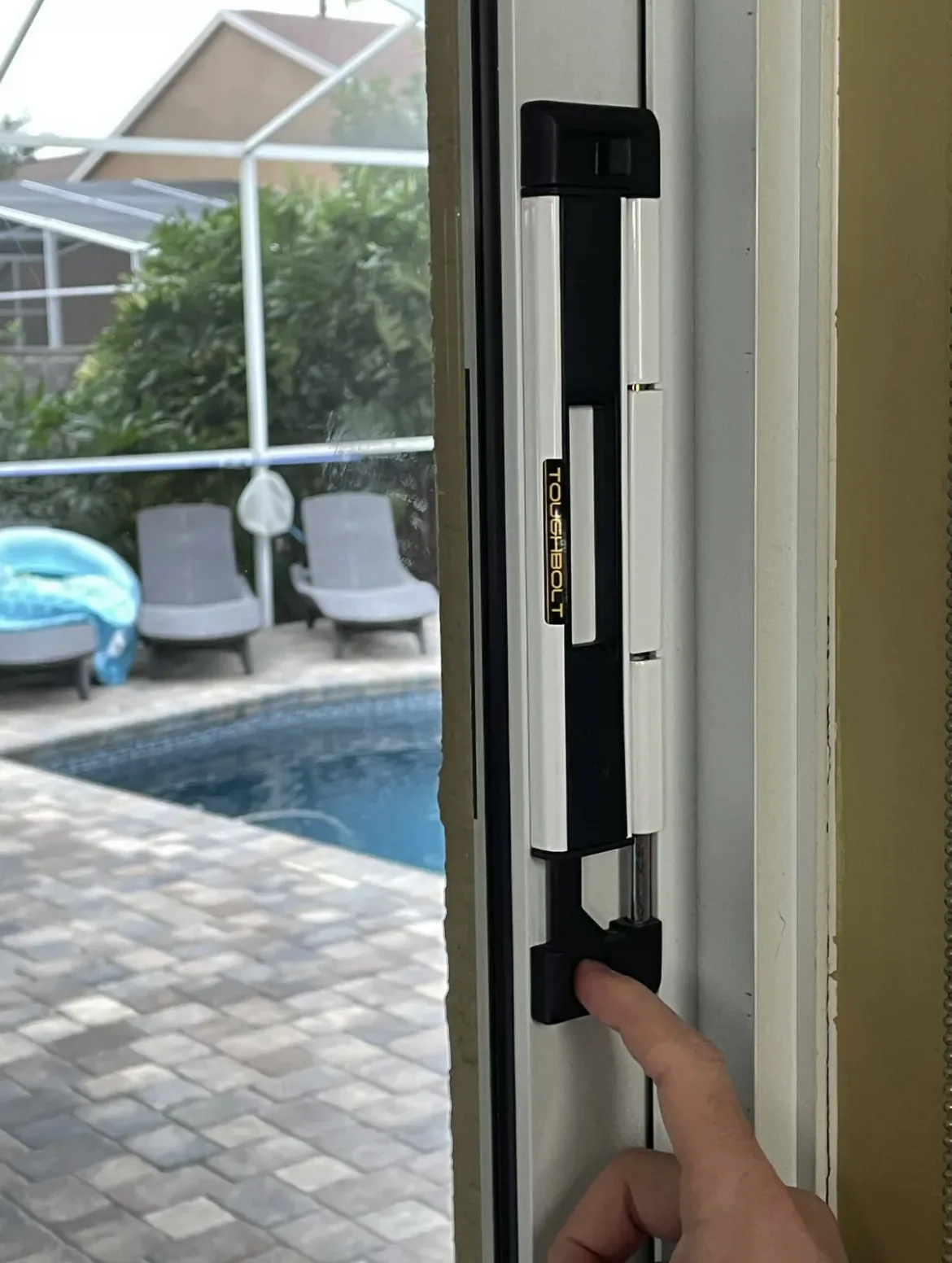
Doors that stick, grind, or jump the track almost always come down to worn rollers. We replace them with heavy-duty stainless rollers so your door glides with one finger again.
About this serviceWe repair torn, sagging, or sun-damaged screens using your existing frames — for a fraction of the cost of a new screen, so bugs stay outside where they belong.
About this serviceBroken pane, cloudy seal, or stained glass? We replace the pane in your existing frame — safely removing the old glass and fitting new, so the fix is permanent, not a temporary shine.
About this serviceFactory latches are solid for everyday use. We add true deadbolts and secondary locks engineered for sliding doors, for an extra layer of security where it counts.
About this serviceDeep track cleaning, lubrication, alignment, and inspection — the tune-up that keeps small wear from turning into a seized door or a broken roller.
About this serviceA cracked arch is a glass problem, not a window problem. The new piece is cut to the shape of your existing opening — half-round, quarter-round or circular — so the frame and surround stay put.
About this serviceStruck impact glass cracks and stays put — that is the system working. In most cases the sealed unit is replaced inside the original frame, grids and all, instead of the whole window.
About this serviceJensen Beach sits where the Indian River Lagoon and the Atlantic are barely a mile apart, and the condo corridor along NE Ocean Boulevard runs right down the middle. That geography produces the worst hardware environment we work in: east-facing balcony doors take direct ocean spray while west-facing units get brackish lagoon air. There is no sheltered side of a Jensen Beach building.
The seasonal rhythm makes it worse. Island properties — Island Dunes, Indian River Plantation, Nettles Island and the buildings along the Ocean Boulevard strip — often sit locked and unused through the humid summer, and hardware corrodes fastest when it never moves, because nothing wipes the salt film off the bearings. Every autumn we field a wave of calls from owners who have just arrived to find a door that will not budge.
On the mainland — Skyline Drive, Pinecrest Lakes, Savanna Club and the streets around downtown Jensen — the pressure is different: constant sea breeze fatigues screen fabric far faster than inland, which is why porch screens here tend to fail on a two-to-three-year cycle rather than lasting a decade.
Not listed? Call 772-722-4036 — this is a sample, not a limit.
Jensen Beach's island condos empty out in summer and fill again in late fall — and a door that sat locked through five humid, salty months often refuses to move in November. Every season we field a wave of "I just got back and the slider is stuck" calls. If you're a seasonal resident, the smart play is a service visit right after you arrive (or just before you leave): we free and service the door, dress the track, and it survives the summer far better. For owners who rent their units, we also do fast turnover repairs between guests, because a balcony door that won't open flatlines a beach rental's reviews.
Five months of salt air worked on a door that never moved. Bearings corrode fastest when they sit still — the salt sits in one spot instead of being wiped by motion. We free the panel, replace the seized rollers with stainless ones, and service the track; most seized doors are gliding again the same visit.
The island corridor along NE Ocean Boulevard and the mainland communities alike. We're comfortable with high-rise logistics — association notice, elevators, and protecting common areas — and we can coordinate directly with property managers for rental units.
Annually, ideally. Direct-exposure hardware simply lives a harder life; a once-a-year clean, lubrication, and inspection visit catches corrosion while it's still surface-level and keeps you off the seized-roller list next season.
Yes. The constant east breeze flexes screen fabric until standard mesh fatigues and tears, especially on elevated porches. We re-screen with heavier fiberglass mesh, and can fit fine no-see-um mesh at the same time — a popular combination this close to the water.
Both sides of the causeway — the Hutchinson Island corridor including Island Dunes, Indian River Plantation and Nettles Island, plus mainland Jensen Beach, Skyline Drive, Pinecrest Lakes, Savanna Club and the downtown area.
Usually yes, and it is a regular request here given how many island units are rented. Tell us the changeover date when you book and we will work to it. Property managers and cleaners can let us in; the owner does not need to be present.
It is the single best thing a seasonal owner can do. A clean, lubricate and lock-down before months of humidity dramatically reduces the chance of coming back to a seized panel — and it is a far smaller job than freeing one that has corroded solid over the summer.
Constant sea breeze. The wind flexes the fabric continuously until standard fiberglass mesh fatigues and splits, and here that happens far faster than inland. Heavier-gauge fabric stands up to it much better, and fine no-see-um mesh is worth considering at the same time this close to the water.
Usually yes for anything visible from outside, and often no for hardware nobody can see from the walkway. Rollers, tracks, keepers and interior locks are typically ordinary maintenance. A change to the glass, an exterior-facing lock or anything that alters how the balcony line looks tends to need board or management sign-off first. Separately from permission, buildings set their own rules on contractor notice, elevator use, working hours and protecting common areas. Tell us what your building asks for when you book and we will tell you plainly what we can supply, so nothing stalls on the day.
Almost always worth repairing, and it is usually the cheapest fault on the list rather than the most expensive. Seizure means the bearings stopped turning; the glass, the panel and the frame are typically sound. We free the panel, fit rollers rated to its weight, dress the track and rehang it. The genuine end points are different: a frame or sill corroded through so it no longer holds a fastener, a rail worn past supporting a wheel, or a laminated unit that has failed across the whole panel. We tell you which you have before we quote, not afterward.
Yes, and they are a large share of the island work. Coastal Martin County is in the wind-borne debris region, so most doors fitted here since the mid-2000s are impact units. Laminated panels are noticeably heavier than what they replaced, which wears rollers faster and punishes a corroded rail harder, so we fit hardware rated to the panel's actual weight rather than the original build spec. What we do not do is alter the glazing or the rating. If the laminated glass itself has failed, that is a glass and permit conversation, and your county building department is the authority on it.
Also serving nearby:
Grooved, bent, pitted or cracked: a sliding door track fails in four ways, and a repair kit only fixes some of them. Here's what dressing, capping and replacement each solve, and what they don't.
Read the guide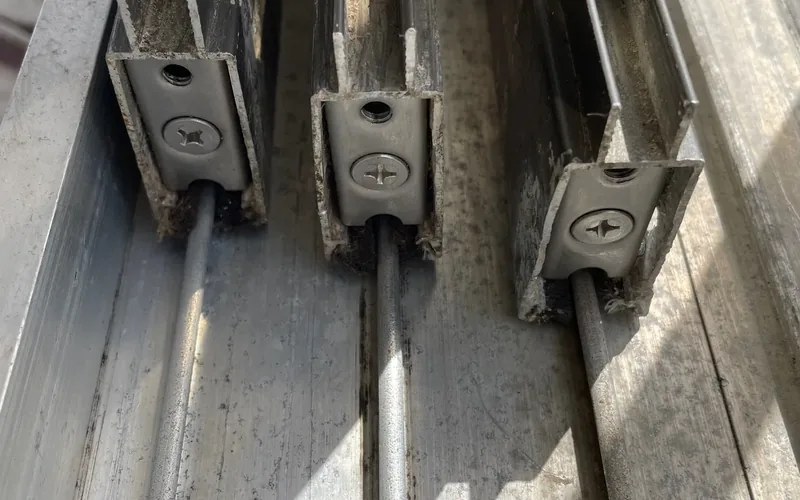
Sliding doors are built to let some water in and drain it back out. When that system clogs, sags or gets overpowered by wind, water ends up on your floor. Here's how to find which part failed, and which leaks are a door repair and which are a wall problem.
Read the guide
Impact glass protects the slider every hour of the year. Shutters protect it when someone closes them. Here's how the five common options compare on protection, effort, insurance and upkeep.
Read the guide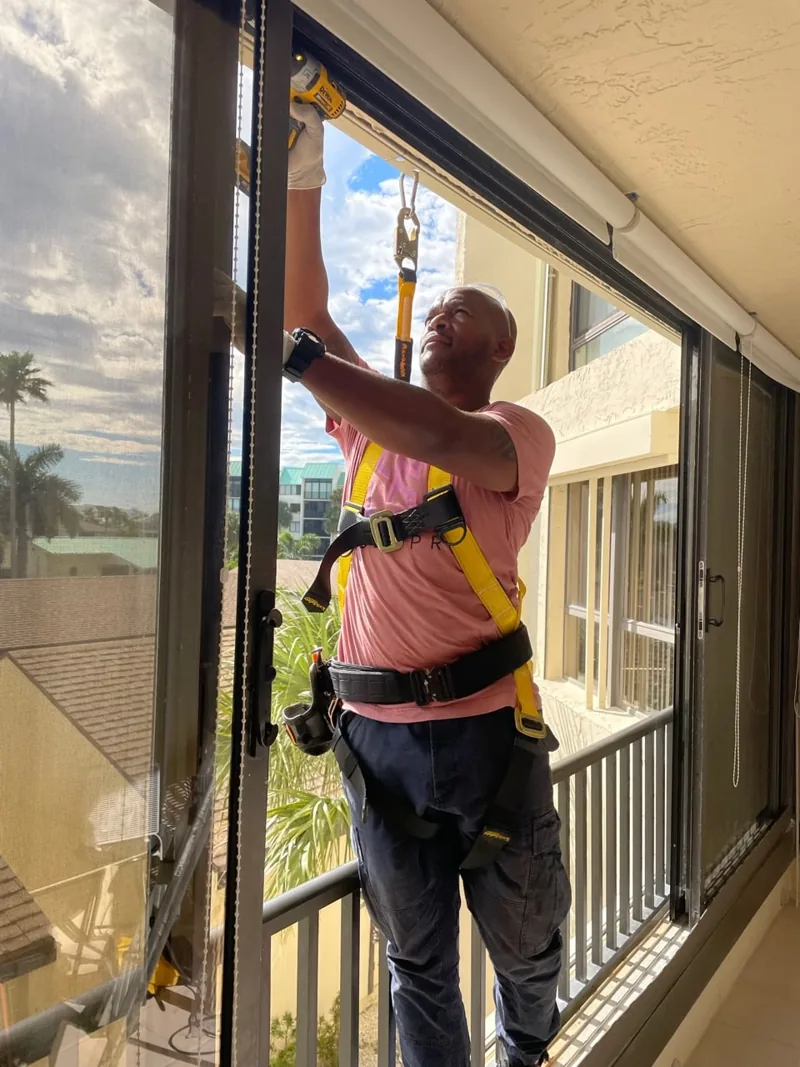
The ocean-facing balcony door takes salt spray the rain never rinses off, wind that grows with every floor, and the weight of impact glass. Here's what that does to the hardware, and how to plan a repair inside a condo building.
Read the guideMore of our Jensen Beach work happens in association buildings than in single-family homes, and the difference is rarely the door. It is the paperwork and the logistics around it.
Buildings set their own rules, and they vary more than owners expect. Some want written notice before any contractor works in a unit. Some restrict working hours, or which elevator can carry tools and a panel. Some require common corridors and lobby floors to be protected while a panel is out, which is reasonable given that a balcony slider panel is heavy, awkward and made of glass. Almost all of them want to know who is in the building and when.
The practical advice is the same every time: tell us what your building asks for at the point you book, and we will tell you plainly what we can supply and what we cannot. That one exchange, done before the day, is what keeps a repair from stalling in a lobby. If you are out of state, your manager, a cleaner or a neighbor with a key can let us in; the owner does not need to be present.
Separately from access, there is the question of permission. Hardware nobody can see from the walkway is usually straightforward maintenance. Anything that changes what the balcony line looks like from outside, or that touches the glass, tends to need board or management sign-off first. Ask before you schedule rather than after, and get the answer in writing.
This is the single most common question we get in Jensen Beach, and the answer nobody wants to hear is that it depends on your declaration rather than on any general rule.
In most buildings here the balcony itself is a limited common element: yours to use exclusively, but governed by the association. A sliding door in that opening then gets divided along a line the condominium documents draw. It is entirely normal for the glass to be treated one way, the frame and track another, and the screen a third. Two neighbors in different buildings, with visibly identical doors, can genuinely have different answers.
Two distinctions save owners money. The first is that maintenance responsibility and insurance responsibility are separate questions. Settling one does not settle the other, and assuming it does is how people end up paying for something that would have been covered. The second is that repair and replacement are sometimes treated differently in the same document, so an answer that holds for new rollers may not hold for a new panel.
What to do, in order: find the clauses on unit boundaries and limited common elements, read the maintenance and insurance provisions, then put the question to your manager or board in writing before you approve any quote. Our guide to who pays for a condo slider walks through exactly which clauses to look for and what each one usually means. It is general information, not legal advice.
Condo doors do not fail one at a time. They fail in stacks, and understanding why saves buildings and owners a lot of money.
A building goes up with one specification. Every unit in a tier gets the same door, the same roller, the same track profile and the same lock, installed within months of each other and then exposed to almost identical conditions for the rest of their lives. So when a bearing design reaches the end of its service life on the fourth floor, the same bearing on the sixth and eighth floors is within a season or two of doing the same thing. The east-facing tier will get there first, because it takes direct spray, but the whole stack is traveling together.
That has three practical consequences. First, if your neighbor's slider seized last season, yours is on the clock, and catching it at the gritty-noise stage is far cheaper than at the seized stage. Second, matching matters: hardware fitted across a stack should be the same part, sized to the same panel weight, so the doors behave consistently and the next technician is not guessing. Third, doing several units on one visit is simply more efficient than several separate calls, and it is worth mentioning to the neighbors on your tier or to your manager.
We work on individual units and on multiple doors in the same building, and we are happy to coordinate directly with a property manager rather than routing everything through owners who are out of state.
Three different faults produce a door that will not move properly, and they need three different fixes. You can tell them apart in about a minute without tools.
One more, specific to balcony doors: if the panel rocks, tips or lifts when you pull it, stop using it. A roller housing has collapsed on one side, and a heavy panel coming out of a track on an upper-floor balcony is a serious hazard rather than an inconvenience. The seven roller failure signs covers the full progression, and the latch that stops catching covers the alignment case.
Give us the decade and the exposure and we can usually name the failure before we see it.
1960s to early 1980s. The older mainland cottages and the earliest island buildings went in with heavy aluminum frames and plated steel rollers in open housings. The frames were overbuilt and are generally worth keeping. The rollers are long past their design life, and their profiles are often discontinued, so the job is as much identification and sourcing as it is fitting. A company that cannot match the housing will quote you a whole new door instead.
1998 to 2006. The boom-build era brought better glass on builder-grade hardware, specified to a price and fitted identically across whole phases and whole tiers. That is why these doors fail in clusters rather than individually.
Post-2005. Coastal Martin County sits in the wind-borne debris region, so most doors installed or replaced here since the mid-2000s are impact units. A laminated panel is two lites of glass bonded to a plastic interlayer and can weigh half again what the single-glazed panel it replaced weighed. Plenty were hung on hardware only marginally heavier than before, so they flat-spot bearings early and wear rails fast.
Exposure then multiplies all of it. An east-facing balcony door on the island lives a harder life than the same door, same year, on a mainland street a mile inland, which is why age alone never settles the question.
We repair for a living and we still tell people to replace, because a company that claims every door can be saved is being exactly as unhelpful as one that claims none of them can.
A seized door, which is what Jensen Beach owners fear most, is usually the cheapest repair on the list rather than the most expensive. Seizure means the bearings stopped turning. The glass, the panel and the frame are almost always sound. We free the panel, fit rollers rated to its weight, dress the track and rehang it.
These are the cases where replacement genuinely wins:
Everything else on a typical Jensen Beach balcony door — rollers, tracks, locks, keepers, screens, weatherstripping — is a repair, and we will tell you which side of that line you are on before we quote.
The door work is the same as anywhere. The building work around it is what makes a condo visit different, so here is the whole sequence.
Across five years and more than 1,600 doors, 96% of our jobs finish in one visit, and same-day service is available when the schedule allows.
Repairs start at $275, and that figure covers parts, labor and a written warranty of one to three years. When you compare quotes, compare that whole package. A lower headline number that excludes parts, excludes labor or carries no warranty is not the same thing being sold.
What moves it on a Jensen Beach door:
You get the number before we start. We are rated 5.0 on Google from more than 170 reviews, hold a Best of 2026 BusinessRate award and are recommended on Nextdoor, and none of that changes how a quote works: we tell you what it is, then you decide. Our Florida repair cost guide sets out what a complete estimate should contain.
Coastal Martin County sits inside Florida's wind-borne debris region, which is why so many Jensen Beach balcony doors installed or replaced since the mid-2000s are impact rated. That has everyday consequences long before it has storm-day ones.
Weight is the first. A laminated panel is heavier than what it replaced, and the rollers, rails and keepers feel that every single cycle. On a barrier-island balcony you then stack corrosion on top of load: the chloride film that sits on a still bearing race is already pitting the wheel, and a heavier panel presses that damaged surface harder into a rail that is itself blooming with aluminum oxide. Direct-exposure impact doors are the fastest-wearing hardware we service anywhere on the Treasure Coast, and it is not because the glass is bad. It is because the hardware is carrying more, in worse air, and often was never sized for either.
The second is sealing. Storm water gets in through a track long before storm wind gets in through glass. A panel sitting low in its frame does not compress its weatherstripping evenly or seat its lock fully, so a worn roller is a water problem as well as a movement problem. Before each season, prove three things by hand: the door closes and locks every time without being lifted or shoved, water poured in the track drains out of the weep holes, and the seals contact along their whole length. Our hurricane prep checklist covers the rest.
On what your specific opening must meet, what needs a permit and what may be swapped on a rated assembly, ask the Martin County building department. We handle the hardware and the alignment, and we will say plainly when a question belongs to them.
Honest quotes and repairs usually finished in a single visit — call or send the form.