Roller Replacement
Doors that stick, grind, or jump the track almost always come down to worn rollers. We replace them with heavy-duty stainless rollers so your door glides with one finger again.
About this service
Palm City's golf-course and gated communities were built around the lanai view — and the sliding doors that frame it deserve better than a two-hand shove.
Palm City is Martin County's community-living capital: Monarch Country Club, Harbour Ridge, Piper's Landing, Crane Creek, Martin Downs and its villages — plus the acreage neighborhoods of Palm City Farms further west. Almost every one of these homes was designed around a screened lanai with a wall of sliding glass between it and the living space, because the golf-course or preserve view is the whole point of the floor plan.
Those sliders now range from a few years old to over thirty, and the failure pattern here is wear more than salt. Palm City sits far enough from open water that corrosion moves slower — but daily use moves faster. A lanai slider in a Palm City home opens and closes thousands of times a year: morning coffee, the dog, the grandkids, dinner on the patio. Builder-grade rollers under that duty cycle flatten and wobble, the door starts jumping the track, and one day the latch stops meeting its keeper — which means the main door to your lanai no longer truly locks.
We restore these doors constantly: stainless roller sets matched to the door's brand and weight, a proper track cleaning (Palm City tracks collect a signature mix of lawn-service grass clippings and irrigation grit), and a final alignment so the door glides quietly and locks positively.
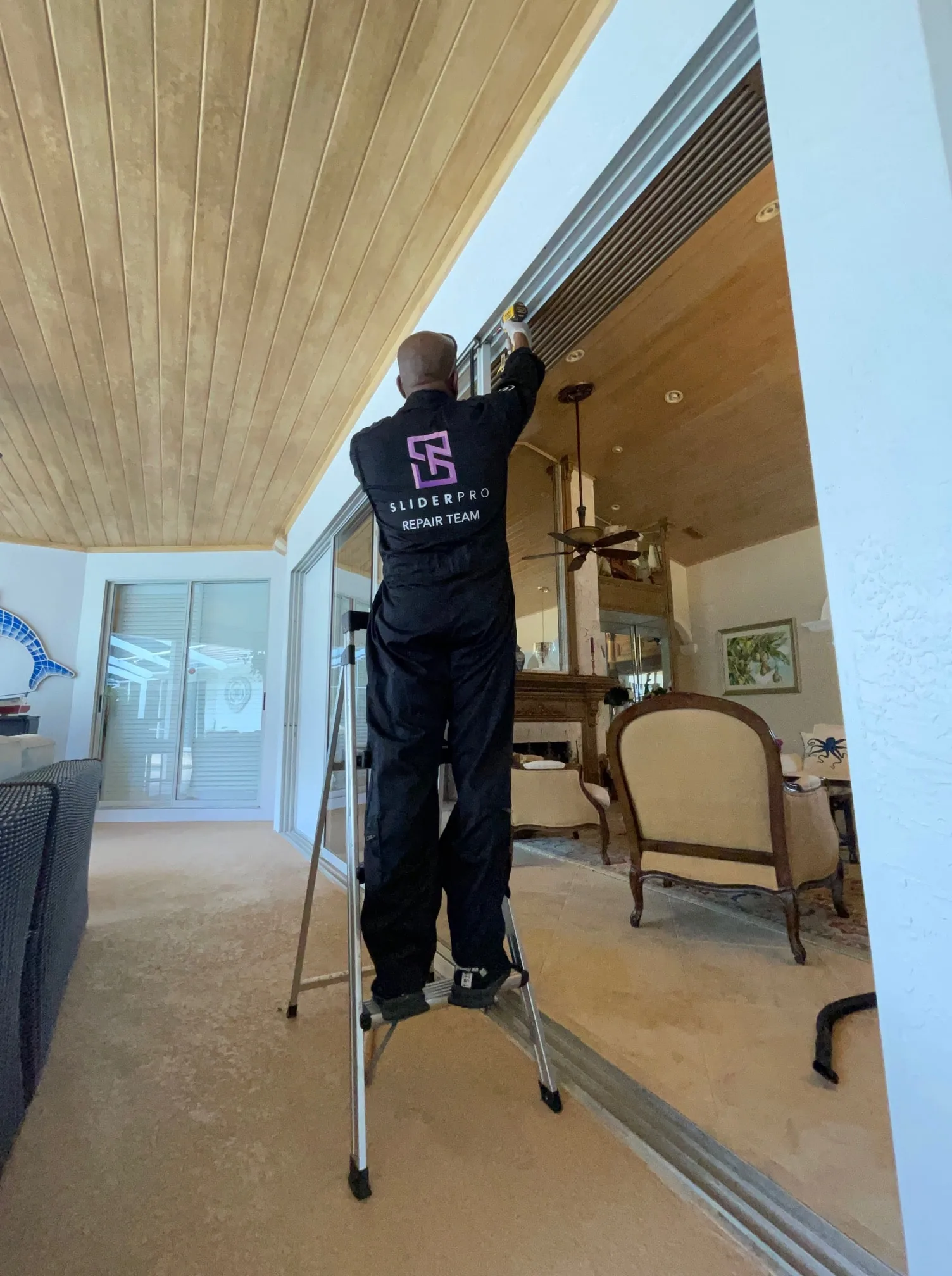
Doors that stick, grind, or jump the track almost always come down to worn rollers. We replace them with heavy-duty stainless rollers so your door glides with one finger again.
About this serviceWe repair torn, sagging, or sun-damaged screens using your existing frames — for a fraction of the cost of a new screen, so bugs stay outside where they belong.
About this serviceBroken pane, cloudy seal, or stained glass? We replace the pane in your existing frame — safely removing the old glass and fitting new, so the fix is permanent, not a temporary shine.
About this serviceFactory latches are solid for everyday use. We add true deadbolts and secondary locks engineered for sliding doors, for an extra layer of security where it counts.
About this serviceDeep track cleaning, lubrication, alignment, and inspection — the tune-up that keeps small wear from turning into a seized door or a broken roller.
About this serviceA cracked arch is a glass problem, not a window problem. The new piece is cut to the shape of your existing opening — half-round, quarter-round or circular — so the frame and surround stay put.
About this serviceStruck impact glass cracks and stays put — that is the system working. In most cases the sealed unit is replaced inside the original frame, grids and all, instead of the whole window.
About this servicePalm City is community-living country, and its floor plans nearly all revolve around the same feature: a wall of sliding glass between the living space and a screened lanai looking onto a golf course or preserve. Martin Downs and its villages, Monarch, Harbour Ridge, Piper's Landing, Crane Creek, Hammock Creek and Cobblestone are all built on that idea.
Which means the lanai door is the most-used door in the house. It gets opened for morning coffee, the dog, the grandchildren and dinner outside — thousands of cycles a year, far more than a front door. Builder-grade rollers were not specified for that. They flatten, the panel starts to jump, and eventually the latch stops meeting its keeper, which means the main door onto your lanai no longer actually locks.
Because Palm City sits well back from open water, corrosion runs slower here than on the coast — the wear is mechanical rather than chemical. What the tracks do collect is a distinctly local mix of lawn-service clippings and irrigation grit, which acts as an abrasive under the wheels. That makes track cleaning unusually effective here, and it is the first thing we check.
Not listed? Call 772-722-4036 — this is a sample, not a limit.
Most of our Palm City work is inside gates, and we make that easy: give us your community's name when you book and we'll handle the gate process — call-ahead, guest list, or QR pass — so the appointment doesn't start with you standing at a callbox. For residents of 55+ neighborhoods we also pay particular attention to door effort: a slider that a strong adult finds "a bit stiff" can be genuinely unusable for someone with arthritis or limited grip strength. Making the door light again is a quality-of-life repair, and it's usually a single visit.
Yes — just mention your community when you book and we'll sort the gate access ahead of time, whether that's a resident call-ahead, the guest list, or a visitor pass. It's routine for us across Monarch, Harbour Ridge, Martin Downs, and the other Palm City gates.
Duty cycle. Lanai doors are the most-used doors in Palm City floor plans — thousands of open/close cycles a year — and builder-grade rollers weren't specified for that. Upgrading to stainless, sealed-bearing rollers typically outlasts the originals several times over.
Yes, in the same visit. Lanai screen doors share the same wear problems — dragging rollers and torn fabric — and it's efficient to do glass slider, screen door, and screen fabric together while we're on site.
That's one of the most rewarding repairs we do. New rollers, a clean dressed track, and correct alignment routinely take a door from a two-hand shove to a one-finger glide — a genuine independence issue for many of our 55+ customers.
All of them, gated or not — Martin Downs and its villages, Monarch Country Club, Harbour Ridge, Piper's Landing, Crane Creek, The Meadows, Hammock Creek, Cobblestone, Canopy Creek and the acreage of Palm City Farms.
Just tell us your community when you book and we will sort the gate beforehand, whether that is a resident call-ahead, the guest list or a visitor pass. It is routine for us across the Palm City gates, and it saves you standing at a callbox on the day.
For a lanai door in Palm City, yes — that is normal. It is the highest-duty door in the house and it was fitted with hardware chosen to a builder's budget. Stainless sealed-bearing rollers typically outlast the originals several times over, which is why we fit those rather than like-for-like replacements.
For a repair, usually not. Associations govern the appearance of the exterior, and replacing worn rollers, cleaning a track or realigning a latch changes nothing anyone can see from the street. Architectural review generally applies to changing the door, the frame color or the glass, not to servicing what is already there. Where it does matter is responsibility: in villa, townhome and condominium communities the declaration may make the association responsible for part of the door, and in that case you want the fault in writing before anyone pays for anything. Read the maintenance clause and the limited common element definition, or start with our guide to who pays for a condo sliding door.
Four things, and they take about twenty minutes. Vacuum the tracks completely dry and clear the weep holes at the outer edge of the sill so summer rain drains instead of standing under the rollers. Slide every panel fully open and closed a few times so no wheel is left parked in one position for five months. Confirm every door actually latches, because an unlatched slider is not secured for a season away. And note anything already dragging, because a stiff door in May is a seized door in October. Hardware corrodes fastest when it never moves, which is why empty houses come back to worse doors than lived-in ones.
Cleaning the track is genuinely worth doing and it will extend the life of good hardware, especially here where clippings, irrigation grit and pollen build up under a screen enclosure. Vacuum dry, never flush a dirty track with water, and clear the weep holes while you are there. What cleaning cannot do is fix a collapsed wheel. Once a bearing has failed, the flattened roller keeps cutting the aluminum rail no matter how clean it is, and the groove it leaves behind then holds water and traps more grit. If the door is already heavy, it is parts, not housekeeping.
Ask whoever quoted you which part they found to be beyond repair. On most Palm City doors the frame and glass are sound and the running gear has worn out, and a company that quotes replacement without checking the frame rail, the corner joints and the track has not run the test that decides it. A repair is the wrong answer when the frame flexes, when a corner joint has opened, when the rail has been cut away completely, or when the glass unit itself has failed. Short of that list, replacing the hardware inside the door you own is the correct fix, and ours carries a 1 to 3 year warranty on parts and labor.
Also serving nearby:
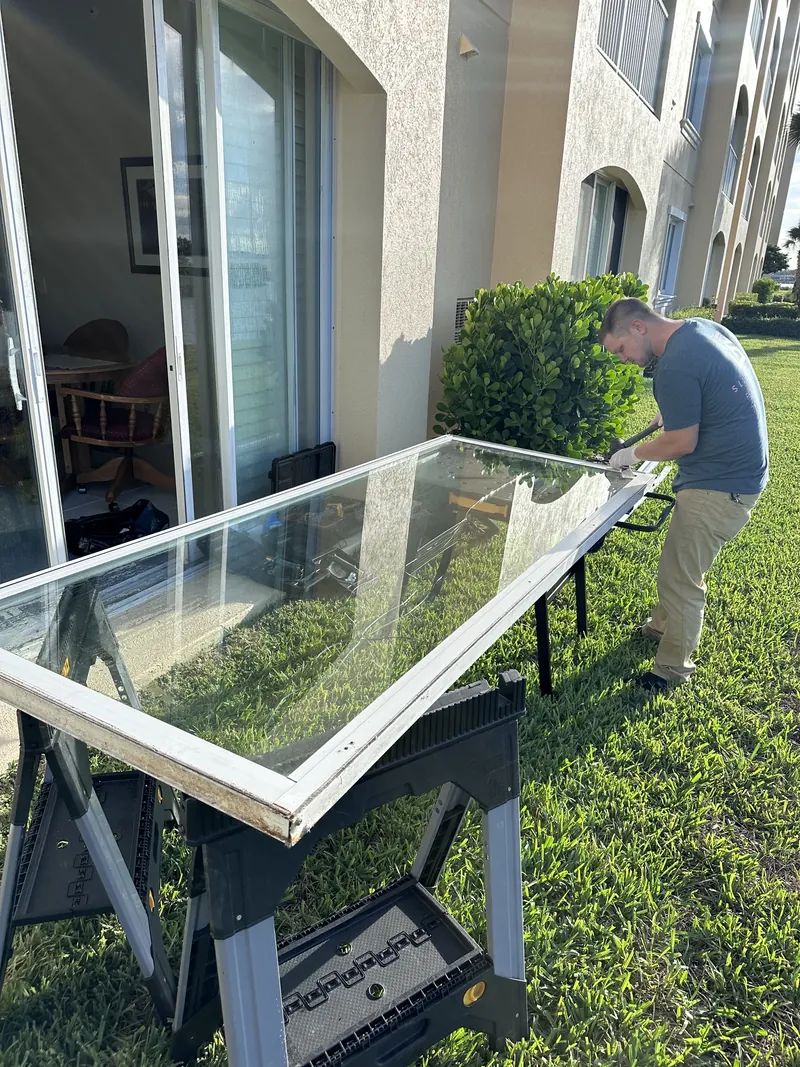
A door off its track is either out of the head channel at the top or off the rail at the bottom, and the two have different causes. Here's how to tell which you have, what's safe to try, and when to leave a heavy panel alone.
Read the guide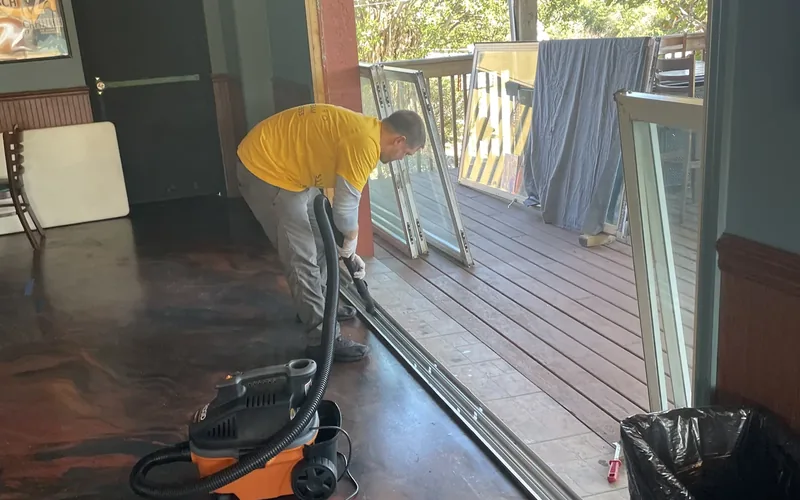
A four-panel stacking slider or a door that pockets into the wall isn't a big version of a patio door. It's a chain of panels that pull each other, a hidden track that collects sand, and a lot more rollers. Here's how they fail and what fixing them involves.
Read the guideThree checks, two minutes, no tools. They will not fix the door, but they tell you which repair you are looking at and they make the phone call a lot shorter.
Noise tells you how far along the failure is. A squeal is a dry bearing and the cheapest stage. Grinding is metal cutting metal. A rhythmic thump at the same point every pass is a flat spot on a wheel. Fine gray powder or aluminum dust in the track means the wheel is now machining the rail, and that is where waiting starts costing real money.
More detail on each symptom is in the seven roller failure signs, by stage. If the door still slides but will not lock, a latch that stops catching is nearly always alignment.
Tell us the year the house went up and we can usually predict the failure before we see the door. Palm City grew in three distinct pushes, and each one left different hardware behind the glass.
The 1970s and 80s ranch era. Older Palm City homes, including much of Old Palm City and the acreage west toward Palm City Farms, carry heavy aluminum sliders running on small steel wheels. The frames were overbuilt by modern standards and the glass is usually still sound, which makes these among the better repair candidates on our route. What has failed is the wheel. A steel roller sitting in an aluminum housing lives in a track that gets wet, and steel and aluminum in contact with moisture form a galvanic couple, so the aluminum around the axle corrodes and swells until the wheel stops turning. The panel then skids rather than rolls.
The 1998 to 2006 boom build. The subdivision wave that filled Martin Downs, Cobblestone and the villages either side of Martin Downs Boulevard brought bigger glass on hardware specified to a builder's budget: nylon-tired wheels in stamped housings, fine on day one and marginal by year twelve. Because a whole phase was fitted with the same part, the phase fails together. If two neighbors are complaining about sticking doors in the same month, that is a hardware cohort aging out, not coincidence.
Post-2005 impact units. Much of Martin County falls inside the Wind-Borne Debris Region under the Florida Building Code, so newer construction and re-glazed openings carry laminated impact glass. A laminated panel can weigh half again to twice what the annealed panel it replaced weighed, and in plenty of cases nobody upsized the rollers underneath it. That is why an eight-year-old impact door can feel worse than a thirty-year-old one. The answer is not a new door. It is a roller assembly rated for the weight the panel actually is.
Palm City sits well back from open water, so corrosion runs slower here than it does in Port Salerno or out on Hutchinson Island. The South Fork of the St. Lucie River is tidal and brackish rather than fresh, so riverside and canal-side homes do get salt in the air. But for most of Palm City the thing that kills hardware is abrasion, and it is worth understanding why abrasion does so much damage to something as simple as a wheel.
A slider's wheel touches the rail along a contact patch about the width of a pencil line. The entire weight of the panel, often 150 to 300 pounds, bears through that line. Drop grit into it and the pressure presses those particles into the softer nylon or steel tire, where they stay embedded. The wheel stops being a wheel and becomes a file, and it cuts a groove into the aluminum rail it runs on.
Palm City tracks collect a distinctly local mix: silica sand, lawn-service grass clippings that rot down into a damp paste, irrigation water that dries and leaves a mineral crust, and a heavy spring pollen load. Screen enclosures make this worse rather than better. An enclosed lanai keeps leaves out, but it also keeps the air still, so whatever lands in the track is never blown back out.
Once the rail is grooved, two things follow. Water sits in the channel instead of draining, and the wheel now has a track to run in, so it drags at the same point every time. That is why a track service here is a genuine repair rather than a courtesy: on a Palm City door, cleaning and dressing the rail is often half the job. The routine we suggest between visits is in the ten-minute track cleaning guide, and the rule that matters most is vacuum dry first, never wet.
A lot of Palm City lives under a covenant, and the question that stalls repairs is who is responsible for the door. The short answer is that it depends on the document, and the document is specific to your community.
In a single-family HOA neighborhood the slider is almost always yours. The association governs the outside of the house, which can mean it has an opinion about frame color or finish if you were ever to replace the unit, but the hardware inside the opening is the homeowner's. A repair rarely needs approval at all.
Villas, townhomes and condominium buildings are where it gets less obvious. Florida declarations commonly treat a patio or balcony slider as a limited common element serving one unit, then split maintenance between the association and the owner. Some give the association the frame and the owner everything that moves. Others do the reverse, or make the whole door the owner's. Two buildings on the same street are often written differently, and a managing agent will not always remember which is which without checking.
The practical steps are the same either way. Find your declaration and read two clauses before you approve any work: the maintenance obligations section, and the definition of limited common elements. If the association is responsible, a written description of the fault gets it onto an agenda far faster than a phone complaint does. If you are responsible, you can simply book the repair.
We go through the common splits, and how to read your own declaration, in who pays for a condo sliding door, owner or HOA.
Plenty of Palm City houses sit closed from May to October, and the doors do not enjoy it. Hardware corrodes fastest when it never moves. Every time a door slides, the wheel rolls its own bearing race and pushes moisture and dust out of the contact area. Leave a panel parked for five humid months and nothing wipes anything: a film sits on the same few millimeters of race, corrosion products build up in the clearance the balls need, and the wheel is stiff before you ever touch it.
Then add the second summer problem. A closed house with the thermostat set high and an afternoon storm most days means high humidity against the glass and standing water in the track. Weep holes, the small slots at the outer edge of the sill that let rainwater escape, silt up over a wet season. Once they block, the track holds water for weeks at a time, directly under the rollers.
Four things are worth doing before you leave. Vacuum the tracks dry and clear the weep holes. Slide every panel fully open and closed several times so no wheel is parked in one spot. Check that each door actually latches, because a door that does not latch is not secured for a season away. And note anything that already drags, because it will be worse in October rather than better.
When you come back, do not force a stiff door. A panel that will not move usually means a seized wheel, and shoving it is exactly how a repairable roller job becomes a bent rail and a cracked frame corner. Book the visit instead. If the house earns its keep between seasons, the turnover checklist for Florida rentals covers what to check between guests.
We repair first, and saying so honestly means naming the cases where a new door really is the better buy. There are four, and none of them is the thing owners usually worry about.
Age is not on that list, and neither is a door being hard to move, which is the symptom of the cheapest repair we do. Worn rollers, a grooved track, a latch that misses its keeper and a sagging screen all describe hardware, and hardware is replaceable inside the door you already own. If you are weighing the two paths, the cost guide sets out what belongs in a complete quote for either one.
Repairs start at $275, and that figure includes the parts, the labor and a 1 to 3 year warranty on both. It is worth reading it that way rather than as a headline number, because the low call-out prices advertised in this trade generally stop before the hardware, and the hardware is the repair.
What moves the number up from there, roughly in order of how much difference each makes:
You get the actual figure for your door before work starts, not after it. The cost guide explains what a complete quote should itemize, so you can compare like with like.
A wide lanai slider is the largest opening in a Palm City house and the one a storm tests hardest. Two things matter, and neither is glamorous.
The first is that a door has to close and latch properly to do its job. Pressure on a sliding panel is carried by the interlock where the panels meet and by the latch seating into its keeper. A door that has dropped on worn rollers does not close into its interlock squarely and does not latch positively, so the load path the door was engineered around is not the load path it actually has, whatever the glass is rated for. Bringing the panel back to its correct height is a real part of storm preparation rather than a comfort upgrade.
The second is drainage. Wind-driven rain puts far more water into a bottom track than ordinary weather does, and the track is designed to shed it through weep holes at the outer edge of the sill. Those holes silt up quietly over a year, and a blocked sill in a heavy band of rain is how water reaches a living room floor with nothing broken at all. Clear them in May, not the afternoon before a storm.
If your opening relies on shutters or removable panels, check the tracks, the anchors and the labeling while there is time to deal with a stripped fastener. The full sequence, including what to check once the storm has passed, is in the hurricane checklist for sliding glass doors.
Honest quotes and repairs usually finished in a single visit — call or send the form.